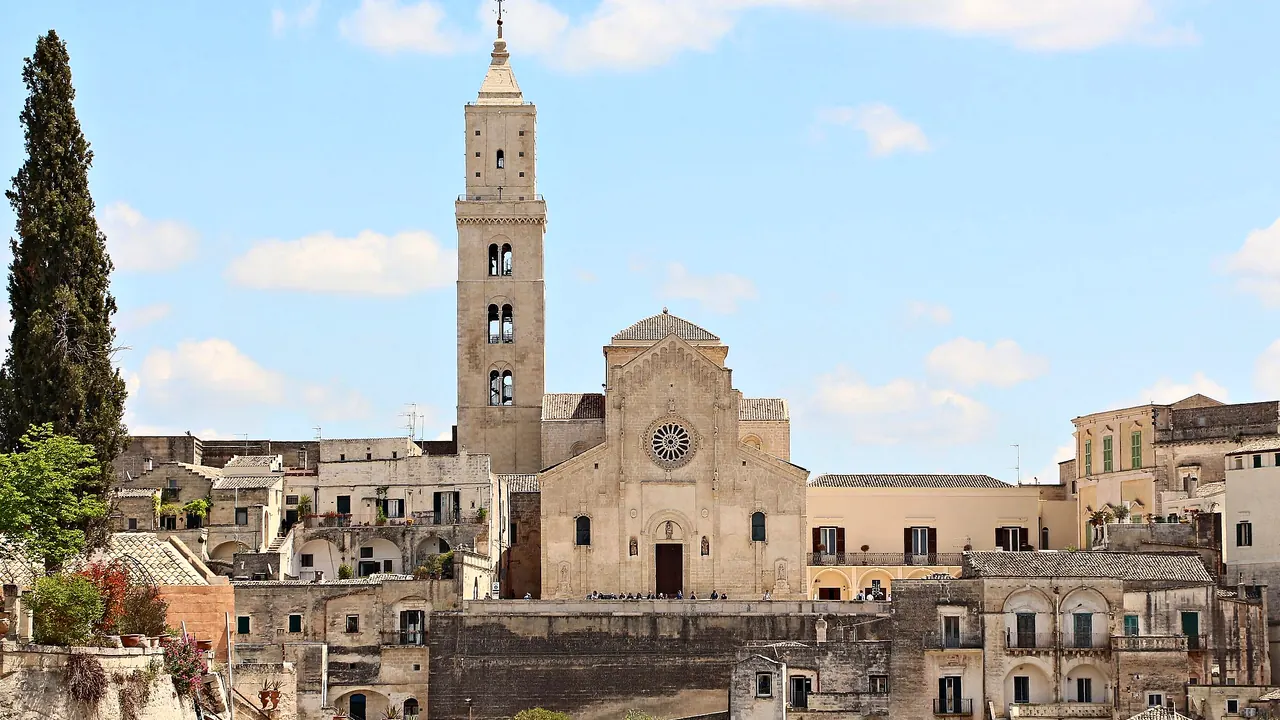
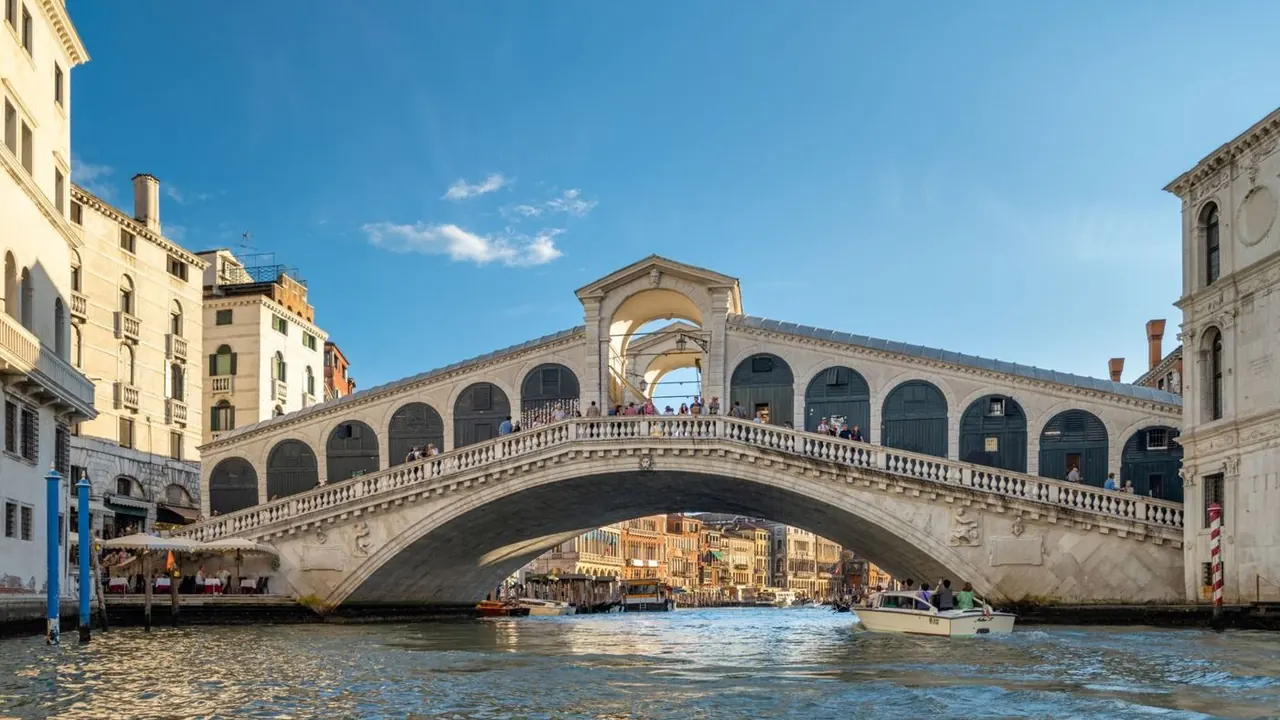
Photos: Matera by Bernard Gagnon, CC BY 4.0, cropped; Venice by David Vives, Pexels License.
Matera or Venice?
Our verdict in twelve categories, each scored against the same fixed benchmark cities, and the climate month by month, so you can choose for your trip.
Choose Matera for
- prices
- nature and the outdoors
Matera suits the traveller who wants one extraordinary place, explored slowly and for less money. The cave districts of the Sassi, the gorge and the Murgia upland just across it make a short stay feel complete, and with a hire car the trulli, white towns and coast of Puglia are all within reach. Pick it if you like walking, quiet evenings and a town that empties after dinner.
Choose Venice for
- live music and the arts
- shopping
- culture and sights
Venice is the stronger pick for a first trip to Italy built around art, architecture and music. It has far more to see and hear: the great Venetian painters, La Fenice, and fast trains to Padua and Verona that mean you never need a car. Expect to pay heavily for that, and to plan carefully if you want to avoid the crowds around San Marco.
Scoreboard
Twelve categories on one fixed scale from 0 to 100. The shaded stretch is the gap between the two.
Your match
Pick a travel style or drag the sliders, and both match scores follow your weighting.
Wins on prices and nature and the outdoors with your weighting.
Wins on live music and the arts and shopping with your weighting.
What matters to you?
Category by category
What the scores mean for a trip.
Beaches & swimming
Venice has the easier beach. The Lido is a short vaporetto ride from San Marco and gives you kilometres of fine Adriatic sand, though much of it is laid out in rows of cabanas and the water is greenish. Pellestrina is wilder if you want space.
Matera's sea is a 45-minute drive away on the Ionian coast at Metaponto and Policoro. The sand there is wide and backed by pines, and the water is just as shallow and warm, but without a car you will hardly see it.
Food & drink
Venice has the more rewarding eating, as long as you know where to go. You can graze on cicchetti at bacari around the Rialto and in Cannaregio, and the fish market supplies cuttlefish risotto and lagoon shellfish. Matera's cooking comes from the land instead: crusty durum-wheat bread, pulse soups, lamb, and crisp fried dried peppers with a glass of Aglianico.
Neither city offers much beyond its regional food. In Venice the main problem is the many tired restaurants along the tourist routes. In Matera it is the narrow range, though the upper town eats well and fairly.
Culture & sights
Matera offers one remarkable sight. Its prehistoric cave districts climb the gorge, with frescoed rock churches, the walk-through Palombaro Lungo cistern and sculpture in carved rooms at MUSMA, and two or three days cover it well.
Venice goes much deeper. The whole city is a monument, from the Basilica and Doge's Palace to the palazzi of the Grand Canal. Then come the Accademia, the Frari, San Rocco and modern art at the Guggenheim and Punta della Dogana. A week there still leaves things unseen.
Nightlife
Both cities go quiet early and neither has a club scene. Venice has a little more life. The aperitivo hour fills the bacari along the Fondamenta della Misericordia, and students keep Campo Santa Margherita going later.
In Matera the evening is a passeggiata on Via del Corso, a long dinner and a drink on a terrace above the lit Sassi, with a few cave bars open late in summer. For a real night out from Venice, people head to Jesolo.
Nature & outdoors
Matera has wild country right at its edge. You can walk straight down from Sasso Caveoso into the Gravina gorge and climb onto the Murgia plateau, past abandoned rock churches and Neolithic sites, with kestrels on the cliffs. The jagged Lucanian Dolomites and the Pollino forests make bigger days out.
Venice's outdoors is the flat lagoon. Here you can kayak or row among the salt marshes around Torcello, watch for herons and flamingos, and cycle the sea walls of Pellestrina. Real mountains are more than two hours away.
Day trips
Both make excellent bases, and Venice has the edge because its outings are so easy to reach. Trains from Santa Lucia reach Padua, Vicenza and Verona quickly, and the boats to Murano, Burano and Torcello need no planning at all.
Matera's list is just as tempting: Altamura and Gravina close by, the trulli of Alberobello, Ostuni and the Valle d'Itria, Castel del Monte, and the ghost town of Craco. Almost all of them need a car.
Good for families
Venice works better with children, though neither city is easy. Water buses instead of cars, glass-blowing on Murano, dinosaurs at the natural history museum and the shallow Lido beach give families plenty to do. The stepped bridges make pushchairs a struggle.
Matera has less to offer. Older children enjoy the caves, the underground cistern and scrambling into the gorge, but the Sassi stairways defeat pushchairs entirely and the sandy beaches need a drive.
Getting around
Inside both towns you walk, Venice over endless stepped bridges and Matera up and down steep stairways between the upper town and the Sassi. The real difference comes when you leave the centre.
Venice has vaporetti across the lagoon, trains that end at Santa Lucia and a bus and boat link to the airport. Matera is off the national rail network, with only a slow narrow-gauge line to Bari and sparse buses, so a hire car is close to essential there.
Shopping & style
Venice has far more to buy. Murano glass, Burano lace, papier-mâché masks, marbled paper and furlane slippers are made in workshops in Dorsoduro and Castello, and the big fashion names line Calle Larga XXII Marzo. The catch is the imported fakes on the main routes.
Matera's shopping fits into a short stroll. You will find painted cuccù whistles, small tufa carvings of the Sassi and ordinary high-street shops on Via del Corso. The best things to take home are dried peppers and local pasta.
Affordability
Matera is much the cheaper of the two. Upper-town trattorias and guesthouses cost far less, and walking the Sassi and the Murgia is free, though the cave hotels charge for the experience.
Venice is expensive in almost every way. Rooms near San Marco, water transport, café tables on the piazza and church entry all add up. Eating cicchetti at the counter and sleeping in Mestre are the main ways to save.
Live music & performing arts
Venice is one of Italy's great music cities. La Fenice runs a full season of opera, ballet and concerts, the Goldoni stages drama, and the Biennale adds contemporary music, theatre and dance. Vivaldi concerts in churches are on almost every night, though their quality varies.
Matera has little beyond concerts from its conservatory and summer open-air events, including a jazz festival. Its one big night is the Festa della Bruna, when the papier-mâché float is torn apart.
Wellness & relaxation
Neither city has a bathing tradition of its own, so the difference lies in the setting. Matera's hotel spas sit in candlelit caves with pools cut into the rock, and the town is at its calmest in the early mornings before the groups arrive.
Venice's spas are in palazzi and on the Lido and Giudecca, and the thermal pools of Abano Terme, in use since Roman times, are about an hour away. For quiet, stay in Castello, Cannaregio or on Giudecca rather than around San Marco.
When should you go?
Pick your month. The climate figures are measured averages, not a forecast.
Matera in July
Venice in July
Daytime high, °C
Rainfall in the month, mm
Where the figures come from
Matera has no rain gauge within 25 km of the centre, so its rainfall comes from a gridded climate dataset read at the city rather than from a gauge further away.
Temperature and rainfall are climate normals, averaged over the years shown. Matera: 2005-2025, 10 years observed (rainfall 1991-2020) normals, Matera / Martella (4.8 km from centre). Venice: 1991-2020 (sunshine 1971-2000, rainfall 1981-2010) normals, Venezia / Tessera (6.7 km from centre).
Matera has the hotter summer. On its bare plateau July reaches about 32°C with little rain, so the Sassi stairways and the gorge are best walked early in the day. May, September and early October suit walking best. The Ionian beaches are at their best from July into September, when the sea is around 25°C. Rain builds from late September to a peak of about 89mm in November, and winter days are cool but rarely harsh.
Venice has the colder winter, about 7°C in January, and a gentler summer peak of around 29°C in July, though the air by the lagoon is humid. July and August are its sunniest months and the time for the Lido. Rain falls through the whole year rather than mostly in winter, with October and November the wettest. April to June and September are the most comfortable months for walking the city.
Which traveller are you?
For a culture and arts trip, Venice wins clearly. Matera's rock churches and Sassi are unique, but Venice adds the Accademia, Titian and Tintoretto, the Biennale and a full season at La Fenice. That is enough to fill a week of galleries and evenings.
On a trip on a tight budget, Matera is far easier. Simple trattorias in the upper town, cheap guesthouses a short walk from the Sassi and free walks in the Murgia keep costs down. In Venice, rooms, boats and church entry all add up quickly.
On an outdoors trip, Matera has the landscape. A path drops from the Sassi into the Gravina gorge and climbs onto the Murgia plateau, and the Lucanian Dolomites and Pollino forests are a drive away. Venice offers flat lagoon kayaking and birdwatching, which is gentler.
Before you go
| Measure | Matera | Venice |
|---|---|---|
| Official language | Italian | Italian |
| Currency | Euro (EUR) | Euro (EUR) |
| Sockets | CFL230 V, 50 Hz | CFL230 V, 50 Hz |
| Driving side | Right | Right |
| Time zone | UTC+1, UTC+2 in summer | UTC+1, UTC+2 in summer |
| Emergency number | 112 | 112 |
| Elevation | 401 m | 2 m |
| Main airport | Bari Karol Wojtyła International Airport (BRI)54 km from centre104 non-stop destinations | Venice Marco Polo Airport (VCE)7 km from centre103 non-stop destinations |
| Public holidays this year | 13 days | 13 days |
By the numbers
| Measure | Matera | Venice |
|---|---|---|
| City population | 59,685 | 250,369 |
| People per km² | 152 | 602 |
| Museums within 10 km | 8 | 52 |
| UNESCO World Heritage sites within 50 km | 1 | 5 |
| Swim season, months above 21 °C | 5 months | 4 months |
Where else could you go?
Every comparison below shares a destination with this one, so you can follow Matera or Venice somewhere new.
- Barivs Matera
- Veronavs Venice
- Rovinjvs Venice
- Triestevs Venice
- Cortina d'Ampezzovs Venice
- Bolognavs Venice