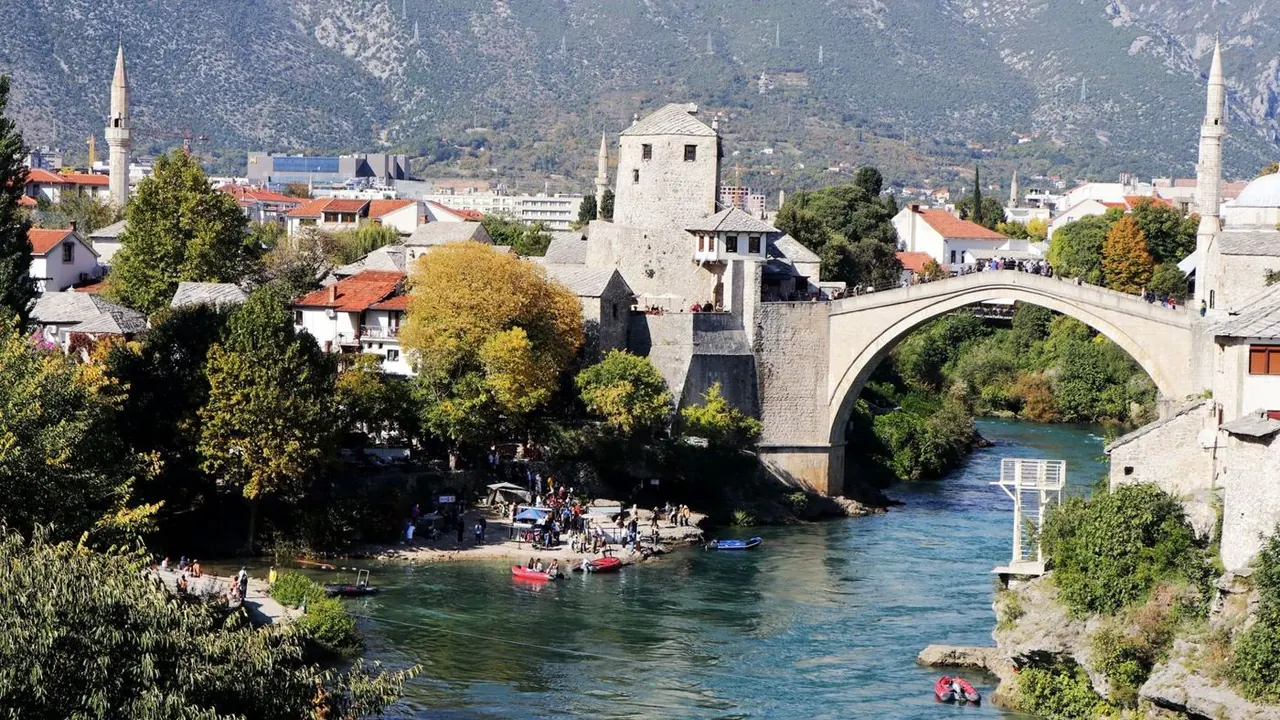
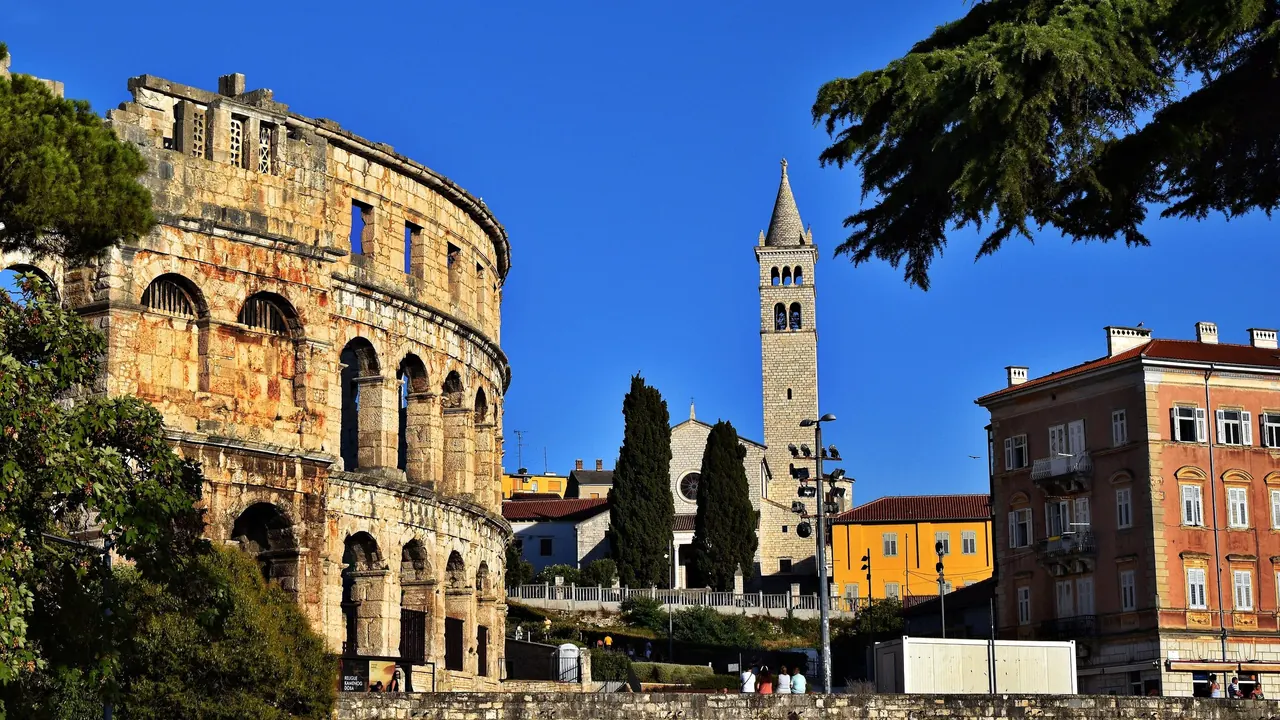
Photos: Mostar by Alan Wang, Pexels License; Pula by Miroslav.vajdic, CC BY-SA 4.0, cropped.
Mostar or Pula?
Our verdict in twelve categories, each scored against the same fixed benchmark cities, and the climate month by month, so you can choose for your trip.
Choose Mostar for
- prices
- shopping
Mostar suits a traveller who wants history with real weight and a stay that costs little. The Old Bridge, the Ottoman houses and the scarred former front line tell a story that Pula cannot match for intensity, and the mountains and river canyons around the city reward anyone who likes rough country. It works best as a short, inexpensive stop of two or three days, not as a base for a long summer vacation.
Choose Pula for
- beaches
- families
- live music and the arts
Pula is the better choice for a fuller trip, especially in summer. It has the sea, with clear water and wild coves at Kamenjak, a Roman amphitheatre that hosts concerts on warm nights, Istrian food, and the whole peninsula within an hour's drive for day trips. Families and anyone who wants swimming built into every day will find it far easier going, though they will pay more for it.
Scoreboard
Twelve categories on one fixed scale from 0 to 100. The shaded stretch is the gap between the two.
Your match
Pick a travel style or drag the sliders, and both match scores follow your weighting.
Wins on prices and shopping with your weighting.
Wins on beaches and families with your weighting.
What matters to you?
Category by category
What the scores mean for a trip.
Beaches & swimming
Mostar has no beach life of its own. The Neretva is too cold for more than a quick plunge, and the real swim is the pool beneath the Kravica waterfalls about 40km away, with the Adriatic at Neum more than an hour off.
Pula is a proper swimming destination, though on rock and pebble rather than sand. Pine-shaded coves line Verudela and Stoja, the wild headland of Cape Kamenjak has dozens of inlets, and the sheltered bays of Medulin suit anyone who wants gentler water. Bring water shoes.
Food & drink
Mostar's table is narrow but satisfying: charcoal-grilled ćevapi in somun bread, burek, stuffed peppers and slow-cooked stews, with Žilavka and Blatina from the surrounding valleys and Bosnian coffee as a ritual of its own. Beyond that, there is little choice.
Pula draws on Istria, a richer and more varied kitchen: truffle pasta, scampi buzara, grilled squid, pršut and estate olive oil, with Malvazija and Teran to drink. The town's own restaurants are only middling, so the best meals come from a drive to the village konobas or the coastal harbours.
Culture & sights
Both cities are built around one great monument, and both can be seen in a day or two. Mostar's is the rebuilt Old Bridge with its divers, surrounded by the Kujundžiluk bazaar, Ottoman houses, a climbable minaret and the war-marked buildings of the old front line, a history that is raw and recent.
Pula offers a little more to see and spans more centuries. The Arena is among the best preserved Roman amphitheatres anywhere, the Temple of Augustus still stands on the Forum, and Venetian and Austro-Hungarian layers add a hilltop fortress museum and a ring of naval forts.
Nightlife
Neither city is a place to go out, but Pula gives a summer evening more to do. After terrace drinks around the Forum, the evening can move to beach bars on Verudela and around Medulin, with a few small clubs busy at weekends.
Mostar's evenings centre on dinner overlooking the lit bridge, and the old town turns quiet once the day visitors leave. A few cocktail bars and student clubs carry on at weekends, and that is the extent of it.
Nature & outdoors
The two are equally strong outdoors, but in opposite settings. Around Mostar it is mountains and rivers: the bare limestone of Velež and the wild Prenj range, rafting and kayaking in the Neretva canyons, the Buna spring at Blagaj and birdlife in the Hutovo Blato wetland.
Pula's outdoors is low coast and sea. Kamenjak is a car-free headland for walking and cycling, with dinosaur footprints on the shore, and the water offers sea kayaking, windsurfing and wreck diving. Serious hiking means a drive to the Učka range. In both, summer heat pushes walking into spring and autumn.
Day trips
Pula has the richer range of outings. Rovinj, the Byzantine mosaics of Poreč, the hill towns of Motovun and Grožnjan with their truffle and wine estates, and the Brijuni islands are all close, and Piran and Trieste make longer days.
Mostar's trips are smaller and closer to home: the dervish house at Blagaj, the walled village of Počitelj, Stolac's medieval tombstones and the wartime sites at Jablanica and Konjic. Sarajevo, reached by a scenic train through the Neretva gorge, is the one big city within reach. In both places a car makes most of this far easier.
Good for families
Pula is much the easier choice with children. Days revolve around the sea, with shallow bays at Medulin and Premantura, and there is an aquarium in an old fort, the Arena to clamber round and the Brijuni safari park.
Mostar holds children's attention for a day or two: the bridge divers, the minaret climb and a swim at Kravica. But the polished, sloping cobbles defeat pushchairs and the valley heat is hard on small children, though restaurants welcome families warmly.
Getting around
Both centres are compact and walkable, and Pula's is slightly easier: flat streets, with city buses out to the hotel areas and southern coves. Mostar's old town is a short stroll too, but its worn, slippery cobbles call for good shoes and its buses are no help to visitors.
Beyond town, both depend on a car or tour. Mostar has one real advantage, the train to Sarajevo, while Pula's rail line is slow and its regional buses are thin.
Shopping & style
Shopping is modest in both, and what is worth buying differs. In Mostar it is handmade copper from the few workshops still working on the Kujundžiluk, among much imported souvenir stock. In Pula the souvenirs are edible: Istrian olive oil, truffle products, wine and honey from the market hall and producers.
Affordability
Mostar is clearly the cheaper stay. Guesthouses, meals and wine cost little, and even the pricier bridge-view terraces are easy to avoid by stepping a few streets away.
Pula sits in the middle. Spring and autumn are reasonable, but in July and August rooms and restaurants near the Arena cost about as much as Western European coasts, and car hire and boat trips add up.
Live music & performing arts
Pula has the one memorable stage of the pair: in summer the Roman Arena hosts touring concerts, classical galas and film festival screenings under the stone arches. Out of season the Istrian National Theatre performs in Croatian.
Mostar offers less. Its national and youth theatres play in local languages, and outside summer's open-air concerts, live music means the occasional café band.
Wellness & relaxation
Neither has a spa tradition, but Pula gives more to someone who wants to slow down. Resort hotels on Verudela and in Medulin have pools, saunas and massage, and pine-shaded coastal paths make for easy evening walks.
In Mostar the Ottoman hammam is a monument, not a working bath, and treatments are few. Its calm comes from early mornings and evenings by the river once the old town empties.
When should you go?
Pick your month. The climate figures are measured averages, not a forecast.
Mostar in July
Pula in July
Daytime high, °C
Rainfall in the month, mm
Where the figures come from
Pula's temperatures are measured 87 km from the centre, at Trieste.
Pula has no rain gauge within 25 km of the centre, so its rainfall comes from a gridded climate dataset read at the city rather than from a gauge further away.
Temperature and rainfall are climate normals, averaged over the years shown. Mostar: 1991-2020 normals, Mostar (0.9 km from centre). Pula: 1991-2020 normals, Trieste (87 km from centre).
Mostar sits in a hot inland basin, and July and August reach 33°C with long, bright days. That is too hot for walking the streets in the middle of the day, though summer is also its driest stretch. May is the best month for exploring: warm, sunny and drier than the spring months before it, with early June close behind. September is still warm, but the rain returns in earnest that month and keeps building through autumn into a wet, cool winter, with December bringing nearly 200mm.
Pula is milder and drier all year, with summer highs a few degrees below Mostar's and less rain than Mostar in every month. The sea is warm enough for swimming from June to September, reaching 25°C in August and staying near 22°C in September. That makes early autumn a good time for a quieter beach trip here, which is not true inland. October and November are its wettest months, yet both are still drier than the same months in Mostar. Winter in both cities is cool and grey, and neither is at its best then.
Which traveller are you?
For a beach and sun trip, Pula is the clear choice. Swimming off the rocks and pebble coves of Verudela and Kamenjak fits into every day, while Mostar is inland and its sea is more than an hour's drive away.
On a tight budget, Mostar goes much further. Guesthouses, ćevapi, local wine and long coffees all cost little, whereas Pula is mid-priced and in July and August its rooms and harbour-side restaurants cost about as much as Western Europe's coasts.
On a family trip with children, Pula is easier work. Shallow bays at Medulin, the aquarium in an old fort and the Arena's passages fill several days, while Mostar's slippery, steep lanes and fierce summer heat suit a short visit at most.
Before you go
| Measure | Mostar | Pula |
|---|---|---|
| Official language | Croatian, Serbian, Bosnian | Croatian |
| Currency | Convertible Mark (BAM) | Euro (EUR) |
| Sockets | CF230 V, 50 Hz | CF230 V, 50 Hz |
| Driving side | Right | Right |
| Time zone | UTC+1, UTC+2 in summer | UTC+1, UTC+2 in summer |
| Emergency number | 112 | 112 |
| Elevation | 60 m | 5 m |
| Main airport | Sarajevo International Airport (SJJ)68 km from centre38 non-stop destinations | Pula Airport (PUY)7 km from centre34 non-stop destinations |
| Public holidays this year | 8 days | 14 days |
By the numbers
| Measure | Mostar | Pula |
|---|---|---|
| City population | 105,448 | 52,220 |
| People per km² | 90 | 971 |
| Museums within 10 km | 3 | 4 |
| UNESCO World Heritage sites within 50 km | 1 | 1 |
| Swim season, months above 21 °C | - | 4 months |
Where else could you go?
Every comparison below shares a destination with this one, so you can follow Mostar or Pula somewhere new.