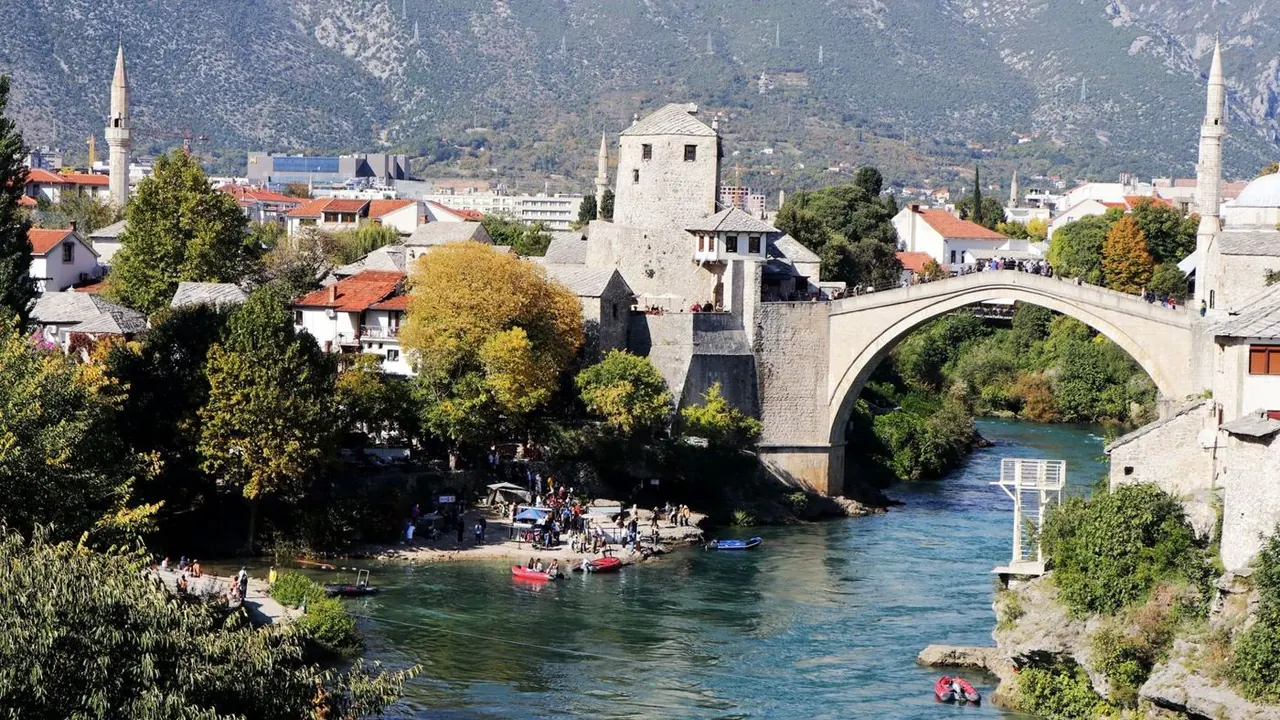
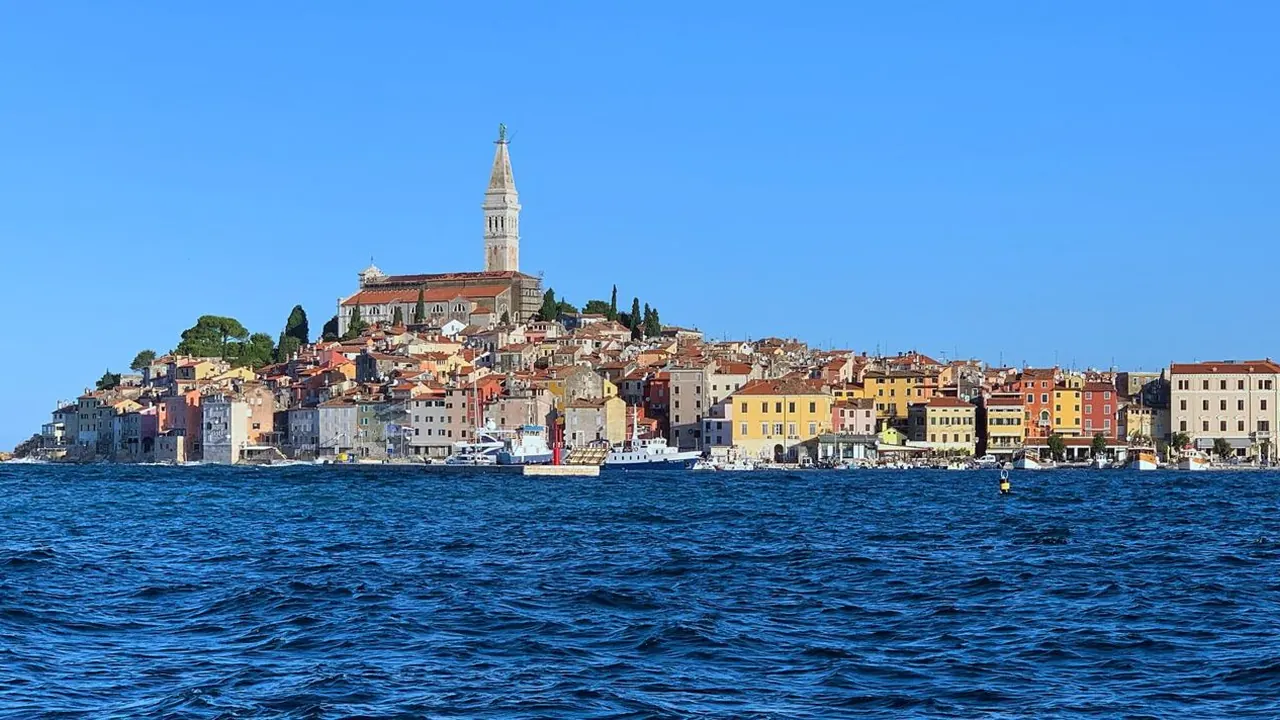
Photos: Mostar by Alan Wang, Pexels License; Rovinj by Vyacheslav Bukharov, CC BY-SA 4.0, cropped.
Mostar or Rovinj?
Our verdict in twelve categories, each scored against the same fixed benchmark cities, and the climate month by month, so you can choose for your trip.
Choose Mostar for
- prices
- culture and sights
- nature and the outdoors
Mostar suits travellers who want history they can feel underfoot and a vacation that costs little. The Old Bridge, the Ottoman houses and the scars of the 1990s give it more weight than a pretty seaside town can offer. The mountains and canyons around it make for rougher, wilder outings, and a guesthouse room with ćevapi and local wine every evening keeps the bill low. It works best as a short, absorbing stop rather than a long stay.
Choose Rovinj for
- beaches
- wellness
- families
Rovinj is the place for a summer of swimming and slow eating on the Adriatic. Clear water runs right below the old town, the pine shade of the Golden Cape is on the doorstep, and the Istrian table of truffles, shellfish and Malvazija is a cut above Mostar's narrower menu. Families and anyone wanting a resort spa will find it easier going too, provided they accept the higher prices that come with a sought-after coast.
Scoreboard
Twelve categories on one fixed scale from 0 to 100. The shaded stretch is the gap between the two.
Your match
Pick a travel style or drag the sliders, and both match scores follow your weighting.
Wins on prices and culture and sights with your weighting.
Wins on beaches and wellness with your weighting.
What matters to you?
Category by category
What the scores mean for a trip.
Beaches & swimming
This is where the two part company most clearly. Mostar is inland, and its swimming means a cold plunge in the Neretva or a day out to the pool beneath the Kravica waterfalls, with the Adriatic at Neum more than an hour's drive away.
Rovinj has the sea at its door: kilometres of limestone ledges, pebble coves and bathing platforms through the Golden Cape, very clear water and islands a short boat ride off. It is rock rather than sand, so water shoes help, but for a swimming vacation there is no contest.
Food & drink
Rovinj eats better and more widely. Its kitchen draws on both the sea and the Istrian hinterland, so grilled fish, scampi buzara, truffle pasta and peppery olive oil sit alongside a few refined restaurants and countryside konobas worth a drive.
Mostar's cooking is hearty and honest, built on charcoal-grilled ćevapi, burek and slow-cooked stews, with Žilavka and Blatina wines and the ritual of Bosnian coffee. Beyond that home cooking the choice runs thin, though the everyday eating is more filling and less tourist-driven a few lanes back from the river than in Rovinj's harbour.
Culture & sights
Mostar offers more to understand. The rebuilt sixteenth-century bridge and its divers, the Kujundžiluk, the Koski Mehmed Pasha Mosque and the carpeted Ottoman houses, followed by Austro-Hungarian streets and war-damaged façades, fill a day or two with real history.
Rovinj's draw is the townscape itself: Venetian houses rising to St Euphemia's bell tower, the Balbi Arch and the lane of Grisia. Add the Batana House and a small town museum and it is a lovely afternoon, but lighter than Mostar's mix of empire, faith and recent conflict.
Nightlife
Neither town is a night out, and evenings in both revolve around a long dinner and a drink with a view. In Mostar that view is the lit bridge from a riverside terrace, with a few student clubs keeping weekends going later. In Rovinj it is the sunset from the rocks and a waterfront cocktail or wine bar, with a couple of dance venues only in high season.
Nature & outdoors
Both are good for the outdoors, but the settings differ completely. Mostar is ringed by bare karst and the jagged Prenj range, with rafting and kayaking in the Neretva canyons, the Buna spring at Blagaj and the birdlife of Hutovo Blato, which makes it rugged and mountainous, if too hot for hiking in high summer.
Rovinj is gentler and shaped by the sea: flat gravel paths through the Golden Cape forest, sea kayaking and diving around the archipelago, the green channel of the Lim Fjord and quiet vineyard roads inland. Choose Mostar for wilderness and Rovinj for easy coastal walks and time on the water.
Day trips
Rovinj has the richer spread of excursions within easy reach. Pula's Roman amphitheatre and Poreč's mosaic-filled Euphrasian Basilica are each well under an hour away, the hill towns of Motovun, Grožnjan and Hum lie among truffle woods, and Piran and Trieste make longer trips across the border.
Mostar's outings are smaller and more atmospheric: the dervish tekke at Blagaj, the walled village of Počitelj, the stećci at Stolac and Tito's bunker at Konjic. Sarajevo is the one major city, a long day out by train through the Neretva gorge. In both places a car makes most of this far easier.
Good for families
Rovinj is the easier place to bring children. Resorts and campsites with pools and playgrounds, boat trips, gelato on the harbour and flat, shaded park paths fill a week without much planning, though the rocky shore means water shoes and a watchful eye.
Mostar works for a day or two: the bridge divers, a minaret climb and a swim at Kravica stick in young memories, and restaurants are relaxed about children. Steep, slippery cobbles and a valley that bakes in summer make a longer family stay hard going.
Getting around
Both centres are walkable and both have treacherous polished cobbles, but Rovinj makes life on foot easier. Its car-free old town connects along a promenade to the swimming rocks and the forest park, bikes cover the coast paths and taxi boats reach the islands.
Mostar's sights fit into a short riverside walk, yet its buses are designed for residents, and Blagaj, Počitelj and Kravica need a car or tour. It does have a train to Sarajevo, which Rovinj lacks.
Shopping & style
The real difference here is what you carry home. Mostar's Kujundžiluk sells hammered copper coffee sets, kilims and Turkish-style lamps, though the pieces worth buying come from a craftsman at work in the shop, not from the imported souvenir stock.
Rovinj sells Istrian produce instead: truffles, olive oil, Malvazija and Teran wine, along with work from the small galleries and artists' studios along Grisia. If you want fashion or design, you will have to go elsewhere from either town.
Affordability
Mostar is far cheaper. Rooms in family guesthouses, grilled dinners, local wine and coffee all cost little, and walking a few streets back from the bridge brings prices down further.
In high summer Rovinj is priced as a fashionable Mediterranean resort, with harbourside restaurants charging for the view and fish sold by weight. Apartments, campsites and a visit in late spring or September help, but it will never match Mostar for value.
Live music & performing arts
Neither town offers much for an evening of performance, and both come alive slightly only in summer. Mostar has a national theatre and a youth theatre, mostly performing in local languages, plus open-air festival concerts. Rovinj has its own curiosity in the bitinada, the unaccompanied singing tied to the batana boats, as well as concerts in St Euphemia, while Pula's Roman arena nearby hosts big summer shows.
Wellness & relaxation
Rovinj is the better place to unwind properly. The larger resort hotels along the shore have well-equipped pools, saunas and treatments open to outside guests, and May, June and September bring long lunches, late swims and walks in the pines.
Mostar's old hammam is a monument rather than a working bath, and spa options are limited to a few hotels. What it does offer is slowness: long coffees in the shade and the quiet hours by the river once the day visitors have left.
When should you go?
Pick your month. The climate figures are measured averages, not a forecast.
Mostar in July
Rovinj in July
Daytime high, °C
Rainfall in the month, mm
Where the figures come from
Rovinj's temperatures are measured 64 km from the centre, at Trieste.
Rovinj has no rain gauge within 25 km of the centre, so its rainfall comes from a gridded climate dataset read at the city rather than from a gauge further away.
Temperature and rainfall are climate normals, averaged over the years shown. Mostar: 1991-2020 normals, Mostar (0.9 km from centre). Rovinj: 1991-2020 normals, Trieste (63.7 km from centre).
Mostar sits in a hot inland basin, so its summer is fiercer than Rovinj's. July and August reach about 33°C in the valley, which is hard work on the polished stone lanes, while Rovinj stays a few degrees cooler with a sea breeze and water warm enough for long swims from June to September, reaching about 26°C in August. For walking Mostar, May and early June are the sweet spot: warm, sunny and fairly dry. Late September and October are pleasant in temperature, but the rain has already returned.
Winter separates the two most clearly. From November to December Mostar is one of the wetter places in the region, with close to 200mm a month, whereas Rovinj gets much less rain, though it is cool and largely shut down out of season. Both cities get their most sunshine in July, and in both spring and autumn are better for walking and cycling than high summer.
Which traveller are you?
On a beach and sun trip, choose Rovinj. From Mostar the sea is a day out to Neum, a little over an hour away, while Rovinj has clear water below its old town walls, rocky coves in the Golden Cape and island boats.
For a trip on a tight budget, Mostar goes much further. Its guesthouses are inexpensive, a grilled dinner with Herzegovinian wine costs little and the old town is free to wander, whereas Rovinj charges like a sought-after Mediterranean resort in summer.
On a culture and arts trip, Mostar has more substance. Its Ottoman bridge, bazaar street, mosques and old front line tell a layered, difficult story, while Rovinj's appeal lies mainly in its photogenic Venetian old town, easily covered in an afternoon.
Before you go
| Measure | Mostar | Rovinj |
|---|---|---|
| Official language | Croatian, Serbian, Bosnian | Croatian |
| Currency | Convertible Mark (BAM) | Euro (EUR) |
| Sockets | CF230 V, 50 Hz | CF230 V, 50 Hz |
| Driving side | Right | Right |
| Time zone | UTC+1, UTC+2 in summer | UTC+1, UTC+2 in summer |
| Emergency number | 112 | 112 |
| Elevation | 60 m | 0 m |
| Main airport | Sarajevo International Airport (SJJ)68 km from centre38 non-stop destinations | Pula Airport (PUY)31 km from centre34 non-stop destinations |
| Public holidays this year | 8 days | 14 days |
By the numbers
| Measure | Mostar | Rovinj |
|---|---|---|
| City population | 105,448 | 12,968 |
| People per km² | 90 | - |
| Museums within 10 km | 3 | 1 |
| UNESCO World Heritage sites within 50 km | 1 | 1 |
| Swim season, months above 21 °C | - | 4 months |
Where else could you go?
Every comparison below shares a destination with this one, so you can follow Mostar or Rovinj somewhere new.