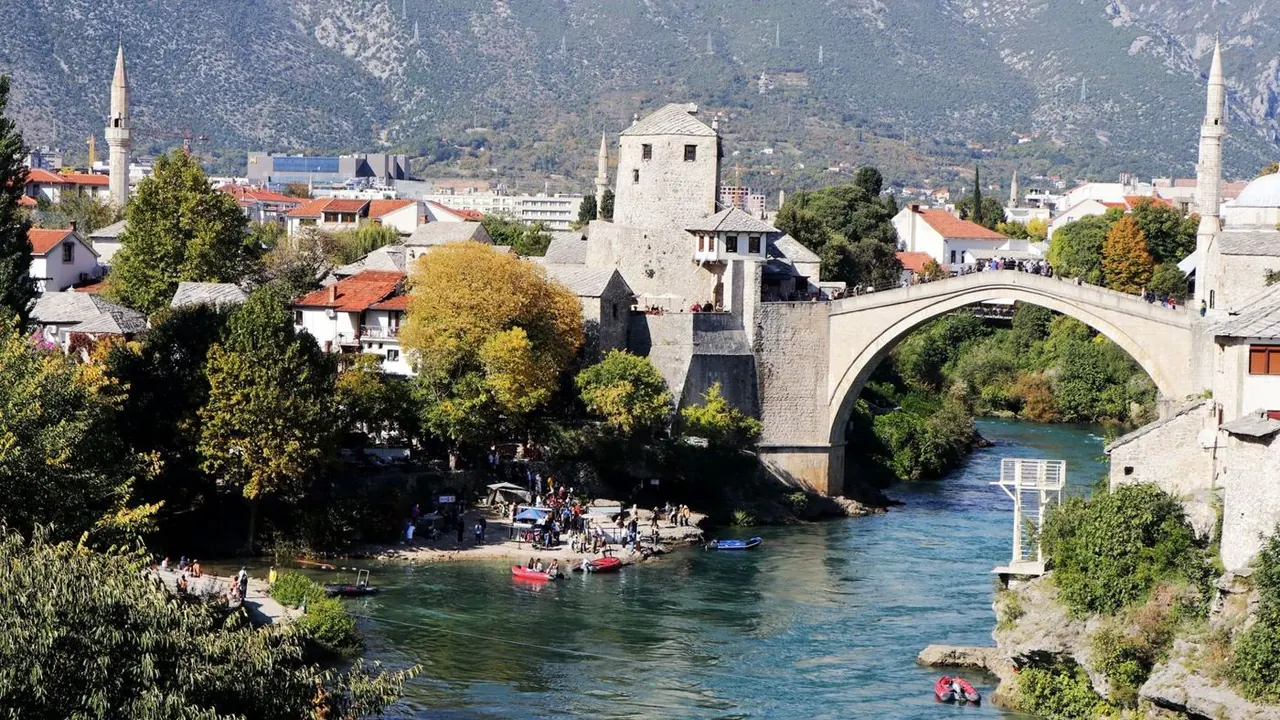
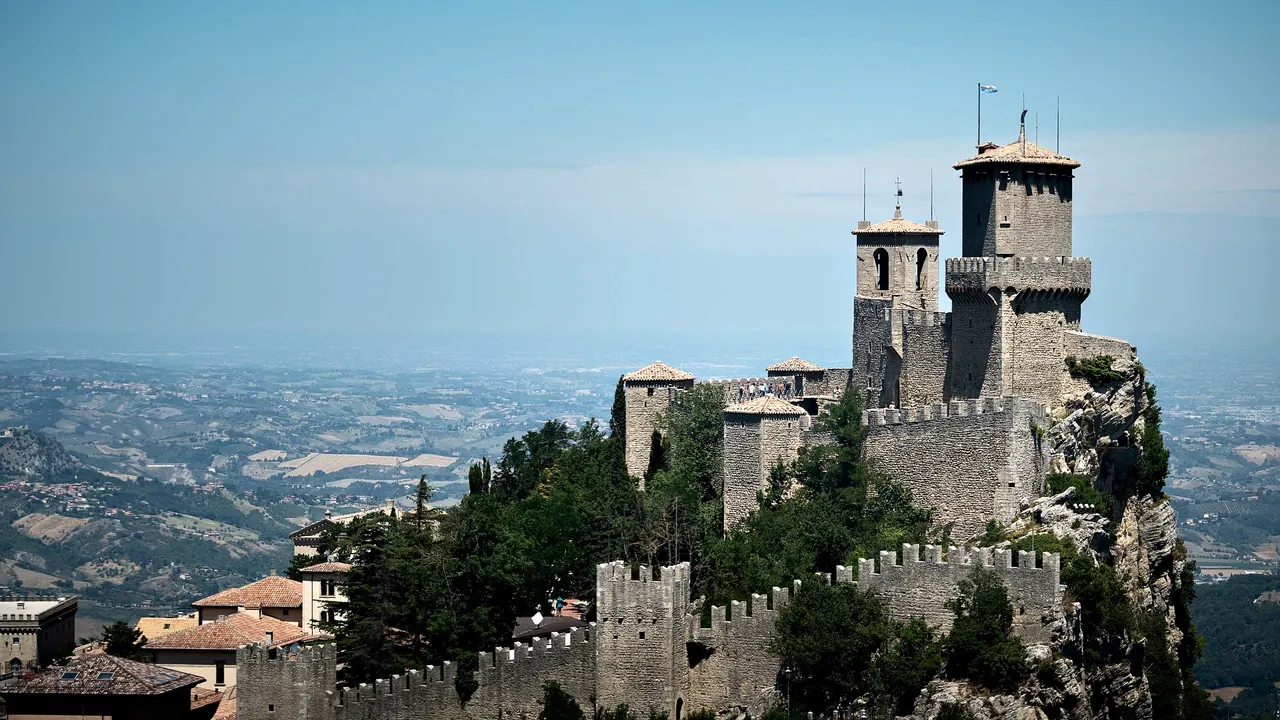
Photos: Mostar by Alan Wang, Pexels License; San Marino by Tibor Szabo, Pexels License.
Mostar or San Marino?
Our verdict in twelve categories, each scored against the same fixed benchmark cities, and the climate month by month, so you can choose for your trip.
Choose Mostar for
- prices
- nature and the outdoors
- nightlife
Mostar suits travellers who want a place with real weight to it and money left over at the end. The Old Bridge and the Ottoman lanes around it carry a hard modern history, the canyons and limestone ranges outside town are wild ground for rafting and hiking, and guesthouses and grilled food cost little. Expect quiet nights and few comforts laid on for children.
Choose San Marino for
- beaches
- families
- day trips
San Marino works better as a calm hilltop base for exploring a wider region. The towers on Monte Titano fill half a day, then Urbino, San Leo, Ravenna and the sandy Romagna shore are all within easy reach by car. Families do well here, with sea, waterparks and theme parks just below the mountain, though prices run higher and the summit itself is small.
Scoreboard
Twelve categories on one fixed scale from 0 to 100. The shaded stretch is the gap between the two.
Your match
Pick a travel style or drag the sliders, and both match scores follow your weighting.
Wins on prices and nature and the outdoors with your weighting.
Wins on beaches and families with your weighting.
What matters to you?
Category by category
What the scores mean for a trip.
Beaches & swimming
San Marino is the better pick for a beach day. The sandy Romagna shore at Rimini and Riccione is about half an hour downhill, with shallow water and organised beach clubs, and the sea is properly warm in high summer.
From Mostar the sea is further, over an hour to Neum and more to the Makarska Riviera. Its best swimming is freshwater instead, in the pool below the Kravica waterfalls or a bracing plunge into the cold Neretva.
Food & drink
Neither is a place to travel for the food, and they are much of a muchness, but the flavours differ. Mostar cooks Bosnian food with Ottoman roots, charcoal-grilled ćevapi, burek and slow-cooked stews, with Žilavka and Blatina wines and the ritual of Bosnian coffee.
San Marino eats like the Romagna hills around it: hand-rolled pasta, passatelli in broth and piadina. In both, the terraces with views are the weak spot, and the better meals are a few streets away in Mostar or down in Borgo Maggiore in San Marino.
Culture & sights
Mostar has more to absorb. The rebuilt Stari Most, the Kujundžiluk, the Koski Mehmed Pasha Mosque and the Ottoman houses fill a day or two, and the war-scarred former front line gives the visit a harder, more recent history.
San Marino's appeal is the setting and the story of an ancient republic: three towers on a cliff edge, the Palazzo Pubblico and the Basilica. It is atmospheric, but most visitors have seen it well within half a day.
Nightlife
Mostar has the more to do after dark, though it is still modest. Dinner on a terrace facing the lit bridge is the main event, and at weekends a few cocktail bars and student clubs keep going later, especially in summer.
San Marino's summit goes quiet once the coaches leave, with a wine bar or two for a last glass above the lights of the coast. For a real night out you have to drive down to the Riviera clubs at Rimini and Riccione.
Nature & outdoors
Mostar wins clearly. It sits in a karst basin ringed by bare mountains, with the Prenj massif among the wildest in the Balkans, white-water in the Neretva canyons upstream and the Buna spring bursting from a cliff at Blagaj. Serious hikers have marked if rugged routes within an hour or two.
San Marino offers gentler scenery: a single limestone ridge with wooded paths between the towers, and the farmland of the Marecchia valley for quiet cycling. It suits a morning walk, not an active trip.
Day trips
Mostar's excursions are small and full of character: the dervish tekke at Blagaj, the walled hillside village of Počitelj, Stolac's stećci tombstones and Tito's bunker at Konjic. Sarajevo is the one big city, and the train through the Neretva gorge makes it a long day.
San Marino is the stronger base, with bigger places close by. San Leo's rock fortress is about half an hour away, Urbino's Renaissance court city about an hour, and Ravenna's Byzantine mosaics a little further. Bologna is a train ride from Rimini. From either base, the smaller places really need a car.
Good for families
San Marino is the easier choice with children. The cable car and battlements entertain on the mountain, and the coast below has theme parks, waterparks and long, shallow beaches, so families with a car can split the day neatly between the two.
Mostar manages a day or two well enough, with the bridge divers and a swim at Kravica the highlights, but slippery stone lanes and hot valley summers wear young children out.
Getting around
In both places you can see the sights on foot, and anything further out is easier with wheels, but the walking feels different. In Mostar the old town, the bridge and the Austro-Hungarian quarter all lie along the river, so the climbs are short. The polished cobbles still call for shoes with grip. On Monte Titano almost every street is a climb or a flight of steps, and the cable car down to Borgo Maggiore saves your knees.
Getting in and out is where the two really differ. Mostar is on a railway line, with trains up the Neretva gorge to Sarajevo and coaches across the region, and taxis are an easy way to reach the nearby sights. San Marino has no station of its own. Without a car you depend on the one bus line down to Rimini to reach Italian trains, and buses between the republic's villages are few.
Shopping & style
Mostar's shopping is a bazaar street, while San Marino's runs on lower taxes. In the Kujundžiluk, look past the imported souvenir stock for the coppersmiths hammering coffee sets by hand, along with kilims and embroidered textiles.
In San Marino, taxes lower than in Italy fill the main streets with perfume, watches and leather goods, an outlet centre in the valley adds fashion brands, and collectors look for the republic's stamps and coins. Serious shoppers in either place look elsewhere.
Affordability
Mostar is much the cheaper of the two. Guesthouses, grilled meals and local wine cost little, and only the bridge-view terraces and old-town rooms in midsummer charge noticeably more.
San Marino is priced like provincial central Italy: moderate hotels, fair trattorias, a mark-up on the summit, and some savings on fuel and spirits thanks to lower taxes.
Live music & performing arts
Both are thin on stage culture, so plan to go elsewhere for this. Mostar has a national theatre and a youth theatre playing mainly in local languages, plus summer open-air concerts. San Marino's highlight is the Medieval Days festival in summer, with costumed musicians and crossbow contests, while Pesaro and Bologna are the nearby options for opera and concerts.
Wellness & relaxation
Neither has a bathing culture, and spa treatments in both are limited to a few hotels, so the rest comes from the pace. In Mostar that means long coffees in the shade and the sound of the river once the old town empties. San Marino offers evening walks along the walls high above the plain, with thermal spas on the coast or in the Apennines for a separate outing.
When should you go?
Pick your month. The climate figures are measured averages, not a forecast.
Mostar in July
San Marino in July
Daytime high, °C
Rainfall in the month, mm
Where the figures come from
San Marino's temperatures are measured 52 km from the centre, at Frontone.
San Marino has no rain gauge within 25 km of the centre, so its rainfall comes from a gridded climate dataset read at the city rather than from a gauge further away.
Temperature and rainfall are climate normals, averaged over the years shown. Mostar: 1991-2020 normals, Mostar (0.9 km from centre). San Marino: 1991-2020 normals, Frontone (51.5 km from centre).
Mostar has the hotter, sunnier summer. July and August reach about 33°C in the valley, which is too hot for comfortable walking or hiking in the middle of the day. May and late September into October are the sweet spot, warm but manageable, with long sunny days in May. The wet season sets in with autumn and peaks in November and December at nearly 198mm a month, when days are short and grey.
San Marino is a few degrees cooler all year, peaking around 30°C in July, so summer sightseeing on the ridge is easier. The sea off Rimini warms to about 26°C in August, making July to early September the beach window. Rain is steadier and lighter than in Mostar, rising modestly in autumn, and winters on the mountain are cold, which makes spring and early autumn the best time for walks along the walls.
Which traveller are you?
On an outdoors trip, Mostar is clearly the stronger choice. The Prenj and Velež ranges, rafting and kayaking in the Neretva canyons, the Blidinje plateau and the Hutovo Blato wetland go well beyond San Marino's pleasant short walks around Monte Titano.
On a family trip with children, San Marino is easier. The cable car and battlements appeal to children on the mountain, and the coast below adds shallow sandy beaches, Italia in Miniatura and waterparks. Mostar's slippery lanes and fierce summer heat are harder going.
For a trip on a tight budget, Mostar goes much further. Family-run guesthouses, ćevapi and local wine cost little, and stepping off the bridge terraces brings prices down fast. San Marino follows central Italian prices, with a premium on the summit.
Before you go
| Measure | Mostar | San Marino |
|---|---|---|
| Official language | Croatian, Serbian, Bosnian | Italian |
| Currency | Convertible Mark (BAM) | Euro (EUR) |
| Sockets | CF230 V, 50 Hz | CFL230 V, 50 Hz |
| Driving side | Right | Right |
| Time zone | UTC+1, UTC+2 in summer | UTC+1, UTC+2 in summer |
| Emergency number | 112 | 112 |
| Elevation | 60 m | 675 m |
| Main airport | Sarajevo International Airport (SJJ)68 km from centre38 non-stop destinations | Bologna Guglielmo Marconi Airport (BLQ)114 km from centre98 non-stop destinations |
| Public holidays this year | 8 days | 18 days |
By the numbers
| Measure | Mostar | San Marino |
|---|---|---|
| City population | 105,448 | 4,040 |
| People per km² | 90 | 569 |
| Museums within 10 km | 3 | 19 |
| UNESCO World Heritage sites within 50 km | 1 | 2 |
| Swim season, months above 21 °C | - | 4 months |
Where else could you go?
Every comparison below shares a destination with this one, so you can follow Mostar or San Marino somewhere new.
- Sarajevovs Mostar
- Dubrovnikvs Mostar
- Assisivs San Marino
- Florencevs San Marino
- Bolognavs San Marino
- Splitvs Mostar