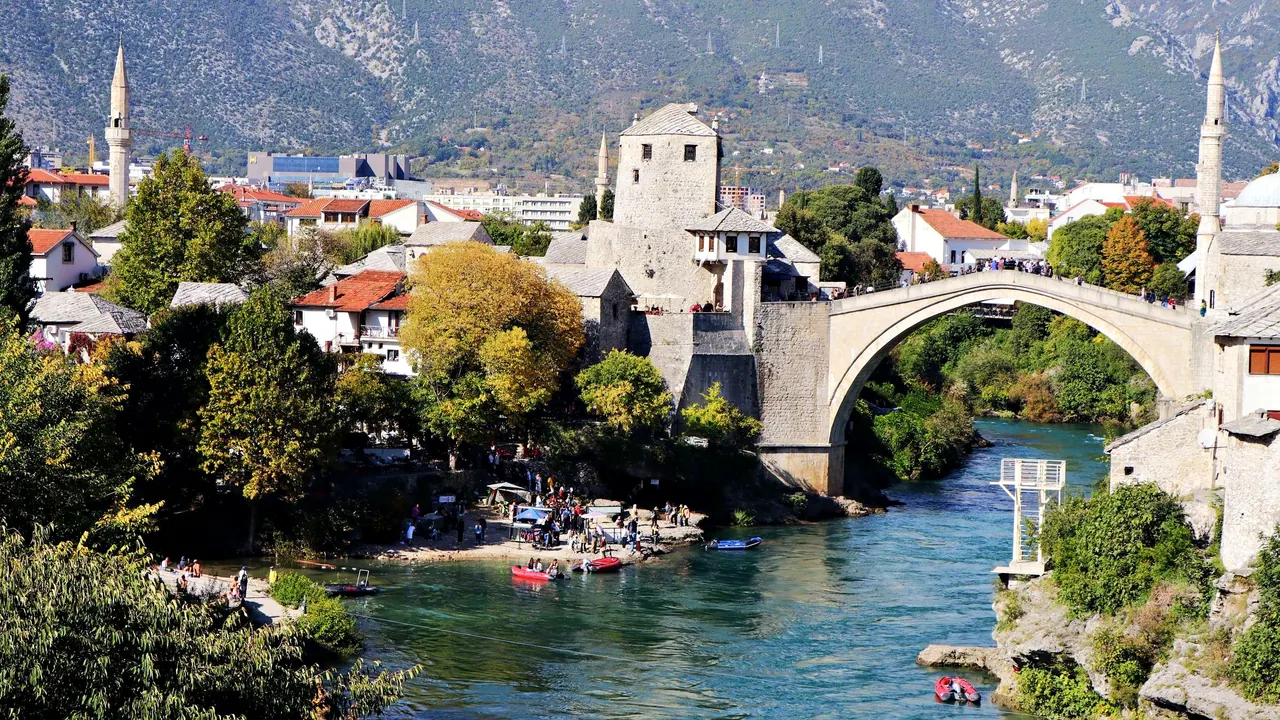
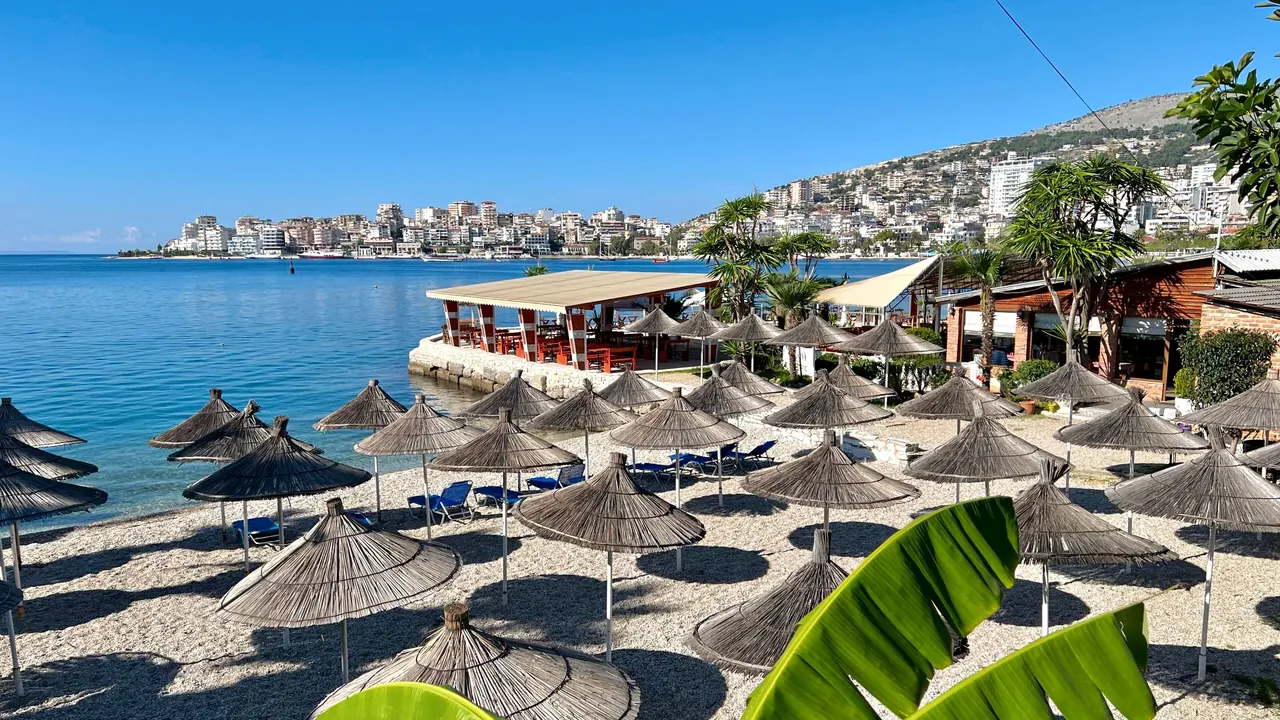
Photos: Mostar by Alan Wang, Pexels License; Saranda by Sharon Hahn Darlin, CC BY 2.0, cropped.
Mostar or Saranda?
Our verdict in twelve categories, each scored against the same fixed benchmark cities, and the climate month by month, so you can choose for your trip.
Choose Mostar for
- culture and sights
- shopping
- live music and the arts
Mostar suits travellers who want history they can walk through: the Ottoman bridge, the bazaar street and the old houses, with the war's marks still on the walls and the Herzegovina valleys around Blagaj and Počitelj close by. It works best as a short, inexpensive stop of a day or two, and it fits a road trip through the Balkans better than a week-long stay.
Choose Saranda for
- beaches
- nightlife
- day trips
Choose Saranda for a vacation by the sea. Its strength is the clear Ionian water at Ksamil and in the Riviera bays. From its base on the bay you can also reach Butrint, Gjirokaster and Corfu, which together make the better set of outings. Summer evenings on the promenade are livelier too, though the town itself has little to see.
Scoreboard
Twelve categories on one fixed scale from 0 to 100. The shaded stretch is the gap between the two.
Your match
Pick a travel style or drag the sliders, and both match scores follow your weighting.
Too close to call, 2 points apart
Wins on culture and sights and shopping with your weighting.
Wins on beaches and nightlife with your weighting.
What matters to you?
Category by category
What the scores mean for a trip.
Beaches & swimming
Here the gap is as wide as it gets. Mostar has no beach life. The Neretva is too cold for more than a plunge from the rocks, the usual swim is the pool below the Kravica waterfalls, and the Adriatic at Neum is over an hour away.
Saranda is built around the sea. Its town beaches are small strips of pebble, but Ksamil's clear coves lie twenty minutes south and the Riviera bays stretch to the north, so you can swim every day without planning a trip for it.
Food & drink
The two eat at a similar level, in the same homely style, and both have little international or fine dining. What differs is the larder. Mostar leans on the Ottoman grill and pastry, with ćevapi in somun and burek, alongside Žilavka and Blatina wines and a proper coffee ritual.
Saranda cooks from the sea: mussels from the Butrint lagoon, grilled fish and octopus, with byrek and salads in local olive oil, but its coffee and wine culture is thinner. In both towns the back streets cook better than the terraces with a view.
Culture & sights
Mostar has far more to see. The rebuilt Old Bridge and its UNESCO old town, the divers, the Kujundžiluk, a mosque minaret to climb and furnished Ottoman houses fill a day or two, and the war-scarred front line adds weight.
Saranda's town is modern. It has the ruin of a synagogue with mosaic floors, fragments of old wall and Lekuresi Castle, which people mostly visit for the view. Its serious history is half an hour away at Butrint, which counts as a day trip rather than a sight in town.
Nightlife
Neither is a nightlife destination, but Saranda goes on later in summer. In July and August its promenade turns from a family stroll into a row of loud cocktail bars, and beach clubs at Ksamil keep DJs playing for a young Albanian and Kosovar crowd.
Mostar's evenings centre on dinner and drinks with the lit bridge in view. The old town goes quiet once the day visitors leave, and only a few bars and student clubs stay open late at weekends. Out of season, both settle into a quiet drink.
Nature & outdoors
Both sit among bare limestone mountains, and in both the walking is better in spring and autumn than in summer, so the difference is in the setting. Mostar is inland and shaped by its river: the wild Prenj range, rafting and kayaking in the Neretva canyons, the Buna spring at Blagaj and the high Blidinje plateau.
Saranda adds the sea, with sea kayaking and boat trips to caves along the Riviera, the lagoon and oak woods of Butrint, and the Blue Eye spring inland. Mostar's hiking routes are marked, while Saranda's mostly are not.
Day trips
Saranda's list is short but stronger. Butrint's layered ancient city is half an hour away, Gjirokaster's Ottoman tower houses about an hour and a quarter, and Corfu under an hour by ferry. That gives three substantial days out with little effort, and the Riviera villages make a fourth.
Mostar's outings are smaller and more intimate: the dervish tekke at Blagaj, walled Počitelj, the stećci tombstones at Stolac and Tito's bunker at Konjic, with Sarajevo a long day away by train. Most of them need a car or a tour.
Good for families
Saranda is the somewhat easier choice with children, mainly because of the water. Ksamil's sheltered coves suit young swimmers, and the evening promenade has ice cream and rides. The downsides are steep streets, summer traffic and packed beaches in August.
Mostar keeps children busy for a day or two with the bridge divers, a minaret climb and the Kravica pool. Its slippery lanes are hard going with a pushchair, though, and the valley heat is tough on small children. Both towns welcome families warmly, and neither has anything built for them.
Getting around
The two are much alike: you walk around a compact centre and need a car for most places worth seeing beyond it. In Mostar the walk follows the river over worn, slippery cobbles, and a train runs on to Sarajevo.
Saranda's centre runs along the seafront promenade, with steep climbs to the hotels on the hillside. Local buses go to Ksamil and Butrint, but there are no printed timetables, and summer traffic clogs the coast road.
Shopping & style
Mostar has the only shopping street of the two worth the name. On the Kujundžiluk, a few coppersmiths still hammer coffee sets and plates by hand among the kilims and imported souvenirs.
Saranda sells beachwear and everyday goods, and its better buys are things to eat and drink: olive oil, mountain honey, raki and dried herbs. For crafts, visitors go to the bazaar in Gjirokaster instead.
Affordability
Both are among Europe's cheaper places to travel, and Mostar is a little easier on the budget. Guesthouses, ćevapi and local wine cost little there, and only the terraces with bridge views and old-town rooms in midsummer charge more.
Saranda is good value for most of the year, but July and August push up the price of sunbeds at Ksamil and seafront hotels, so booking early matters. Late spring and September give you the same sea for far less.
Live music & performing arts
Mostar at least has stages of its own: a national theatre and a long-established youth theatre, though most of their performances are in local languages. Summer adds open-air concerts and festival events, but for the rest of the year live music rarely amounts to more than a band in a café bar.
Saranda has no theatre, concert hall or regular venue. In summer you might find a concert on the seafront, an occasional performance in Butrint's ancient theatre or live Albanian music in a restaurant on a busy night, and that is about all. For traditional polyphonic singing, you would need to head inland towards Gjirokaster.
Wellness & relaxation
Neither town has a bathing tradition, and spa treatments in both are limited to hotels, plus massages at beach resorts in Saranda. Mostar's hammam is a historic monument rather than a working bath.
What relaxes you in each is the pace, and it slows at different times. Mostar is calmest in the early morning and the evening, after the coach groups have gone. Saranda changes by season: it is loud in July and August and slow in May, June and late September.
When should you go?
Pick your month. The climate figures are measured averages, not a forecast.
Mostar in July
Saranda in July
Daytime high, °C
Rainfall in the month, mm
Where the figures come from
Saranda's temperatures are measured 30 km from the centre, at Kerkyra Airport.
Saranda has no rain gauge within 25 km of the centre, so its rainfall comes from a gridded climate dataset read at the destination rather than from a gauge further away.
Temperature and rainfall are climate normals, averaged over the years shown. Mostar: 1991-2020 normals, Mostar (0.9 km from centre). Saranda: 1991-2020 normals, Kerkyra Airport (29.8 km from centre).
Both places have hot, dry summers and wet winters, but the coast softens the extremes. Mostar sits in an inland basin that bakes in July and August at around 33°C, too hot for walking the cobbles at midday. From September the rain comes back heavily and peaks at nearly 200mm in December, when the days are cool and grey. May, early June and the warm days of early autumn are the comfortable times for the old town and the hills.
Saranda is the drier and sunnier of the two in summer, and July is almost rainless. The sea is warm enough for swimming from June into October and reaches 25°C in August. Its winters are milder than Mostar's but just as wet, with November and December the rainiest months. June and September bring beach weather without the full heat of midsummer.
Which traveller are you?
On a beach and sun trip, Saranda wins outright. Ksamil's pale coves and islets, the quieter pebble bays at Lukova and Borsh and a warm Ionian sea are all close by, while from Mostar the nearest sea, at Neum, means a day out by car.
For a culture and arts trip, Mostar is the better pick. Stari Most, the coppersmiths' street, the Ottoman houses and the old front line make a compact and absorbing set. Saranda's own sights are few, and most of its history lies at Butrint, outside town.
On a food and nightlife trip in summer, Saranda has the edge for going out, with promenade bars and beach clubs open well past midnight. Mostar's evenings are quieter, on terraces by the lit bridge, though its grills, Herzegovina wines and coffee ritual hold their own against Saranda's seafood.
Before you go
| Measure | Mostar | Saranda |
|---|---|---|
| Official language | Croatian, Serbian, Bosnian | Albanian |
| Currency | Convertible Mark (BAM) | Lek (ALL) |
| Sockets | CF230 V, 50 Hz | CF220 V, 50 Hz |
| Driving side | Right | Right |
| Time zone | UTC+1, UTC+2 in summer | UTC+1, UTC+2 in summer |
| Emergency number | 112 | 112 |
| Elevation | 60 m | 0 m |
| Main airport | Sarajevo International Airport (SJJ)68 km from centre38 non-stop destinations | Corfu Ioannis Kapodistrias International Airport (CFU)32 km from centre88 non-stop destinations |
| Public holidays this year | 8 days | 14 days |
By the numbers
| Measure | Mostar | Saranda |
|---|---|---|
| Population | 105,448 | 22,613 |
| People per km² | 90 | 383 |
| Museums within 10 km | 3 | 0 |
| UNESCO World Heritage sites within 50 km | 1 | 3 |
| Swim season, months above 21 °C | - | 5 months |
Where else could you go?
Every comparison below shares a destination with this one, so you can follow Mostar or Saranda somewhere new.