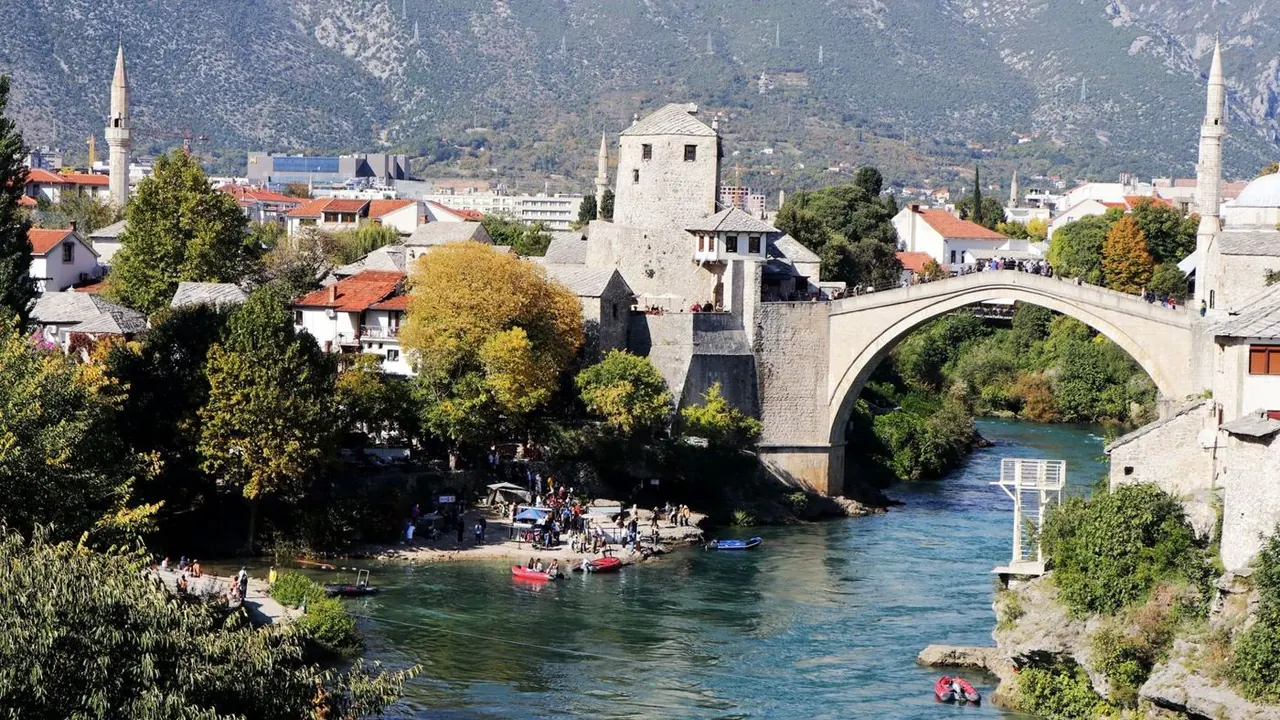
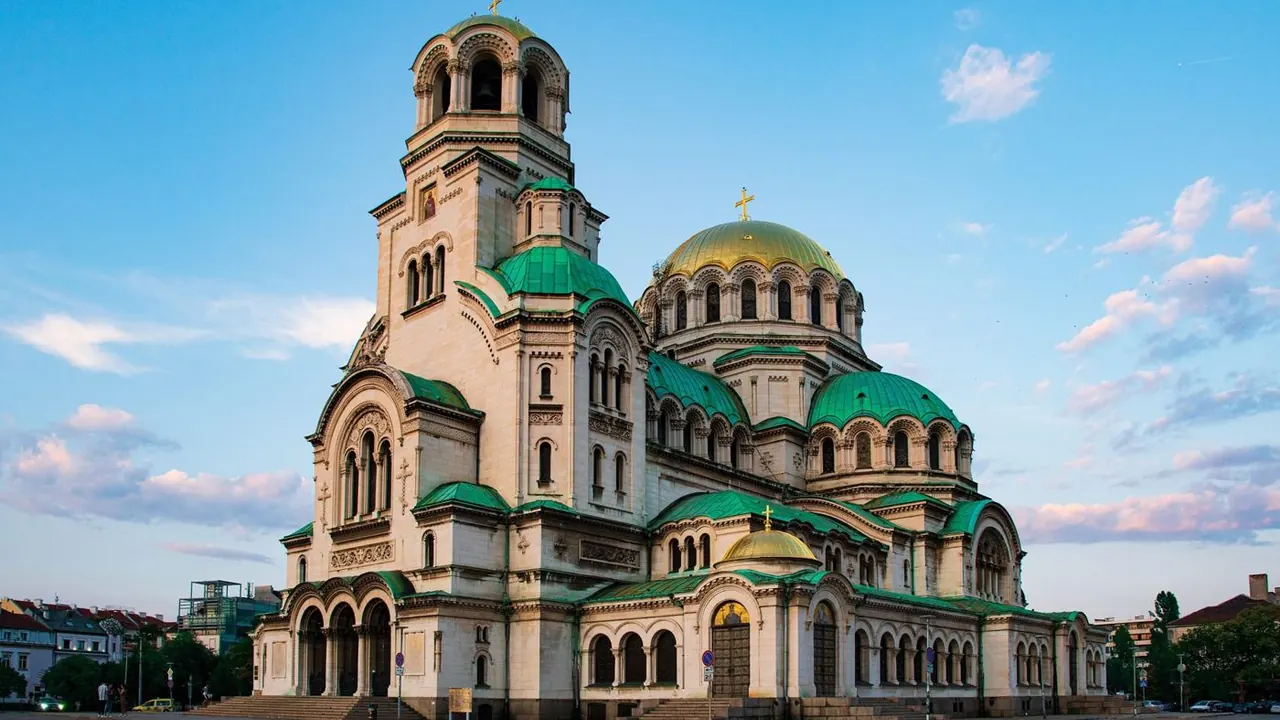
Photos: Mostar by Alan Wang, Pexels License; Sofia by Jose Ligero Loarte, CC BY-SA 4.0, cropped.
Mostar or Sofia?
Our verdict in twelve categories, each scored against the same fixed benchmark cities, and the climate month by month, so you can choose for your trip.
Choose Mostar for
- beaches
Mostar suits a short, slow stay built around one great sight. The Ottoman bridge, the bazaar lane and the old stone houses fill a day or two, and the evenings are for terraces above the green river. Hot summers bring swimming beneath the Kravica falls, and the villages of Herzegovina are close by. Go for atmosphere, cheap guesthouses and Bosnian coffee rather than a full programme.
Choose Sofia for
- live music and the arts
- nightlife
- wellness
Sofia is the better pick for a longer or fuller trip. As a capital it has more history to explore, a proper opera and concert season, a real bar quarter and mineral springs. Above all it has Vitosha, a mountain you can reach by city bus, with the Rila range and Plovdiv within a day's reach. A metro from the airport makes all of this easy to manage without a car.
Scoreboard
Twelve categories on one fixed scale from 0 to 100. The shaded stretch is the gap between the two.
Your match
Pick a travel style or drag the sliders, and both match scores follow your weighting.
Wins on beaches with your weighting.
Wins on live music and the arts and nightlife with your weighting.
What matters to you?
Category by category
What the scores mean for a trip.
Beaches & swimming
Neither city is a beach destination, but Mostar is closer to a good swim. Locals jump from the rocks into the cold Neretva below the old town, the pool beneath the Kravica falls makes a proper summer outing, and Neum and the Makarska Riviera bring the Adriatic within a day trip.
Sofia's options stay inside the city limits: outdoor pools in the parks and the lake at Pancharevo. The Black Sea is far enough away that it means a separate leg of the trip rather than a day out.
Food & drink
The two cities eat in much the same broad way, grilled minced meat and pastry, but with different accents. Mostar's Ottoman-tinged cooking means ćevapi in soft somun, burek and slow-cooked stuffed vegetables, followed by coffee from a copper džezva. It is best eaten a few lanes back from the bridge terraces, with a glass of Herzegovinian Žilavka or Blatina.
Sofia has a little more range. Banitsa from corner bakeries makes breakfast, mehana taverns serve clay-pot dishes, sometimes with folk music, and small bistros near Vitosha Boulevard give the food a lighter touch. Wine bars pour Mavrud and Melnik. Neither city goes far beyond its regional kitchen.
Culture & sights
Sofia gives a visitor more to see, and for longer. Roman Serdica lies open around the metro station, the Rotunda of St George, a mosque and a cathedral stand within minutes of each other, and the gold domes of Alexander Nevsky crown the centre. Add the UNESCO-listed frescoes at Boyana and the Thracian treasures in the National Museum of History, and two or three days are easily filled.
Mostar's appeal is narrower and more concentrated. The rebuilt Stari Most, with divers leaping from its arch, is the image everyone comes for, and the Kujundžiluk, the Koski Mehmed Pasha minaret and the Ottoman houses around it make a beautiful whole. The war-scarred old front line adds weight, but the set is covered in a day or two.
Nightlife
Sofia is clearly the place for a night out. Around Shishman and Tsar Ivan Asen streets there are cocktail bars, craft beer pubs and wine bars, students fill the cellar bars under old buildings, and a few electronic clubs keep going late. It is relaxed rather than wild, but there is enough for several evenings.
Mostar's evenings mostly end with dinner and a drink facing the lit bridge. Once the day visitors leave, the old town goes quiet, and only a few cocktail bars and student clubs carry on at weekends.
Nature & outdoors
Sofia has the stronger outdoors offer, mainly because Vitosha rises right behind it. City buses and a gondola reach spruce forest, boulder rivers and the trail to Cherni Vrah. The Seven Rila Lakes and proper skiing at Borovets are within reach, and summers are mild enough for hiking.
Mostar's landscape is harsher karst, ringed by Velež and the wild Prenj massif. The Neretva canyons upstream are its real strength, with rafting and kayaking, and the Blagaj spring, Blidinje plateau and the birdlife of Hutovo Blato are all nearby. The valley heat pushes walking into spring and autumn.
Day trips
Both cities have plenty within a day's reach, but the outings are of different kinds. From Mostar they are small places close together: the dervish tekke at Blagaj, the walled hill village of Počitelj, the stećci tombstones at Stolac, plus Konjic and Jablanica along the Neretva. Most need a car or a tour. Sarajevo, about two hours away by train through the gorge, is the one big city you can visit.
Sofia has two major trips rather than a cluster. Rila Monastery sits in its mountain valley, and Plovdiv, with its Roman theatre and painted merchant houses, is about two hours by train. Koprivshtitsa and the Iskar Gorge make gentler alternatives.
Good for families
Sofia is a little easier with children over several days. Borisova Gradina and South Park have playgrounds and space to run, the gondola and forest trails on Vitosha make a good family day, and there is a hands-on science centre for a rainy one.
Mostar works for a short stop. The bridge divers and the minaret climb hold attention for an afternoon, and a swim at Kravica is the highlight. Steep, slippery lanes and the summer heat in the valley are harder on small children than Sofia's cracked pavements.
Getting around
On foot, both centres are easy, but beyond them Sofia is much simpler. Its metro runs from the airport through the centre to the station and the foothills of Vitosha, and trams, trolleybuses and plentiful taxis cover the rest. The main drawback is that signs away from the centre are mostly in Cyrillic.
In Mostar, the old town and the Austro-Hungarian streets are a short stroll apart on slippery cobbles. Getting to Blagaj, Počitelj or Kravica, though, means a hired car, a taxi or a tour, because the city buses are run for residents.
Shopping & style
Neither city is a shopping destination, and what each sells is quite different. Mostar's shopping is a single bazaar street, the Kujundžiluk, where the find is a coppersmith hammering a coffee set in his doorway among the imported souvenirs.
Sofia covers more ground. There are chain stores on Vitosha Boulevard and in the malls, rose oil and Troyan pottery in the craft shops, and a flea market of icons and curiosities near Alexander Nevsky.
Affordability
Both are among the cheapest trips in Europe, and the savings show up in different places. In Mostar it is family guesthouses and plates of ćevapi that cost little, and the bridge-view terraces and old-town rooms in midsummer are where prices rise. In Sofia, comfortable central hotels, low museum admissions and cheap metro rides stretch a budget, and even the smarter bistros stay moderate.
Live music & performing arts
Sofia has a real performance calendar, and Mostar has very little. The National Opera and Ballet performs through most of the year, the Sofia Philharmonic plays at Bulgaria Hall, and Orthodox and choral singing is something worth hearing nowhere else. Mostar has a national theatre and a youth theatre playing in local languages, plus open-air summer concerts, but most evenings offer nothing more than a band in a café bar.
Wellness & relaxation
Sofia has the stronger wellness side. Its mineral springs flow from public taps beside the old Central Mineral Baths, and there are pools on the edge of the city. The spa town of Bankya is about half an hour away, with larger resorts such as Velingrad further out.
Mostar's hammam near the bridge is a monument, not a working bath, and spa treatments are limited to a few hotels. What it offers instead is stillness, early and late in the day, when the old town empties and you hear only the river.
When should you go?
Pick your month. The climate figures are measured averages, not a forecast.
Mostar in July
Sofia in July
Daytime high, °C
Rainfall in the month, mm
Temperature and rainfall are climate normals, averaged over the years shown. Mostar: 1991-2020 normals, Mostar (0.9 km from centre). Sofia: 1991-2020 normals, Sofia Observ. (7.3 km from centre).
Mostar runs hotter and much wetter than Sofia. May and June are its most comfortable months: warm enough for a swim at Kravica, fairly dry and with long sunny days. July and August are the sunniest and driest of all, but highs of 33°C in the valley make the old town's cobbles hard going at midday. From September it stays warm but turns wet, and the rain keeps building through the mild winter to about 198mm in December.
Sofia sits higher and stays milder in summer, peaking around 28°C, so July and August suit both city walks and mountain hikes. Its winters are far colder, with January highs of 4°C and snow on the mountains. Rain stays moderate all year, but late spring and early summer are its wettest stretch, with May and June getting about twice the rain of midwinter. September is drier again, which makes it a good month in Sofia just as Mostar turns damp. For the most heat and sun, go to Mostar in July and August. For summer walking without the fierce heat, Sofia is the easier choice.
Which traveller are you?
On a beach and sun trip, Mostar is the better of the two. Its summers are hotter, the Kravica waterfall pool is about 40km away, and the Adriatic at Neum is a little over an hour's drive. From Sofia, the Black Sea needs a separate stay.
For a culture and arts trip, Sofia offers much more. There is Roman Serdica, the frescoes of Boyana and the Thracian gold for the days, and the National Opera and Ballet or the Philharmonic for the evenings. Mostar's bridge is memorable, but its stages are mostly quiet.
On a relaxing and wellness trip, choose Sofia. Warm mineral springs run through the city, and the spa town of Bankya is about half an hour away. Mostar has no working bathhouse, so rest there means long coffees and quiet evenings by the river.
Before you go
| Measure | Mostar | Sofia |
|---|---|---|
| Official language | Croatian, Serbian, Bosnian | Bulgarian |
| Currency | Convertible Mark (BAM) | Euro (EUR) |
| Sockets | CF230 V, 50 Hz | CF230 V, 50 Hz |
| Driving side | Right | Right |
| Time zone | UTC+1, UTC+2 in summer | UTC+2, UTC+3 in summer |
| Emergency number | 112 | 112 |
| Elevation | 60 m | 560 m |
| Main airport | Sarajevo International Airport (SJJ)68 km from centre38 non-stop destinations | Sofia Airport (SOF)8 km from centre97 non-stop destinations |
| Public holidays this year | 8 days | 15 days |
By the numbers
| Measure | Mostar | Sofia |
|---|---|---|
| City population | 105,448 | 1,213,134 |
| People per km² | 90 | 2,466 |
| Museums within 10 km | 3 | 42 |
| UNESCO World Heritage sites within 50 km | 1 | 1 |
Where else could you go?
Every comparison below shares a destination with this one, so you can follow Mostar or Sofia somewhere new.