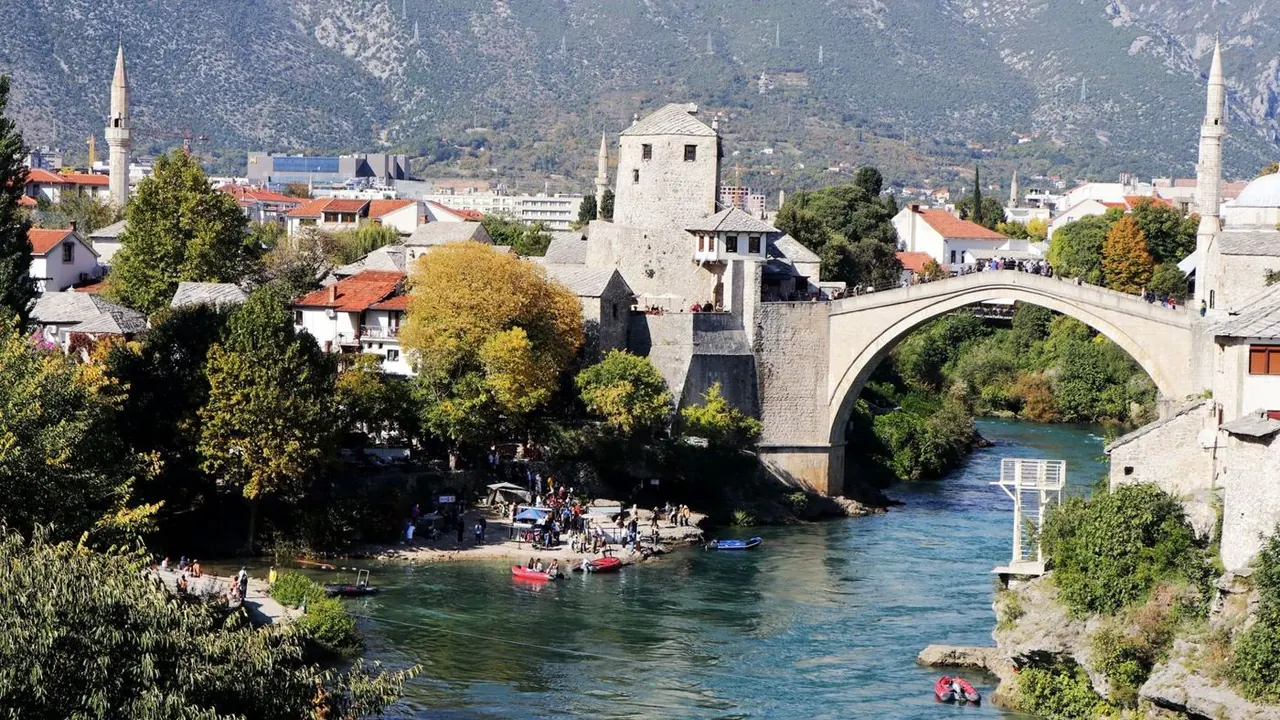
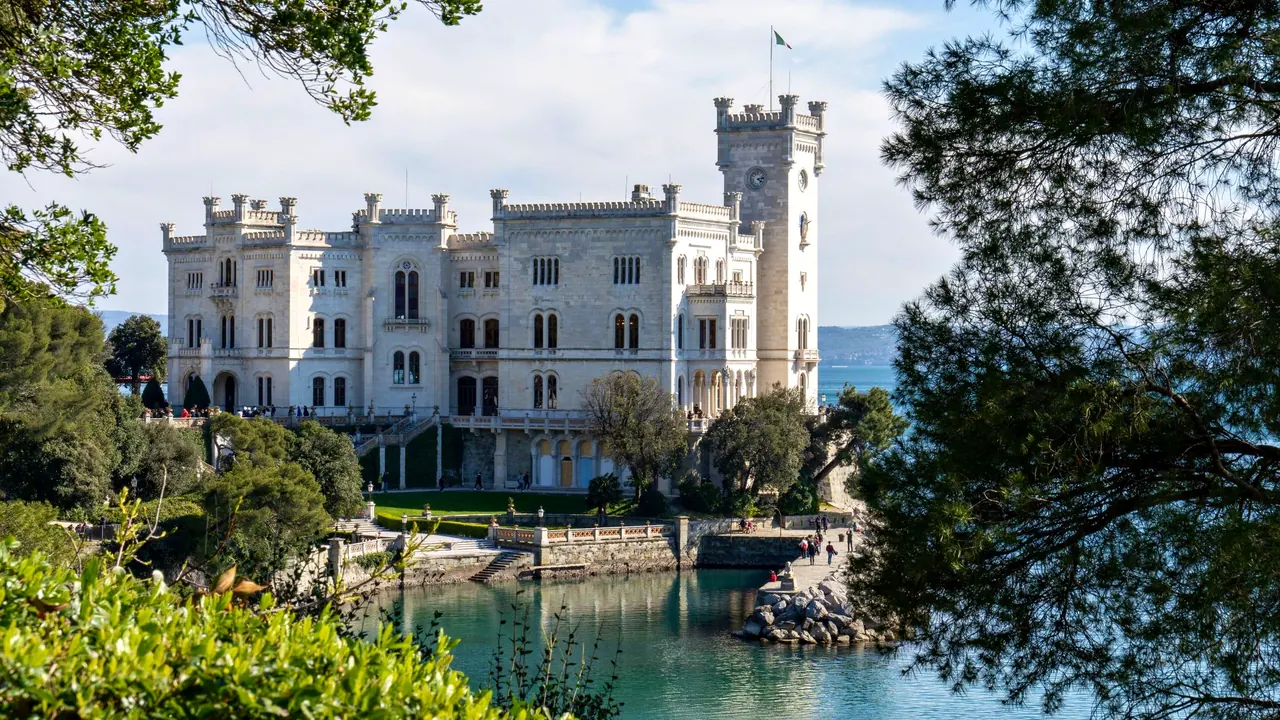
Photos: Mostar by Alan Wang, Pexels License; Trieste by Tibor Szabo, Pexels License.
Mostar or Trieste?
Our verdict in twelve categories, each scored against the same fixed benchmark cities, and the climate month by month, so you can choose for your trip.
Choose Mostar for
- prices
Mostar suits a traveller who wants one powerful sight and a cheap, slow stay around it. The Ottoman bridge over the emerald Neretva, the bazaar lanes and the war-marked streets make a compact, moving stop of a day or two. Add the karst mountains, rafting canyons and small valley villages, and it works best as a low-cost leg of a wider Balkan journey with a car.
Choose Trieste for
- beaches
- live music and the arts
- getting around
Trieste is the more complete base for a week. It has the Adriatic on its doorstep for swimming, a grand Habsburg centre that is easy to walk, opera at the Teatro Verdi, and a coffee and buffet culture of its own. Day trips run into three countries by train and bus. You pay more for it, but there is far more to fill the days, especially in summer and for families.
Scoreboard
Twelve categories on one fixed scale from 0 to 100. The shaded stretch is the gap between the two.
Your match
Pick a travel style or drag the sliders, and both match scores follow your weighting.
Wins on prices with your weighting.
Wins on beaches and live music and the arts with your weighting.
What matters to you?
Category by category
What the scores mean for a trip.
Beaches & swimming
Mostar has no beach. A swim there means a cold plunge into the Neretva below the old town, or the pool beneath the Kravica waterfalls about 40km south. The real sea at Neum or the Makarska Riviera is a day trip.
Trieste has no sand either, but the sea is part of daily life. Locals climb down ladders from Barcola's concrete platforms into clear water, use the old bathing establishments in town, and head to the pebble coves at Sistiana, Duino and Grignano. If you are happy swimming off rocks, it gives you a summer by the sea that Mostar cannot.
Food & drink
Mostar's cooking is tasty but narrow: charcoal-grilled ćevapi in somun bread, burek, stuffed peppers and slow-cooked stews, best eaten a few lanes away from the bridge terraces. The Herzegovina wines, Žilavka and Blatina, are the pleasant surprise.
Trieste has more to explore. There are steaming buffet counters carving boiled pork with horseradish, jota and fried sardoni, and Central European cakes. Up on the Karst, farmhouse osmize sell Vitovska and Terrano. Both cities are serious about coffee, in different ways. Mostar's is a slow ritual from a copper džezva, and Trieste's is a quick 'nero' at a standing bar or in a grand coffee house.
Culture & sights
Mostar's culture centres on one extraordinary place: Stari Most and the Ottoman quarter around it. That means the Kujundžiluk, the Koski Mehmed Pasha minaret and the Bišćević house, with the scarred old front line nearby as a reminder of 1993. It is intense but quickly seen.
Trieste has more range and more to fill the days. There are Piazza Unità facing the sea, the canal-side Borgo Teresiano with San Spiridione, the cathedral and castle on San Giusto, a Roman theatre and Miramare Castle. The Revoltella museum, the great synagogue and the Risiera di San Sabba memorial add depth.
Nightlife
Neither city is a place for a big night out. Mostar has a little less to offer. After the coach groups leave, its evenings come down to a meal on a terrace looking at the lit bridge, plus a few cocktail bars and student clubs at summer weekends.
Trieste has a stronger evening ritual in the aperitivo, with spritz and local white wine around Piazza Unità, the Canal Grande and Cavana. In summer the kiosks on the Barcola seafront stay open late into warm nights, though clubs are still few.
Nature & outdoors
Both cities sit on limestone karst, and both have good walking country close by. Trieste edges ahead because the sea and the plateau are both on its doorstep. You can walk the Strada Napoleonica above the gulf or the Rilke Path at Duino, hike Val Rosandra, visit the Grotta Gigante, or sail and snorkel off Miramare.
Mostar's surroundings are wilder and drier. The bare Prenj and Velež ranges, rafting in the Neretva canyons and the Blidinje plateau all reward an active traveller. Its summer heat means spring and autumn are the times for it.
Day trips
Mostar's outings are small and full of character: the dervish tekke at Blagaj, the hillside village of Počitelj, the stećci tombstones at Stolac, and Konjic with Tito's bunker. Most of them need a car or a tour. Sarajevo, two hours away by train through the gorge, is the only big destination.
Trieste offers far more, and it is easier to get to. Aquileia's mosaics, star-shaped Palmanova, Cividale and the Collio wine country are all about an hour away in Friuli. Piran, Ljubljana and Postojna are across the Slovenian border, and Venice is a long but realistic train ride.
Good for families
Mostar suits families only for a short stop. The bridge divers and the climb up the minaret fill an afternoon, and Kravica is the swim children remember. The slippery, steep cobbles and the summer heat in the valley make it hard going with small children.
Trieste works better for a longer stay. Children can explore the Grotta Gigante, the gardens at Miramare, the waterfront aquarium and the science centre, and spend summer days at Barcola. Its swimming from rocks and its stepped streets suit older children more than toddlers.
Getting around
In both cities the main sights are within walking distance. The difference comes when you want to go further. Mostar's buses are for residents, so Blagaj, Počitelj and Kravica mean a car, a taxi or a tour.
Trieste's flat seafront centre is backed by a dense bus network. It reaches Barcola, Miramare and the Karst, and boats cross the bay to Muggia. You need a car only for the wine villages and trips across the border. The climb to San Giusto is the one hard walk.
Shopping & style
Mostar's shopping is really one street, the Kujundžiluk, where a few coppersmiths still hammer coffee sets and plates by hand in their doorways. They work among stalls of kilims, lamps and imported souvenir stock. Beyond the bazaar there are only ordinary malls.
Trieste gives you a little more to browse, though it is just as low-key. The antique and second-hand shops in the old town lanes recall its merchant past, and Corso Italia has everyday Italian clothes and shoes. The best things to carry home are edible: roasted coffee, Karst wine and honey, and presnitz.
Affordability
Mostar is clearly the cheaper of the two. Family guesthouses, grilled meat, local wine and endless coffees all cost little. Only the terraces with a bridge view and old town rooms in midsummer cost more.
Trieste is reasonable for northern Italy. Buffet lunches, coffee at the bar and the buses are cheap, and the swimming and Karst walks are free. Its seafood restaurants and better hotels charge normal Italian prices.
Live music & performing arts
Here the two cities are far apart. Trieste's Teatro Verdi has a proper opera and ballet season, and the city's fondness for operetta, inherited from the Habsburgs, is rare in Italy. The Politeama Rossetti and a Slovenian-language theatre add more, and in summer there are concerts in the castle courtyard on San Giusto.
Mostar has a national theatre and a youth theatre, but they perform mostly in local languages. For most of the year a visitor finds little more than the odd band in a café bar.
Wellness & relaxation
Mostar offers little in the way of pampering. The Ottoman hammam by the bridge is kept as a historic building rather than a working bath, so rest here depends on timing. The old town is calmest before the day visitors arrive and after they leave, and a terrace above the green river is the place to wait for those hours.
Trieste gives a slow stay more to fill it. The city moves at an unhurried pace, its old coffee houses let you linger as long as you like, and a sunset walk out along the Molo Audace or a summer swim in the gulf makes quiet days easy to string together. Neither city has thermal baths, and in both a spa treatment usually means booking one at a hotel.
When should you go?
Pick your month. The climate figures are measured averages, not a forecast.
Mostar in July
Trieste in July
Daytime high, °C
Rainfall in the month, mm
Temperature and rainfall are climate normals, averaged over the years shown. Mostar: 1991-2020 normals, Mostar (0.9 km from centre). Trieste: 1991-2020 normals, Trieste (1.6 km from centre).
Mostar sits in a hot inland basin, and its summers are fierce. July and August reach around 33°C, which is hard work on the old town's stone lanes. Trieste stays a few degrees cooler and has the sea to cool off in. The Adriatic there is warm enough to swim from June to September and peaks around 25°C in midsummer. Both cities get plenty of sunshine from May to August.
The big difference comes in the cooler half of the year. Mostar turns very wet from September, and the rain builds to almost 200mm in December. Trieste's autumn is damp too, but its winters are much drier, though the cold Bora wind can make them raw. Visit Mostar in May or late September and early October, when walking is comfortable before or after the heat. Trieste is at its best from June to September for swimming, with May and early autumn good for walking the Karst.
Which traveller are you?
On a trip on a tight budget, Mostar is the better choice. Guesthouses, ćevapi and local wine cost little, and you can walk the old town and the bridge for free. Trieste is fairly priced for Italy, but it is not cheap.
For a beach and sun trip, Trieste wins easily. You can swim off the Barcola promenade and the coves at Sistiana and Duino all summer. Mostar is inland, the Neretva stays cold, and the sea means a day out of more than an hour.
On a culture and arts trip, Trieste offers more depth. It has Habsburg squares, Miramare Castle, San Giusto's mosaics and a real opera and ballet season. Mostar's Old Bridge and Ottoman houses are moving, but you will see them in a day or two, and there is little on stage.
Before you go
| Measure | Mostar | Trieste |
|---|---|---|
| Official language | Croatian, Serbian, Bosnian | Italian |
| Currency | Convertible Mark (BAM) | Euro (EUR) |
| Sockets | CF230 V, 50 Hz | CFL230 V, 50 Hz |
| Driving side | Right | Right |
| Time zone | UTC+1, UTC+2 in summer | UTC+1, UTC+2 in summer |
| Emergency number | 112 | 112 |
| Elevation | 60 m | 2 m |
| Main airport | Sarajevo International Airport (SJJ)68 km from centre38 non-stop destinations | Trieste Airport (TRS)31 km from centre32 non-stop destinations |
| Public holidays this year | 8 days | 13 days |
By the numbers
| Measure | Mostar | Trieste |
|---|---|---|
| City population | 105,448 | 198,417 |
| People per km² | 90 | 2,332 |
| Museums within 10 km | 3 | 33 |
| UNESCO World Heritage sites within 50 km | 1 | 5 |
| Swim season, months above 21 °C | - | 4 months |
Where else could you go?
Every comparison below shares a destination with this one, so you can follow Mostar or Trieste somewhere new.