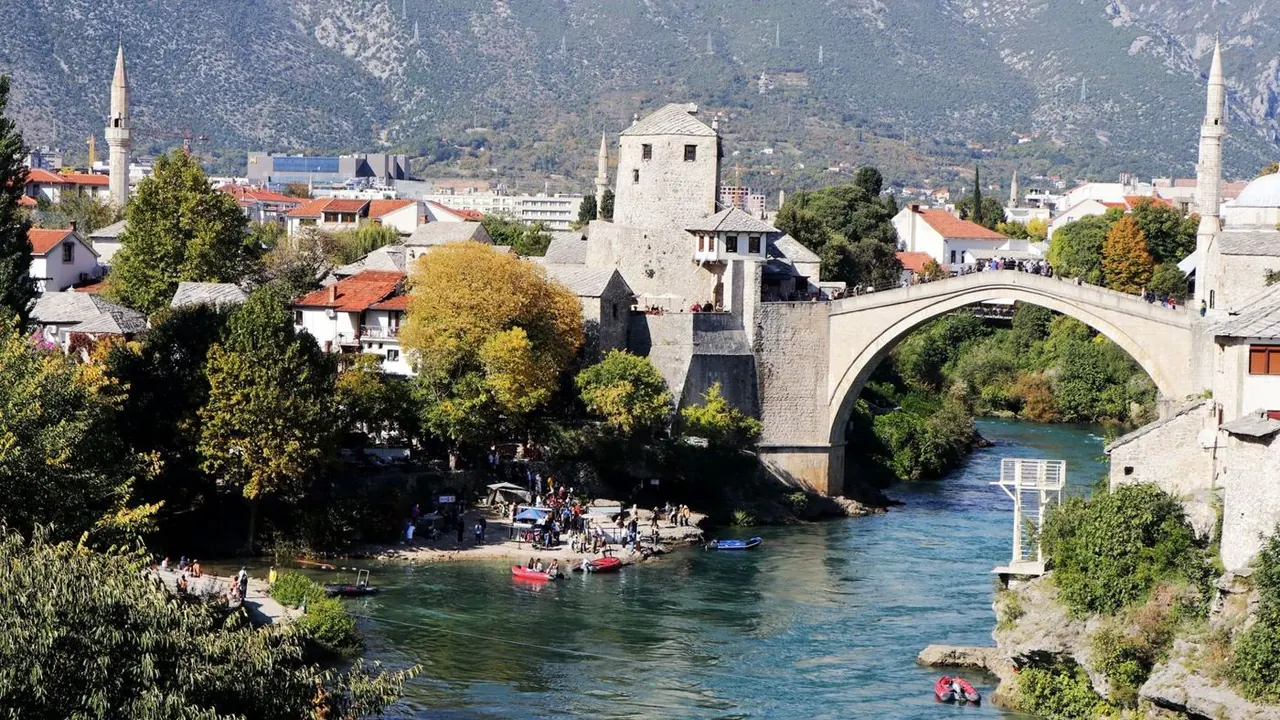
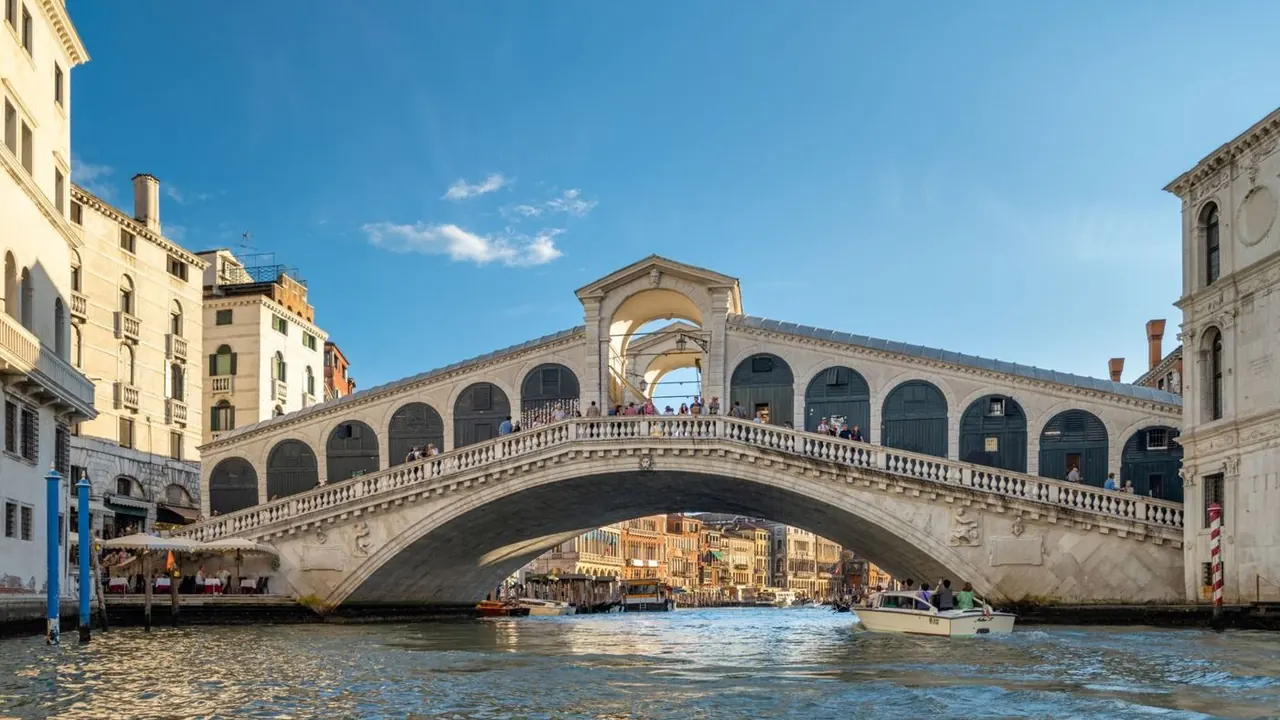
Photos: Mostar by Alan Wang, Pexels License; Venice by David Vives, Pexels License.
Mostar or Venice?
Our verdict in twelve categories, each scored against the same fixed benchmark cities, and the climate month by month, so you can choose for your trip.
Choose Mostar for
- prices
- nature and the outdoors
Mostar suits travellers who want a short, inexpensive stop with a single great landmark and real mountain country around it. The Old Bridge and its Ottoman quarter take a day or two, and then the attraction is the outdoors: rafting in the Neretva canyons, the Buna spring at Blagaj and walks in the limestone ranges. It works best as part of a Balkan road trip, especially for anyone who has a car and is watching their spending.
Choose Venice for
- live music and the arts
- culture and sights
- beaches
Venice is the choice for anyone who wants depth. There are centuries of art and architecture on water, opera at La Fenice and an easy train to Padua or Verona, and a week there never feels repetitive. You pay heavily for it and give up any real nightlife, but if you have come for painting, churches, music and the lagoon islands, nothing in Mostar compares.
Scoreboard
Twelve categories on one fixed scale from 0 to 100. The shaded stretch is the gap between the two.
Your match
Pick a travel style or drag the sliders, and both match scores follow your weighting.
Wins on prices and nature and the outdoors with your weighting.
Wins on live music and the arts and culture and sights with your weighting.
What matters to you?
Category by category
What the scores mean for a trip.
Beaches & swimming
Neither is a beach destination, but Venice has sand on its doorstep and Mostar has none. In Venice, a short vaporetto ride takes you to the Lido's long Adriatic shore, where the water is shallow and warm in summer. Pellestrina is quieter if you want more space.
In Mostar, swimming means a cold plunge into the Neretva or a trip to the pool under the Kravica waterfalls, about 40km away. The sea at Neum is more than an hour's drive, which makes it a day trip rather than something to fit into an afternoon.
Food & drink
Venice has more variety and a clearer local style. You can stand at a bacaro counter in Cannaregio with cicchetti and a spritz, or sit down to cuttlefish risotto made with fish from the Rialto market. The trap is the many tourist menus around San Marco.
Mostar's cooking is simpler and heartier: charcoal-grilled ćevapi, burek and stuffed peppers, with Žilavka and Blatina wines from the surrounding valleys and Bosnian coffee served slowly. You get honest food, but not much beyond it.
Culture & sights
This is where the gap between the two cities is widest. Venice is a whole city of palaces and churches with no cars, and its art fills the Accademia, the Frari, the Scuola Grande di San Rocco and the modern collections at the Guggenheim and Punta della Dogana. It rewards a week.
Mostar has one world-famous sight, the rebuilt Ottoman bridge with divers leaping from its crown, plus the Kujundžiluk, a mosque minaret you can climb and old merchant houses. The war-scarred façades along the former front line add a weight Venice does not have, but the whole set fits into a day or two.
Nightlife
Both cities go quiet early, and neither is worth choosing for nights out. Venice's high point is the early-evening aperitivo at the bacari on the Fondamenta della Misericordia, with student bars around Campo Santa Margherita lasting later. In Mostar the evening means dinner on a terrace facing the lit bridge, with a few cocktail bars and student clubs busy at summer weekends.
Nature & outdoors
Mostar is set in much wilder country. Bare limestone ranges rise right around the karst basin, the Neretva canyons offer rafting, and Blidinje and the Hutovo Blato wetland are within easy reach. The catch is the summer heat, which pushes serious walking into spring and autumn.
Venice's outdoors is gentler and mostly on water: kayaking or rowing through the salt marshes near Torcello, where herons and flamingos feed, and cycling along the Pellestrina sea walls. Real mountains are a long way off.
Day trips
Venice has the richer list and makes it easier. Fast trains reach Padua, Vicenza and Verona, and Murano, Burano and Torcello are just a boat ride across the lagoon, so you don't need a car.
Mostar's outings are smaller but full of character: the dervish tekke at Blagaj, the hillside village of Počitelj and the medieval tombstones at Stolac. Most need a car or a tour. Sarajevo, about two hours away by train through the Neretva gorge, is the one big city in reach.
Good for families
Venice works a little better with children. Riding the vaporetto, watching glass-blowing on Murano and paddling at the Lido all appeal, and there are no cars to worry about. The many stepped bridges, though, defeat pushchairs.
Mostar is fine for a short stop, with the bridge divers and the Kravica falls as the highlights. But its steep, polished lanes and fierce summer heat are hard on small children, and there is little else built for them.
Getting around
Both historic centres are best on foot, but Venice adds a transport network that Mostar lacks. Vaporetti cover the Grand Canal and the islands, and trains and buses arrive at the edge of the centre. The bridges and crowded boats are tiring.
In Mostar, the old town and the Austro-Hungarian quarter are a short stroll apart. Getting to Blagaj, Počitelj or Kravica, though, means a car, taxi or tour, because the local buses are not run with visitors in mind.
Shopping & style
Mostar's shopping comes down to one street, the Kujundžiluk. A few coppersmiths there still hammer coffee sets and plates by hand, among stalls of kilims, lamps and imported souvenirs. Beyond it there is little fashion or design.
The Venetian crafts run much deeper, and much of what is sold is made in the city: Murano glass, Burano lace, papier-mâché masks, marbled paper and furlane slippers from workshops in Dorsoduro and Castello. The big fashion labels line the Mercerie. Venice's main routes share Mostar's problem of imported stock sold as local, so in both cities it pays to buy from someone you can see working.
Affordability
Mostar costs a fraction of Venice. Family guesthouses, grilled meat and local wine are cheap, and only the rooms and terraces closest to the bridge charge more in summer.
Venice is costly at almost every turn: hotels in the centre, water transport, church entry fees and a seat in a café on the piazza. Staying in Mestre and eating standing at a bar counter helps, but only so far.
Live music & performing arts
In Mostar, an evening at the theatre is hard to enjoy unless you speak the language, because both the national theatre and the youth theatre play mainly in local languages. Summer brings concerts out into the open air. For the rest of the year, music after dinner usually means a band playing in a café bar.
Venice has the opposite problem: there is more on most nights than you can fit in, and much of it needs no translation. Opera, ballet and orchestral evenings run through the year at the city's great opera house and at the smaller Malibran. Most evenings a church or scuola grande also hosts a baroque concert, usually Vivaldi in his home city, though the quality varies. Only the drama at the Goldoni needs Italian, and there is little for anyone who wants jazz or rock.
Wellness & relaxation
Neither city has its own bathing tradition, but Venice has more to offer. There are hotel spas in palazzi and on the Lido and Giudecca, and the thermal pools of Abano Terme are about an hour away.
Mostar's hammam is a monument rather than a working bath, so relaxing there means long coffees in the shade and the quiet old town once the day visitors have gone.
When should you go?
Pick your month. The climate figures are measured averages, not a forecast.
Mostar in July
Venice in July
Daytime high, °C
Rainfall in the month, mm
Where the figures come from
Venice has no rain gauge within 25 km of the centre, so its rainfall comes from a gridded climate dataset read at the city rather than from a gauge further away.
Venice's sunshine is measured 26 km from the centre, at Treviso / S. Angelo.
Temperature and rainfall are climate normals, averaged over the years shown. Mostar: 1991-2020 normals, Mostar (0.9 km from centre). Venice: 1991-2020 normals, Venezia / Tessera (6.7 km from centre).
Mostar is at its most comfortable in May and early June, when the days are warm and sunny but the basin has not yet begun to bake. In July and August it reaches about 33°C under almost constant sun, which makes midday sightseeing hard work. With no sea of its own, summer swimming means the Kravica falls or a drive to the coast. September is pleasant for walking again, but the autumn rains are already arriving, and from October to December the city is very wet, with close to 200mm in each of the last two months.
Venice follows a similar but milder curve, and May and June are its easiest months too. In July and August highs of around 30°C come with humidity, while the sea warms to about 25°C, enough for an afternoon on the Lido sand. October is Venice's wettest month, though still less wet than Mostar's autumn. Its winters are cold but much drier, so a crisp January walk along the canals is more realistic there than a winter stroll over Mostar's slippery cobbles.
Which traveller are you?
On a trip on a tight budget, Mostar is the clear choice. Guesthouses, ćevapi and local wine cost little, and a few streets back from the bridge prices fall further. Venice is one of Italy's most expensive stays, even if you live on cicchetti.
For a culture and arts trip, choose Venice. Titian, Tintoretto and the Accademia, the Biennale, and opera and ballet at La Fenice fill a week. Mostar's Ottoman bridge and houses are absorbing but are covered in a day or two.
On an outdoors trip, Mostar wins. It has rafting and kayaking in the Neretva canyons, rugged hiking in the Prenj and Velež mountains, and the Blidinje plateau within reach. Venice's lagoon has birdlife and rowing, but the land is flat and the Dolomites are far away.
Before you go
| Measure | Mostar | Venice |
|---|---|---|
| Official language | Croatian, Serbian, Bosnian | Italian |
| Currency | Convertible Mark (BAM) | Euro (EUR) |
| Sockets | CF230 V, 50 Hz | CFL230 V, 50 Hz |
| Driving side | Right | Right |
| Time zone | UTC+1, UTC+2 in summer | UTC+1, UTC+2 in summer |
| Emergency number | 112 | 112 |
| Elevation | 60 m | 2 m |
| Main airport | Sarajevo International Airport (SJJ)68 km from centre38 non-stop destinations | Venice Marco Polo Airport (VCE)7 km from centre103 non-stop destinations |
| Public holidays this year | 8 days | 13 days |
By the numbers
| Measure | Mostar | Venice |
|---|---|---|
| City population | 105,448 | 250,369 |
| People per km² | 90 | 602 |
| Museums within 10 km | 3 | 52 |
| UNESCO World Heritage sites within 50 km | 1 | 5 |
| Swim season, months above 21 °C | - | 4 months |
Where else could you go?
Every comparison below shares a destination with this one, so you can follow Mostar or Venice somewhere new.