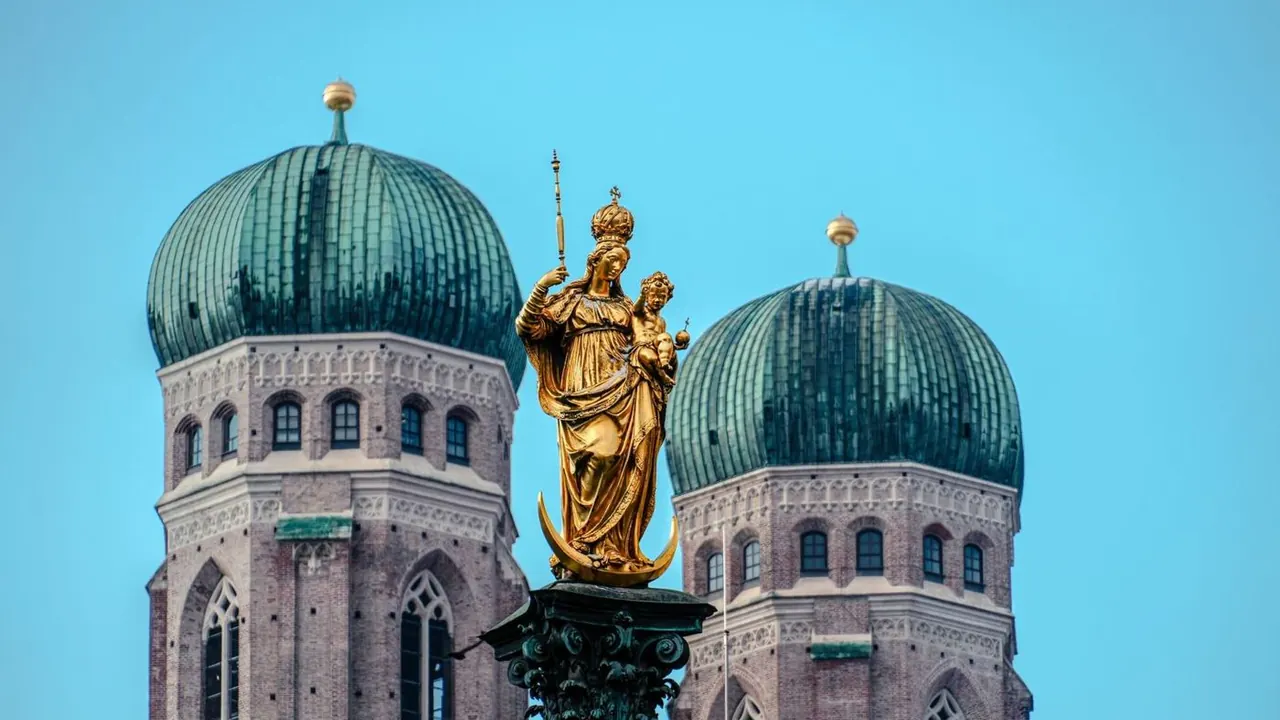
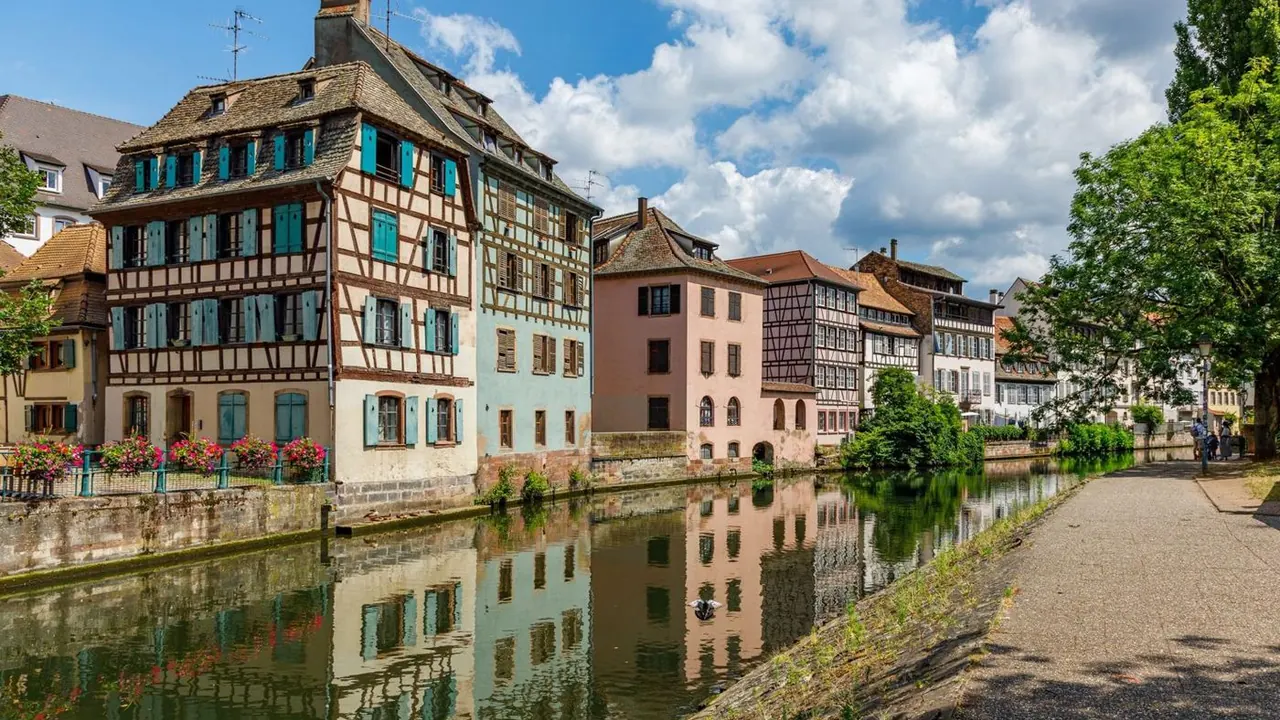
Photos: Munich by 0xd1ma, Pexels License; Strasbourg by Edoardo Colombo, Pexels License.
Munich or Strasbourg?
Our verdict in twelve categories, each scored against the same fixed benchmark cities, and the climate month by month, so you can choose for your trip.
Choose Munich for
- live music and the arts
- nature and the outdoors
- shopping
Munich is the pick for a fuller, longer trip. It has the bigger museums and palaces, a world-class opera house and orchestras, the Alps within an hour by train, and enough day trips to Salzburg, Nuremberg and the royal castles to fill a second week. Families and walkers get more from it too, as long as the budget can take its hotels.
Choose Strasbourg for
- prices
- food and drink
For a slower, more compact stay, Strasbourg makes more sense. The cathedral, Petite France and the Grande Ile can be seen in a few unhurried days on foot or by bike. Evenings are spent in winstubs over a pichet of Riesling, and the Alsace wine villages lie just to the south. It costs less than Munich and suits travellers who would rather have charm and long lunches than a packed programme.
Scoreboard
Twelve categories on one fixed scale from 0 to 100. The shaded stretch is the gap between the two.
Your match
Pick a travel style or drag the sliders, and both match scores follow your weighting.
Wins on live music and the arts and nature and the outdoors with your weighting.
Wins on prices and food and drink with your weighting.
What matters to you?
Category by category
What the scores mean for a trip.
Beaches & swimming
Neither city has a coast, but Munich makes better use of summer water. The gravel banks of the Isar at the Flaucher give it a river beach in town, and the Starnberger See and Ammersee, under an hour away by S-Bahn, are proper alpine lakes with jetties and lawns.
Strasbourg's swimming is in old gravel pits such as the Baggersee, which you can reach by tram and which has lifeguards in July and August. These are fine for a hot afternoon, but the Rhine is unsafe for swimming and there is no lake country to match Bavaria's.
Food & drink
Both cities serve rich, filling food in large portions, and what you drink sets the tone. Munich eats around beer: brewery halls, beer gardens under chestnut trees, roast pork, white sausage before noon, and the Viktualienmarkt for snacks.
Strasbourg sits between French and German cooking, and its natural setting is the winstub, where choucroute, baeckeoffe or tarte flambée come with a pichet of local white wine. Foie gras and a strong fine-dining tier give it a more French finish, though the tourist menus around the cathedral are best avoided. Neither city goes far beyond its own regional cooking.
Culture & sights
Munich has the deeper collections. The Alte Pinakothek and the rest of the Kunstareal, the Residenz, Nymphenburg and the Deutsches Museum could fill a week, though much of the old town was rebuilt after wartime bombing.
Strasbourg's strength is its setting. The cathedral with its astronomical clock, the timber-framed Grande Ile and Petite France make up one UNESCO-listed ensemble, and the Palais Rohan museums complete it. Still, the main sights fit into two or three unhurried days.
Nightlife
Munich gives you a fuller evening out. Many people spend the whole night in a beer hall, the area around Gärtnerplatz has cocktail and gay bars, and a few serious techno clubs stay open until morning at weekends. From late September, Oktoberfest takes over the city.
Strasbourg is a student bar town, centred on Krutenau and Place Saint-Étienne, with summer terraces along the quays. It has few clubs, and evenings are pleasant rather than late.
Nature & outdoors
Munich has the Alps on its skyline, and trains take you to them in about an hour: Garmisch, the Zugspitze and Tegernsee, with alpine hiking in summer and skiing in winter. In the city, the English Garden and the surfers on the Eisbach give you a lot of green without leaving town.
Strasbourg's outdoors is gentler. There is level cycling along the Rhine, there are storks in the riverside forests, and the Vosges and the Black Forest are within an hour for forest walks and castle ruins. A car makes those hills much easier to reach.
Day trips
Both cities make excellent bases, and Munich's range is wider and runs almost entirely by train. Salzburg and Innsbruck lie across the border, Augsburg, Nuremberg and Regensburg are close, and the royal castles of Neuschwanstein and Herrenchiemsee are the classic excursions.
From Strasbourg the days out are about wine and small towns: Colmar half an hour away, then wine-route villages such as Riquewihr and Eguisheim, and Baden-Baden, Freiburg and Basel across the borders. A car or a bike makes the vineyard days easier.
Good for families
Munich has more for children within the city. There is the Tierpark Hellabrunn along the Isar, the hands-on Deutsches Museum, the transport museum, and beer gardens with playgrounds attached, while the lake beaches make easy summer days.
Strasbourg is just as easy with a pushchair, with boat trips around Petite France, storks and rowing boats in the Orangerie, and the Le Vaisseau science centre. Its biggest family draw, Europa-Park, is an hour away across the border.
Getting around
Both cities have compact, largely pedestrianised centres. Munich's integrated U-Bahn, S-Bahn, tram and bus network reaches further, out to Nymphenburg, the Olympic Park, the airport and the lakes, and delays on the central S-Bahn are the only real annoyance.
Strasbourg gets by on trams and bikes. You can walk across the old town island in twenty minutes, and its separated cycle lanes are among the best in France. It falls behind once you head for the wine villages, where a car becomes useful.
Shopping & style
Munich is the stronger shopping city. Luxury houses line Maximilianstrasse, department stores fill Kaufingerstrasse, and Glockenbach and Schwabing have independent boutiques. Its signature buy is Tracht, the dirndls and lederhosen made by specialist tailors.
Strasbourg is better for regional things to take home: Alsace wine, Soufflenheim pottery, printed linens and kougelhopf moulds. There is little fashion or luxury, and the Christmas market stalls are partly mass-produced.
Affordability
Strasbourg is easier on the wallet. Prices are what you would expect in a French regional city, winstub meals and wine by the pichet are fair, and the cathedral and old town cost nothing to enjoy.
Munich is Germany's most expensive city, and its hotels are dear all year. Picnics in beer gardens, free parks and lakes and token Sunday museum entry help to offset that. Both cities' hotels get much dearer at peak times: Oktoberfest and trade fairs in Munich, the Christmas market and parliament sessions in Strasbourg.
Live music & performing arts
In performing arts, Munich is in a different league. It has the Bavarian State Opera in the National Theatre, three orchestras of real standing, chamber opera in the rococo Cuvilliés Theatre and a long-running summer opera festival, as well as jazz clubs and big touring acts at the Olympic Park.
Strasbourg does well for its size, with the Opéra national du Rhin, the Philharmonic and the Théâtre National de Strasbourg, and it stands out for contemporary music during the autumn Musica festival. It simply has much less on any given night.
Wellness & relaxation
Each city has a historic public bathhouse: Munich's Art Nouveau Müller'sches Volksbad and Strasbourg's tiled Bains municipaux. Munich adds the huge thermal complex at Erding, about forty minutes away, and the spa towns of Bad Tölz and Bad Reichenhall, and its beer gardens and the lawns of the English Garden are made for idling.
Strasbourg's best spa trip is across the Rhine to the Friedrichsbad and Caracalla baths in Baden-Baden, under an hour away. Its canal-side walks are calm for most of the year, but the December crowds make the centre anything but restful.
When should you go?
Pick your month. The climate figures are measured averages, not a forecast.
Munich in July
Strasbourg in July
Daytime high, °C
Rainfall in the month, mm
Temperature and rainfall are climate normals, averaged over the years shown. Munich: 1991-2020 normals, München (1.9 km from centre). Strasbourg: 1991-2020 normals, Strasbourg (9.1 km from centre).
The two cities share a central European climate, with warm summers and cold winters, and Strasbourg runs a degree or so warmer for most of the year. July and August are the warmest months, around 25°C in Munich and 26°C in Strasbourg, and the lakes are warm enough for swimming from June to early September. Munich's summer is also its wettest season, with about 121mm of rain in June. Strasbourg stays drier all year, and its wettest month is May at 77mm.
For walking the streets, May, June and September suit both cities best, as they are warm without being hot. Late autumn and winter are cold in both, and Strasbourg's are the gloomier, with only about two-thirds of the December sunshine Munich gets.
Which traveller are you?
For a culture and arts trip, Munich is the stronger choice. Days in the Alte Pinakothek, the Residenz and the Deutsches Museum can end at the Bavarian State Opera or with one of three leading orchestras. Strasbourg's calendar is good but smaller.
On an outdoors trip, Munich gives you real alpine terrain, with high trails and summits, without needing a car, so one city base covers both town and mountains. Strasbourg swaps height for gentle country: wooded hills and level riverside rides suit cyclists and easy walkers better than climbers.
On a tight budget, Strasbourg goes further. Lower hotel bills can pay for an extra night or two, and you can see most of the compact old town on foot. What you give up is Munich's depth of galleries and opera, which matters less on a short, slow stay.
Before you go
| Measure | Munich | Strasbourg |
|---|---|---|
| Official language | German | French |
| Currency | Euro (EUR) | Euro (EUR) |
| Sockets | CF230 V, 50 Hz | CE230 V, 50 Hz |
| Driving side | Right | Right |
| Time zone | UTC+1, UTC+2 in summer | UTC+1, UTC+2 in summer |
| Emergency number | 112 | 112 |
| Elevation | 519 m | 132 m |
| Main airport | Munich Airport (MUC)29 km from centre210 non-stop destinations | Strasbourg Airport (SXB)10 km from centre43 non-stop destinations |
| Public holidays this year | 12 days | 11 days |
By the numbers
| Measure | Munich | Strasbourg |
|---|---|---|
| City population | 1,505,036 | 293,771 |
| People per km² | 4,844 | 3,752 |
| Museums within 10 km | 74 | 21 |
| UNESCO World Heritage sites within 50 km | 1 | 1 |
Where else could you go?
Every comparison below shares a destination with this one, so you can follow Munich or Strasbourg somewhere new.