Namibia
Swakopmund
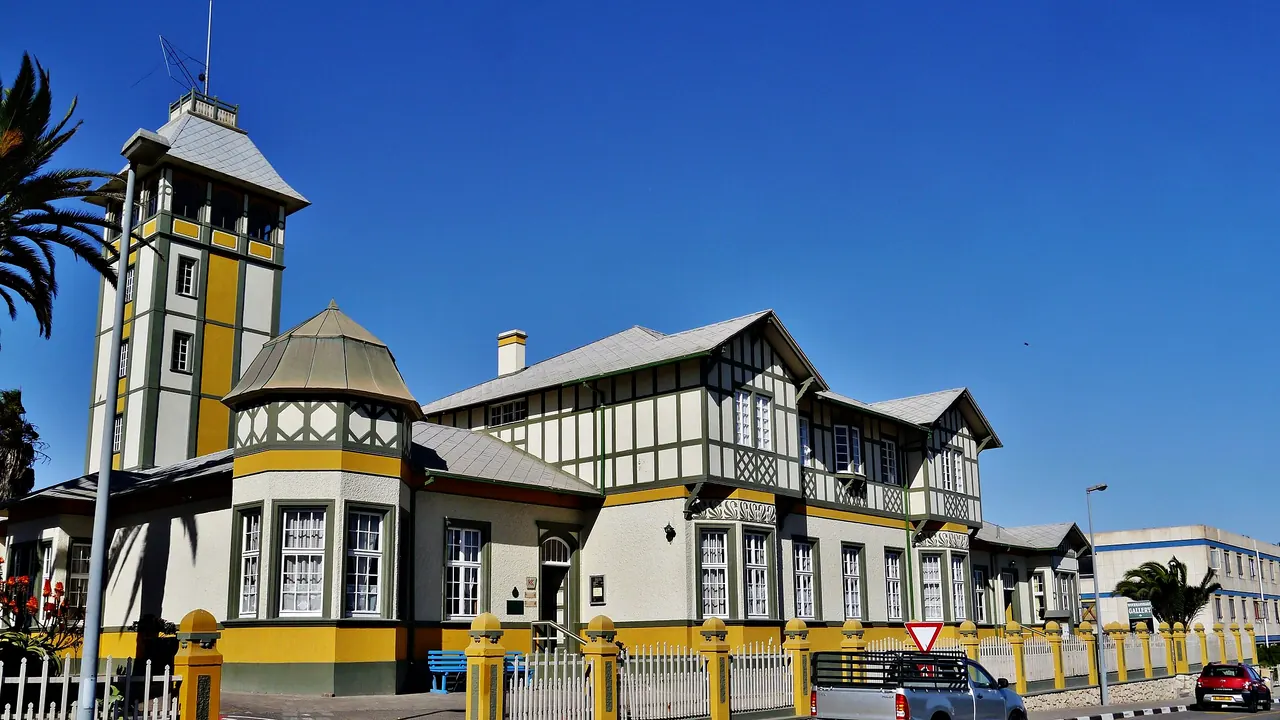
The Woermannhaus and its tower
- Nature & outdoors72
- Affordable cities62
- Families48
Photo: Zairon, CC BY-SA 4.0, cropped
Match
35
Every category weighted equally
- Beach & sun36
- Culture & arts32
- Food & nightlife30
- Family trip41
- Outdoors40
- Relax & unwind36
- Shopping & style33
- On a budget38
Swakopmund in twelve categories
Our verdict on each, scored 0 to 100 against the same fixed benchmark cities, so a score means the same thing on every page.
Beaches & swimming. Scores 18 out of 100.
Food & drink. Scores 40 out of 100.
Culture & sights. Scores 30 out of 100.
Nightlife. Scores 15 out of 100.
Nature & outdoors. Scores 72 out of 100.
Day trips. Scores 22 out of 100.
Good for families. Scores 48 out of 100.
Getting around. Scores 42 out of 100.
Shopping & style. Scores 30 out of 100.
Affordability. Scores 62 out of 100.
Live music & performing arts. Scores 8 out of 100.
Wellness & relaxation. Scores 30 out of 100.
Swakopmund category by category
Beaches & swimming
18Swakopmund sits right on the Atlantic, with long sandy beaches running north and south of the town and a sheltered stretch by the Mole and the jetty. The sea is the problem. The cold Benguela Current keeps the water at around 14°C to 17°C even in summer, a sea fog often rolls in until midday, and the surf can be rough, so few visitors do more than paddle.
The shore is used for walking, fishing and watching the sunset rather than for lying in the sun. Locals from the hot interior come in December to escape the heat, not to swim. Anyone who wants a beach vacation in the warm sense should look elsewhere.
Food & drink
40Eating in Swakopmund reflects its German colonial past and its position on a cold, rich sea. Bakeries and coffee houses serve Black Forest cake, apfelstrudel and proper bread, and beer brewed to German purity rules is the standard drink. On the seafood side, oysters farmed in the Walvis Bay lagoon are the local pride, along with kingklip, kob and other line fish.
Game meat, oryx, kudu and springbok, turns up on most menus, and braai culture is strong. The choice is limited to a few dozen restaurants and cafés in the centre and along the seafront, so a week's stay will cover the best of it, but the quality of the fish and the café culture make meals a real pleasure.
Culture & sights
30The town's main sight is the town itself: a well-kept set of German colonial buildings from the early 1900s, with half-timbered gables, turrets and pastel façades that look strange against the desert. The Woermann House with its tower, the old railway station, the Hohenzollern Building, the lighthouse and the iron jetty can all be seen on a relaxed walk.
The Swakopmund Museum covers local history, natural history and the region's peoples, and there is a large crystal and gemstone gallery. Guided tours of the Mondesa township add a view of present-day Namibian life. It is an interesting afternoon or two, but nobody travels here for the sights.
Nightlife
15Evenings in Swakopmund centre on dinner and a drink, often a sundowner by the jetty or a beer in one of the German-style pubs. There are a few bars that stay busy on weekends with locals and overland travellers, but no real club scene, and most of the town is quiet well before midnight. Anyone after a night out will find it modest.
Nature & outdoors
72This is the real reason to stay. The dunes of the Namib begin where the town ends, and they are a playground for sandboarding, quad biking, scenic flights and skydiving over the meeting of sand and sea. Living desert tours track geckos, chameleons and sidewinder snakes in the dunes, and inland the Moon Landscape and the welwitschia plains show a stranger, rockier desert.
To the south, the Walvis Bay lagoon is full of flamingos and pelicans, kayakers paddle among Cape fur seals and boat trips meet dolphins. Sandwich Harbour, where dunes drop straight into the ocean, needs a 4x4 tour. North along the Skeleton Coast lie shipwrecks and the vast seal colony at Cape Cross, and the granite domes of Spitzkoppe are about two hours away. There are no forests or mountain trails, and the coast is grey and cool.
Day trips
22As places to visit rather than landscapes, the options are thin. Walvis Bay, half an hour south, is a working port town with a waterfront of oyster bars and boat departures. Henties Bay is a small fishing resort to the north, and Cape Cross marks the spot where a Portuguese navigator planted a stone cross in the 1480s.
The rock paintings at Spitzkoppe, about two hours inland, are the main cultural outing. Beyond that, the excursions from Swakopmund are into the desert and along the coast, and the longer journeys to Sossusvlei or Damaraland need a night away.
Good for families
48Swakopmund is easy with children in a practical sense: it is small, calm and orderly, the centre is flat, and the climate is mild rather than hot. The National Marine Aquarium has a walk-through tunnel, and a small snake park adds another hour. Older children usually remember the dunes most, sliding down on boards or riding quad bikes with a guide, and boat trips from Walvis Bay to see seals and dolphins suit all ages.
What it lacks is a deep list of things made for children, and the cold sea limits beach days to building sandcastles. Many outings involve long drives on gravel roads, which can be tiring for younger ones.
Getting around
42The centre is small, flat and pleasant to walk, and the seafront, jetty, museum and most restaurants are a few minutes apart. Beyond that there is no useful public transport. Almost every activity operator collects guests from their lodging, taxis are available, and most visitors arrive in a hire car as part of a road trip around Namibia. A car is the realistic way to reach Walvis Bay, Cape Cross or the desert on your own terms.
Shopping & style
30Shopping here is about crafts and souvenirs with a local character. Open-air craft markets near the lighthouse and the seafront sell woodcarvings, baskets and beadwork from across the country, and Herero dolls in traditional dress. Specialist shops deal in Namibian gemstones, tourmaline and amethyst, karakul wool rugs, leather goods and kudu-hide shoes. The town also has a few German bookshops and delicatessens. For fashion or design there is little to find.
Affordability
62Day-to-day costs are modest. Guesthouses and self-catering flats are easy to find, restaurant meals with fresh fish and game are reasonably priced by European standards, and local beer is cheap. The costs that add up are the activities, since dune tours, boat trips and above all scenic flights and skydives are priced for international visitors, and the hire car most people need. As the main vacation town on the coast, it fills up in December and January, when rooms are harder to find and book out early.
Live music & performing arts
8There is very little to attend. A small local theatre and community events put on the occasional performance, and some pubs host live bands on weekends, but there is no regular concert, theatre or music programme to plan an evening around.
Wellness & relaxation
30Swakopmund has no bathing tradition, and its spa offer is a few day spas and treatment rooms in guesthouses and lodges. What it does have is a slow pace. The town is quiet, the sea air is cool after the heat of the interior, and long walks on the promenade or coffee and cake in the afternoon set the rhythm. It suits a few days of rest in the middle of a Namibian road trip rather than a dedicated wellness stay.
When should you go?
Pick a month to see what it is like. The climate figures are measured averages, not a forecast.
Swakopmund in July
Daytime high, °C
Rainfall in the month, mm
The whole year
Shaded against this city’s own year: the deepest cell is its best month for that figure and the palest its weakest.
Where the figures come from
Swakopmund's temperatures are measured 26 km from the centre, at Walvis Bay-Pelican Point.
Swakopmund has no rain gauge within 25 km of the centre, so its rainfall comes from a gridded climate dataset read at the city rather than from a gauge further away.
Temperature and rainfall are climate normals, averaged over the years shown. Swakopmund: 2005-2025 (rainfall 1991-2020) normals, Walvis Bay-Pelican Point (26.2 km from centre).
Before you go
| Measure | Swakopmund |
|---|---|
| Official language | English |
| Currency | Namibia Dollar (NAD) |
| Sockets | M220 V, 50 Hz |
| Driving side | Left |
| Time zone | UTC+2 |
| Emergency number | 112 |
| Elevation | 6 m |
| Main airport | Walvis Bay International Airport (WVB)37 km from centre2 non-stop destinations |
| Public holidays this year | 13 days |
By the numbers
| Measure | Swakopmund |
|---|---|
| City population | 75,921 |
| People per km² | 419 |
| Museums within 10 km | 1 |
| UNESCO World Heritage sites within 50 km | 0 |
| Swim season, months above 21 °C | None |
Compare Swakopmund with
Every comparison with a written verdict behind it.