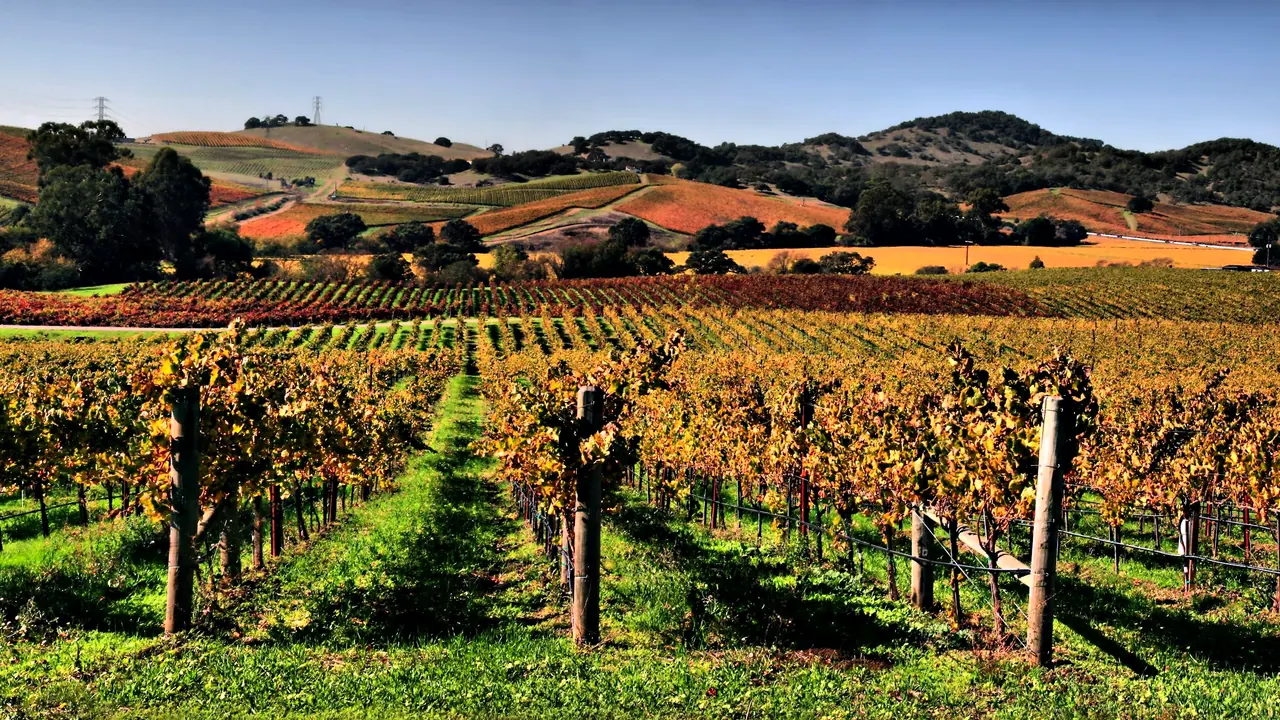
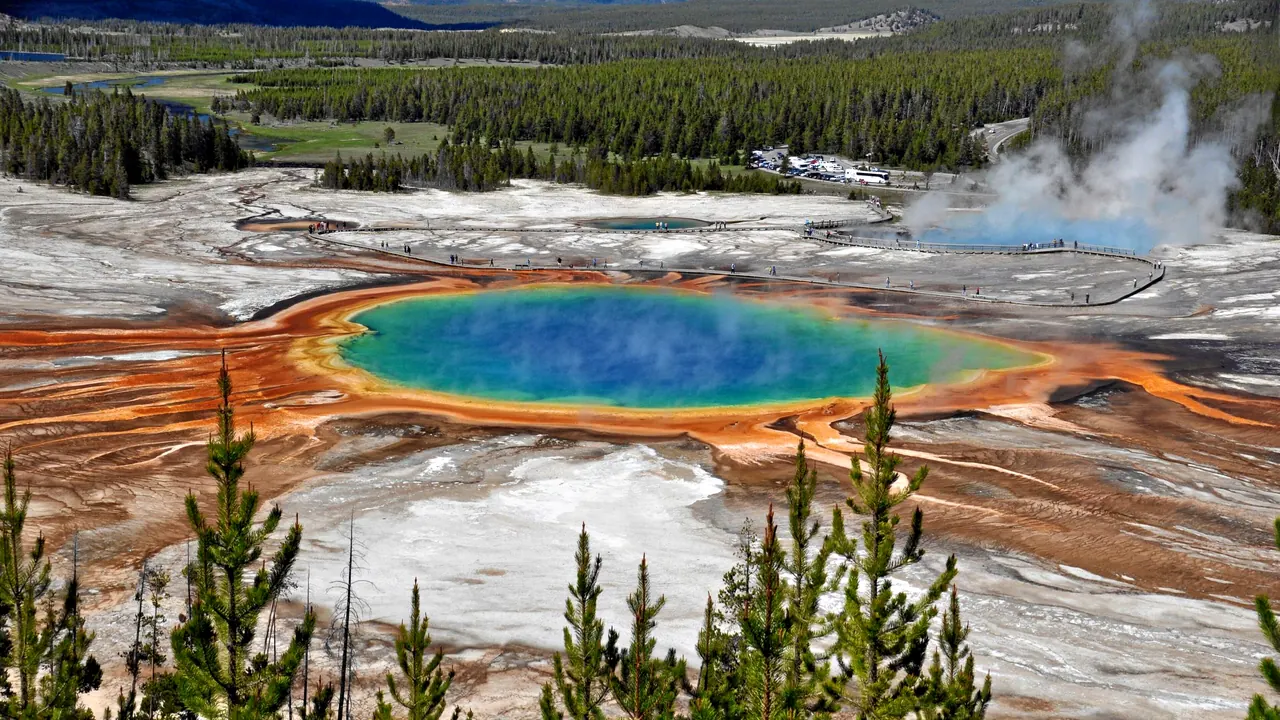
Photos: Napa Valley by Brocken Inaglory, CC BY-SA 3.0, cropped; Yellowstone by James St. John from Newark, Ohio, CC BY 2.0, cropped.
Napa Valley or Yellowstone?
Our verdict in twelve categories, each scored against the same fixed benchmark cities, and the climate month by month, so you can choose for your trip.
Choose Napa Valley for
- food and drink
- wellness
- day trips
Napa Valley suits adults who want a slow, comfortable trip built around the table and the glass. Days pass between cellar doors on Highway 29 and the Silverado Trail, long lunches in Yountville or St. Helena and a mud bath in Calistoga. It is also a short, easy drive from San Francisco and Sonoma. It costs a great deal and asks little physical effort, and that is much of its appeal.
Choose Yellowstone for
- nature and the outdoors
- families
- prices
Yellowstone is the choice for anyone who wants raw landscape and wild animals: geysers erupting on a plateau, bison crossing the road and wolves watched at dawn in Lamar Valley. Families do well here too, because children are thrilled by what they see. In exchange you get plain food, long drives and early nights. Come for the land, and treat everything else as practical support.
Scoreboard
Twelve categories on one fixed scale from 0 to 100. The shaded stretch is the gap between the two.
Your match
Pick a travel style or drag the sliders, and both match scores follow your weighting.
Wins on food and drink and wellness with your weighting.
Wins on nature and the outdoors and families with your weighting.
What matters to you?
Category by category
What the scores mean for a trip.
Beaches & swimming
Neither is a swimming destination, though Napa Valley comes out slightly ahead. Lake Berryessa, over the eastern hills, warms up properly in summer and has coves for swimming and paddling. The Sonoma coast is a scenic drive away, but the water there is too cold for bathing.
Yellowstone Lake stays near 10°C even in August, and the thermal pools are scalding and closed to bathers. A quick cold plunge in the Firehole River is about all the park offers, so in both places a hotel pool does most of the work.
Food & drink
This is where the two are furthest apart. In Napa Valley, eating and drinking are the reason for the trip. You can taste Cabernet at grand estates or at appointment-only cellars on Howell and Spring Mountains, and Yountville has a remarkable concentration of fine dining. The one gap is cheap, casual food.
In Yellowstone, meals are fuel between sights: lodge dining rooms, cafeterias, and steakhouses and burger grills in the gateway towns. Bison burgers, trout and huckleberry pie give it some local flavour, but serious cooking means a long drive to Jackson or Bozeman.
Culture & sights
Yellowstone has the more striking heritage. As the world's first national park, it has the great log-and-stone Old Faithful Inn, the Roosevelt Arch and the old army buildings of Fort Yellowstone at Mammoth. The Buffalo Bill Center of the West in Cody is a museum of real substance, about an hour beyond the east entrance.
Napa Valley's history is the story of wine, told through stone cellars, the old Greystone building and Victorian storefronts along the river in Napa. It makes a pleasant backdrop to tastings but not a reason to go, and for major museums people head to San Francisco.
Nightlife
Both go to bed early, but Napa Valley at least has somewhere to go. Downtown Napa has wine bars, taprooms and cocktail bars along First Street and the river, even if they are quiet before midnight. Yellowstone's evenings are a lodge lounge, a ranger talk or the stars, because the best wildlife watching starts at dawn.
Nature & outdoors
Yellowstone is one of the great natural places on earth. It holds most of the world's active geysers, from Old Faithful to Grand Prismatic Spring, plus the yellow canyon of its river, a high lake under the Absaroka peaks, and grizzlies, wolves and bison herds. Real backcountry and the Tetons are close at hand.
Napa Valley's landscape is farmed and gentle: vineyards between oak-covered ridges, best seen from a dawn balloon or a bicycle on the Silverado Trail. Mount St. Helena and the redwoods of Bothe-Napa Valley make good walks, but they are pleasant rather than dramatic.
Day trips
Napa Valley has much the better choice of outings. San Francisco is within easy reach by road or by ferry from Vallejo, and Sonoma's mission plaza, Healdsburg, Berkeley and Sausalito are all straightforward days out, although most of them lead to more wine country.
From Yellowstone, every outing is a long drive to one place: Jackson's square and wildlife art museum, Cody's Wild West streets, Bozeman, or the Beartooth Highway to Red Lodge. Most visitors find the park itself fills every day.
Good for families
Yellowstone works far better for children. Old Faithful erupts on schedule, mud pots bubble, bison wander past the car, and the Junior Ranger badge gives children a goal. The catch is close supervision on the boardwalks and around the animals, plus long hours on the road.
Napa Valley is built around tastings and long dinners, and children are tolerated more than catered for. The small geyser and petrified forest at Calistoga, the hot-spring pools and the wildlife park in Vallejo can fill a few days, but not a whole family vacation.
Getting around
You need a car in both, but Napa Valley is far simpler. The valley runs only about 50km from Napa to Calistoga, the roads are easy, and the central towns can be explored on foot. Because the day involves wine, many visitors book a driver or a tour, or cycle the flat valley floor.
Yellowstone's Grand Loop Road covers about 230km at low speeds, with no public transport and traffic held up by bison and full car parks. The airports are an hour or two from the gates, and in winter the interior can be reached only by snowcoach or snowmobile.
Shopping & style
Napa Valley has the better shopping, though most of it is wine bought at the cellar door and shipped home, often bottles you cannot buy elsewhere. St. Helena's Main Street boutiques, local olive oil and cheese, and an outlet centre outside Napa round it out.
In Yellowstone it comes down to lodge gift shops, fly-fishing and outdoor gear, and Western boots, hats and wildlife bronzes in Cody and Jackson.
Affordability
Both are expensive, but Yellowstone is easier to do on a budget. The sights cost nothing beyond park entry, campgrounds and picnics keep spending down, and spring and autumn are cheaper than high summer. Rooms and meals in season are still overpriced for what they are.
Napa Valley is a splurge however carefully you plan it. Up-valley inns, tasting fees and dinners at well-known restaurants add up fast. Staying in Napa town and picnicking from the delis helps only a little.
Live music & performing arts
Napa Valley has more to attend. Downtown Napa has a restored nineteenth-century opera house and an Art Deco theatre for touring bands and comedians. There are summer concerts at wineries and in Yountville, and a big rock and pop festival takes over the Expo grounds in late spring.
Yellowstone's best evening show is the summer rodeo in Cody. There are also family musicals in West Yellowstone and the Grand Teton Music Festival's classical season near Jackson.
Wellness & relaxation
Napa Valley is the place to unwind. Calistoga was founded as a hot-springs resort and still offers volcanic-ash mud baths, mineral soaks and geothermal pools, while resort spas around Yountville and the Silverado Trail pair a treatment with fine dining. The slow days and long outdoor lunches help as much as the spas.
In Yellowstone the ground steams everywhere, but the springs are off limits. Soaking means the hot-spring pools near Gardiner and in Paradise Valley. The stillness here comes from a dawn by the lake or a quiet trail in September rather than from spas.
When should you go?
Pick your month. The climate figures are measured averages, not a forecast.
Napa Valley in July
Yellowstone in July
Daytime high, °C
Rainfall in the month, mm
Where the figures come from
Napa Valley has no rain gauge within 25 km of the centre, so its rainfall comes from a gridded climate dataset read at the destination rather than from a gauge further away.
Napa Valley's sunshine is measured 76 km from the centre, at Sacramento Executive Airport.
Yellowstone has no weather station within reach, so its figures come from a gridded climate model rather than a measured record, and read a broad area rather than one spot.
Temperature and rainfall are climate normals, averaged over the years shown. Napa Valley: 1991-2020 (sunshine 1981-2010) normals, Napa / Middleton (21.9 km from centre). Yellowstone: 2001-2020 normals, NASA POWER reanalysis grid, no weather station within 90 km.
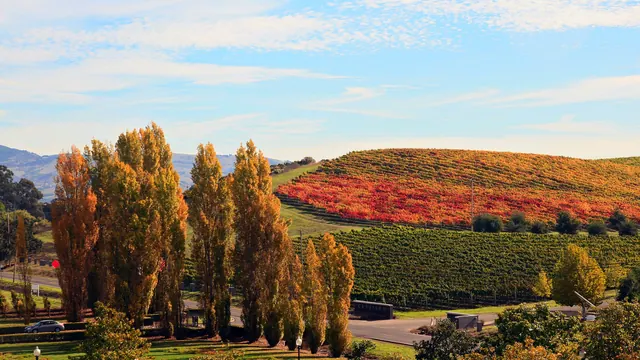
Napa Valley is mild for most of the year and has a clear wet season. Rain falls mainly from November to March, with around 141mm in January, while June to September is almost completely dry. Summer highs sit around 26°C under long hours of sunshine, which makes for warm afternoons on terraces and hot drives between wineries. Autumn is the best of it: still warm and dry, with the vines turning colour. Late winter is wetter and cooler but brings mustard flowers between the rows.
Yellowstone has a short summer and a long, hard winter. Highs reach about 25°C in July and fall well below freezing from December to February. Most roads are closed to cars from early November to late April, so July and August, followed by a cooler September, are the practical window for a driving trip. The valley can be visited comfortably for most of the year. The park really only works for about four months, unless you come for a snowcoach trip in winter.
Which traveller are you?
On a food and nightlife trip, choose Napa Valley. The food is the whole point there: wineries in the hundreds, Yountville's run of fine dining and oysters at Oxbow Public Market. Evenings are quiet in both places, but Napa's riverfront wine bars beat Yellowstone's early-closing saloons.
For an outdoors trip, Yellowstone is in another league. It has geyser basins, the canyon at Lower Falls, wildlife in Hayden and Lamar valleys and hundreds of kilometres of backcountry trail. Napa offers pleasant cycling, balloon flights and a climb up Mount St. Helena, but nothing wild.
On a relaxing and wellness trip, Napa Valley wins easily. Calistoga's volcanic-ash mud baths and geothermal pools, plus resort spas among the vines, are made for unhurried days. In Yellowstone the thermal springs cannot be entered, and the soaking happens in a few pools outside the park.
Before you go
| Measure | Napa Valley | Yellowstone |
|---|---|---|
| Currency | US Dollar (USD) | US Dollar (USD) |
| Sockets | AB120 V, 60 Hz | AB120 V, 60 Hz |
| Driving side | Right | Right |
| Time zone | UTC-8, UTC-7 in summer | UTC-7, UTC-6 in summer |
| Emergency number | 911 | 911 |
| Main airport | San Francisco International Airport (SFO)143 non-stop destinations | Bozeman Yellowstone International Airport (BZN)27 non-stop destinations |
| Public holidays this year | 13 days | 11 days |
Where else could you go?
Every comparison below shares a destination with this one, so you can follow Napa Valley or Yellowstone somewhere new.
- Sonomavs Napa Valley
- Grand Tetonvs Yellowstone
- Lake Tahoevs Napa Valley
- Big Survs Napa Valley
- Yosemitevs Napa Valley
- Kings Canyonvs Napa Valley