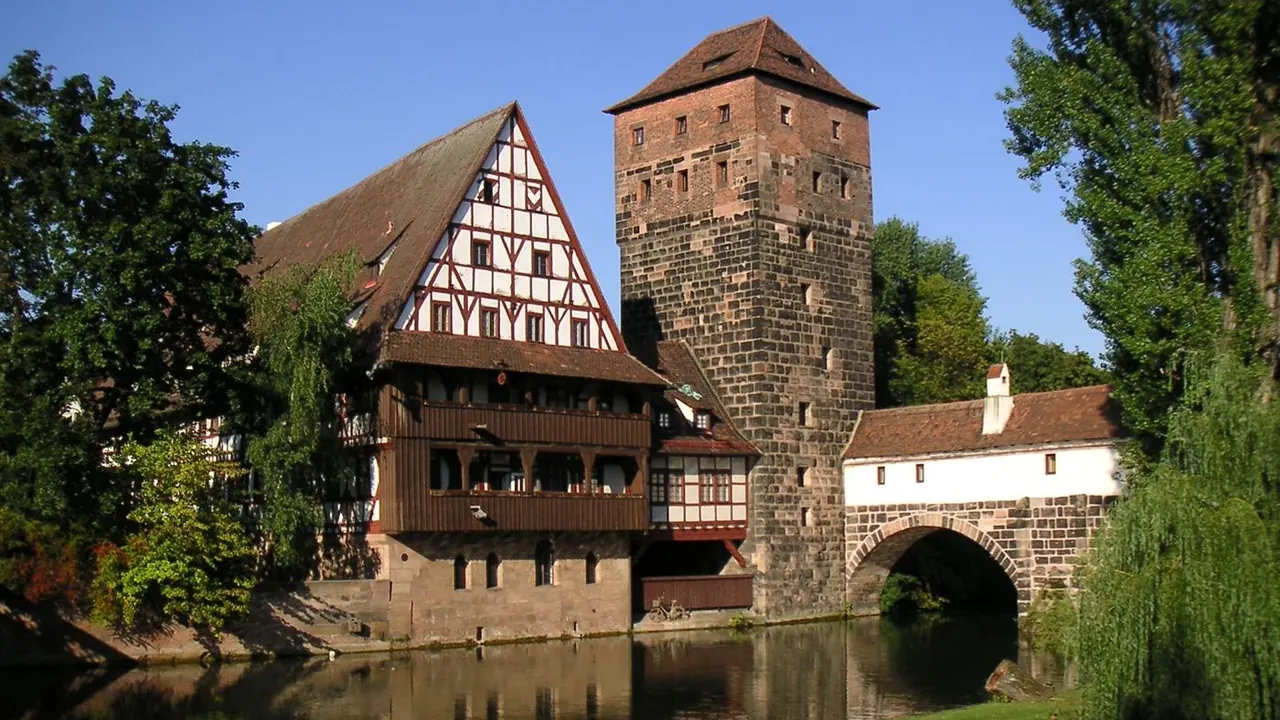
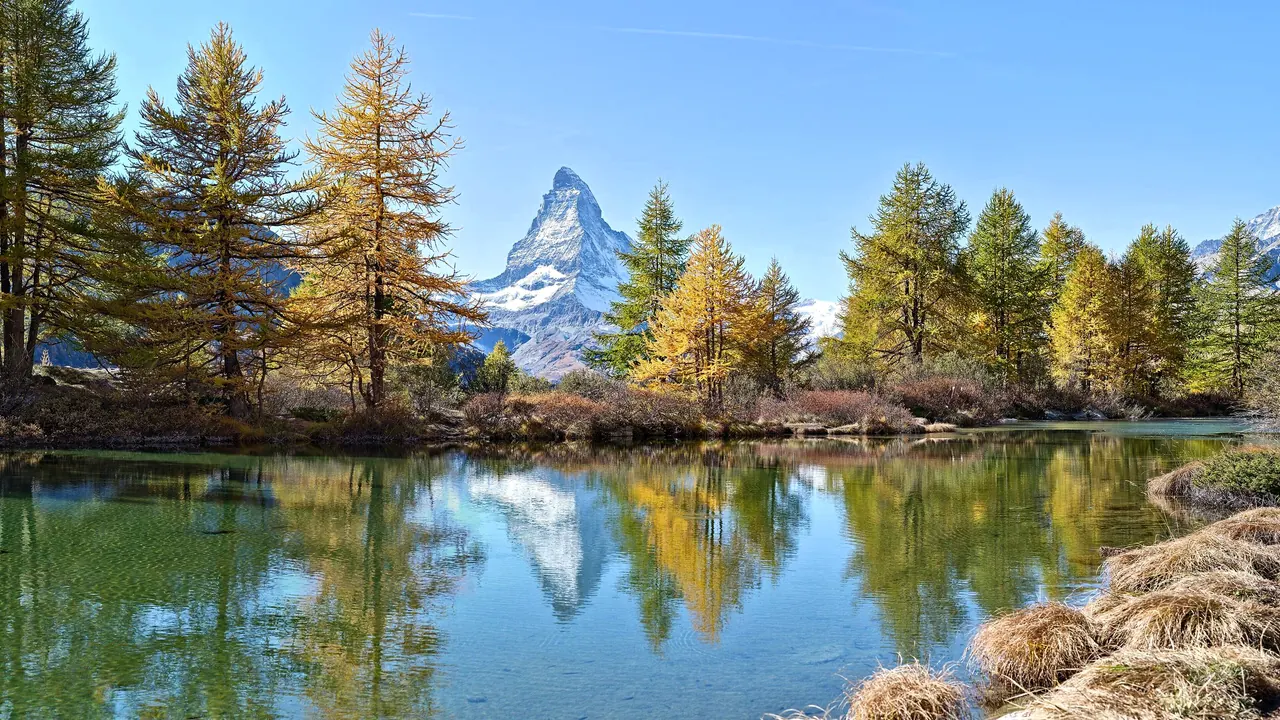
Photos: Nuremberg by Horst Gutmann, CC BY 2.0, cropped; Zermatt by Roy Egloff, CC BY-SA 4.0, cropped.
Nuremberg or Zermatt?
Our verdict in twelve categories, each scored against the same fixed benchmark cities, and the climate month by month, so you can choose for your trip.
Choose Nuremberg for
- culture and sights
- day trips
- prices
Nuremberg suits a traveller who wants a city with depth and a good base for exploring. Inside its medieval walls are the imperial castle, Gothic churches and one of Germany's great museums, and the twentieth-century sites at the Rally Grounds and Courtroom 600 add a weight few cities can match. Franconian taverns and beer gardens fill the evenings. Bamberg, Würzburg and Regensburg are all within easy reach by train, and the whole trip costs far less than a week in the Swiss Alps.
Choose Zermatt for
- nature and the outdoors
- wellness
Zermatt is the choice when the mountains are the whole point. The Matterhorn stands over a car-free village, lifts and cog railways climb to glaciers and four-thousand-metre peaks, and the skiing and hiking are among the best in the Alps. Little else competes for your time here: the culture fills a morning, the evenings are quiet outside après-ski, and the prices are among the highest anywhere. Choose it for skiing or serious walking, and budget for it.
Scoreboard
Twelve categories on one fixed scale from 0 to 100. The shaded stretch is the gap between the two.
Your match
Pick a travel style or drag the sliders, and both match scores follow your weighting.
Wins on culture and sights and day trips with your weighting.
Wins on nature and the outdoors and wellness with your weighting.
What matters to you?
Category by category
What the scores mean for a trip.
Beaches & swimming
Neither place is for swimming, but Nuremberg at least has an option. The Franconian Lake District around the Brombachsee is about an hour south, with grassy shores and water warm enough in high summer for an afternoon with children.
Zermatt has nothing comparable. Its mountain tarns are glacier-cold and best enjoyed for the Matterhorn reflected in them, so swimming means a hotel pool.
Food & drink
Nuremberg gives you more to eat and drink. There are finger-sized bratwurst grilled over beechwood, Sunday Schäufele and Lebkuchen, and above all Franconian beer, poured fresh from small breweries in old-town taverns and beer gardens along the Pegnitz.
Zermatt is narrower and much costlier. Its best moments are long terrace lunches in mountain hamlets such as Findeln and Zum See, with raclette, air-dried beef and Valais wines, and a few ambitious kitchens in the village. Many places close between seasons.
Culture & sights
Nuremberg has far more to see. The walled old town, the imperial castle, St Sebaldus and St Lorenz, and the vast Germanisches Nationalmuseum could fill several days. The Rally Grounds documentation centre and Courtroom 600 bring the twentieth century in hard focus.
Zermatt's heritage is small and all about climbing: the underground Matterhorn Museum, the mountaineers' cemetery and the larch-wood barns of the Hinterdorf. It is moving, but it fits into a single morning.
Nightlife
Neither is a party destination, and both are mostly about bars. Nuremberg's evenings run all year, from old-town taverns and summer crowds on the riverbanks to the small alternative bars of Gostenhof. Erlangen's students keep weekends lively.
Zermatt's nightlife is seasonal. It means loud, cheerful and pricey après-ski on the runs into the village in winter, then early nights in summer among hikers with dawn starts.
Nature & outdoors
This is Zermatt's reason to exist. The Matterhorn rises right above the village, ringed by dozens of four-thousanders and the Gorner Glacier, and lifts reach high-altitude skiing that links into Italy. In summer the same lifts open up trails like the Five Lakes walk and the Europaweg suspension bridge.
Nuremberg's outdoors is gentle by comparison. The Reichswald pine forest begins at the edge of town and there is riverside cycling along the Pegnitz. Franconian Switzerland, an hour away, has limestone towers, caves and good rock climbing.
Day trips
Nuremberg is a superb base. Bamberg, Würzburg and Regensburg are each about an hour by train, the walled towns of Rothenburg and Dinkelsbühl are a little further, and Munich and Bayreuth are also easy to reach.
From Zermatt every outing begins with the long train ride down the valley. Sion, with its castle hills, is the best of it, and Brig and Saas-Fee are pleasant. Most visitors spend their spare days in the mountains instead.
Good for families
Nuremberg has more made for children. Its toy-making past shows in the Toy Museum, the railway museum has full-size locomotives, the zoo spreads through wooded former quarries, and a play park sits just outside town in Zirndorf.
Zermatt is calm and car-free, with nursery slopes at Sunnegga and marmots to spot in summer. But there is no zoo or theme park, rainy days are hard to fill, and the highest viewpoints can be too thin-aired for small children. It works best for families who ski or hike together.
Getting around
Both are easy without a car, in different ways. Nuremberg's walled centre is about 1.5km across and fully walkable, and one ticket covers the U-Bahn, trams and S-Bahn out to the zoo, the Rally Grounds and Fürth.
Zermatt is car-free, so you arrive by train via Täsch and walk the village, using electric taxis for the outer lift stations. Your transport is really the cog railway, funicular and gondolas, and leaving the valley takes over an hour.
Shopping & style
Nuremberg has a little more to offer. Its main streets are ordinary chain-store territory, but Lebkuchen tins, wooden toys and the Handwerkerhof's crafts make good gifts, and in Advent the Christkindlesmarkt is one of Germany's most famous.
Zermatt's single main street sells luxury watches, cowbells and chocolate. It is genuinely worth it only for ski and mountaineering gear.
Affordability
The gap here is wide. Nuremberg is mid-priced for Western Europe, with cheap beer, filling meals and inexpensive transport. Hotels jump only during trade fairs and the Advent market, so time your stay around those.
Zermatt is among the dearest places in the Alps, with steep rooms, pricey meals and lift fares that every visitor pays. Self-catering or staying down in Täsch softens the bill, but only slightly.
Live music & performing arts
Nuremberg has a proper year-round season. The Staatstheater stages opera, ballet and drama in its Art Nouveau house, two orchestras perform, and in summer there are the free Bardentreffen folk weekend and a big open-air concert in the Luitpoldhain.
Zermatt has no theatre or concert hall. Its calendar rests on two festivals: Zermatt Unplugged in spring and chamber music in the church in late summer. Otherwise, live music means an après-ski band.
Wellness & relaxation
Both are fairly level here, and neither has historic baths of its own. Nuremberg relies on the German sauna culture, with a large thermal spa a short U-Bahn ride away in Fürth and floating saline pools at Bad Windsheim, plus slow beer garden afternoons.
Zermatt's strength is its many excellent hotel spas with mountain views, some open to non-residents. The car-free quiet and clear air are restful, though the village mood is active rather than lazy.
When should you go?
Pick your month. The climate figures are measured averages, not a forecast.
Nuremberg in July
Zermatt in July
Daytime high, °C
Rainfall in the month, mm
Where the figures come from
Zermatt has no weather station within reach, so its figures come from a gridded climate model rather than a measured record, and read a broad area rather than the city itself.
Temperature and rainfall are climate normals, averaged over the years shown. Nuremberg: 1991-2020 normals, Nuernberg (5.5 km from centre). Zermatt: 1991-2020 normals, TerraClimate 4 km grid at the town, no weather station within 90 km.
Nuremberg has a full four-season city climate. May to September is the time to go, with days of 20°C to 25°C and long sunshine in June and July, which are good for beer gardens, riverside afternoons and day trips to the Franconian lakes. Summer brings the most rain, often as short showers, while spring and early autumn are mild and comfortable for walking the old town. From November to February the days are cold, short and grey. Advent is still worth it for the Christmas market, but come dressed for it.
Zermatt works almost the other way round. From December to March daytime highs stay around or below freezing, which is ski season. In July and August the village only reaches about 14°C, cool and fresh for high trails but never warm, and it is colder again up at the viewpoints. Rain and snow come all year, and November is the wettest month at 130mm, so the shoulder months are the weakest time to visit. For hiking, go in high summer. For skiing, go in deep winter.
Which traveller are you?
On a culture and arts trip, Nuremberg is the obvious pick. It has the Kaiserburg, the Germanisches Nationalmuseum, Dürer's house and the sobering Nazi-era sites, plus opera at the Staatstheater. Zermatt's mountaineering museum and old barns fill only a morning.
For an outdoors trip, Zermatt is in a different league. Lifts climb to over 3,800m, hundreds of kilometres of trails pass lakes and glaciers, and there is guided climbing on four-thousanders. Nuremberg offers pleasant forest and Franconian Switzerland, but nothing on this scale.
On a tight budget, choose Nuremberg. Filling tavern meals, cheap local beer and low transport costs keep spending modest if you avoid trade fair weeks. Zermatt is expensive at every turn, from hotel rooms to the lift passes you cannot do without.
Before you go
| Measure | Nuremberg | Zermatt |
|---|---|---|
| Official language | German | French, German, Italian, Romansh |
| Currency | Euro (EUR) | Swiss Franc (CHF) |
| Sockets | CF230 V, 50 Hz | CJ230 V, 50 Hz |
| Driving side | Right | Right |
| Time zone | UTC+1, UTC+2 in summer | UTC+1, UTC+2 in summer |
| Emergency number | 112 | 112 |
| Elevation | 209 m | 1,624 m |
| Main airport | Nuremberg Airport (NUE)5 km from centre56 non-stop destinations | Geneva International Airport (GVA)128 km from centre150 non-stop destinations |
| Public holidays this year | 12 days | 9 days |
By the numbers
| Measure | Nuremberg | Zermatt |
|---|---|---|
| City population | 531,159 | 6,023 |
| People per km² | 2,848 | 25 |
| Museums within 10 km | 50 | 2 |
| UNESCO World Heritage sites within 50 km | 1 | 2 |
Where else could you go?
Every comparison below shares a destination with this one, so you can follow Nuremberg or Zermatt somewhere new.
- Chamonixvs Zermatt
- Interlakenvs Zermatt
- Luganovs Zermatt
- Lausannevs Zermatt
- Turinvs Zermatt
- Bernvs Zermatt