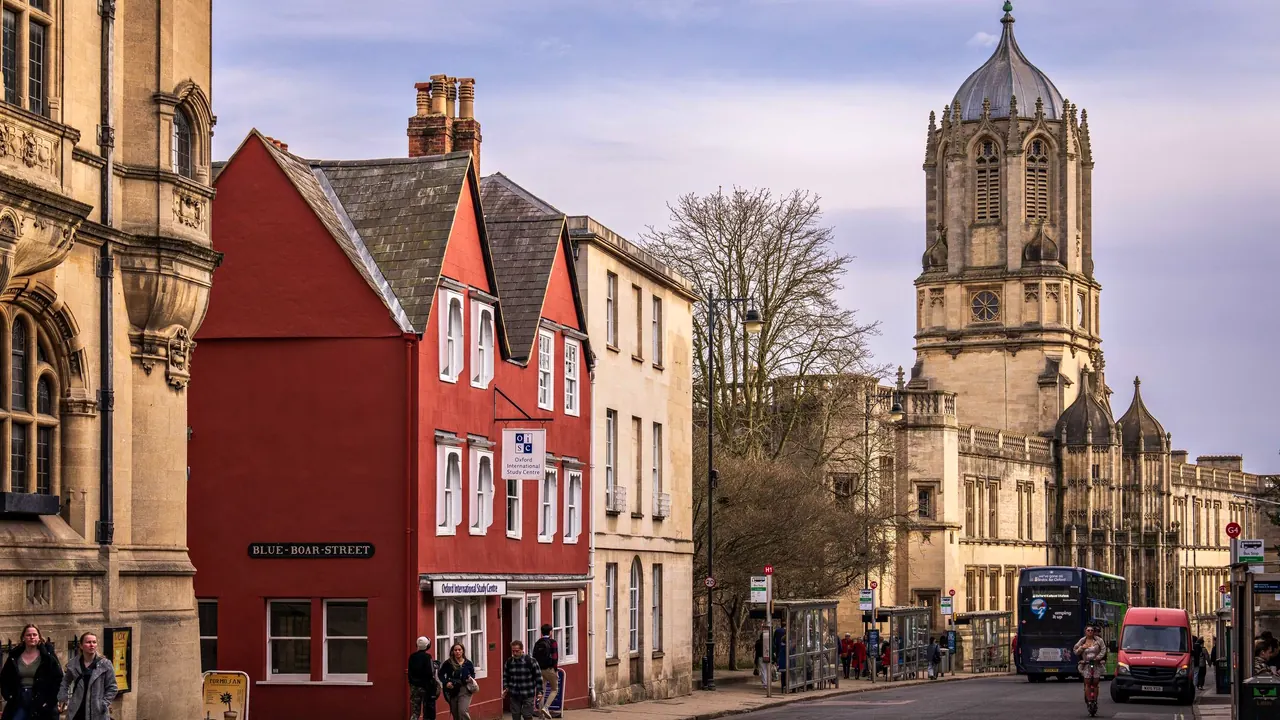

Photos: Oxford by Mark Stebnicki, Pexels License; York by PAUL FARMER, CC BY-SA 2.0, cropped.
Oxford or York?
Our verdict in twelve categories, each scored against the same fixed benchmark cities, and the climate month by month, so you can choose for your trip.
Choose Oxford for
- live music and the arts
- shopping
- day trips
Oxford suits travellers who want the arts as much as the architecture. Its college quadrangles and fine free museums match York's heritage, but the evenings are the real difference: candlelit Evensong by choirs of world standing, concerts in the Sheldonian and chamber music in the Holywell Music Room. It is also the better base for shopping and for a trip that takes in London, Blenheim and the Cotswolds. Expect to pay more for a bed.
Choose York for
- nature and the outdoors
- families
- prices
York is the better choice for families, walkers and anyone watching costs. The National Railway Museum, Jorvik and the walk along the walls hold children's attention better than Oxford's colleges do, and the North York Moors and the Dales offer bigger, wilder country than Oxford's gentle meadows and hills. Rooms are a little easier on the budget too, especially midweek.
Scoreboard
Twelve categories on one fixed scale from 0 to 100. The shaded stretch is the gap between the two.
Your match
Pick a travel style or drag the sliders, and both match scores follow your weighting.
Too close to call, level with your weighting
Wins on live music and the arts and shopping with your weighting.
Wins on nature and the outdoors and families with your weighting.
What matters to you?
Category by category
What the scores mean for a trip.
Beaches & swimming
Neither city is a place for the beach, but the swimming is different. In Oxford you swim in fresh water, in the Thames at Port Meadow, the Cherwell or the open-air pool at Hinksey, and the south coast is a long trip away.
York has no swimming in the city, but Scarborough's two sandy bays are about an hour away by train, with Whitby and Filey beyond. The North Sea is cold, so it makes a seaside day out rather than a swim.
Food & drink
You will eat about as well in either, and in both the pub is the heart of it. Oxford has more range: Cowley Road brings cheap Middle Eastern, South Asian and Caribbean cooking, Jericho has neighbourhood bistros, and the old Covered Market is good for lunch.
York leans harder on Yorkshire tradition, with tearooms serving afternoon tea and fat rascals, Yorkshire puddings with the roast and local cheese and pies at the Shambles Market. There is less international food, so come for comfort rather than variety.
Culture & sights
Both cities fill two or three days with first-rate heritage, but in different ways. Oxford is a university city: honey-coloured college quadrangles, the Radcliffe Camera and the Bodleian, and museums such as the Ashmolean and the Pitt Rivers, which are far better than a city this size would usually have.
York's appeal is its long history, which you can see layer by layer. There is the great Gothic Minster with its medieval glass, walls you can walk along, Viking remains at Jorvik and abbey ruins in the Museum Gardens, and the National Railway Museum adds a strand of history that Oxford has nothing like.
Nightlife
Both are pub towns that go quiet early, so neither suits a big night out. Oxford follows the university year: student-filled taverns in term, riverside pubs in summer and later bars on Cowley Road, though it thins out once term ends.
York's old inns along Micklegate and Stonegate make for a fine ale crawl, but weekends bring stag and hen parties, and race days at the Knavesmire bring dressed-up crowds. For clubbing, people take the short train ride to Leeds.
Nature & outdoors
Oxford's green spaces start right in the centre, with Port Meadow, Christ Church Meadow and the flat towpaths good for walking, cycling and punting. Further out, the Cotswolds, Chilterns and Ridgeway offer pleasant, mild country.
York has more dramatic country nearby. The North York Moors turn purple in late summer and end in high cliffs at Robin Hood's Bay, and the Dales add limestone scars and waterfalls. For serious walking or cycling it is clearly the better base, though a car helps a great deal.
Day trips
Oxford has the slightly richer choice, and more of the names are famous. Blenheim Palace is about twenty minutes away at Woodstock, and Cotswold villages such as Burford, Bibury and Chipping Campden are within an hour. London's museums are an hour away by train. Stratford-upon-Avon, Warwick Castle, Windsor and Bath all fit into a day, at around an hour and a half each.
York's outings are about Yorkshire and the North East. Durham's cathedral and castle, Leeds and the spa town of Harrogate are easy by train, and Castle Howard and Fountains Abbey are under an hour by road. Further out are the ruined abbeys at Rievaulx and Whitby, the Brontë village of Haworth and the steam railway from Pickering. From either city, the country houses and villages are much easier to reach with a car or a tour.
Good for families
York keeps children busier. They can walk among real locomotives at the free National Railway Museum, Jorvik and the Victorian street at the Castle Museum bring history to life, and walking the walls or going on a ghost tour feels like an adventure.
Oxford has dinosaur skeletons, the Pitt Rivers' curiosities, punting and some Harry Potter recognition at Christ Church. Beyond those, though, most of the city is aimed at adults, and the wildlife park and Blenheim's maze need a trip out.
Getting around
On foot the two are level. Both centres are flat and small enough to cross in well under half an hour, and in both a car is more trouble than it is worth. The difference is in feel. Oxford is a cycling city, with bikes everywhere and buses out to the residential districts. York's walls make a neat frame, and the walk from the station to the Minster takes about fifteen minutes.
The trains are where they really differ. Oxford's railway is above all a quick link to London, with lines to the Midlands as well. York is a junction for the whole north, so Durham, Harrogate, Leeds and the coast make easy days out without a car. Once you head into the countryside, you need a car or a tour from either city: to the Cotswolds from Oxford, and to the moors and country houses from York.
Shopping & style
Oxford has a little more to offer shoppers. The outlet village near Bicester draws designer-label hunters from far and wide, and the city has the great book rooms of Blackwell's, antique map sellers and the small traders of the Covered Market.
York's appeal is its setting, with independent boutiques, jewellers and antiques dealers lining Stonegate and Petergate. The Shambles leans towards souvenirs, fashion is limited, and the Christmas markets are its biggest shopping draw.
Affordability
Neither is cheap, but York stretches a budget further, mostly because rooms are easier to find. In Oxford central beds are scarce, and university events push rates up, so many visitors stay by the ring road or come from London for the day.
Once there, Oxford has the edge on free sights, as the major museums cost nothing. York charges for the Minster, Jorvik and the castle museums, but its rooms are cheaper midweek and just outside the walls.
Live music & performing arts
Oxford has much more to offer in the evenings. Evensong sung by the Christ Church, Magdalen and New College choirs is a highlight of any trip, and there are orchestral concerts at the Sheldonian, chamber music and jazz in the historic Holywell Music Room, and student drama in the college gardens in summer.
York has the Theatre Royal and its pantomime, an early-music festival and free Evensong at the Minster. Its revived Mystery Plays, performed on wagons in the streets, are its own tradition, but there is less to see night after night, and bigger touring shows go to Leeds.
Wellness & relaxation
Neither city has a bathing culture, and both offer quiet more than treatments. Oxford's version is the Botanic Garden, the deer park at Magdalen, Addison's Walk and a slow afternoon on a punt.
York has the Museum Gardens, the walls early in the morning and long afternoon teas. Its advantage is Harrogate, half an hour away by train, whose Victorian Turkish baths offer the proper steam and plunge pools that Oxford cannot match.
When should you go?
Pick your month. The climate figures are measured averages, not a forecast.
Oxford in July
York in July
Daytime high, °C
Rainfall in the month, mm
Where the figures come from
Oxford's temperatures are measured 37 km from the centre, at Fairford Royal Air Force Base.
Oxford has no rain gauge within 25 km of the centre, so its rainfall comes from a gridded climate dataset read at the city rather than from a gauge further away.
Oxford's sunshine is measured 57 km from the centre, at Lyneham.
York has no rain gauge within 25 km of the centre, so its rainfall comes from a gridded climate dataset read at the city rather than from a gauge further away.
York's sunshine is measured 48 km from the centre, at Leeming.
Temperature and rainfall are climate normals, averaged over the years shown. Oxford: 1961-1990 (sunshine 1991-2020, rainfall 1991-2020) normals, Fairford Royal Air Force Base (37 km from centre). York: 1991-2020 normals, Linton-On-Ouse (14.9 km from centre).
The two cities have much the same climate. Both are at their best from late May to early September, when afternoons reach about 20°C and long walks, riverside pubs and day trips are easy. Oxford is a touch warmer and noticeably sunnier at the height of summer, with around 208 hours of sun in July against York's 170. Neither ever gets too hot for walking the streets, and neither is warm enough for a beach vacation.
Rain falls through the whole year in both. York's wettest stretch is summer, at about 67mm in August, while Oxford's comes in October and November. Winters are cold and dark in both, with days at around 5°C to 7°C, so those months suit museums, Evensong and, in York, the Christmas markets more than the countryside.
Which traveller are you?
On a culture and arts trip, Oxford is the better pick. The sightseeing is about even, but Oxford keeps going after dark, with sacred music and concerts on most evenings in term. York has fewer evening performances, and the big productions go elsewhere.
For an outdoors trip, York wins clearly. You can follow the Cleveland Way along the coast, cross the Howardian Hills or go out to the Dales, which is real walking country. Oxford's surroundings suit gentle afternoon rambles more than full days on the hills.
On a family trip with children, York keeps young visitors busier for longer. Its history comes as stories children can follow, about Vikings, trains and ghosts. For a change of pace, a theme park, a zoo and the Scarborough sands are all about an hour away.
Before you go
| Measure | Oxford | York |
|---|---|---|
| Official language | English | English |
| Currency | Pound Sterling (GBP) | Pound Sterling (GBP) |
| Sockets | G230 V, 50 Hz | G230 V, 50 Hz |
| Driving side | Left | Left |
| Time zone | UTC, UTC+1 in summer | UTC, UTC+1 in summer |
| Emergency number | 112 or 999 | 112 or 999 |
| Elevation | 73 m | 25 m |
| Main airport | London Heathrow Airport (LHR)63 km from centre224 non-stop destinations | Leeds Bradford Airport (LBA)39 km from centre69 non-stop destinations |
| Public holidays this year | 8 days | 8 days |
By the numbers
| Measure | Oxford | York |
|---|---|---|
| City population | 147,500 | 208,400 |
| People per km² | 3,235 | 766 |
| Museums within 10 km | 11 | 24 |
| UNESCO World Heritage sites within 50 km | 1 | 2 |
Where else could you go?
Every comparison below shares a destination with this one, so you can follow Oxford or York somewhere new.