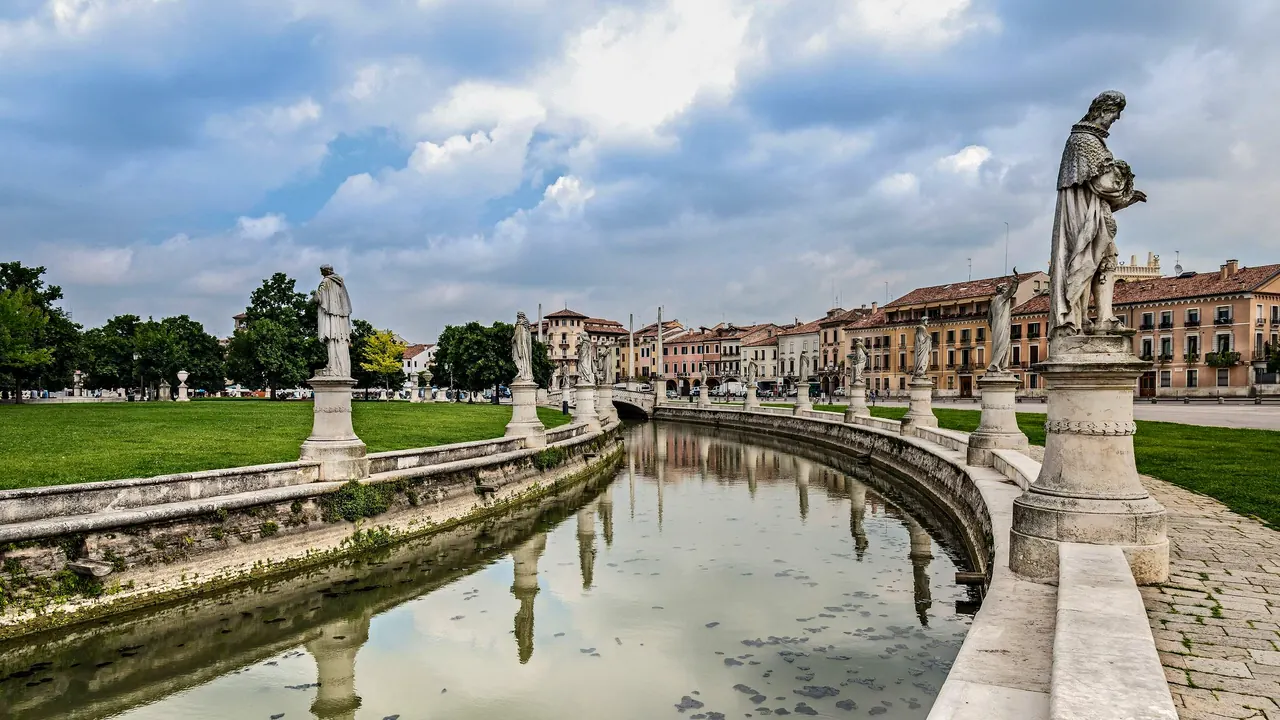
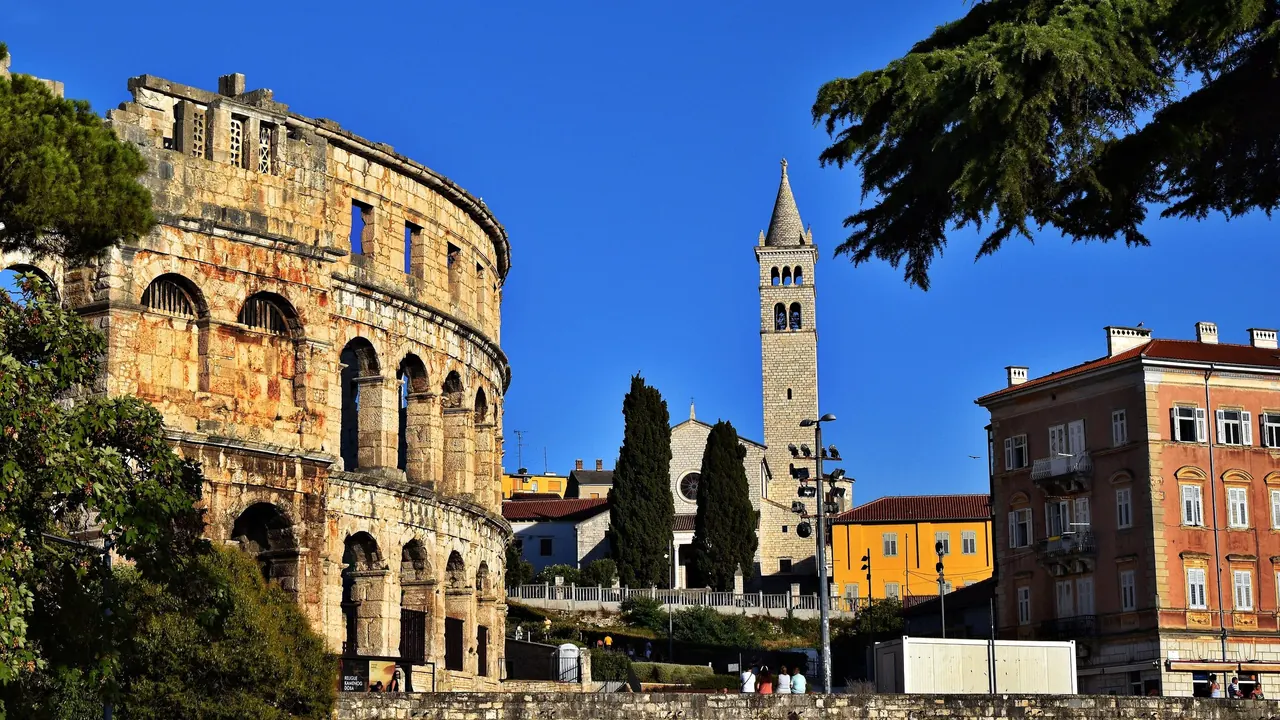
Photos: Padua by Didier Descouens, CC BY-SA 4.0, cropped; Pula by Miroslav.vajdic, CC BY-SA 4.0, cropped.
Padua or Pula?
Our verdict in twelve categories, each scored against the same fixed benchmark cities, and the climate month by month, so you can choose for your trip.
Choose Padua for
- wellness
- getting around
- day trips
Padua suits a traveller who wants art and history in depth and a good base for exploring the region. Giotto's frescoes in the Scrovegni Chapel, the Basilica of Saint Anthony and the old university fill a couple of days. After that, fast trains reach Venice, Vicenza, Verona and Bologna without a car, and the thermal pools of Abano Terme are a short ride away for a soak at the end of the day.
Choose Pula for
- beaches
- families
- nature and the outdoors
For sea, sun and a slower summer, Pula is the better choice. The Roman Arena and Forum are worth a day or two, but the real draw is the clear water off the rocky coves of Verudela, Stoja and Cape Kamenjak, with shallow bays at Medulin for children. With a hire car, the Istrian hill towns, Rovinj and the Brijuni islands are all within reach.
Scoreboard
Twelve categories on one fixed scale from 0 to 100. The shaded stretch is the gap between the two.
Your match
Pick a travel style or drag the sliders, and both match scores follow your weighting.
Wins on wellness and getting around with your weighting.
Wins on beaches and families with your weighting.
What matters to you?
Category by category
What the scores mean for a trip.
Beaches & swimming
Pula is the beach destination here, and Padua is not. Padua sits inland, and its nearest sand at Sottomarina or the Lido of Venice is about an hour away: long, flat rows of umbrellas in shallow, calm water. It is fine for a day out but not a reason to stay.
Pula's swimming is right on the edge of town, off rocks, concrete platforms and pebble coves around Verudela and Stoja. The best of it is at Cape Kamenjak, where the water is very clear. Bring water shoes, and head to Medulin if you want gently shelving water.
Food & drink
Padua offers more within the city itself. The morning markets in Piazza delle Erbe and Piazza della Frutta, the delicatessens under the Palazzo della Ragione, Venetian dishes such as bigoli and baccalà, and the early-evening spritz in the squares all give a stay a daily food rhythm. Caffè Pedrocchi adds an old coffee-house tradition.
Pula's Istrian cooking is just as distinctive, with truffle pasta, scampi buzara, pršut and Malvazija. The best meals are often found in hinterland konobas or harbour taverns rather than in town, where the tables near the Arena lean towards tourist menus.
Culture & sights
Both cities have Roman or medieval landmarks of real stature, but Padua's run deeper. Giotto's Scrovegni frescoes and the UNESCO-listed fourteenth-century fresco cycles around them belong in the history of European art. Add Donatello's work at the Basilica of Saint Anthony, the world's oldest permanent anatomical theatre and the 1545 botanical garden.
Pula's strength is one great monument and the Roman town around it: the Arena with its complete outer ring, the Temple of Augustus on the Forum and the Arch of the Sergii. Its Austro-Hungarian naval forts add a later layer. A day or two covers it.
Nightlife
Neither city is built for a big night out, but Padua has the livelier evenings. Its students keep the aperitivo crowd in Piazza delle Erbe and Piazza dei Signori going late, even on weekdays during term.
Pula's nights depend on summer, with terraces around the Forum, then beach bars on Verudela and a handful of small clubs. The two run on opposite calendars: Padua goes quiet in high summer and the university breaks, just when Pula is at its busiest.
Nature & outdoors
Pula's outdoors begin at the edge of town. The car-free headland of Kamenjak has cliffs, wild flowers and dinosaur footprints, and there is sea kayaking around the islets, windsurfing in Premantura bay and wreck diving from the naval era.
Padua needs a short trip first. The Euganean Hills, 15km away, offer vineyard trails and good road cycling, and the Brenta towpaths make gentle bike rides. Proper mountain walking on Monte Grappa or the Asiago plateau is about an hour and a half by car.
Day trips
Padua is one of the best bases in Italy. Venice is under half an hour by train, so you can visit it several times and sleep somewhere calmer. Vicenza, Verona, Treviso, Bologna and Ferrara are all easy rail outings, and the Brenta villas and the walled towns around the Euganean Hills are closer still.
Pula has a fine list of its own: Rovinj, the Euphrasian Basilica at Poreč, the hill towns of Motovun and Hum, and the Brijuni islands. Most of these need a car, though, and the longer trips to Piran or Trieste take around two hours.
Good for families
Pula is the easier choice with children because the days organise themselves around the sea. There are shallow bays at Medulin and Premantura, the aquarium in a fort on Verudela, the Arena's tunnels, and a dinosaur park and water park within an hour. Rocky shores and summer heat still take some managing.
Padua is safe, flat and welcoming, and Prato della Valle gives children room to run. But its sights are frescoes and churches, so families usually rely on trips to Gardaland or Lake Garda.
Getting around
Padua is much simpler without a car. Its sights lie within a 20-minute walk under sheltering arcades, a tram links the station with the centre, and the station puts half of northern Italy within easy reach by train.
Pula's compact old town is just as easy on foot, and buses serve Verudela. Beyond the city, however, the slow rail line and sparse regional buses leave Kamenjak, the hill towns and the wider coast largely to drivers and scooter riders.
Shopping & style
Padua gives a shopper more to browse. Its arcaded streets have Italian fashion and shoe shops, independent boutiques and university bookshops, and a large antiques market fills Prato della Valle one Sunday a month.
Pula's shopping is mostly about food to take home: Istrian olive oil, truffle products, honey, rakija and pršut from the market hall or straight from producers. In both cities the food markets are the best place to buy something worth carrying home.
Affordability
Overall the two cost about the same, but the pattern differs. Padua is moderate all year, a cheaper bed for those visiting Venice and the region by train, with rooms dearer around trade fairs and graduation season.
Pula swings with the season. Spring and autumn in private apartments are good value, while July and August rooms cost about as much as on Western European coasts. Car hire and boat trips add up quickly.
Live music & performing arts
Neither city has a big stage scene, but they offer different things. Padua has a modest programme that runs through the year: prose and some opera at Teatro Verdi, a resident chamber orchestra, and concerts in the frescoed Sala dei Giganti. The Fenice in Venice and Verona's summer Arena are easy to reach.
Pula's highlight is seasonal: a summer concert or a Pula Film Festival screening under the arches of the Roman Arena. Outside summer, the Istrian National Theatre performs mainly in Croatian.
Wellness & relaxation
Padua is far stronger for a restful stay. Abano Terme and Montegrotto Terme, about 12km away, form one of Europe's largest thermal districts, with hot mineral water and mud treatments used since Roman times. Many spa hotels take day visitors, so you can combine a morning of frescoes with an afternoon in the pools.
Pula has no spa tradition of its own beyond resort hotel saunas on Verudela and in Medulin. It relies instead on coastal paths through the pines and a slow pace outside high summer.
When should you go?
Pick your month. The climate figures are measured averages, not a forecast.
Padua in July
Pula in July
Daytime high, °C
Rainfall in the month, mm
Where the figures come from
Padua's temperatures are measured 35 km from the centre, at Treviso / Istrana.
Padua has no rain gauge within 25 km of the centre, so its rainfall comes from a gridded climate dataset read at the city rather than from a gauge further away.
Padua's sunshine is measured 36 km from the centre, at Treviso / S. Angelo.
Pula's temperatures are measured 87 km from the centre, at Trieste.
Pula has no rain gauge within 25 km of the centre, so its rainfall comes from a gridded climate dataset read at the city rather than from a gauge further away.
Temperature and rainfall are climate normals, averaged over the years shown. Padua: 1991-2020 normals, Treviso / Istrana (35.4 km from centre). Pula: 1991-2020 normals, Trieste (87 km from centre).
Padua is at its best in April and May and again in September and October, when the days are mild enough to walk the arcades and squares in comfort. July and August reach about 31°C on the humid plain, which makes sightseeing heavy going. Winter brings cold days and low fog. Rain falls fairly evenly through the year, with no real dry season, and late autumn is the wettest stretch.
Pula's summer is a little less hot, at about 29°C, and noticeably drier and sunnier, so June to September is easy beach weather, with the sea at about 25°C in August. The rain arrives in September and peaks in November at about 107mm. For a swim, choose Pula in high summer. For walking either city, spring and early autumn are kinder than midsummer.
Which traveller are you?
On a beach and sun trip, Pula is the clear choice. Clear water, pine-shaded coves on Verudela and the wild inlets of Cape Kamenjak sit right on its doorstep. From Padua the nearest flat Adriatic sand is an hour away.
For a relaxing and wellness trip, Padua wins. Abano Terme and Montegrotto, one of Europe's largest thermal districts, lie just outside town and welcome day visitors to their hot mineral pools. Pula offers only hotel spas and an easy off-season pace.
On a family trip with children, Pula works better. Shallow bays around Medulin, an aquarium inside an old fort and the Arena's underground passages keep children busy. In Padua the main sights are frescoes and churches, and there is little made for children.
Before you go
| Measure | Padua | Pula |
|---|---|---|
| Official language | Italian | Croatian |
| Currency | Euro (EUR) | Euro (EUR) |
| Sockets | CFL230 V, 50 Hz | CF230 V, 50 Hz |
| Driving side | Right | Right |
| Time zone | UTC+1, UTC+2 in summer | UTC+1, UTC+2 in summer |
| Emergency number | 112 | 112 |
| Elevation | 12 m | 5 m |
| Main airport | Venice Marco Polo Airport (VCE)39 km from centre103 non-stop destinations | Pula Airport (PUY)7 km from centre34 non-stop destinations |
| Public holidays this year | 13 days | 14 days |
By the numbers
| Measure | Padua | Pula |
|---|---|---|
| City population | 206,496 | 52,220 |
| People per km² | 2,220 | 971 |
| Museums within 10 km | 29 | 4 |
| UNESCO World Heritage sites within 50 km | 5 | 1 |
| Swim season, months above 21 °C | 4 months | 4 months |
Where else could you go?
Every comparison below shares a destination with this one, so you can follow Padua or Pula somewhere new.