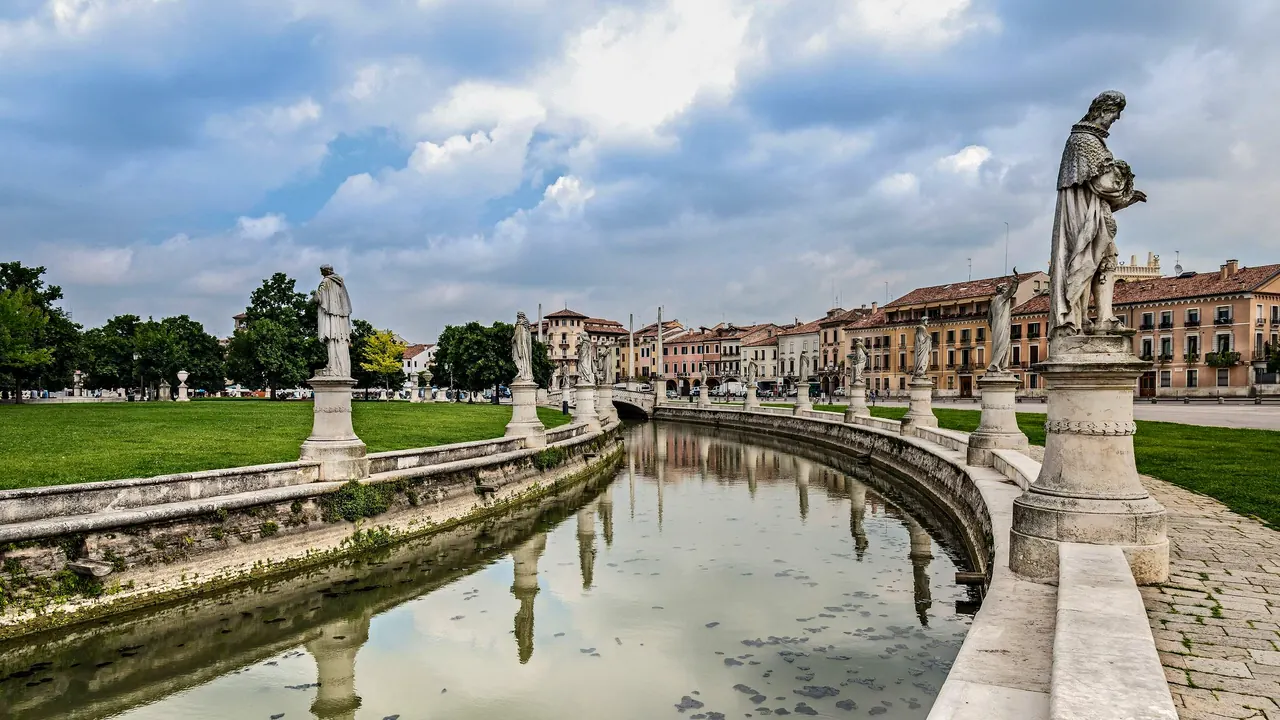
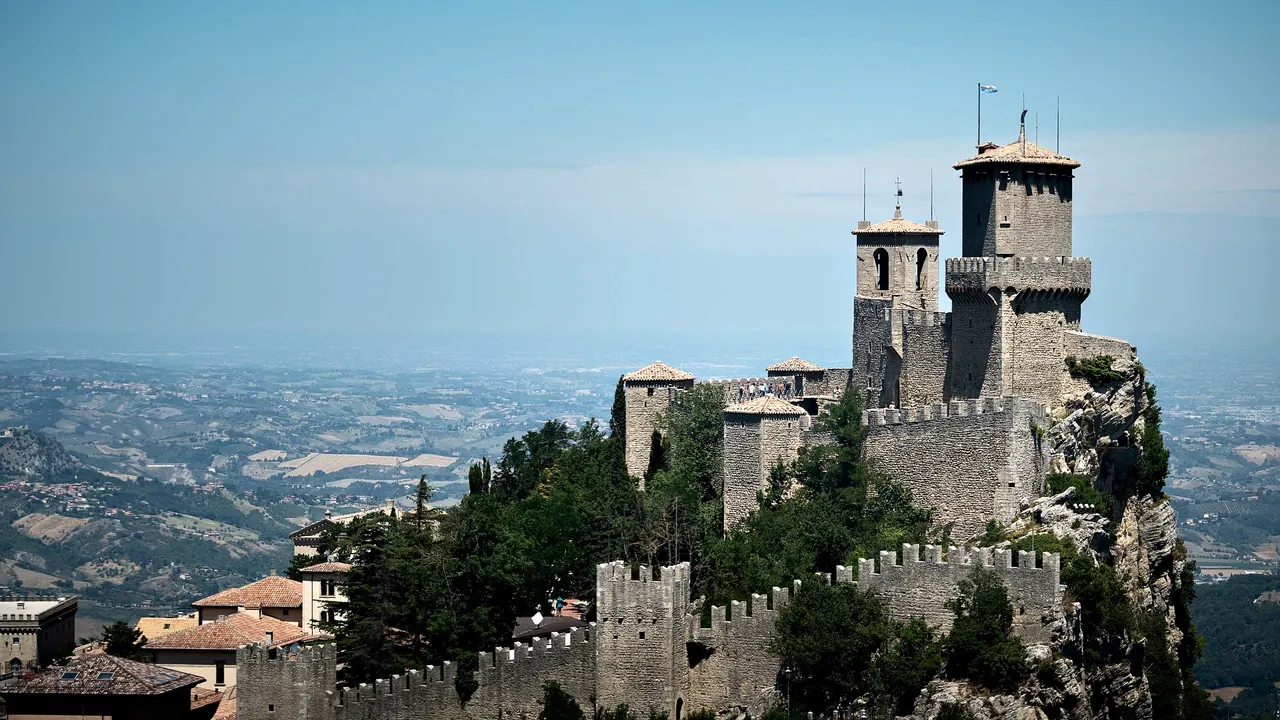
Photos: Padua by Didier Descouens, CC BY-SA 4.0, cropped; San Marino by Tibor Szabo, Pexels License.
Padua or San Marino?
Our verdict in twelve categories, each scored against the same fixed benchmark cities, and the climate month by month, so you can choose for your trip.
Choose Padua for
- wellness
- nightlife
- getting around
Padua suits travellers who want substance and a good base. Giotto's frescoes in the Scrovegni Chapel, the Basilica of Saint Anthony and the old university give it real cultural weight. The station puts Venice, Vicenza, Verona and Bologna within easy reach, and the thermal pools of Abano Terme are just outside town. Choose it for a week of art, markets, spritz in the squares and train day trips, all without a car.
Choose San Marino for
- beaches
- families
San Marino is the better pick for a short, scenic stop with the Adriatic close by. The walled summit town on Monte Titano, its three towers and the long views over Romagna make a memorable half day, and the Rimini and Riccione beaches are close enough for afternoons by the sea. It works best for travellers with a car who want to combine a mountain republic, hill towns such as San Leo and Urbino, and a beach.
Scoreboard
Twelve categories on one fixed scale from 0 to 100. The shaded stretch is the gap between the two.
Your match
Pick a travel style or drag the sliders, and both match scores follow your weighting.
Wins on wellness and nightlife with your weighting.
Wins on beaches and families with your weighting.
What matters to you?
Category by category
What the scores mean for a trip.
Beaches & swimming
Neither is a beach destination, but San Marino has the easier route to the sea. Rimini and Riccione are roughly half an hour downhill, close enough to see from the walls, so a beach afternoon is a simple add-on.
From Padua the sand at Sottomarina or the Venice Lido is about an hour away by car or by train and boat, which makes it a full outing. Both coasts are the same flat Adriatic stretch of umbrellas and shallow, calm water, so the real difference is distance rather than scenery.
Food & drink
Padua eats noticeably better. Its morning markets in Piazza delle Erbe and Piazza della Frutta, Venetian dishes such as bigoli with duck sauce and baccalà, and the early-evening spritz ritual give a stay a strong food rhythm, and Caffè Pedrocchi adds a grand old coffee house.
San Marino's Romagna cooking of piadina, passatelli and strozzapreti is honest, but many summit terraces sell the view more than the meal. The better plates are down in Borgo Maggiore's trattorias or over the border in the countryside.
Culture & sights
Padua has much more to see. The Scrovegni Chapel alone justifies a visit, and around it are the Eremitani and Baptistery frescoes, the Basilica of Saint Anthony, Palazzo della Ragione's vast hall, Palazzo Bo and the botanical garden founded in 1545.
San Marino's appeal is the setting and its history as an ancient republic: the towers of Guaita and Cesta on the cliff edge, the Palazzo Pubblico and a few small museums. It makes a striking half day, while Padua rewards two or three days of art.
Nightlife
Padua at least has an evening scene. Students and locals fill Piazza delle Erbe and Piazza dei Signori over spritz until late, with wine bars in the old ghetto during term, though it is sociable rather than clubby.
San Marino goes quiet once the coaches leave, offering little more than dinner on a terrace above the coast lights. For a real night out you have to drive down to the Riviera clubs at Rimini.
Nature & outdoors
Padua has the stronger outdoor options despite its flat setting. The volcanic Euganean Hills about 15km away have trails, vineyards and cycling roads, the Brenta towpaths make easy rides, and the pre-Alps around Monte Grappa and Asiago offer proper mountain walking.
San Marino puts you on the scenery itself, with cliff paths between the towers and views across to the Apennines. However, it is limited to short walks and drives through the Montefeltro hills.
Day trips
Both make good bases, but Padua is the stronger one. Venice is under half an hour by train, Vicenza a quarter of an hour, and Verona, Bologna and Ferrara are all an easy rail hop away, with the Brenta villas and the walled towns of Este and Montagnana close by.
San Marino's list is attractive too: the fortress of San Leo, ducal Urbino, Ravenna's mosaics and Gradara. Most of these need a car, though, because the only regular public link is the bus down to Rimini.
Good for families
San Marino has the slight edge with children, thanks to towers to climb, battlements, a cable car ride and Italia in Miniatura, Fiabilandia and the waterparks along the coast below. Its steep streets and steps are hard work with a pushchair.
Padua is flat, pedestrianised and easy to manage, with Prato della Valle for running about. Its own sights are mostly frescoes, so families usually head out to Gardaland and Lake Garda.
Getting around
Padua is much easier to move around. Its centre is flat and arcaded, most sights are within a 20-minute walk, a tram runs from the station, and the main-line rail hub makes a car unnecessary.
San Marino is compact but almost every street climbs or descends by steps. Arriving without a car means the bus from Rimini, and beyond the summit and its cable car, village buses are infrequent.
Shopping & style
Padua is the better place to shop, though neither is a destination for it. Its arcades have Italian fashion, shoe shops, university bookshops and delicatessens under the Palazzo della Ragione, plus a monthly antiques market on Prato della Valle.
San Marino's streets lean towards souvenirs, decorative crossbows, stamps and coins, and lower-tax perfume, watches and spirits, with an outlet centre in the valley.
Affordability
Costs are much the same in both: moderate, northern or central Italian prices rather than resort rates. The difference lies in where the premium falls. In Padua, rooms cost more around trade fairs and graduations, but a walkable centre keeps transport costs down.
In San Marino, the summit hotels and view terraces cost more than places a few kilometres downhill, while lower taxes make fuel and spirits cheaper.
Live music & performing arts
Padua has a real, if modest, programme. Teatro Verdi stages drama and some opera, and the chamber orchestra plays in settings such as the frescoed Sala dei Giganti. The Fenice in Venice and the Arena in Verona are both an easy trip away.
San Marino has little beyond occasional local concerts and the costumed Medieval Days festival in summer.
Wellness & relaxation
This is one of the widest gaps between the two. Padua sits beside Abano Terme and Montegrotto, one of Europe's largest thermal districts, where many spa hotels welcome day visitors to their hot mineral pools, a short ride from the sights.
San Marino has no bathing tradition and only a few hotel spas. What it offers is calm after the day crowds leave, with evening walks along the walls.
When should you go?
Pick your month. The climate figures are measured averages, not a forecast.
Padua in July
San Marino in July
Daytime high, °C
Rainfall in the month, mm
Where the figures come from
Padua's temperatures are measured 35 km from the centre, at Treviso / Istrana.
Padua has no rain gauge within 25 km of the centre, so its rainfall comes from a gridded climate dataset read at the city rather than from a gauge further away.
Padua's sunshine is measured 36 km from the centre, at Treviso / S. Angelo.
San Marino's temperatures are measured 52 km from the centre, at Frontone.
San Marino has no rain gauge within 25 km of the centre, so its rainfall comes from a gridded climate dataset read at the city rather than from a gauge further away.
Temperature and rainfall are climate normals, averaged over the years shown. Padua: 1991-2020 normals, Treviso / Istrana (35.4 km from centre). San Marino: 1991-2020 normals, Frontone (51.5 km from centre).
The two places follow a similar seasonal pattern, but the details differ. Padua, on the plain, has the hotter summer, with highs around 31°C in July and August that can make sightseeing heavy going, and its sunshine peaks in July. San Marino stays a little cooler on its ridge. In both, June to early September is beach weather, with the Adriatic at about 25°C in July and warmer still in August. May, late September and early October are the most comfortable months for walking the streets.
The rain comes at different times. In Padua it is fairly steady from spring onwards and peaks at nearly 100mm in November, and in winter fog often settles over the plain. San Marino has its driest month in July, then turns wet from September, with October and November the wettest months on the mountain. Winters are cold in both. From December to February daytime highs stay at about 10°C or below, and the mountain is a degree or two colder than the plain.
Which traveller are you?
For a beach and sun trip, San Marino is the closer match. The sandy Romagna shore at Rimini and Riccione is about half an hour below the mountain, so mornings on the battlements and afternoons by the sea fit into the same day.
On a culture and arts trip, Padua is far ahead. It has Giotto's Scrovegni frescoes, a UNESCO-listed group of fresco cycles, Donatello at the Basilica of Saint Anthony and the historic anatomical theatre, and a chamber orchestra season fills the evenings.
For a relaxing and wellness trip, Padua has the thermal district of Abano and Montegrotto about 12km away, with hot mineral pools and mud treatments. San Marino has only a few hotel spas and its quiet evenings on the walls.
Before you go
| Measure | Padua | San Marino |
|---|---|---|
| Official language | Italian | Italian |
| Currency | Euro (EUR) | Euro (EUR) |
| Sockets | CFL230 V, 50 Hz | CFL230 V, 50 Hz |
| Driving side | Right | Right |
| Time zone | UTC+1, UTC+2 in summer | UTC+1, UTC+2 in summer |
| Emergency number | 112 | 112 |
| Elevation | 12 m | 675 m |
| Main airport | Venice Marco Polo Airport (VCE)39 km from centre103 non-stop destinations | Bologna Guglielmo Marconi Airport (BLQ)114 km from centre98 non-stop destinations |
| Public holidays this year | 13 days | 18 days |
By the numbers
| Measure | Padua | San Marino |
|---|---|---|
| City population | 206,496 | 4,040 |
| People per km² | 2,220 | 569 |
| Museums within 10 km | 29 | 19 |
| UNESCO World Heritage sites within 50 km | 5 | 2 |
| Swim season, months above 21 °C | 4 months | 4 months |
Where else could you go?
Every comparison below shares a destination with this one, so you can follow Padua or San Marino somewhere new.
- Venicevs Padua
- Veronavs Padua
- Assisivs San Marino
- Florencevs San Marino
- Bolognavs San Marino
- Bolognavs Padua