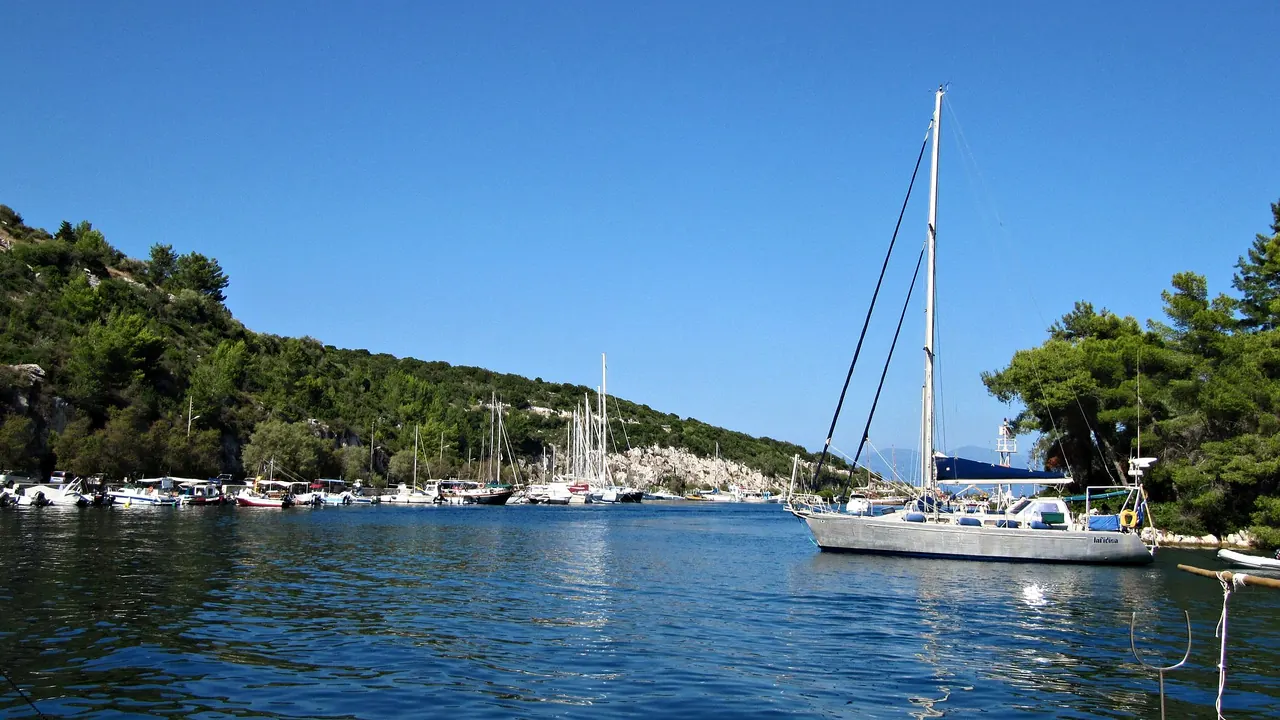
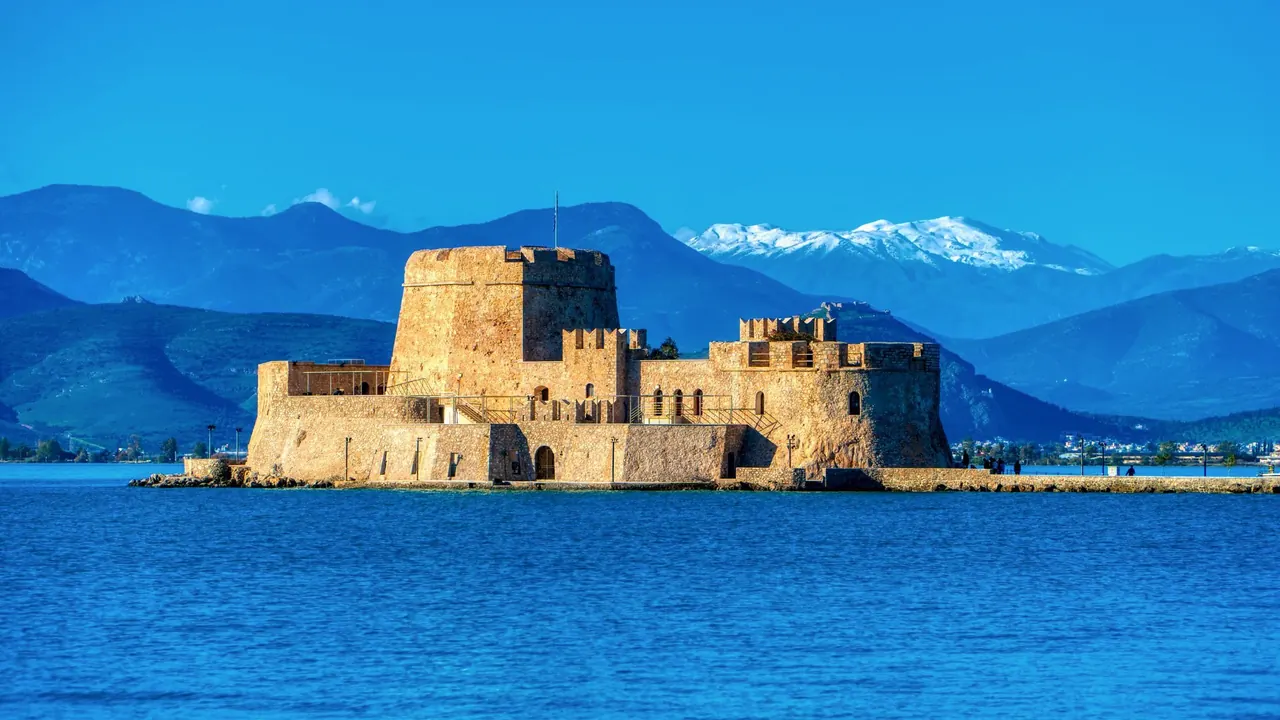
Photos: Paxos by Poiesia, CC BY-SA 4.0, cropped; Peloponnese by Alex Ravvas, Pexels License.
Paxos or Peloponnese?
Our verdict in twelve categories, each scored against the same fixed benchmark cities, and the climate month by month, so you can choose for your trip.
Choose Paxos for
Paxos does not lead in any category we score.
Paxos suits travellers who want one small island and very little else: a villa in the olive groves, a hired boat, and days spent moving between pebble coves and the sandy bays of Antipaxos. Everything is within a short drive or a walk, evenings end on a harbour front, and there is almost nothing you feel you ought to be seeing. That calm is the point, and it costs you depth in food, history and outings.
Choose Peloponnese for
- culture and sights
- day trips
- prices
The Peloponnese is the better choice for almost any trip that wants more than swimming. It pairs beaches just as good as Paxos's with Mycenae, Olympia, Mystras and Epidaurus, real mountains to walk in, wine country around Nemea and village cooking that costs noticeably less. The price is time at the wheel, as distances are long and a car is close to essential, so it rewards travellers happy to change base or drive for their sights.
Scoreboard
Twelve categories on one fixed scale from 0 to 100. The shaded stretch is the gap between the two.
Your match
Pick a travel style or drag the sliders, and both match scores follow your weighting.
Has no clear advantage with the weighting you have chosen.
Wins on culture and sights and day trips with your weighting.
What matters to you?
Category by category
What the scores mean for a trip.
Beaches & swimming
Both are excellent for swimming, but they offer different kinds of beach. Paxos itself has small pebble coves on its sheltered east coast and calm sandy shallows at Lakka. Its best sand is across the water on Antipaxos, so a beach day there often means a hired motorboat and coves that no road reaches.
The Peloponnese offers far more coastline to choose from. There is the sand of Voidokilia and Navarino Bay in Messinia, the tropical-looking water of Elafonisos, rocky swims in the Mani and easy family beaches at Tolo. The beaches are spread over hundreds of kilometres rather than gathered around a single island.
Food & drink
Paxos eats well but within narrow limits: grilled fish, bourdeto and sofrito at harbour tavernas in Gaios, Lakka and Loggos. Menus vary little, and many kitchens close once summer ends.
The Peloponnese is the better table. Kalamata olives, Mani cured pork, slow-cooked goat and wild greens come with the region's own wines, the red Agiorgitiko from Nemea and the Moschofilero white from the Tripoli plateau. Kalamata and Nafplio have the widest choice of places to eat.
Culture & sights
This is where the two differ most. On Paxos, culture means a Venetian fort ruin and a monastery on the islets off Gaios, a small folk museum and the old olive presses you pass on a walk. Anyone wanting serious history takes the boat to Corfu Town.
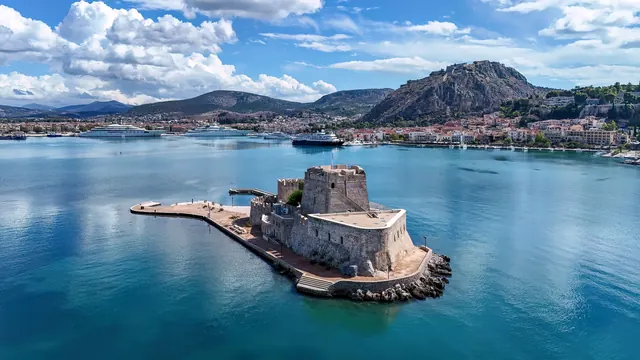
The Peloponnese holds a large share of ancient Greece: Mycenae's Lion Gate, the theatre at Epidaurus, Olympia, Ancient Corinth and the lone temple at Bassae. Above these sit Mystras, Monemvasia and the Venetian castles of Methoni and Koroni. Nafplio makes the obvious base for the Argolid sites.
Nightlife
Neither is a place to come for going out, but the Peloponnese has more of it. Paxos offers waterfront drinks beside the moored yachts in Gaios or Lakka, with only a little dancing in high summer.
On the mainland, Nafplio's old town and Kalamata's seafront stay busy late with café-bars and cocktail bars full of locals. Patras, a university city, has the region's only proper club scene, at its busiest during carnival.
Nature & outdoors
Paxos's scenery is mostly on its west coast: the white Erimitis cliffs, the Tripitos arch and sea caves best seen from a kayak. Inland there are gentle olive-grove paths along the end-to-end trail, with no high ground anywhere.
The Peloponnese is wilder by a wide margin. Taygetos rises to about 2,400m, the Lousios gorge links cliffside monasteries, and the Menalon Trail crosses Arcadia. Add the stark Mani peninsula, the bird lagoon at Gialova and winter skiing on Chelmos.
Day trips
From Paxos every outing depends on the boats and the sea: Corfu Town about an hour away by fast ferry, Parga and Sivota on the mainland, and the Antipaxos beaches. Once those are done, there is little else to do.
The Peloponnese gives you far more choice, as long as you have a car. Hydra and Spetses are short ferry rides from the southern Argolid, Athens is about two hours by road, and Monemvasia, Elafonisos and the Arcadian hill villages each fill a good day.
Good for families
Paxos suits families with older children who love swimming and snorkelling, and Lakka's shallow bay is the one easy spot for toddlers. Steep paths down to pebble coves and nothing to do on rainy days make it harder with little ones.
The Peloponnese works better for families. It has more shallow sandy bays, resort hotels in Messinia with kids' clubs and pools, and Mycenae or Olympia for curious older children, best visited early in the day. The trade-off is long hours in the car.
Getting around
Both are hard work without your own wheels, in different ways. Paxos has no airport and depends on ferries that rough seas can cancel, but once you are there it is only about 10km long. A small car, a scooter or a hired boat covers it easily.
The Peloponnese is easy to reach and has fast motorways between its main towns, but mountain and Mani roads are slow, and buses rarely reach the sites or beaches. Here the car is less a convenience than a necessity.
Shopping & style
On Paxos, shopping means a few summer boutiques in the lanes behind the harbours in Gaios and Lakka, selling linen, beachwear and jewellery. Anything practical means a trip to Corfu. Nafplio's old lanes are the closest either comes to a proper shopping street, with ceramics, jewellery and worry beads among the souvenir shops.
On both, the best things to take home are edible. Paxos has its own olive oil and honey, but the Peloponnese has far more choice: wine bought straight from the Nemea wineries, Kalamata olives, mountain herbs and the weekly markets in Kalamata and Tripoli.
Affordability
Paxos is an expensive island. Villas and guesthouses book up early for summer, harbourside dining charges for the view, and ferries and boat or car hire push the cost up further.
The mainland Peloponnese costs noticeably less, above all in the villages of the Mani and Arcadia, where family-run rooms and taverna meals are good value. The main extra costs are a hire car, fuel and entry to the big sites. On both, May, June and September are the cheaper months.
Live music & performing arts
Paxos has very little: an end-of-summer chamber music festival in churches and squares, and traditional music and dancing at saints' day feasts, above all the Panagia in August.
The Peloponnese has one event worth planning a trip around, ancient drama on summer weekend nights in the theatre of Epidaurus, where the actors need no amplification. Kalamata's July dance festival adds to it.
Wellness & relaxation
Thermal bathing is the one thing the Peloponnese has and Paxos lacks. Paxos offers a quieter kind of rest in a small space: villas among the olive trees, few cars, no high-rise building, yoga weeks on some estates and only a handful of treatment rooms.
On the mainland, the old spa towns of Loutraki and Methana and the sulphur-fed lake at Kaiafas give you the soak Paxos cannot, and the Messinian resort hotels have the region's most complete spas. They are spread across the region, though, so you will not have them on your doorstep.
When should you go?
Pick your month. The climate figures are measured averages, not a forecast.
Paxos in July
Peloponnese in July
Daytime high, °C
Rainfall in the month, mm
Where the figures come from
Paxos's temperatures are measured 52 km from the centre, at Kerkyra Airport.
Paxos has no rain gauge within 25 km of the centre, so its rainfall comes from a gridded climate dataset read at the destination rather than from a gauge further away.
Peloponnese's temperatures are measured 89 km from the centre, at Kalamata Airport.
Peloponnese has no rain gauge within 25 km of the centre, so its rainfall comes from a gridded climate dataset read at the destination rather than from a gauge further away.
Temperature and rainfall are climate normals, averaged over the years shown. Paxos: 1991-2020 normals, Kerkyra Airport (52.1 km from centre). Peloponnese: 1991-2020 normals, Kalamata Airport (89 km from centre).
In high summer the two are almost identical. Both reach about 32°C in July and August, which is too hot for long walks in the middle of the day. Both have seas warm enough for swimming from June to October, peaking near 26°C in August, and at the measured Peloponnese point the water warms a little faster in July than around Paxos. May is the gentler month for walking and sightseeing in both places, though the sea is still cool for most swimmers.
They part ways in autumn and winter. Paxos, out in the Ionian, turns wet early. The rain returns in September and reaches about 108mm in October, against 47mm at the measured point on the Peloponnese. The mainland also keeps more sunshine through the cooler months, so October there is still a fair month for touring ancient sites and mountain villages, while on Paxos outdoor days become hit and miss.
Which traveller are you?
On a culture and arts trip, the Peloponnese wins without contest. Mycenae, Epidaurus, Olympia, Messene and Byzantine Mystras are all within the region, with summer drama in the ancient theatre at Epidaurus, while Paxos has a ruined islet fort and a small museum.
For a trip on a tight budget, the Peloponnese is far easier. Family-run rooms in Mani and Arcadian villages and cheap taverna meals go a long way, whereas Paxos is a pricey island where villas, ferries and boat hire all add up quickly.
On a relaxing and wellness trip, Paxos is the purer escape. Its villas sit quietly among olive groves, there is hardly any traffic and a slow harbour morning sets the pace. The Peloponnese has more spas and thermal springs, but it also brings long drives between places.
Before you go
| Measure | Paxos | Peloponnese |
|---|---|---|
| Official language | Greek | Greek |
| Currency | Euro (EUR) | Euro (EUR) |
| Sockets | CF230 V, 50 Hz | CF230 V, 50 Hz |
| Driving side | Right | Right |
| Time zone | UTC+2, UTC+3 in summer | UTC+2, UTC+3 in summer |
| Emergency number | 112 | 112 |
| Main airport | Corfu Ioannis Kapodistrias International Airport (CFU)88 non-stop destinations | Athens Eleftherios Venizelos International Airport (ATH)176 non-stop destinations |
| Public holidays this year | 15 days | 15 days |
By the numbers
| Measure | Paxos | Peloponnese |
|---|---|---|
| Population | 2,300 | - |
| People per km² | 91 | - |
| Swim season, months above 21 °C | 5 months | 5 months |
Where else could you go?
Every comparison below shares a destination with this one, so you can follow Paxos or Peloponnese somewhere new.
- Corfuvs Paxos
- Aeginavs Peloponnese
- Lefkadavs Paxos
- Hydravs Peloponnese
- Kefaloniavs Paxos
- Zakynthosvs Paxos