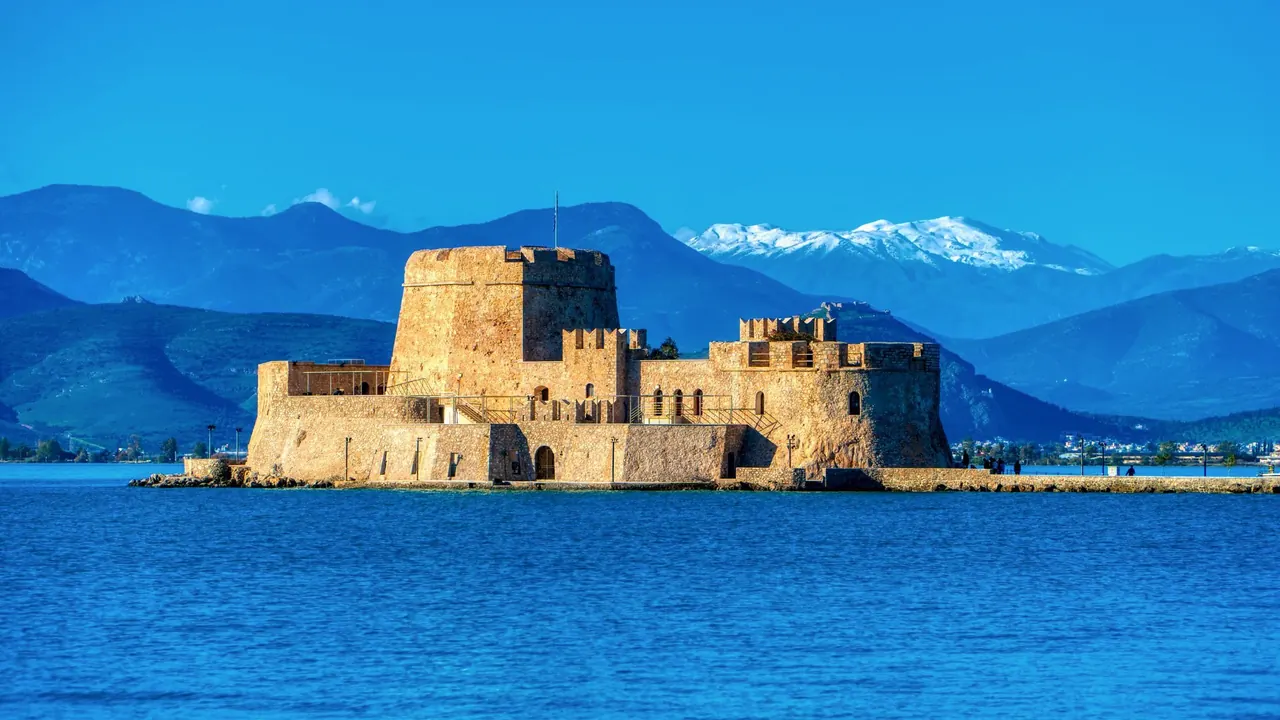
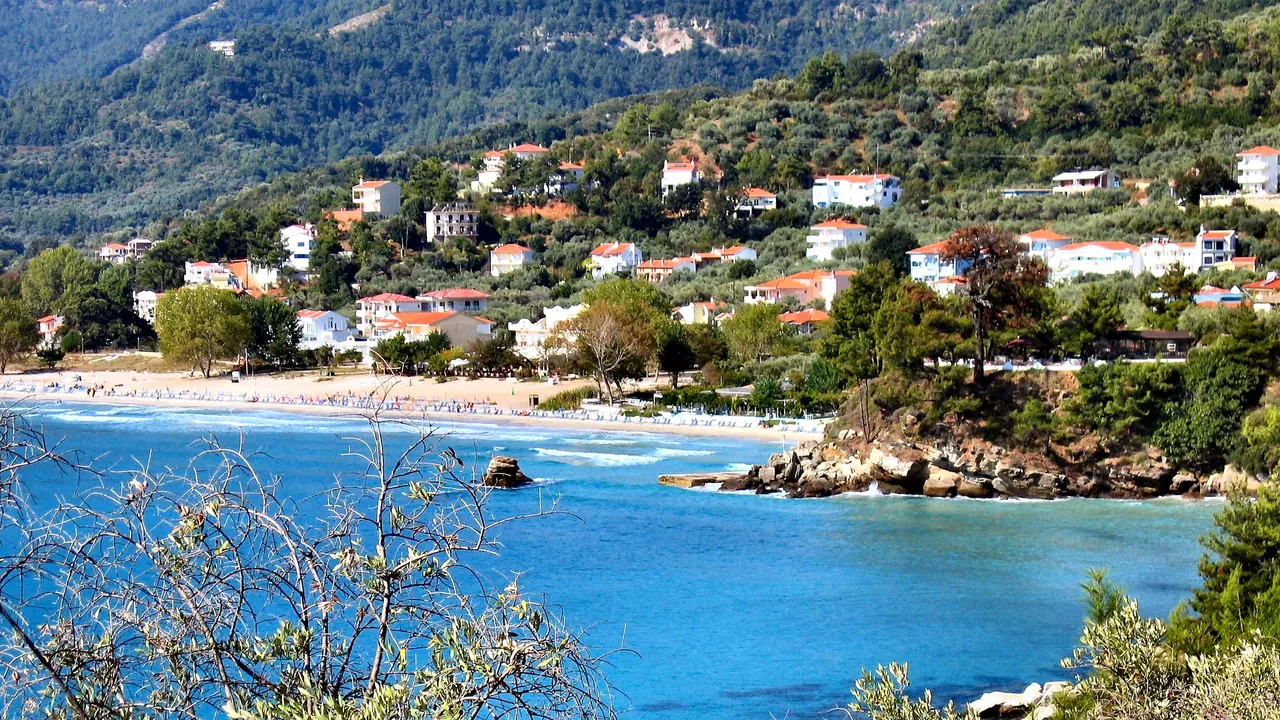
Photos: Peloponnese by Alex Ravvas, Pexels License; Thassos by Ronald Saunders from Warrington, UK, CC BY-SA 2.0, cropped.
Peloponnese or Thassos?
Our verdict in twelve categories, each scored against the same fixed benchmark cities, and the climate month by month, so you can choose for your trip.
Choose Peloponnese for
- culture and sights
- day trips
- food and drink
The Peloponnese is the choice for a road trip through Greek history with good swimming along the way. Mycenae, Epidaurus, Olympia, Mystras and Monemvasia lie within one region, and between the sites there are Messinian beaches, Nemea wine and mountain villages in Arcadia. What it asks in return is a lot of driving and probably more than one base, because the Argolid, the Mani and the west coast are far apart.
Choose Thassos for
- getting around
- prices
- beaches
Thassos suits a simpler trip: one green island, one ring road and a different beach every day without long drives. It is slightly cheaper, the resorts are small and easy, and the crossing from Kavala or Keramoti is short. The trade-off is that there is little to do beyond swimming, a walk in the hills and the ruins around Limenas, and evenings stay quiet.
Scoreboard
Twelve categories on one fixed scale from 0 to 100. The shaded stretch is the gap between the two.
Your match
Pick a travel style or drag the sliders, and both match scores follow your weighting.
Wins on culture and sights and day trips with your weighting.
Wins on getting around and prices with your weighting.
What matters to you?
Category by category
What the scores mean for a trip.
Beaches & swimming
These two are about equal for swimming, but the beaches differ in kind. In the Peloponnese the best beaches lie along a long coast: the horseshoe of Voidokilia and Navarino Bay in Messinia, the tropical-looking sand of Elafonisos in the far south and pebble coves below the Mani villages. Seeing them all means moving between bases. The sea also stays warm a few weeks longer into October.
Thassos puts its beaches in a ring that can all be reached from one base. There is fine sand at Golden Beach, white marble pebbles at Saliara, pine-backed coves at Aliki and Paradise Beach, and Giola, a natural rock pool near Astris.
Food & drink
The Peloponnese gives a food lover much more to work with. Kalamata olives and oil, Mani cured pork, red wine from Nemea's Agiorgitiko grape and Moschofilero whites from the Tripoli plateau all come from a real farming region. Kalamata's covered market and Nafplio's mix of ouzeri and more ambitious kitchens add range.
Thassos eats well but simply: grilled octopus at the harbours, roast goat in Theologos and Panagia, pine honey and spoon sweets, tsipouro with small plates. Resort menus repeat, and many kitchens close outside summer.
Culture & sights
This is where the two differ most. The Peloponnese is one of the great regions of the ancient Greek world: Mycenae's Lion Gate, the theatre at Epidaurus, Olympia, Messene and the lonely temple at Bassae. On top of that come the medieval layers of Mystras, Monemvasia and the Venetian castles of Methoni and Koroni. You could fill a whole trip and still not see everything.
On Thassos the sights cluster around Limenas, with its agora, its theatre in the pines and a museum holding the kouros carrying a ram, plus the marble quarries at Aliki and the slate-roofed houses of Theologos. They make a pleasant morning or two between swims.
Nightlife
Neither is a party destination, but the Peloponnese has more variety. Patras, the northern university city, has proper streets of bars and clubs and a famous carnival, and Kalamata's seafront fills with locals.
Thassos offers harbour bars in Limenas, a strip of bars for younger visitors in Potos and beach bars at Golden Beach in high summer, but nowhere to go dancing.
Nature & outdoors
The Peloponnese has the bigger and wilder landscapes. Taygetos rises to about 2,400m above Sparta, the Lousios gorge and the Menalon Trail cross Arcadia past cliffside monasteries, Chelmos has winter skiing, and the Gialova lagoon draws migrating birds.
Thassos is smaller in scale but unusually green for a Greek island. Pine and chestnut forest climbs to Mount Ypsario, at about 1,200m, and there are waterfalls near Kallirachi and Maries. Its clear coves are good for kayaking, snorkelling and diving.
Day trips
From the Peloponnese the outings keep coming. From Nafplio you can reach car-free Hydra and Spetses, the Nemea wineries and even Athens, and from further south Monemvasia, Elafonisos and the Mani tower villages, with Kythira one ferry further.
Thassos has one strong excursion: across to Kavala's castle and Ottoman quarter, then on to ancient Philippi. Xanthi is a longer drive. Because every trip starts with a ferry, most visitors make only one or two.
Good for families
For families the two come out about even, but the day-to-day differs. Thassos is easier to manage, with small resorts, gently shelving bays at Golden Beach, Skala Prinou and Pefkari, and no long drives. The Peloponnese means more hours in the car, but older children get Mycenae and Olympia, and the Messinian resort hotels have kids' clubs. Neither has theme parks or aquariums.
Getting around
Thassos is the easier to get around. A single coastal road links every resort and beach, so no drive is long, though the buses are too infrequent for beach-hopping and the ferry queues build on summer weekends.
The Peloponnese has fast motorways between its main towns. Off them, though, the mountain and Mani roads are slow, buses rarely reach the sites or beaches, and trains barely run. A car is essential, and journeys take longer than they look on the map.
Shopping & style
Neither is a shopping destination, but the Peloponnese has a little more. Nafplio's old lanes sell jewellery, worry beads and ceramics, wine can be bought straight from the Nemea estates, and Kalamata and Tripoli have weekly markets. On Thassos it comes down to pine honey, spoon sweets, carved local marble and one short street in Limenas.
Affordability
Both are cheaper than Greece's famous islands, and Thassos is slightly cheaper again. Its studios and tavernas are priced for visitors driving down from the Balkans, though the ferry adds to the bill.
In the Peloponnese the costs vary more. The Mani and Arcadian villages are good value, while Nafplio and the Messinian resorts cost more, and entry fees at the big sites add up. Both really need a hire car, and both are cheaper in June and September.
Live music & performing arts
The Peloponnese has one event worth planning a summer trip around: ancient drama performed at night in the theatre of Epidaurus. Concerts at the Little Theatre nearby and Kalamata's July dance festival add to it. Thassos offers a few festival plays in the ancient theatre above Limenas, plus music and dancing at the mid-August village feasts.
Wellness & relaxation
Both are restful mostly because life is slow, but the Peloponnese has actual places to bathe. There are thermal spa towns at Loutraki and on Methana, warm sulphur springs feeding the lake at Kaiafas, and full spas in the Messinian resort hotels. On Thassos, wellness means a few hotel spas, the odd yoga class and long lunches under the plane trees of Theologos.
When should you go?
Pick your month. The climate figures are measured averages, not a forecast.
Peloponnese in July
Thassos in July
Daytime high, °C
Rainfall in the month, mm
Where the figures come from
Peloponnese's temperatures are measured 89 km from the centre, at Kalamata Airport.
Peloponnese has no rain gauge within 25 km of the centre, so its rainfall comes from a gridded climate dataset read at the destination rather than from a gauge further away.
Thassos has no rain gauge within 25 km of the centre, so its rainfall comes from a gridded climate dataset read at the destination rather than from a gauge further away.
Temperature and rainfall are climate normals, averaged over the years shown. Peloponnese: 1991-2020 normals, Kalamata Airport (89 km from centre). Thassos: 1997-2020 (rainfall 1991-2020) normals, Chrysoupoli Airport (24.5 km from centre).
Both are at their best for swimming from June to September, and July and August are hot in each, with highs above 30°C that make midday walking hard going. The Peloponnese holds its summer longer. On its measured coast the sea is still about 23°C in October, with daytime highs around 25°C and plenty of sunshine, so autumn there is good for both the beach and the ancient sites. Thassos cools sooner, and by October its sea has dropped to about 20°C.
Spring arrives earlier in the Peloponnese too, which makes April and May a good time for walking and sightseeing. In winter the difference is larger. Thassos falls to highs of about 10°C and turns wet from October to December. The Peloponnese stays milder, but November and December are its rainiest months as well.
Which traveller are you?
On a culture and arts trip, the Peloponnese wins easily: Mycenae, Olympia, Epidaurus and Byzantine Mystras, with Nafplio as an elegant base and ancient drama at Epidaurus in summer. The ruins, Aliki quarries and cliff-top monastery of Thassos are modest by comparison.
For a beach and sun trip, it is a close call. The Peloponnese has the more memorable sands, Voidokilia's horseshoe and the pale water of Elafonisos, and its sea stays warm well into October. Thassos trades drama for convenience, with its sandy and marble-pebble bays only a short drive apart.
On a trip on a tight budget, the Peloponnese has cheap village rooms in the Mani and Arcadia, but fuel over long distances and entry fees at the big sites add up. Thassos goes a little further, with family-run studios and taverna meals that stay modestly priced even in the busiest resorts.
Before you go
| Measure | Peloponnese | Thassos |
|---|---|---|
| Official language | Greek | Greek |
| Currency | Euro (EUR) | Euro (EUR) |
| Sockets | CF230 V, 50 Hz | CF230 V, 50 Hz |
| Driving side | Right | Right |
| Time zone | UTC+2, UTC+3 in summer | UTC+2, UTC+3 in summer |
| Emergency number | 112 | 112 |
| Main airport | Athens Eleftherios Venizelos International Airport (ATH)176 non-stop destinations | Kavala Alexander the Great International Airport (KVA)15 non-stop destinations |
| Public holidays this year | 15 days | 15 days |
By the numbers
| Measure | Peloponnese | Thassos |
|---|---|---|
| Population | - | 13,100 |
| People per km² | - | 35 |
| Swim season, months above 21 °C | 5 months | 4 months |
Where else could you go?
Every comparison below shares a destination with this one, so you can follow Peloponnese or Thassos somewhere new.
- Aeginavs Peloponnese
- Hydravs Peloponnese
- Halkidikivs Thassos
- Zakynthosvs Peloponnese
- Milosvs Peloponnese
- Sifnosvs Peloponnese