Peru
Puno
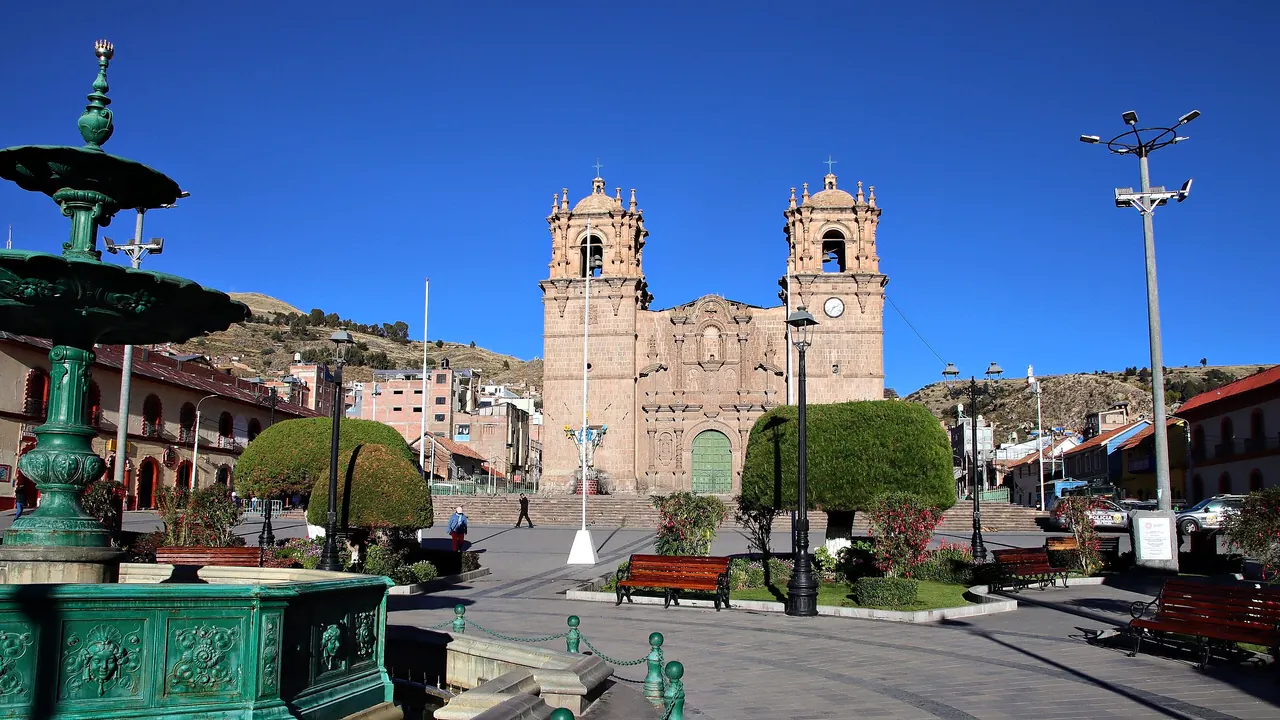
The cathedral from the Plaza de Armas
- Affordable cities85
- Day trips65
- Nature & outdoors60
Photo: Draceane, CC BY-SA 4.0, cropped
Match
36
Every category weighted equally
- Beach & sun33
- Culture & arts39
- Food & nightlife35
- Family trip37
- Outdoors43
- Relax & unwind34
- Shopping & style34
- On a budget41
Puno in twelve categories
Our verdict on each, scored 0 to 100 against the same fixed benchmark cities, so a score means the same thing on every page.
Beaches & swimming. Scores 6 out of 100.
Food & drink. Scores 30 out of 100.
Culture & sights. Scores 30 out of 100.
Nightlife. Scores 15 out of 100.
Nature & outdoors. Scores 60 out of 100.
Day trips. Scores 65 out of 100.
Good for families. Scores 8 out of 100.
Getting around. Scores 42 out of 100.
Shopping & style. Scores 35 out of 100.
Affordability. Scores 85 out of 100.
Live music & performing arts. Scores 38 out of 100.
Wellness & relaxation. Scores 15 out of 100.
Puno category by category
Beaches & swimming
6Puno sits on the shore of Lake Titicaca, but this is not a swimming lake. At around 3,800m the water stays cold all year, usually about 10°C to 14°C, and the city waterfront is a working port lined with reed beds. A few islands have small sandy coves where hardy visitors take a quick dip on a sunny afternoon. Nobody plans a stay around the water, and nobody should come here for a beach.
Food & drink
30Eating in Puno means altiplano cooking. Trout from the lake is the staple, fried, grilled or in ceviche. There are thick quinoa stews, chairo soup, alpaca steaks and, on special occasions, roast cuy. Breakfast at the Mercado Central brings hot quinoa drinks, bread and soups at long shared counters. Hot coca tea follows you all day, because it is the standard remedy for the altitude.
The restaurants along the pedestrian Jirón Lima serve travellers the same mix of trout, pizza and set menus, and a few of them do it with some care. Range and depth are limited, though. There is no fine dining tier, nightlife eating ends early, and food lovers usually save their appetite for the bigger cities on the route.
Culture & sights
30The city's own sights are few and quickly seen. The stone cathedral on the Plaza de Armas has a carved baroque façade typical of the altiplano churches, and the steps up to the Kuntur Wasi viewpoint give a wide view over the roofs and the lake. A small number of museums fill an afternoon. One holds pre-Columbian pieces from the region, another tells the story of the coca leaf. The Yavari is a Victorian iron steamship, carried over the Andes in pieces in the 1860s and now moored as a museum near the shore.
Puno itself is mostly a plain brick town. What draws visitors is the lake culture just beyond it, and that means a boat trip.
Nightlife
15A handful of pubs and small bars around Jirón Lima serve pisco sours and local beer to travellers, and a few of them stay open past midnight at weekends. Nights at 3,800m are cold, often below freezing in winter. Alcohol hits harder at this altitude, and most visitors have a dawn boat or bus the next morning, so evenings tend to end with dinner. The exception is the festival season, when the whole town turns out on the streets.
Nature & outdoors
60The landscape is the reason to be here. Lake Titicaca spreads to the horizon under a hard, bright high-altitude sky, rimmed by bare brown hills and, on clear days, the snow peaks of the Cordillera Real on the Bolivian side. The national reserve protects wide totora reed beds that are home to coots, grebes, ibis and the flightless Titicaca grebe. On the Capachica peninsula, kayaking among the reeds and walking between farming villages are the main outdoor activities.
The island trails, climbing past terraced fields to hilltop shrines, are short but demanding in the thin air. The dry season from May to September brings clear days and freezing nights. The summer rains turn the hills green. Thin air and slow acclimatisation limit how much a visitor can do.
Day trips
65Puno is above all a base for the lake and the altiplano around it. The floating Uros islands, built from layered totora reeds, are a short boat ride from the port. Taquile is a longer crossing, an island of stone paths and arches, whose community-run knitting and weaving are recognised by UNESCO. Amantaní, further out, is usually visited with a night in a family homestay.
On land, the round stone burial towers of Sillustani stand on a peninsula above Lake Umayo, under an hour away. The southern shore road passes Chucuito and its fertility temple to Juli, a village with several colonial churches, about an hour and a half away. To the north, Lampa has a richly decorated church and Pucará is known for its ceramic bulls. Copacabana, over the Bolivian border, is a longer outing.
Good for families
8At about 3,800m, Puno is hard on small children. Altitude sickness can hit them quickly, nights are bitterly cold in the dry season, and many guesthouses have little heating. The boat ride to the reed islands and a chance to climb a reed watchtower are the main attraction for older children. Otherwise there is almost nothing in the city made for them. Families who come usually arrive slowly from lower ground and keep the stay short.
Getting around
42The centre is small. The Plaza de Armas, Jirón Lima and the main market are all a few minutes apart on foot, and the lake port is an easy walk downhill. The walk back up is another matter. At this altitude even gentle slopes leave newcomers breathless. Local transport means crowded colectivo minibuses, taxis and pedal or motor tricycles, all cheap but chaotic. Boats to the islands leave from the port, and organised tours or colectivos reach Sillustani and the southern shore villages, so a car is never needed. Pavements are uneven and the traffic in the commercial streets is heavy.
Shopping & style
35Shopping in Puno is about textiles. The craft market near the port is a long run of stalls selling alpaca sweaters, scarves, ponchos, woven belts and knitted chullo hats. Quality ranges from machine-made acrylic to fine baby alpaca, so it pays to handle the goods carefully. The best pieces come straight from the islands, where Taquile's men knit and the women weave, and buying there supports the makers directly. The central markets sell everyday goods, coca leaves and mountains of potatoes, which is interesting to see but is not a shopping experience. There is nothing in the way of fashion or design.
Affordability
85Puno is one of the cheapest stops on the southern Peru circuit. Family guesthouses and simple hotels in the centre cost little, and set lunches in local restaurants and breakfasts at the market counters are very inexpensive. Colectivos and tricycle taxis cost next to nothing, and the shared boat trips to the islands are cheap too.
The pricier end is the handful of comfortable lakeside hotels and the traveller restaurants on Jirón Lima, which charge noticeably more than the places locals use. Even so, a careful traveller who eats where townspeople eat and sleeps in a guesthouse can get by on very little here.
Live music & performing arts
38Puno calls itself the folklore capital of Peru, and its dance tradition is real. Each February the Festival of the Virgen de la Candelaria takes over the city. Tens of thousands of dancers in sequined costumes and devil masks parade for days to brass bands and panpipe ensembles. It is one of the largest festivals in South America, and UNESCO recognises it as intangible heritage.
The rest of the year, live performance means restaurants staging Andean music and dance for diners in the evening, and occasional events in the municipal theatre. Outside February, a visitor who comes for music will find a lot of panpipes and not much else.
Wellness & relaxation
15There is no bathing or spa culture here. A few of the better lakeside hotels offer massages, and that is about the extent of it. The lake itself has a quiet, slow feel, especially on the islands at dusk. But the altitude makes the first days tiring rather than restful, nights are cold, and the town centre is noisy with traffic. Rest here means sitting in the sun with coca tea and letting your body adjust.
When should you go?
Pick a month to see what it is like. The climate figures are measured averages, not a forecast.
Puno in July
Daytime high, °C
Rainfall in the month, mm
The whole year
Shaded against this city’s own year: the deepest cell is its best month for that figure and the palest its weakest.
Where the figures come from
Puno's temperatures are measured 42 km from the centre, at Juliaca.
Puno has no rain gauge within 25 km of the centre, so its rainfall comes from a gridded climate dataset read at the city rather than from a gauge further away.
Temperature and rainfall are climate normals, averaged over the years shown. Puno: 1991-2020 normals, Juliaca (42.3 km from centre).
Before you go
| Measure | Puno |
|---|---|
| Official language | Spanish, Aymara, Quechua |
| Currency | Sol (PEN) |
| Sockets | ABC220 V, 60 Hz |
| Driving side | Right |
| Time zone | UTC-5 |
| Emergency number | 111 or 911 |
| Elevation | 3,830 m |
| Main airport | Inca Manco Capac International Airport (JUL)44 km from centre1 non-stop destination |
| Public holidays this year | 17 days |
By the numbers
| Measure | Puno |
|---|---|
| City population | 128,637 |
| Museums within 10 km | 1 |
| UNESCO World Heritage sites within 50 km | 1 |
Compare Puno with
Every comparison with a written verdict behind it.