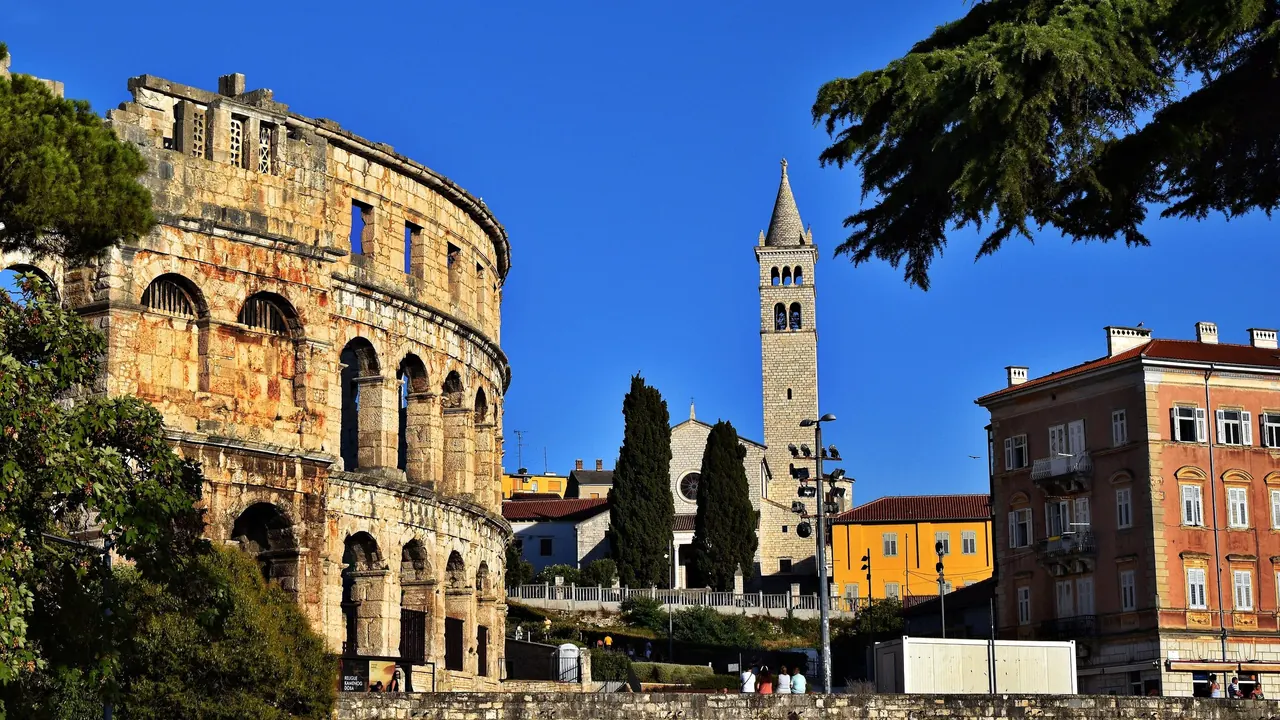
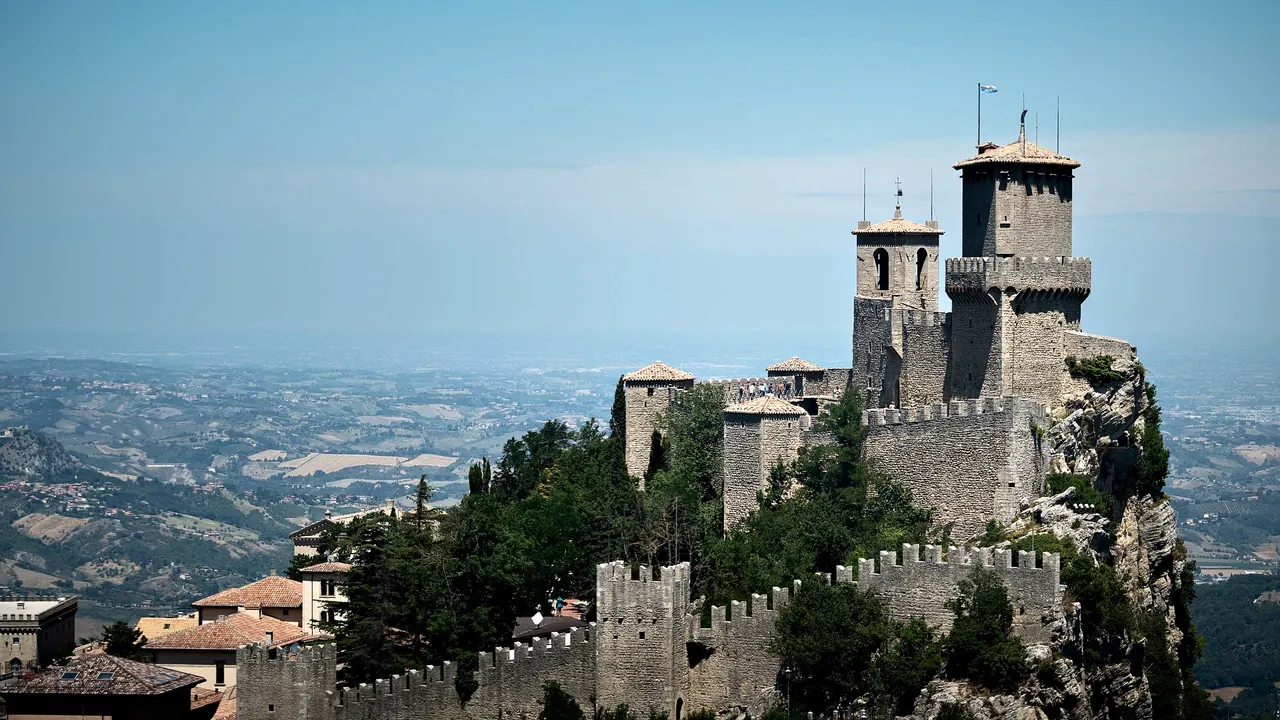
Photos: Pula by Miroslav.vajdic, CC BY-SA 4.0, cropped; San Marino by Tibor Szabo, Pexels License.
Pula or San Marino?
Our verdict in twelve categories, each scored against the same fixed benchmark cities, and the climate month by month, so you can choose for your trip.
Choose Pula for
- beaches
- nightlife
- live music and the arts
Pula is the better choice for a proper summer vacation by the sea. Clear water off rocks and pine-shaded coves, Cape Kamenjak close by, a Roman amphitheatre that still hosts concerts and a distinctive Istrian kitchen give it enough for a week. It also makes a sound base for Rovinj, the hill towns and the Brijuni islands.
Choose San Marino for
- prices
San Marino works best as a night or two on a wider tour of northern and central Italy. The towers on Monte Titano and the story of an ancient republic fill a morning, and the summit grows calm in the evening. From the mountain you can reach Urbino, San Leo and Ravenna, with the sandy Romagna beaches below for an afternoon.
Scoreboard
Twelve categories on one fixed scale from 0 to 100. The shaded stretch is the gap between the two.
Your match
Pick a travel style or drag the sliders, and both match scores follow your weighting.
Wins on beaches and nightlife with your weighting.
Wins on prices with your weighting.
What matters to you?
Category by category
What the scores mean for a trip.
Beaches & swimming
Pula lives by the water. You swim from rock platforms, pebble coves and pine-shaded ledges around Verudela and Stoja, with the wild inlets of Cape Kamenjak a short ride south and the shallow, sheltered bays of Medulin for calmer swimming. The water is very clear, but there is no sand, so pack water shoes.
San Marino has no shore of its own. The nearest swimming is half an hour down the mountain on the sandy, organised beaches of Rimini and Riccione, with rows of umbrellas and gentle shallows. That makes a good day out, but not a stay built around the sea.
Food & drink
Istrian cooking gives Pula the edge, with truffle pasta, scampi buzara, Malvazija and Teran, and a market hall that shows what is in season. As in San Marino, though, the best meals are away from the tourist core, in village and harbour taverns rather than around the Arena.
San Marino serves the hearty food of Romagna and Montefeltro, from passatelli to piadina and the layered Tre Monti cake. The summit terraces sell the view more than the cooking, so plan your dinners in Borgo Maggiore or across the border.
Culture & sights
Both places are compact, but Pula has more to see. The Arena, the intact Temple of Augustus, the Arch of the Sergii and the forts from its time as a Habsburg naval base layer Roman, Venetian and Austro-Hungarian history in one small city, and they fill a day or two.
San Marino's appeal is a single dramatic set piece: the walled town and three towers along the crest of Monte Titano. The Palazzo Pubblico is a reminder that this is one of the oldest surviving republics, and half a day covers the visit well.
Nightlife
Neither city is a party destination, but Pula at least has summer evenings with some life. Drinks on terraces around the Forum lead to cocktail and beach bars on Verudela and in Medulin, and a few small clubs fill up at weekends.
In San Marino the summit empties when the coaches leave, and an evening means dinner and a glass of wine above the lights of the coast. For a real night out you have to drive down to the Riviera.
Nature & outdoors
Pula has more to do outdoors. Kamenjak's car-free headland is good for walking and cycling, and the sea adds kayaking among the islets, windsurfing in Premantura bay and dives on naval-era wrecks. The Učka range is further off for proper hiking.
Monte Titano gives San Marino cliffs, wooded paths between the towers and long views to the Adriatic and the Apennines, and the Marecchia valley has quiet roads for cycling. It is scenery for a morning, though, rather than a base for active days.
Day trips
Both make good touring bases, and in both places a car makes most trips far easier. From Pula the outings are coastal and rural: Venetian Rovinj, the Byzantine mosaics of Poreč, the truffle hill towns of Motovun and Hum, and the boat to Brijuni.
San Marino looks towards Italian art cities and fortresses instead: the Renaissance court at Urbino, San Leo on its rock, the mosaics of Ravenna, and Bologna. Ravenna and Bologna are easy by train from Rimini, which Pula's weak rail links cannot match.
Good for families
Pula is easier with children because the sea is close. There are shallow bays at Medulin and Premantura, an aquarium inside a fort on Verudela and underground passages to explore at the Arena, though the heat and rocky shores still take some managing.
In San Marino the towers and the cable car will thrill children for a morning. But steep steps make pushchairs hard work, and the family attractions, from Italia in Miniatura to the waterparks, are on the coast below, so most family days involve driving.
Getting around
Pula's centre is flat, and the Arena, Forum and harbour are minutes apart on foot, with city buses out to the hotel areas and southern coves. San Marino is just as small, but nearly every street climbs, often by steps, though the cable car to Borgo Maggiore helps.
Beyond town, both places depend on a car. San Marino's one strong link is the bus down to Rimini and its trains, while Pula's regional buses and inland railway are of little use to visitors.
Shopping & style
Neither is a place to go shopping, and they sell very different things. Pula's best buys are edible: olive oil, truffles, wine, honey and pršut from the market hall and from producers in the countryside.
San Marino makes the most of its lower taxes. Perfume, watches, leather and spirits line the main streets, an outlet centre sits in the valley, and collectors come for the republic's own stamps and coins.
Affordability
Overall costs are similar, but they rise in different places. Pula is reasonable in spring and autumn but much dearer in July and August, and hiring a car and taking boat trips add up quickly.
San Marino stays closer to provincial Italian prices all year. The extra cost comes from staying on the summit and eating on view terraces rather than from the season, and lower taxes make fuel and spirits cheaper.
Live music & performing arts
Pula has one great stage. In summer the Arena hosts concerts and film festival screenings under its Roman arches, and the Istrian National Theatre keeps a programme going through the year.
San Marino offers little beyond a small theatre, concerts in the squares and the costumed Medieval Days festival each summer. For opera or a concert season you would travel to Bologna or Pesaro.
Wellness & relaxation
Neither place has a spa tradition, so for treatments you rely on hotel spas, which in Pula means the resorts on Verudela and in Medulin. The city's calm comes from its slow pace outside high summer: pine-shaded coastal paths, long coffees on the Forum and quiet days in the countryside.
On San Marino's summit the quiet comes in the evening, once the day visitors have gone, with walks along the walls above the plain. During the day in summer the streets around the towers are crowded, and the thermal baths are a separate trip to the coast or the Apennines.
When should you go?
Pick your month. The climate figures are measured averages, not a forecast.
Pula in July
San Marino in July
Daytime high, °C
Rainfall in the month, mm
Where the figures come from
Pula's temperatures are measured 87 km from the centre, at Trieste.
Pula has no rain gauge within 25 km of the centre, so its rainfall comes from a gridded climate dataset read at the city rather than from a gauge further away.
San Marino's temperatures are measured 52 km from the centre, at Frontone.
San Marino has no rain gauge within 25 km of the centre, so its rainfall comes from a gridded climate dataset read at the city rather than from a gauge further away.
Temperature and rainfall are climate normals, averaged over the years shown. Pula: 1991-2020 normals, Trieste (87 km from centre). San Marino: 1991-2020 normals, Frontone (51.5 km from centre).
In Pula the sea is warm enough to swim in from June to September, when it sits in the low to mid twenties, and July is the sunniest month with around 300 hours of sunshine. Spring and early summer are fairly dry, so April and May are good months for the Roman sites and the walks at Kamenjak before highs reach 29°C in July and August. From September the rain builds steadily to a peak of about 107mm in November, and winters are mild but grey.
San Marino follows a similar pattern but is a couple of degrees colder in winter, with January highs of around 7°C. Its springs are also wetter, so walks on the ridge from March to May are more likely to meet showers. July is the hottest month at around 30°C, which makes the steep streets hard work at midday, but the Rimini shore below runs a degree warmer than Pula's sea all summer. Late May, June and September are the most comfortable months on the mountain, and from September onwards autumn brings the wettest weather of the year.
Which traveller are you?
On a beach and sun trip, Pula is the clear choice. You can swim every day in clear water from rocks and pebble coves and spend afternoons at Kamenjak. From San Marino, each visit to the sandy Rimini beaches means half an hour down the mountain.
For a food and nightlife trip, Pula again comes out ahead. Istrian truffle pasta, scampi and local wines lead into summer evenings at terrace and beach bars. San Marino's summit goes quiet after dinner, and its clubs are down on the Riviera.
On an outdoors trip, Pula offers more variety: walking and cycling on Kamenjak, sea kayaking among the islets, windsurfing and wreck diving. San Marino's ridge paths and Montefeltro roads are pretty, but they fill a morning rather than a week of active days.
Before you go
| Measure | Pula | San Marino |
|---|---|---|
| Official language | Croatian | Italian |
| Currency | Euro (EUR) | Euro (EUR) |
| Sockets | CF230 V, 50 Hz | CFL230 V, 50 Hz |
| Driving side | Right | Right |
| Time zone | UTC+1, UTC+2 in summer | UTC+1, UTC+2 in summer |
| Emergency number | 112 | 112 |
| Elevation | 5 m | 675 m |
| Main airport | Pula Airport (PUY)7 km from centre34 non-stop destinations | Bologna Guglielmo Marconi Airport (BLQ)114 km from centre98 non-stop destinations |
| Public holidays this year | 14 days | 18 days |
By the numbers
| Measure | Pula | San Marino |
|---|---|---|
| City population | 52,220 | 4,040 |
| People per km² | 971 | 569 |
| Museums within 10 km | 4 | 19 |
| UNESCO World Heritage sites within 50 km | 1 | 2 |
| Swim season, months above 21 °C | 4 months | 4 months |
Where else could you go?
Every comparison below shares a destination with this one, so you can follow Pula or San Marino somewhere new.