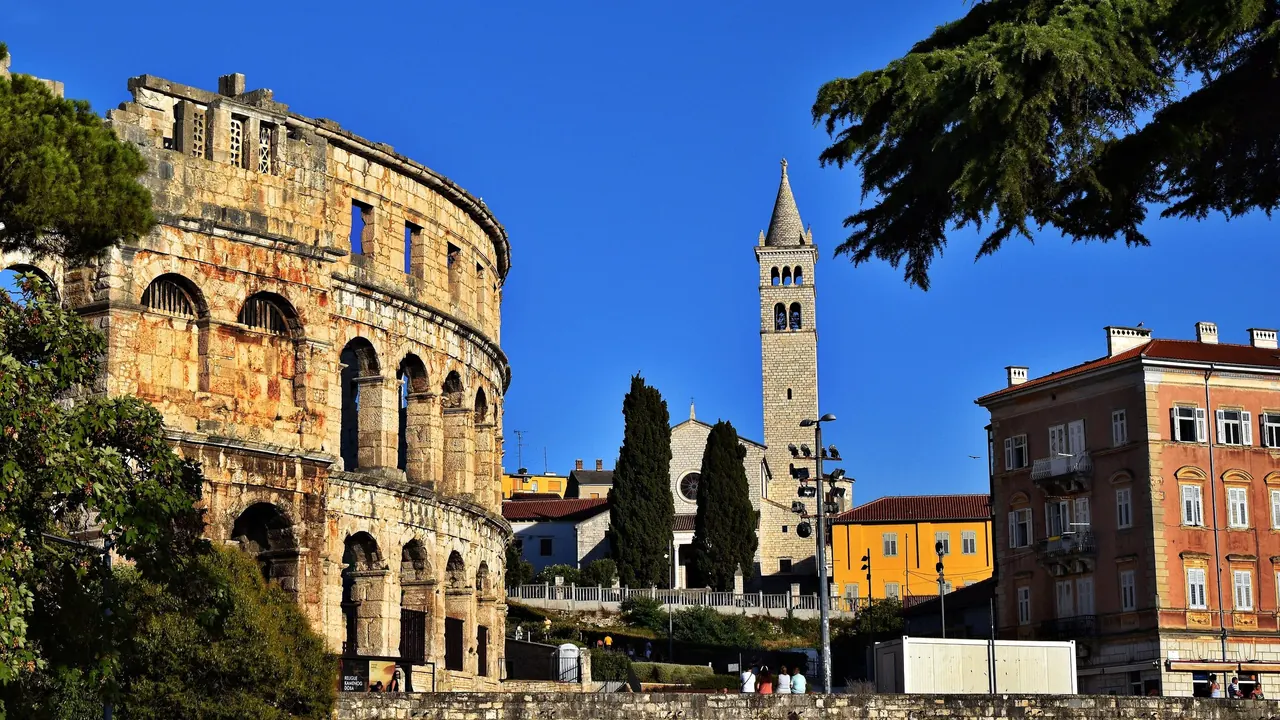
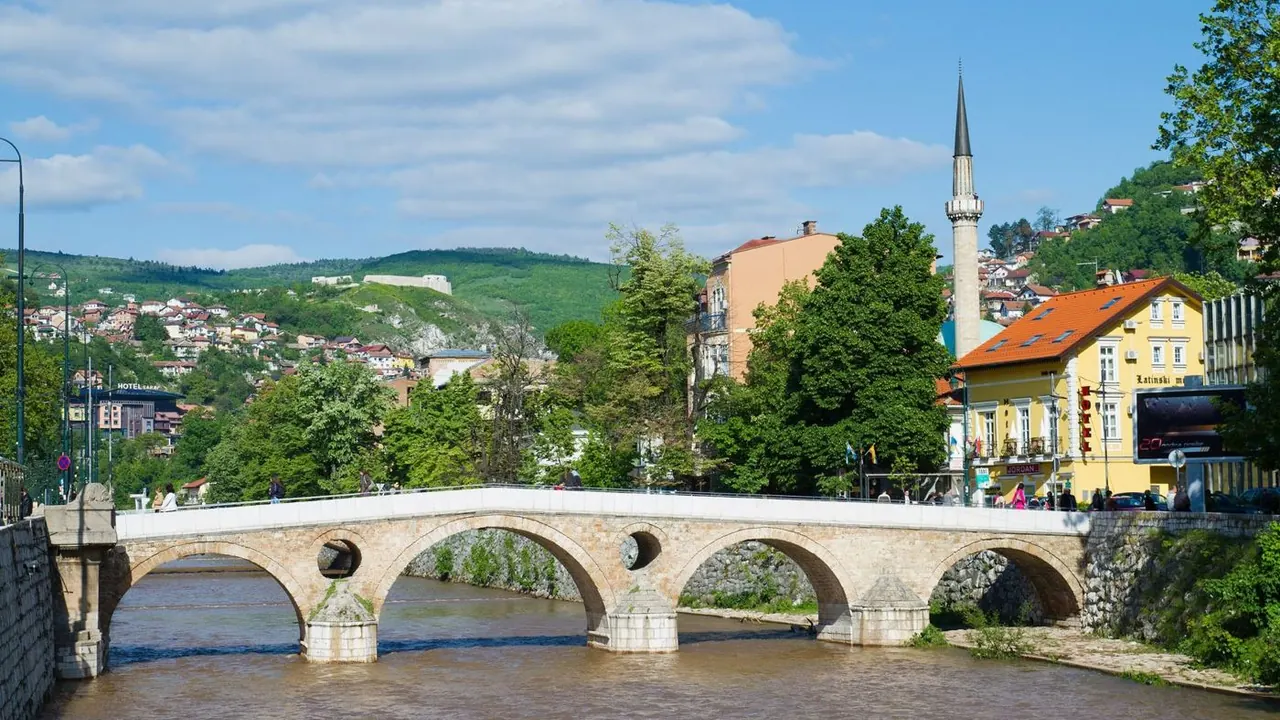
Photos: Pula by Miroslav.vajdic, CC BY-SA 4.0, cropped; Sarajevo by Tumi-1983, CC0.
Pula or Sarajevo?
Our verdict in twelve categories, each scored against the same fixed benchmark cities, and the climate month by month, so you can choose for your trip.
Choose Pula for
- beaches
- families
- day trips
Pula suits a summer trip built around the sea. You get clear water off pine-shaded rocks, the wild coves of Kamenjak, a Roman Arena in the middle of town and the whole of Istria within a short drive for hill towns, Rovinj and the Brijuni islands. It is also the easier choice with children, as long as you are happy to hire a car.
Choose Sarajevo for
- prices
- nature and the outdoors
- wellness
Sarajevo is for travellers who want a city that costs far less and has mountains on its doorstep. The Ottoman bazaar, the Austro-Hungarian avenues and the memory of the siege make a moving few days. The cable car and the Olympic ski slopes are close by, and trams and cheap taxis make it easy to manage without a car. Just don't come expecting to swim.
Scoreboard
Twelve categories on one fixed scale from 0 to 100. The shaded stretch is the gap between the two.
Your match
Pick a travel style or drag the sliders, and both match scores follow your weighting.
Too close to call, 1 point apart
Wins on beaches and families with your weighting.
Wins on prices and nature and the outdoors with your weighting.
What matters to you?
Category by category
What the scores mean for a trip.
Beaches & swimming
This is the clearest difference between the two. Pula has no sand, but its rock platforms and pebble coves around Verudela, Stoja and Medulin have very clear water. The protected headland of Kamenjak has dozens of wild coves, and the shallow bays near Medulin suit small children.
Sarajevo has nothing like this. Swimming there means cold mountain rivers, the lake at Jablanica or a pool, and the coast is too far away for a day trip. If swimming matters, add a few nights on the Croatian or Montenegrin coast.
Food & drink
Both kitchens are regional and deeply local, but they are very different. Pula serves Istrian food: truffle pasta, scampi buzara, grilled fish, pršut and estate olive oil, with Malvazija and Teran to drink. The best meals are often in the hinterland villages rather than at the tables around the Arena.
Sarajevo serves Ottoman-Balkan comfort food, built around the ćevapi grills of Baščaršija, the pita bakeries and slow-cooked dishes, and Bosnian coffee is a ritual of its own. You will eat well in the centre, but the range is narrower than Istria's mix of sea and inland cooking.
Culture & sights
You can see the main sights in either city in a day or two of walking, but they show you very different things. Pula is a Roman city first, with its near-complete Arena, the Temple of Augustus on the Forum and the Arch of the Sergii. On top of that come Venetian and Habsburg naval buildings.
In Sarajevo, faiths and recent history meet within a few streets. The Gazi Husrev-beg Mosque, two cathedrals and the Old Synagogue are minutes apart, and the Latin Bridge marks the start of the First World War in 1914. The siege is remembered at the Tunnel of Hope and the War Childhood Museum. Pula impresses with its stone, while Sarajevo moves you with its stories.
Nightlife
Neither city is somewhere to plan a trip around going out, but Sarajevo offers a little more, and for more of the year. Its café-bars fill up from the afternoon, drinks are cheap, and students keep cellar bars and small clubs going past midnight at weekends, even outside summer.
Pula's nights out happen mainly in summer: terraces on the Forum, then beach and cocktail bars on Verudela and around Medulin. For the rest of the year most evenings end early.
Nature & outdoors
Sarajevo is better for the outdoors, because the mountains start at the edge of town. The cable car climbs Trebević to the old Olympic bobsleigh track. Jahorina and Bjelašnica offer skiing in winter and hiking on the ridges in summer, and the shepherds' village of Lukomir sits high above the Rakitnica canyon.
Pula's nature is gentler and mostly by the sea: the cliffs, wild flowers and dinosaur footprints of Kamenjak, plus sea kayaking, windsurfing and wreck diving. For proper hills you have to drive about an hour and a half to the Učka range.
Day trips
Pula is the better base for day trips, because Istria fits a lot into short distances. Rovinj is within an hour, and so are the Byzantine mosaics of Poreč and the hill towns of Motovun, Grožnjan and Hum. The Brijuni islands are a short boat ride from Fažana, and Piran and Trieste are within reach for a longer day.
Sarajevo has fewer day trips, and they take longer. The highlight is Mostar, two hours away by a scenic train along the Neretva, with Konjic, Blagaj and Počitelj nearby. Travnik and Višegrad mean slow, winding roads, and in both places most trips are easier by car.
Good for families
Pula is the easier place with children. There are the shallow bays around Medulin and Premantura, the aquarium in an old fort on Verudela, the Arena to climb around and the safari animals on Brijuni. A dinosaur park and a water park are both within an hour.
Sarajevo welcomes children, and the cable car, the pigeons at the Sebilj and the streams of Vrelo Bosne make good outings. Beyond those, the main sights are about war and history, the hillside streets are steep, and winter smog is hard on small lungs.
Getting around
On foot the two are much alike: Pula's Arena, Forum and harbour are a few minutes apart, as are Baščaršija and the Austro-Hungarian avenues in Sarajevo, and both centres are flat. The difference starts at the edge of town. In Pula, city buses go no further than the hotels on Verudela, while the Kamenjak coves and the Istrian hill towns lie along roads that public transport barely covers, so almost every outing means hiring a car or a scooter and then finding somewhere to park in summer.
Sarajevo's sights sit along one valley floor, so its old tram line takes you from the bazaar out to the thermal springs at Ilidža without any planning. Cheap taxis fill in the gaps, which helps on the stepped lanes above the centre. In Sarajevo you only need a car or a tour for the Tunnel of Hope and the mountains, while in Pula you need one for nearly everything beyond the old town.
Shopping & style
Sarajevo gives you more to browse. On Kazandžiluk the coppersmiths still hammer out coffee sets and trays, and the Bezistan and the lanes around it sell kilims, slippers and filigree jewellery, though you need to look closely to tell real craft from souvenir stock.
In Pula the best things to buy are edible: olive oil, truffles, wine, honey and pršut from the market hall and from producers in the countryside. Neither city has design or luxury shopping.
Affordability
Sarajevo is far cheaper. Meals, coffee, museums, trams and central guesthouses all cost well below Western European levels, and prices rise only a little in the Old Town and during the summer film festival.
Pula is mid-priced. It is good value in spring and autumn if you stay in an apartment and eat in simple konobas, but in July and August rooms cost about as much as on Western Europe's coasts. Car hire and boat trips add up quickly.
Live music & performing arts
Neither city's stage life is worth planning a trip around, but what they offer is quite different. Pula comes alive in summer, when the Arena hosts pop and rock concerts, classical galas and film festival screenings under the Roman arches.
Sarajevo has a steadier programme through the year, with drama, opera and ballet at the National Theatre and concerts by the Sarajevo Philharmonic. It also has the MESS theatre festival in autumn, a jazz festival in November and sevdah songs in traditional restaurants.
Wellness & relaxation
Sarajevo has the advantage thanks to Ilidža, at the end of the tram line. Thermal springs used since Roman times feed a spa there with warm pools and treatments, and the nearby avenue to Vrelo Bosne makes a calm walk.
Pula has no spa tradition beyond the saunas and pools of the resort hotels on Verudela and in Medulin. You unwind there with walks on the pine-shaded coastal paths and long coffees on the Forum, best of all outside high summer.
When should you go?
Pick your month. The climate figures are measured averages, not a forecast.
Pula in July
Sarajevo in July
Daytime high, °C
Rainfall in the month, mm
Where the figures come from
Pula's temperatures are measured 87 km from the centre, at Trieste.
Pula has no rain gauge within 25 km of the centre, so its rainfall comes from a gridded climate dataset read at the city rather than from a gauge further away.
Temperature and rainfall are climate normals, averaged over the years shown. Pula: 1991-2020 normals, Trieste (87 km from centre). Sarajevo: 1991-2020 (rainfall 1971-2000) normals, Sarajevo-Bejelave (2 km from centre).
Pula is a summer place. From June to September the sea is warm enough for long swims, reaching about 25°C in August, and July and August are hot, very sunny and fairly dry. Rain picks up from September, and November is the wettest month at 107mm. June and September are the best months for combining swimming with sightseeing while the heat is still comfortable. May and October are good for walking the Roman streets and the coastal paths, but the sea is cool, only about 17°C in May.
Sarajevo is inland among mountains, so its winters are much colder, with highs of about 4°C in December and January. That is the season for skiing on the nearby slopes rather than wandering the bazaar. Rain falls steadily all year with no dry season. Summer highs of around 28°C are pleasant for walking the streets, and late spring and early autumn suit both city sightseeing and hiking in the mountains.
Which traveller are you?
For a beach and sun trip, Pula is the obvious choice. Its clear water, pine-shaded rocks and the wild coves of Cape Kamenjak give a long summer of swimming. Sarajevo sits in an inland valley, three hours from the nearest coast.
On a tight budget, your money goes much further in Sarajevo. Ćevapi, pastries and bazaar coffee cost very little, trams and taxis are cheap and central guesthouses are well below Western prices. In July and August, Pula charges close to Western European coastal rates.
For a skiing trip, only Sarajevo will do. Jahorina and Bjelašnica, the 1984 Olympic mountains, are under an hour's drive away and have reliable winter snow, so you can ski by day and eat in Baščaršija at night. Pula has no slopes.
Before you go
| Measure | Pula | Sarajevo |
|---|---|---|
| Official language | Croatian | Croatian, Serbian, Bosnian |
| Currency | Euro (EUR) | Convertible Mark (BAM) |
| Sockets | CF230 V, 50 Hz | CF230 V, 50 Hz |
| Driving side | Right | Right |
| Time zone | UTC+1, UTC+2 in summer | UTC+1, UTC+2 in summer |
| Emergency number | 112 | 112 |
| Elevation | 5 m | 518 m |
| Main airport | Pula Airport (PUY)7 km from centre34 non-stop destinations | Sarajevo International Airport (SJJ)7 km from centre38 non-stop destinations |
| Public holidays this year | 14 days | 8 days |
By the numbers
| Measure | Pula | Sarajevo |
|---|---|---|
| City population | 52,220 | 275,524 |
| People per km² | 971 | 1,947 |
| Museums within 10 km | 4 | 26 |
| UNESCO World Heritage sites within 50 km | 1 | 1 |
| Swim season, months above 21 °C | 4 months | - |
Where else could you go?
Every comparison below shares a destination with this one, so you can follow Pula or Sarajevo somewhere new.