Photos: Pula by Miroslav.vajdic, CC BY-SA 4.0, cropped; Zermatt by Roy Egloff, CC BY-SA 4.0, cropped.
Pula or Zermatt?
Our verdict in twelve categories, each scored against the same fixed benchmark cities, and the climate month by month, so you can choose for your trip.
Choose Pula for
- beaches
- prices
- day trips
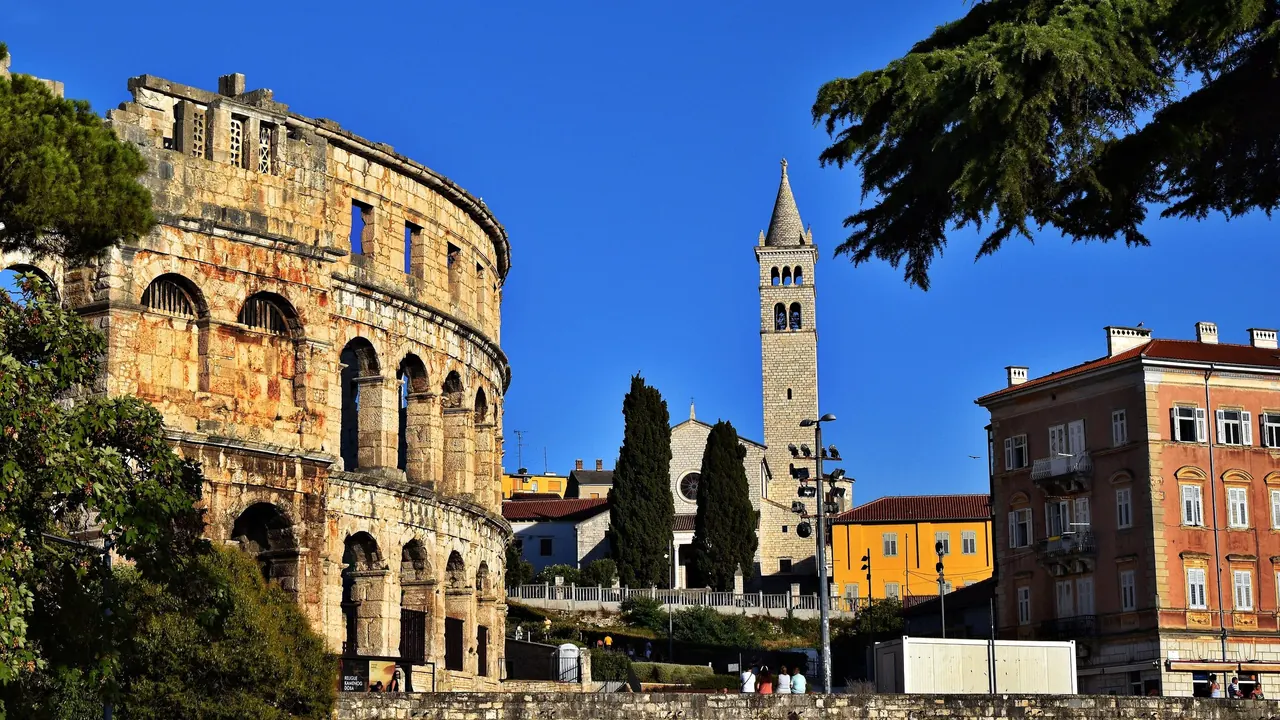
Pula suits a summer trip built around the sea and the past. You can swim off pine-shaded rocks and in the coves of Kamenjak, there is a Roman amphitheatre in the middle of town, and Rovinj, the Istrian hill towns and the Brijuni islands are all an easy drive away. It costs far less than Zermatt and its Istrian cooking gives you more to eat, although a hire car does much of the work.
Choose Zermatt for
- nature and the outdoors
- getting around
- wellness
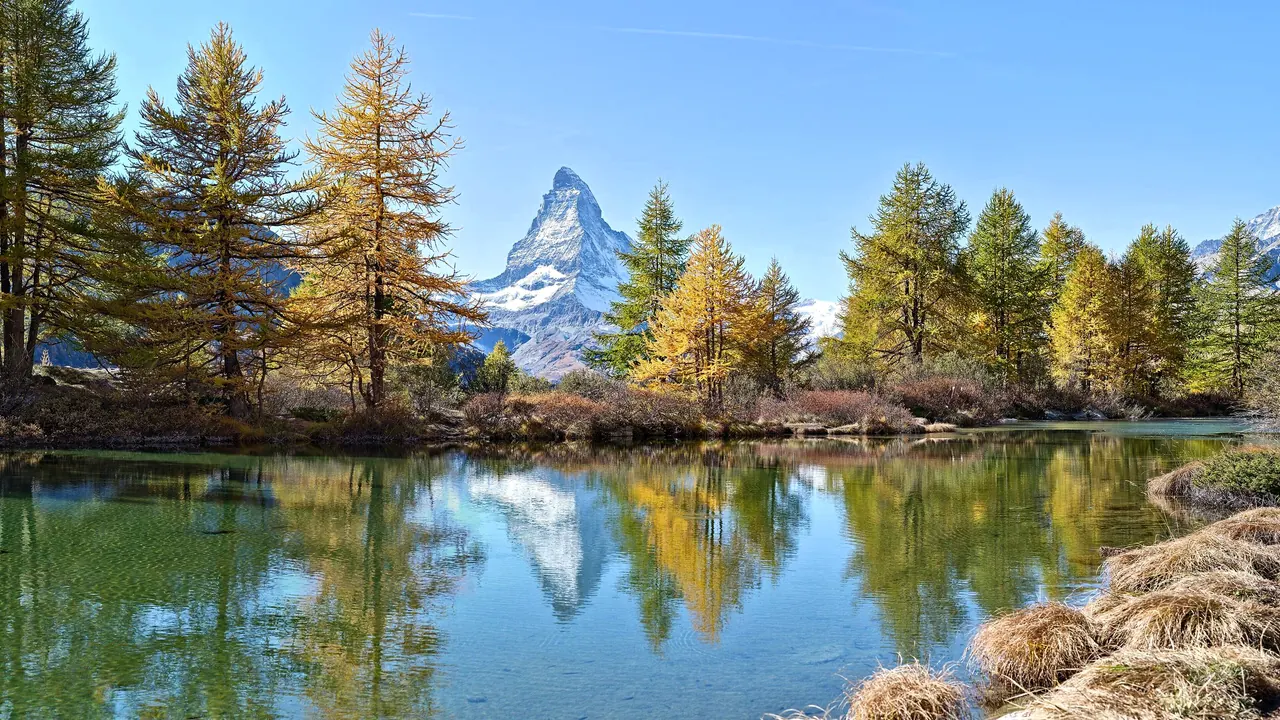
Choose Zermatt if the mountains are the whole point. The Matterhorn stands over a car-free village, and lifts and cog railways climb to glacier terrain, serving skiers in winter and hikers in summer. It is expensive and has few sights and little to do in the evenings, but for high Alpine scenery Pula has nothing to match it.
Scoreboard
Twelve categories on one fixed scale from 0 to 100. The shaded stretch is the gap between the two.
Your match
Pick a travel style or drag the sliders, and both match scores follow your weighting.
Wins on beaches and prices with your weighting.
Wins on nature and the outdoors and getting around with your weighting.
What matters to you?
Category by category
What the scores mean for a trip.
Beaches & swimming
This is the widest gap between the two. Pula has very clear Adriatic water, rock platforms and pebble coves around Verudela and Stoja, the wild inlets of Cape Kamenjak and shallow bays at Medulin. You can swim comfortably from June to late September.
Zermatt has no sea and no bathing lake, and the tarns above the village stay too cold to swim in even in August. Pack water shoes for Pula's sharp rocks. In Zermatt a swimsuit is only for the hotel pool.
Food & drink
Pula has the better food, mostly thanks to Istria: truffle pasta, scampi buzara, pršut and the local Malvazija and Teran wines. The best meals are in hinterland taverns and harbourside konobas, not at the tourist tables around the Arena.
Zermatt eats well for a village of its size. A long lunch at a mountain chalet in Findeln or Zum See, with the Matterhorn in view, is a highlight in itself. But the choice is narrowly Alpine (raclette, fondue and air-dried beef), cheap meals are hard to find, and many kitchens close between seasons.
Culture & sights
Pula's Roman remains explain the gap. There is the Arena with its outer ring of three storeys still complete, the Temple of Augustus on the Forum and the Arch of the Sergii. Add the Venetian fortress and the Austro-Hungarian naval forts, and the sights fill a day or two.
Zermatt's heritage is mountaineering, told in the Matterhorn Museum and the climbers' cemetery. Add the old larch-wood barns of the Hinterdorf and the Gornergrat railway, and that is about a morning. Nobody chooses Zermatt for its monuments.
Nightlife
Neither is a place for a serious night out, but Pula offers a little more across a long summer. There are drinks on terraces around the Forum, beach and cocktail bars on Verudela and at Medulin, and a few small clubs on warm weekends. Zermatt's evenings belong to winter après-ski, loud and expensive, and in summer most visitors turn in early before a day's hiking.
Nature & outdoors
Here Zermatt is in a different league. The Matterhorn rises straight above the village, and lifts climb above 3,800m to glacier terrain. The skiing crosses into Italy, and in summer there are hundreds of kilometres of marked trails, the Five Lakes walk and guided climbs of four-thousanders.
Pula's outdoors are gentler and coastal. There is the car-free headland of Kamenjak for walking and cycling, sea kayaking among its islets, windsurfing in Premantura bay and diving on naval-era wrecks. The nearest real mountains, the Učka range, are about an hour and a half away.
Day trips
Pula wins easily here, because its outings are close and varied. Within about an hour's drive you can reach Rovinj's Venetian harbour, the Byzantine mosaics of Poreč's basilica and the truffle and wine country around the hilltop villages of Motovun, Grožnjan and Hum. A short crossing from Fažana takes you to the Roman ruins and Tito's retreat on Brijuni. Piran and Trieste stretch a day to about two hours each way, and buses are thin enough that a car pays off.
From Zermatt, any excursion begins with more than an hour on the valley train, and there are fewer places to go: Brig's Stockalper Palace, the castle hills and vineyards of Sion, and Saas-Fee in the next valley. A week in Pula can mix towns, islands and wine estates. In Zermatt, the mountains above the village are usually a better use of a free day than the valley below.
Good for families
Pula gives children more to do. There are shallow, sheltered bays at Medulin and Premantura, an aquarium inside a fort on Verudela and the Arena's underground passages, plus a dinosaur park and a water park within an hour. The drawbacks are the summer heat, the rocky shores near town and the need for a car.
Zermatt's strength is its car-free calm, with ski schools, nursery slopes at Sunnegga and walks where children can spot marmots. Beyond skiing and hiking there is little made for children, and the highest viewpoints can be too cold and thin-aired for the youngest.
Getting around
Zermatt is the easier place to get around. You arrive by train and then walk everywhere, with electric taxis, ski buses, the cog railway and the Sunnegga funicular all close to the centre and smooth Swiss rail links out of the valley. Only the hotels on the slopes mean a steep climb with luggage.
Pula's old centre is small, flat and easy on foot, and city buses reach Verudela. But Kamenjak, the hill towns and most of the wider coast really need a car or a scooter, and parking near the centre is tight in summer.
Shopping & style
Neither is a shopping destination, and what differs is what you would buy. In Pula it is food and drink, such as olive oil, truffle products, wine, honey and pršut, from the market hall and the producers inland. Zermatt's one main street sells Swiss watches and jewellery to wealthy skiers and, more usefully, excellent ski and mountaineering gear.
Affordability
The gap in cost is very large. Pula is cheaper than the best-known resorts further down the Croatian coast, and its city buses and the Arena and other Roman sights cost little. High summer narrows the advantage, as rooms then cost about as much as on Western Europe's coasts and the tables beside the Arena and the harbour charge tourist rates. The extras to plan for are a hire car and boat trips.
Zermatt is expensive even by Alpine standards. Plain hotels charge steeply in season, a meal or a drink on a mountain terrace costs well above the European norm, and the lifts and cog railways every visitor depends on add a heavy daily cost. Supermarket picnics or a bed down the valley in Täsch soften the bill, but the same week still costs far more than it would in Pula.
Live music & performing arts
Pula has the stronger offer, mostly because of one venue. In summer the Roman Arena hosts touring pop and rock acts, classical galas and film festival screenings, so a summer visit has a fair chance of an evening under the stone arches. The Istrian National Theatre adds drama all year, although it is in Croatian, and there is little regular opera or classical music.
Zermatt's calendar rests on two short festivals: acoustic sets at Zermatt Unplugged in spring, played in tents and on mountain stages, and chamber music in the village church in late summer. Outside those weeks there is no theatre or concert hall, and live music means a band at après-ski, so Pula's long open-air season is the safer bet.
Wellness & relaxation
Neither has thermal springs, but Zermatt has many more good hotel spas, with indoor pools, saunas and steam rooms, often with mountain views, and some sell day access. The car-free quiet and clear air help, although in peak weeks the mood is active rather than slow.
In Pula, spa facilities are limited to the large resort hotels on Verudela and in Medulin. Unwinding there is simpler: long coffees on the Forum and evening walks along pine-shaded coastal paths outside high summer.
When should you go?
Pick your month. The climate figures are measured averages, not a forecast.
Pula in July
Zermatt in July
Daytime high, °C
Rainfall in the month, mm
Where the figures come from
Pula's temperatures are measured 87 km from the centre, at Trieste.
Pula has no rain gauge within 25 km of the centre, so its rainfall comes from a gridded climate dataset read at the city rather than from a gauge further away.
Zermatt has no weather station within reach, so its figures come from a gridded climate model rather than a measured record, and read a broad area rather than the city itself.
Temperature and rainfall are climate normals, averaged over the years shown. Pula: 1991-2020 normals, Trieste (87 km from centre). Zermatt: 1991-2020 normals, TerraClimate 4 km grid at the town, no weather station within 90 km.
Pula is at its best in summer. From June to September the days are hot, with highs of 29°C in July and August, and the sea is warm enough for long swims, at around 24°C. Late spring and early autumn are the most comfortable months for walking the Roman centre or cycling the coast. Rain builds from September to a wet November of 107mm, and the winters are mild but grey.
Zermatt has two seasons. From December to March daytime highs stay around or below freezing, which is the skiing season. July and August reach only 14°C, cool enough for long days on the high trails. Rainfall is spread fairly evenly through the year, with November the wettest month. Late autumn and spring fall between the seasons, when much of the village shuts.
Which traveller are you?
On a beach and sun trip, Pula is the clear choice. In August the Adriatic is clear and warm, there are pebble coves and cliff ledges at Kamenjak, and the sheltered bays at Medulin suit children. In Zermatt the only swimming is in a hotel pool.
For an outdoors trip, Zermatt wins easily. Lifts and cog railways take you from the village to glaciers, four-thousand-metre peaks and hundreds of kilometres of marked trails, with skiing in winter. Pula's coastal walks, kayaking and cycling are pleasant but much smaller in scale.
On a tight budget, Pula is the realistic option. Private apartments and simple konobas keep a stay reasonable, especially in spring and autumn. In Zermatt, rooms, meals and lift tickets are steep in every season, and even self-catering only goes so far.
Before you go
| Measure | Pula | Zermatt |
|---|---|---|
| Official language | Croatian | French, German, Italian, Romansh |
| Currency | Euro (EUR) | Swiss Franc (CHF) |
| Sockets | CF230 V, 50 Hz | CJ230 V, 50 Hz |
| Driving side | Right | Right |
| Time zone | UTC+1, UTC+2 in summer | UTC+1, UTC+2 in summer |
| Emergency number | 112 | 112 |
| Elevation | 5 m | 1,624 m |
| Main airport | Pula Airport (PUY)7 km from centre34 non-stop destinations | Geneva International Airport (GVA)128 km from centre150 non-stop destinations |
| Public holidays this year | 14 days | 9 days |
By the numbers
| Measure | Pula | Zermatt |
|---|---|---|
| City population | 52,220 | 6,023 |
| People per km² | 971 | 25 |
| Museums within 10 km | 4 | 2 |
| UNESCO World Heritage sites within 50 km | 1 | 2 |
| Swim season, months above 21 °C | 4 months | - |
Where else could you go?
Every comparison below shares a destination with this one, so you can follow Pula or Zermatt somewhere new.