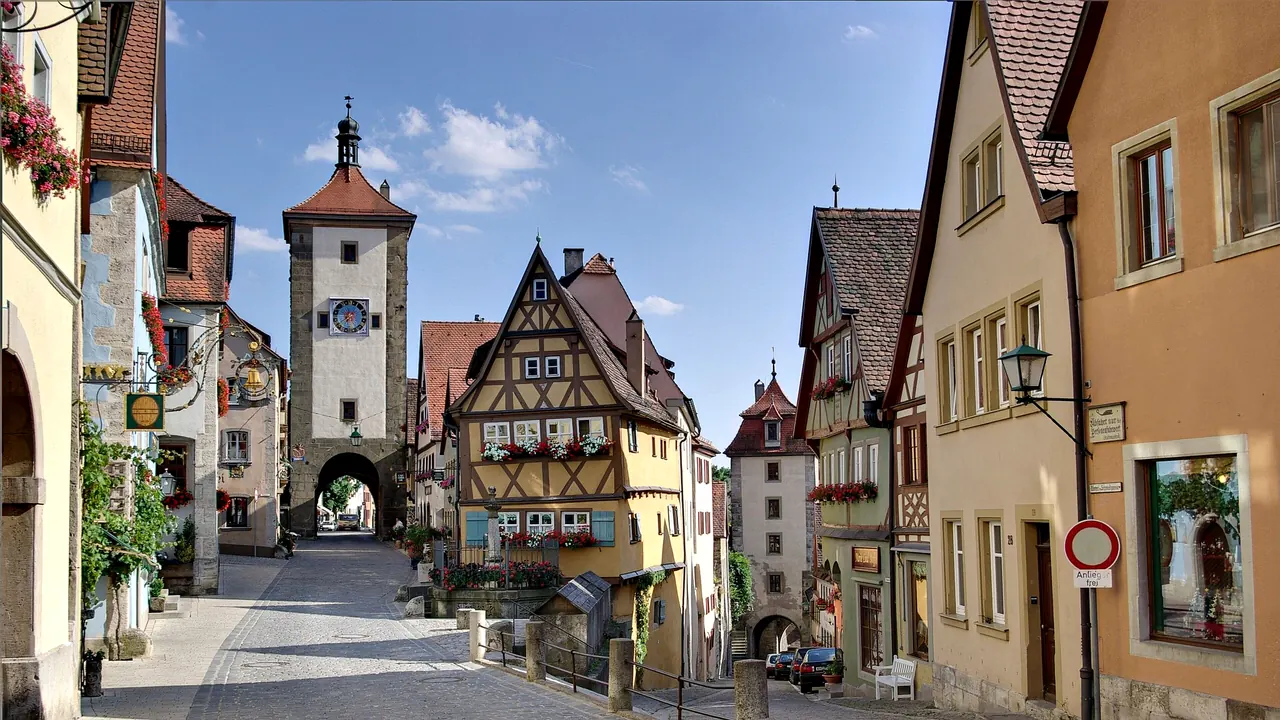
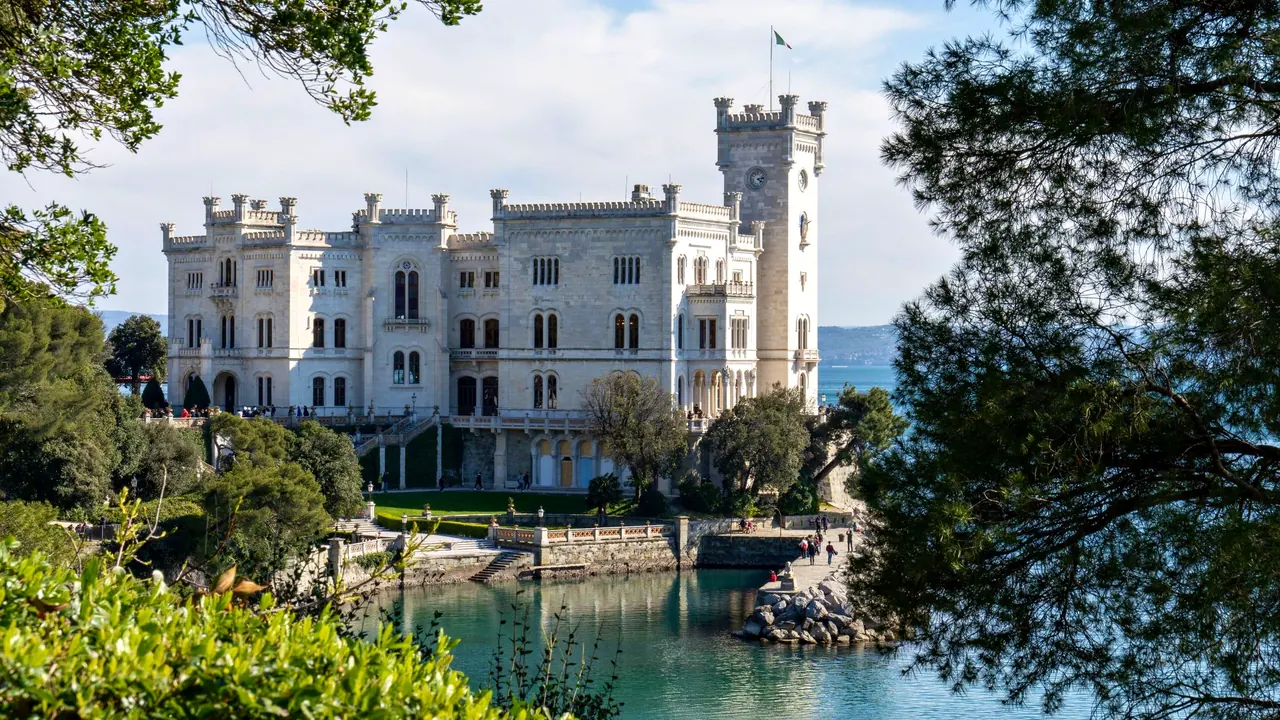
Photos: Rothenburg ob der Tauber by Berthold Werner, Public domain; Trieste by Tibor Szabo, Pexels License.
Rothenburg ob der Tauber or Trieste?
Our verdict in twelve categories, each scored against the same fixed benchmark cities, and the climate month by month, so you can choose for your trip.
Choose Rothenburg ob der Tauber for
Rothenburg ob der Tauber does not lead in any category we score.
Rothenburg is the choice for a traveller who wants a medieval town that looks the way storybooks draw them: intact walls you can walk on, gabled lanes with almost nothing modern, and the Romantic Road's other walled towns a short drive away. It suits a slow stopover of a day or two, ideally with a car, and in December the Christmas market and year-round decoration shops give it a pull few places match. Expect quiet evenings and plain Franconian food.
Choose Trieste for
- beaches
- live music and the arts
- food and drink
Trieste is the fuller trip. A Habsburg port city on the Adriatic, it adds what Rothenburg lacks: summer swimming off the Barcola seafront, a real opera house, coffee-house and buffet culture, and the Karst plateau rising straight behind the streets. Choose it for a week rather than a weekend, with Slovenia, Friuli and Venice all within day-trip range.
Scoreboard
Twelve categories on one fixed scale from 0 to 100. The shaded stretch is the gap between the two.
Your match
Pick a travel style or drag the sliders, and both match scores follow your weighting.
Has no clear advantage with the weighting you have chosen.
Wins on beaches and live music and the arts with your weighting.
What matters to you?
Category by category
What the scores mean for a trip.
Beaches & swimming
Rothenburg sits on a hilltop deep inland, so swimming means the town pool or an hour's drive to the grassy shores of the Altmühlsee and the other Franconian lakes. It is not a place for a water vacation.
Trieste has the Adriatic on its doorstep, though not in the form of sand. Locals spread towels on the concrete terraces and lawns at Barcola and climb down ladders into clear sea, and prettier pebble coves sit below the cliffs at Sistiana, Duino and Grignano. Anyone happy to swim off rocks will use the sea every day in summer.
Food & drink
Both places have a fairly narrow table, but Trieste's is far more interesting. Rothenburg serves solid Franconian fare such as Schäufele, bratwurst and dumplings with Silvaner in its squat Bocksbeutel, and the best meals are in family guesthouses and wine taverns away from the coach-party restaurants on the Marktplatz.
Trieste mixes Italian, Austrian and Slavic cooking: boiled pork carved at the counter of an old buffet, jota soup, marinated sardoni and strudel. Its coffee culture, with its own ordering vocabulary, and the seasonal osmize farmhouses on the Karst give eating there a character Rothenburg cannot match.
Culture & sights
The two are about equally rewarding but in very different ways. In Rothenburg the town itself is the sight: one complete medieval ensemble of walls, towers and gabled houses, crowned by Riemenschneider's Holy Blood Altar in St Jakob's and the Medieval Crime Museum. It is intense but quickly seen.
Trieste spreads its interest across many eras: a Roman theatre, the mosaics of San Giusto cathedral, the Habsburg palaces of Piazza Unità and the Borgo Teresiano, Miramare Castle, a great synagogue and the Risiera di San Sabba memorial. Its literary ghosts, Joyce and Svevo among them, add a layer Rothenburg has no equivalent for.
Nightlife
Rothenburg barely has a nightlife. After the day visitors leave, the evening's event is the night watchman's lantern tour, followed by a glass in an inn, and the lanes are silent by eleven.
Trieste is livelier without being a party city. Spritz and white wine around Piazza Unità and the Canal Grande, student bars in the old town and summer kiosks along Barcola make for pleasant late evenings, though clubs are few.
Nature & outdoors
Rothenburg's countryside is soft and pastoral: paths drop from the walls to mills and meadows along the Tauber, and the valley cycle path follows the river through vineyards. It looks best in blossom or autumn colour, but there is nothing wild.
Trieste has far more drama within reach of the city buses. The limestone Karst rises right behind the streets, with the Strada Napoleonica high above the gulf, the cliff-top Rilke Path, the Val Rosandra gorge and the vast Grotta Gigante. The gulf adds sailing, snorkelling and kayaking in the Miramare reserve.
Day trips
Both make good bases, Rothenburg for one tight theme and Trieste for sheer variety. From Rothenburg the Romantic Road delivers more walled towns, Dinkelsbühl and crater-ringed Nördlingen, plus Würzburg's Residenz and Nuremberg about an hour away, but you really need a car.
Trieste reaches into three countries: Aquileia's mosaics and star-shaped Palmanova in Friuli, Piran and Ljubljana in Slovenia, Istria in Croatia, and Venice by train in about two hours.
Good for families
Rothenburg delights children briefly: walking the covered ramparts, climbing the Rathaus tower, trailing the night watchman and shuddering at the Crime Museum's shame masks. After a day or two there is little left, and the cobbles are hard on pushchairs.
Trieste keeps families busy for longer with the Grotta Gigante, the gardens at Miramare, an aquarium, a science centre and summer days at Barcola. Rocky swimming and stepped streets make it better for older children than toddlers.
Getting around
Both centres are walkable, Rothenburg's tiny and traffic-free inside the walls, Trieste's flat along the waterfront but steep behind it. The difference lies beyond the centre. Rothenburg sits at the end of a branch line with a change at Steinach and thin regional buses, so a car is almost essential for exploring.
Trieste has a dense bus network out to Barcola, Miramare and the Karst, plus passenger boats across the bay to Muggia, and only needs a car for wine country and border trips.
Shopping & style
Neither is a shopping destination. Rothenburg's shops are devoted to Christmas: baubles, nutcrackers and Erzgebirge carvings all year, teddy bears and cuckoo clocks besides, with one of Germany's most atmospheric Christmas markets in December. Almost everything is aimed at visitors.
Trieste offers a broader if modest mix: ordinary Italian fashion around Corso Italia, antique and second-hand shops in the old town, and edible souvenirs such as freshly roasted coffee, Karst wine and presnitz.
Affordability
Trieste is the somewhat easier city on the wallet. Coffee at the bar and a buffet plate are cheap, buses cost little, and swimming at Barcola and walks on the Karst cost nothing.
Rothenburg carries a tourist premium on its old-town rooms and Marktplatz meals, sharpest in December and on summer weekends. Staying outside the walls or in a nearby village brings costs down considerably.
Live music & performing arts
Rothenburg's performances are mostly about its own past: the costumed Meistertrunk play recalling the Thirty Years' War, a small summer open-air theatre and organ concerts in St Jakob's.
Trieste has a genuine stage life, led by the waterfront Teatro Verdi with its opera and ballet season and a rare Italian fondness for operetta. The Politeama Rossetti, a Slovenian-language theatre and summer concerts in San Giusto's castle courtyard round it out.
Wellness & relaxation
Neither has a bathing tradition of its own, so the calm comes from pace in both. In Rothenburg it is the early morning and evening, when the coach groups have gone and the walls and valley fall silent, and real thermal pools at Bad Windsheim and Bad Mergentheim are within an hour's drive.
Trieste's calm is urban and seaside: long sittings over a newspaper in the old coffee houses and sunset walks on the Molo Audace, but for thermal baths you have to leave the area.
When should you go?
Pick your month. The climate figures are measured averages, not a forecast.
Rothenburg ob der Tauber in July
Trieste in July
Daytime high, °C
Rainfall in the month, mm
Where the figures come from
Rothenburg ob der Tauber's sunshine is measured 27 km from the centre, at Feuchtwangen-heilbronn.
Temperature and rainfall are climate normals, averaged over the years shown. Rothenburg ob der Tauber: 1991-2020 normals, Rothenburg ob der Tauber (0.9 km from centre). Trieste: 1991-2020 normals, Trieste (1.6 km from centre).
Rothenburg has a proper inland German climate. Winters are cold, with daytime highs near 3°C in January and short, grey days, so it is at its best for walking the walls from May to September, when afternoons are mild to warm and the long evenings are bright. Rain is spread fairly evenly through the year, with no truly dry or wet season, and December is cold and dark but has the Christmas market.
Trieste is milder in winter and hotter in summer, with highs around 29°C in July and August. That heat makes the steep lanes up to San Giusto hard work in the afternoon. The sea is warm enough to swim in from June to September and peaks around 25°C, and summer is very sunny. The wet season runs from September to November, with each of those months well over 100mm, and in winter the Bora can make cold days raw. May and June suit sightseeing in both cities. September is still a good month in Rothenburg, but in Trieste it brings warm sea along with much more rain.
Which traveller are you?
On a beach and sun trip, Trieste is the only real option. Its summer sea is warm and clear, Barcola is a daily swimming spot, and coves at Sistiana and Duino lie close by, while Rothenburg offers a town pool and distant artificial lakes.
For an outdoors trip, Trieste wins on range: Karst cliff paths, the Val Rosandra gorge, enormous caves, sailing and snorkelling in the gulf, with the Julian Alps beyond. Rothenburg's Tauber valley is lovely for gentle walks and family cycling, but little more.
For a short city break, Rothenburg fits neatly. The walled centre crosses in fifteen minutes, the ramparts, Plönlein, Rathaus tower and Riemenschneider altar fill a satisfying day or two, and nothing pulls you elsewhere. Trieste rewards a longer stay.
Before you go
| Measure | Rothenburg ob der Tauber | Trieste |
|---|---|---|
| Official language | German | Italian |
| Currency | Euro (EUR) | Euro (EUR) |
| Sockets | CF230 V, 50 Hz | CFL230 V, 50 Hz |
| Driving side | Right | Right |
| Time zone | UTC+1, UTC+2 in summer | UTC+1, UTC+2 in summer |
| Emergency number | 112 | 112 |
| Elevation | 430 m | 2 m |
| Main airport | Nuremberg Airport (NUE)66 km from centre56 non-stop destinations | Trieste Airport (TRS)31 km from centre32 non-stop destinations |
| Public holidays this year | 12 days | 13 days |
By the numbers
| Measure | Rothenburg ob der Tauber | Trieste |
|---|---|---|
| City population | 11,331 | 198,417 |
| People per km² | 272 | 2,332 |
| Museums within 10 km | 6 | 33 |
| UNESCO World Heritage sites within 50 km | 2 | 5 |
| Swim season, months above 21 °C | - | 4 months |
Where else could you go?
Every comparison below shares a destination with this one, so you can follow Rothenburg ob der Tauber or Trieste somewhere new.
- Piranvs Trieste
- Rovinjvs Trieste
- Nurembergvs Rothenburg ob der Tauber
- Ljubljanavs Trieste
- Bambergvs Rothenburg ob der Tauber
- Bledvs Trieste