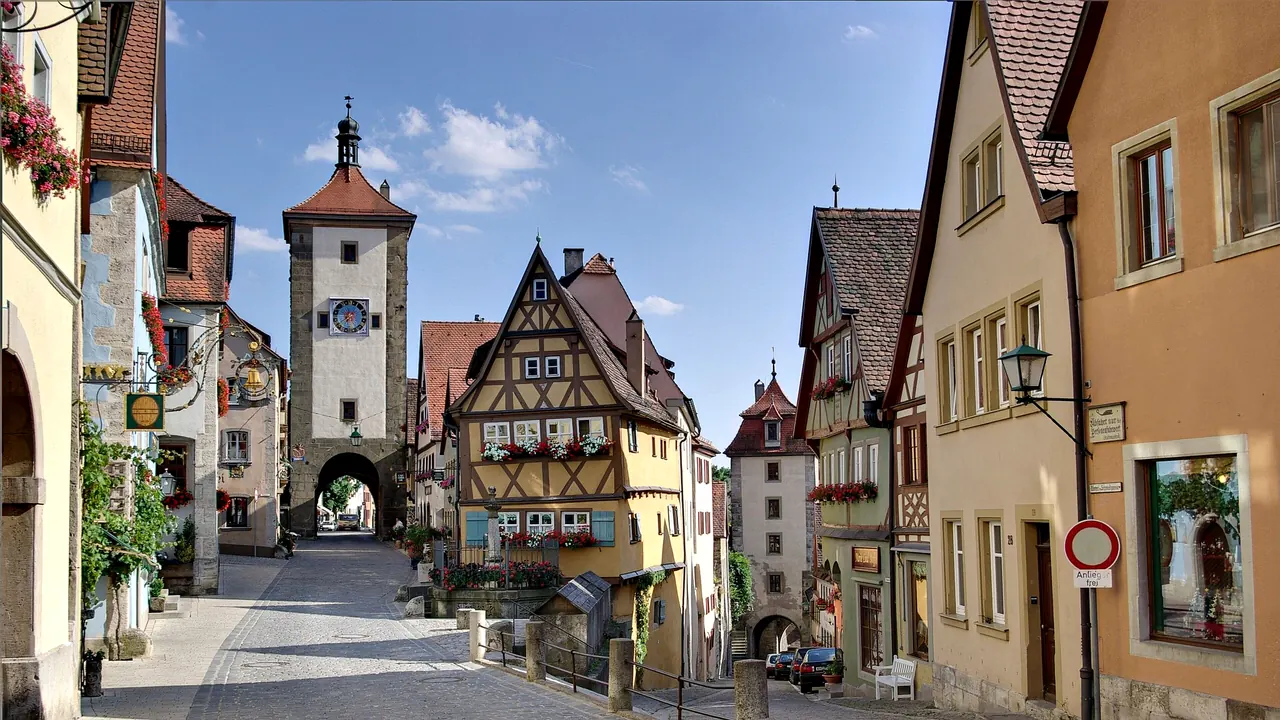
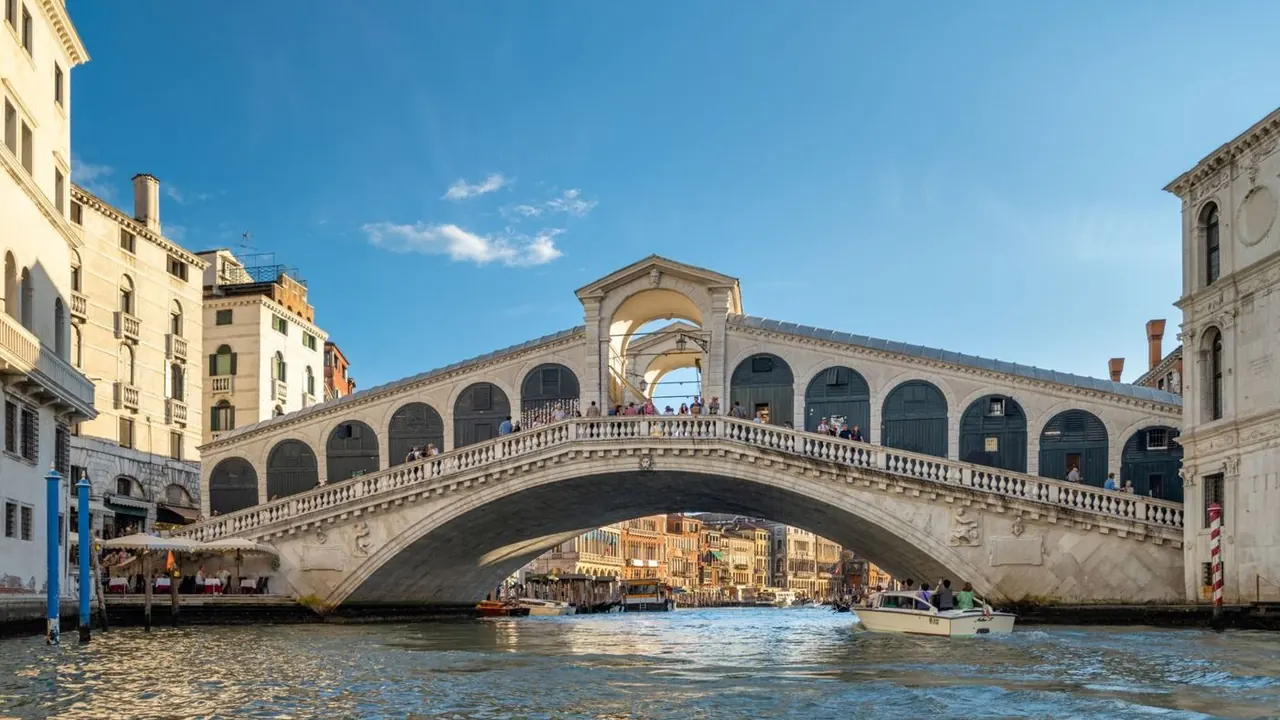
Photos: Rothenburg ob der Tauber by Berthold Werner, Public domain; Venice by David Vives, Pexels License.
Rothenburg ob der Tauber or Venice?
Our verdict in twelve categories, each scored against the same fixed benchmark cities, and the climate month by month, so you can choose for your trip.
Choose Rothenburg ob der Tauber for
- prices
Rothenburg ob der Tauber is the choice for a slower, cheaper stop in a walled medieval town that you can see properly in a day or two. It suits travellers driving the Romantic Road, couples who like quiet evenings in wine taverns, and anyone drawn by the Christmas market. With a car it also makes a base for Dinkelsbühl, Nördlingen and Würzburg. Come for the atmosphere and the ramparts, not for food, shows or a night out.
Choose Venice for
- beaches
- live music and the arts
- culture and sights
Venice offers far more for a longer stay, as long as you can pay for it. Its art and architecture fill a week, La Fenice and the church concerts give it evenings, and the cicchetti of the bacari beat Franconian inn cooking on variety. It also has the Lido for a beach afternoon and fast trains to Padua and Verona. The costs are high prices, crowds on the main routes and a lot of stepped bridges.
Scoreboard
Twelve categories on one fixed scale from 0 to 100. The shaded stretch is the gap between the two.
Your match
Pick a travel style or drag the sliders, and both match scores follow your weighting.
Wins on prices with your weighting.
Wins on beaches and live music and the arts with your weighting.
What matters to you?
Category by category
What the scores mean for a trip.
Beaches & swimming
Rothenburg is a hilltop town in the middle of Germany, so swimming there means the town pool or a drive of about an hour to the grassy shores of the Altmühlsee and the other Franconian lakes.
Venice has a real sandy beach a short vaporetto ride away. The Lido's shallow, warm Adriatic water suits children well, and the quieter Pellestrina is further along. Few people come to Venice for the sea, but a hot afternoon on the beach is easy to fit into a stay there and impossible in Rothenburg.
Food & drink
Rothenburg serves Franconian inn food: Schäufele, bratwurst with sauerkraut, Silvaner from the round Bocksbeutel bottle, and the sugary Schneeball pastry that is sold everywhere. The range is narrow, and the better meals are in family guesthouses away from the Marktplatz.
Venice has much more variety and a lighter way of eating. You can graze on cicchetti at bacari around the Rialto, then sit down to cuttlefish risotto or lagoon crab from the market. Both towns have tourist menus near their main squares, but in Venice the good food is worth the search.
Culture & sights
Both places are complete historic towns with almost nothing modern to spoil them. Rothenburg gives you a walk along its covered ramparts, the view at the Plönlein and Riemenschneider's carved Holy Blood Altar in St Jakob, and it is rewarding but quickly done.
Venice works on a different scale. Beyond San Marco and the Doge's Palace, the Grand Canal, the Accademia and the Frari, Tintoretto's cycle at San Rocco and modern art at the Guggenheim would fill a week. Even small parish churches hold masterpieces.
Nightlife
Neither town is made for late nights. In Rothenburg the evening means a meal, a glass in a wine tavern and the night watchman's lantern tour, and for anything more you have to go to Würzburg or Nuremberg.
Venice at least has a proper aperitivo hour, with spritzes on the Fondamenta della Misericordia and students filling Campo Santa Margherita. It still has no clubs, and the canals go quiet around midnight.
Nature & outdoors
The outdoors are gentle in both places, but very different. From Rothenburg, paths drop from the walls into the green Tauber valley, past mills and orchards to the Topplerschlösschen, and the Tauber valley cycle path follows the river through vineyards.
Venice offers more variety. In the northern lagoon around Torcello you can kayak or take a rowing lesson past salt marshes with egrets and flamingos, and you can cycle the sea walls of the Lido and Pellestrina. Neither has mountains close by.
Day trips
Rothenburg is a good base for drivers. Along the Romantic Road, walled Dinkelsbühl and Nördlingen, which sits in a meteorite crater, are each an hour or less away. Schwäbisch Hall, the palace gardens at Weikersheim and Würzburg's Residenz are all within about an hour. Without a car, though, the branch line and the sparse buses turn each of these into a long day.
Venice has more variety on its doorstep. Giotto's frescoes in Padua, Verona's Roman arena and Palladio's Vicenza are each a short train ride from Santa Lucia. The lagoon adds Murano's glass furnaces, the painted houses of Burano and Torcello's cathedral among the marshes, all reached by boat. Most of Rothenburg's neighbours are more walled towns much like it, while from Venice each day out can be quite different.
Good for families
Families do about equally well in both towns, and both are best on short stays with older children. Rothenburg is a storybook walled town, with ramparts to walk, the lantern-lit night watchman tour and the gruesome Medieval Crime Museum, though cobbles and steep valley paths tire small legs.
Venice charms children with vaporetto rides, glass-blowing on Murano and the shallow Lido beach. Its hundreds of stepped bridges, packed summer crowds and lack of playgrounds make it harder work.
Getting around
Rothenburg is small enough to cross in fifteen minutes, so inside the walls you never need transport, only some stamina for the cobbles and the steep climb back up from the Tauber valley. The difficulty starts at the gates. Trains run on a short branch line with a change at Steinach, and regional buses are few, so you really need a car.
Venice gets you further without one. Crossing the centre on foot takes about forty minutes along twisting alleys that often get people lost, but the vaporetti run along the Grand Canal and out to the islands, and trains stop right at Santa Lucia. The drawbacks are physical: wheeled cases bumped over stepped bridges, and slow, crowded boats on the main lines.
Shopping & style
Rothenburg sells mostly Christmas: glass baubles, nutcrackers and Erzgebirge carvings all year round, plus a December market on the Marktplatz with real atmosphere. There is very little fashion or everyday shopping.
Venice gives you crafts made on the spot, such as Murano glass, Burano lace, papier-mâché masks and marbled paper, along with the big fashion names on Calle Larga XXII Marzo. You will need to tell the real workshops from the imported copies on the main routes.
Affordability
Rothenburg costs much less. You pay small-town German prices plus a tourist premium inside the walls, and staying in a nearby village cuts the bill a good deal.
Venice is among the dearest places to stay in Italy. Rooms around San Marco, water transport and church entries all add up. Eating cicchetti at the counter and sleeping in Mestre help, but they do not close the gap.
Live music & performing arts
Rothenburg's stage is its history. The costumed Meistertrunk play retells the town's rescue in the Thirty Years' War, and there are organ and choral concerts in St Jakob, but most evenings have no performance at all.
Venice has a real season at La Fenice, the opera house where Verdi and Rossini premiered works, along with drama at the Teatro Goldoni and the Biennale's festivals. On almost any night you can also hear Vivaldi in a church or scuola.
Wellness & relaxation
A proper thermal soak is about an hour's drive from either town. From Rothenburg you can float in the salt-water pool at Bad Windsheim or visit the old spa town of Bad Mergentheim. From Venice you go to the hot mud and thermal pools of Abano and Montegrotto Terme, which have been used since Roman times.
The quiet is different in each. Rothenburg empties once the coach groups leave, and an early walk on the walls or down into the Tauber valley is very peaceful. Venice has no traffic noise at all, so finding calm there means choosing Castello, Cannaregio or Giudecca over San Marco. Its hotel spas are often in grand palazzi, where Rothenburg's are small.
When should you go?
Pick your month. The climate figures are measured averages, not a forecast.
Rothenburg ob der Tauber in July
Venice in July
Daytime high, °C
Rainfall in the month, mm
Where the figures come from
Rothenburg ob der Tauber's sunshine is measured 27 km from the centre, at Feuchtwangen-heilbronn.
Temperature and rainfall are climate normals, averaged over the years shown. Rothenburg ob der Tauber: 1991-2020 normals, Rothenburg ob der Tauber (0.9 km from centre). Venice: 1991-2020 (sunshine 1971-2000, rainfall 1981-2010) normals, Venezia / Tessera (6.7 km from centre).
Rothenburg has a cold inland winter, with daytime highs around 3°C in January. The town is at its best from May to September, when the days are long and sunny and highs reach about 25°C in July and August. Rain is spread fairly evenly through the year and is a little heavier in summer, but it is never heavy. December is grey and cold, so dress warmly for a visit to the Christmas market.
Venice is warmer all year. In July the days reach around 29°C and feel humid, which makes long walks hard work. The sea is warm enough for the Lido from June to September and is at its warmest in August, around 26°C. Rain is heaviest in June and October, with up to 96mm in the wettest month. That leaves May and September as the most comfortable months for walking, and winter as mild but dim compared with sunny midsummer.
Which traveller are you?
For a culture and arts trip, Venice is the clear pick. Titian, Tintoretto, the Accademia, the Biennale and opera at La Fenice add up to far more than Rothenburg's walls, its Riemenschneider altar and its crime museum, which take a day or two.
On a food and nightlife trip, Venice wins as well. You can eat cicchetti standing at a Rialto bacaro, cooked from the lagoon catch, and spend the aperitivo hour on the Fondamenta della Misericordia. Rothenburg offers inn suppers and a night watchman's tour, and its lanes are silent by eleven.
On a trip with a tight budget, Rothenburg goes much further. It has guesthouses in nearby villages, beer and Silvaner at fair prices, modest entry fees and ramparts you can walk for free. Venice charges for rooms, boats and most churches.
Before you go
| Measure | Rothenburg ob der Tauber | Venice |
|---|---|---|
| Official language | German | Italian |
| Currency | Euro (EUR) | Euro (EUR) |
| Sockets | CF230 V, 50 Hz | CFL230 V, 50 Hz |
| Driving side | Right | Right |
| Time zone | UTC+1, UTC+2 in summer | UTC+1, UTC+2 in summer |
| Emergency number | 112 | 112 |
| Elevation | 430 m | 2 m |
| Main airport | Nuremberg Airport (NUE)66 km from centre56 non-stop destinations | Venice Marco Polo Airport (VCE)7 km from centre103 non-stop destinations |
| Public holidays this year | 12 days | 13 days |
By the numbers
| Measure | Rothenburg ob der Tauber | Venice |
|---|---|---|
| City population | 11,331 | 250,369 |
| People per km² | 272 | 602 |
| Museums within 10 km | 6 | 52 |
| UNESCO World Heritage sites within 50 km | 2 | 5 |
| Swim season, months above 21 °C | - | 4 months |
Where else could you go?
Every comparison below shares a destination with this one, so you can follow Rothenburg ob der Tauber or Venice somewhere new.
- Paduavs Venice
- Nurembergvs Rothenburg ob der Tauber
- Bambergvs Rothenburg ob der Tauber
- Piranvs Venice
- Stuttgartvs Rothenburg ob der Tauber
- Veronavs Venice