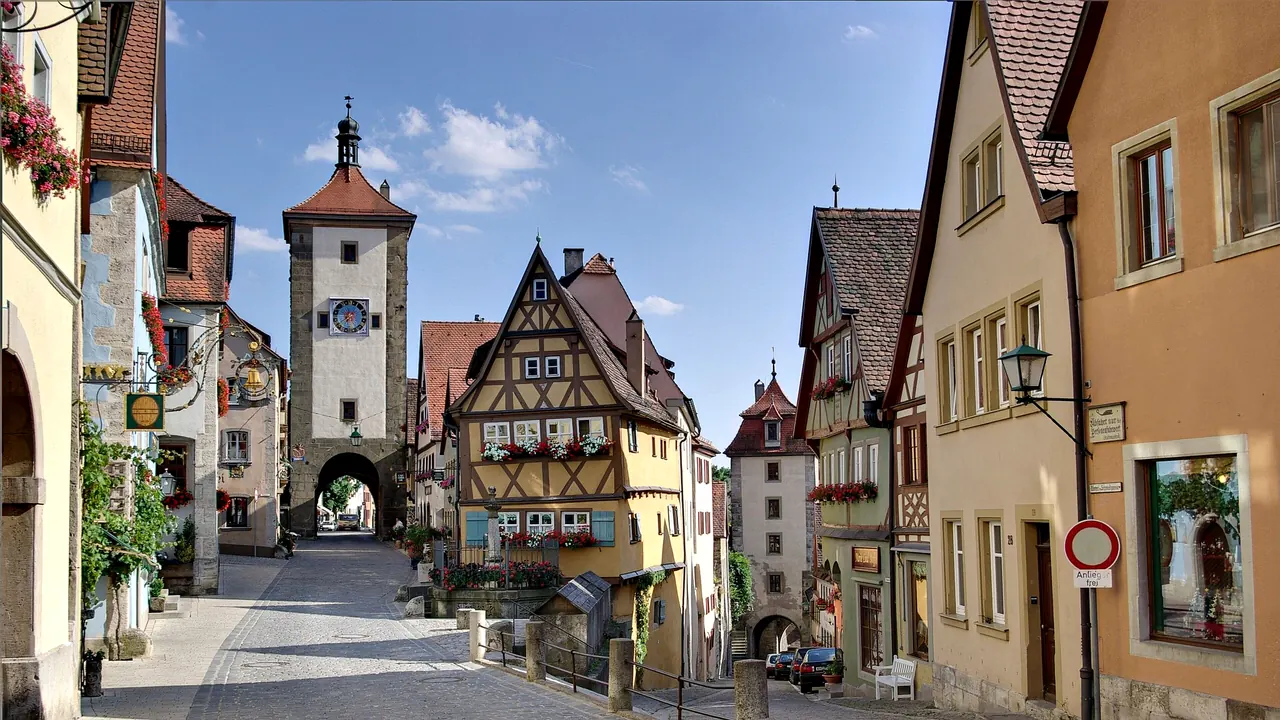
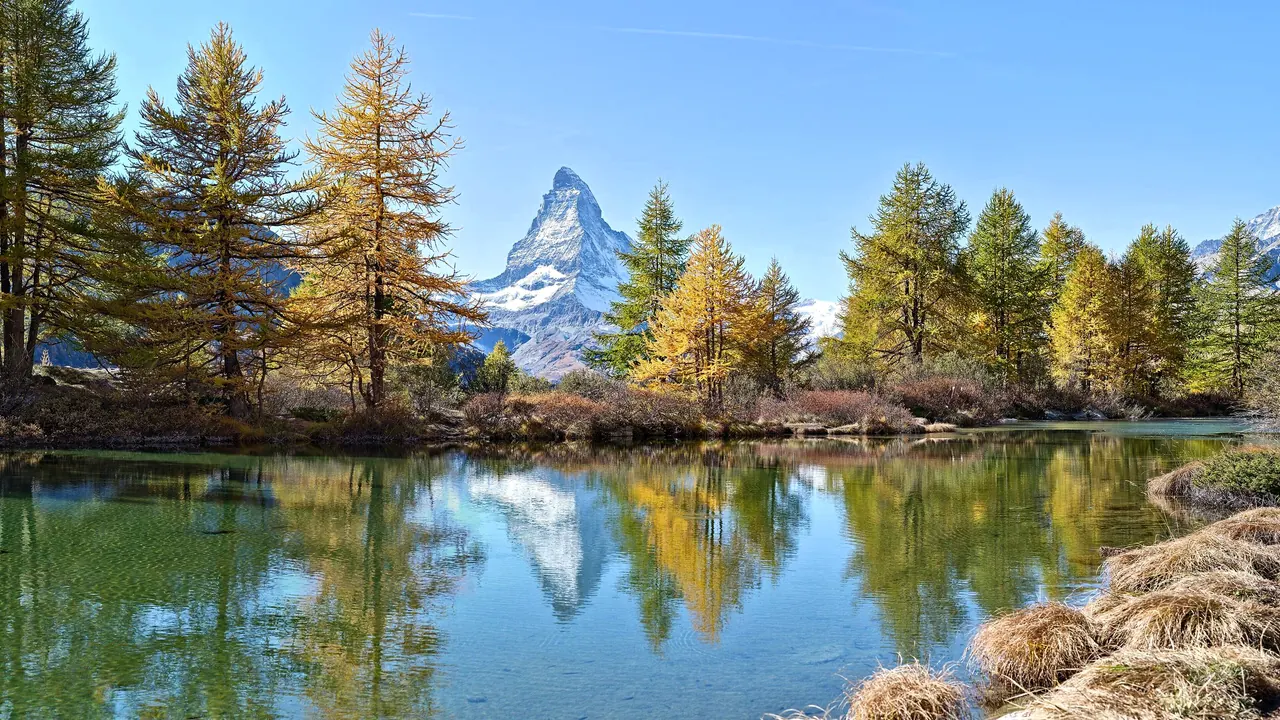
Photos: Rothenburg ob der Tauber by Berthold Werner, Public domain; Zermatt by Roy Egloff, CC BY-SA 4.0, cropped.
Rothenburg ob der Tauber or Zermatt?
Our verdict in twelve categories, each scored against the same fixed benchmark cities, and the climate month by month, so you can choose for your trip.
Choose Rothenburg ob der Tauber for
- culture and sights
- prices
- day trips
Rothenburg suits travellers who want history they can walk through. It has an intact walled medieval town, Riemenschneider's altar in St Jakob, and a whole run of Romantic Road towns within an hour's drive. It costs much less and works well for a slow touring trip by car through Franconia, as long as you don't expect lively evenings or big scenery.
Choose Zermatt for
- nature and the outdoors
- nightlife
- getting around
Choose Zermatt for the mountains. The Matterhorn rises over a car-free village, and cog railways and cable cars take you up to glaciers, ski runs and high trails that the gentle Tauber valley can't come close to. It is far more expensive and has little in the way of monuments, but skiers, hikers and anyone who wants to wake up in the high Alps will be happier here.
Scoreboard
Twelve categories on one fixed scale from 0 to 100. The shaded stretch is the gap between the two.
Your match
Pick a travel style or drag the sliders, and both match scores follow your weighting.
Too close to call, level with your weighting
Wins on culture and sights and prices with your weighting.
Wins on nature and the outdoors and nightlife with your weighting.
What matters to you?
Category by category
What the scores mean for a trip.
Beaches & swimming
Neither place is for swimming. The difference is in what you do instead. Rothenburg has an outdoor town pool, and about an hour away are the grassy bathing areas of Franconian lakes such as the Altmühlsee, which make a proper summer swimming day possible. In Zermatt the mountain tarns are for photographing the Matterhorn's reflection, not for swimming, so a hotel pool is all there is.
Food & drink
Rothenburg's food is hearty and plain: Schäufele, bratwurst and sauerkraut, with Silvaner from the round Bocksbeutel bottle. Many places around the Marktplatz cook for coach parties, so the better meals are in family-run guesthouses and Tauber valley wine taverns.
Zermatt eats better, mostly because of its mountain chalets. In the hamlets of Findeln, Furi and Zum See you can have a long lunch on a terrace with raclette, air-dried beef and a glass of Petite Arvine, and getting there on skis or on foot is part of the fun. The village also has a few ambitious fine-dining kitchens, though cheap meals are hard to find.
Culture & sights
Here Rothenburg is far ahead. The whole town is the sight: a complete medieval walled town with a covered walkway along the wall, the Plönlein view between two gate towers and the Rathaus tower over the Marktplatz. Inside St Jakob is Riemenschneider's carved altar, one of the finest pieces of late Gothic woodcarving anywhere.
Zermatt's heritage is small and all about climbing. The underground Matterhorn Museum tells the story of the 1865 first ascent, the mountaineers' cemetery holds climbers' graves, and old larch barns stand on stone slabs in the Hinterdorf. It is worth a morning, but people come for the peaks, not the monuments.
Nightlife
Rothenburg goes quiet once the day visitors leave. The evening's highlight is following the night watchman on his lantern-lit tour, then a glass of wine in a tavern, and the lanes are silent by eleven.
Zermatt has more going on, at least in winter. Après-ski bars on the runs into the village fill up from late afternoon, and a few bars and small clubs on the main street stay open past midnight on busy weekends. Summer evenings end early, because the hikers and climbers have dawn starts.
Nature & outdoors
Rothenburg's outdoors is gentle. Paths drop from the walls into the Tauber valley past mills and the Topplerschlösschen, and the Tauber valley cycle path runs downstream through vineyards. Spring blossom and autumn colour are its best moments.
Zermatt is on another scale entirely. The Matterhorn stands over the village, a ring of four-thousand-metre peaks surrounds it, and lifts climb to the Matterhorn Glacier Paradise at over 3,800m. There is skiing across the border into Italy, some glacier runs stay open in summer, and hundreds of kilometres of trails pass marmots, ibex and the suspension bridge on the Europaweg.
Day trips
Rothenburg is a far better base for exploring. Walled Dinkelsbühl is about 45 minutes away and crater-ringed Nördlingen a little further. Schwäbisch Hall, Weikersheim's palace gardens, Würzburg's Residenz and Nuremberg's castle are all about an hour by car, so the Romantic Road becomes a string of easy outings.
From Zermatt, every excursion starts with the long train ride down the valley. Sion, with its two castle hills and the Valère basilica, is the most rewarding trip, and Brig's Stockalper Palace is the nearer alternative. Most visitors would rather spend their spare days up in the mountains.
Good for families
Rothenburg works like a storybook for a day or two. Children can walk the ramparts, climb the Rathaus tower and follow the night watchman, and older ones love the torture devices in the Crime Museum. After that it runs out of ideas, and the cobbles make pushchairs hard work.
Zermatt holds families a little longer, especially active ones. There is no traffic in the car-free streets, and the village has ski schools and nursery slopes on the Sunnegga side in winter, and marmots and cog railways in summer. The viewpoints above 3,000m can be too cold and thin-aired for small children, and rainy days are hard to fill in either place.
Getting around
Both centres are walkable, and both keep cars out. Rothenburg's old town takes fifteen minutes to cross on foot, but leaving it is harder. The branch line usually means a change at Steinach, and regional buses are sparse, so a car is close to essential for the surrounding area.
Zermatt is easier overall. The Gornergrat railway, the underground funicular to Sunnegga and the gondolas all start within walking distance, and electric taxis reach the outer lift stations. Leaving the valley takes over an hour, but the trains connect smoothly into the Swiss rail network.
Shopping & style
Neither is a shopping destination, and what they sell is very different. Rothenburg is about Christmas, with year-round shops on the Herrngasse full of glass baubles, nutcrackers and Erzgebirge carvings, plus one of Germany's most atmospheric Christmas markets. Zermatt's single main street sells Swiss watches and jewellery for wealthy skiers, along with genuinely good ski and mountaineering gear.
Affordability
Rothenburg costs far less. Prices are those of small-town Germany with a tourist premium on top, inn beer and wine are fairly priced, and staying in a village nearby cuts costs further.
Zermatt is among the most expensive places in the Alps. Even plain hotels charge a lot in season, and terrace lunches and lift and railway tickets add up fast. Self-catering apartments or a bed down the valley in Täsch help, but Zermatt can't be done on a tight budget.
Live music & performing arts
Both towns are thin on live performance, so it's mostly a matter of timing your visit. Rothenburg's highlight is history in costume: the Meistertrunk play about the Thirty Years' War, plus summer open-air theatre and organ concerts in St Jakob. Zermatt brings in musicians for two festivals, acoustic sets at Zermatt Unplugged in spring and chamber music in the church in late summer. The rest of the year, its live music is the band in an après-ski bar.
Wellness & relaxation
Rothenburg's calm comes in the early mornings and evenings, when the lanes empty and a walk on the walls is very quiet. It has only a few small hotel spas, so for proper bathing you drive to the saltwater pool of the Franken-Therme at Bad Windsheim or to Bad Mergentheim.
Zermatt is the more restful choice. It has an unusual number of excellent hotel spas, many with mountain views, and some sell day passes. The car-free streets and clear air add to the calm, although the mood in peak weeks is more active than slow.
When should you go?
Pick your month. The climate figures are measured averages, not a forecast.
Rothenburg ob der Tauber in July
Zermatt in July
Daytime high, °C
Rainfall in the month, mm
Where the figures come from
Rothenburg ob der Tauber's sunshine is measured 27 km from the centre, at Feuchtwangen-heilbronn.
Zermatt has no weather station within reach, so its figures come from a gridded climate model rather than a measured record, and read a broad area rather than the city itself.
Temperature and rainfall are climate normals, averaged over the years shown. Rothenburg ob der Tauber: 1991-2020 normals, Rothenburg ob der Tauber (0.9 km from centre). Zermatt: 1991-2020 normals, TerraClimate 4 km grid at the town, no weather station within 90 km.
Rothenburg is at its best from late spring to early autumn. From June to August days reach about 25°C with long hours of sunshine. That is the time to walk the walls, linger in the lanes and use the outdoor pool or the Franconian lakes. May and September are milder and suit the valley paths. Rain falls fairly evenly through the year, so no month is reliably dry. In winter highs are only a few degrees above freezing and the days are short and dim, so time spent in the streets is chilly.
Zermatt's calendar has two seasons. From December to February daytime highs in the village stay around -2°C, and the cold lasts through March into April, so winter conditions hold well into spring. In July and August highs reach only about 14°C, which is fresh for walking and colder on the trails above. The awkward months fall between the seasons. May is cool and wet as the snow retreats, and November is the wettest month at about 130mm. Neither is good for skiing or for hiking.
Which traveller are you?
For a culture and arts trip, Rothenburg is the clear choice. It has the ramparts, Riemenschneider's Holy Blood Altar and the Medieval Crime Museum, and Dinkelsbühl, Nördlingen and Würzburg are nearby to add more. Zermatt's mountaineering heritage fills a single morning.
On an outdoors trip, Zermatt has no rival here. The Matterhorn, the Gorner Glacier, high ski runs linked to Italy and summer walks such as the Five Lakes trail all start above the village. Rothenburg offers gentle valley walks and the Tauber cycle path.
On a tight budget, Rothenburg is far kinder. Beer and wine in the inns are reasonably priced, entry fees are modest and rooms outside the walls cost less again. In Zermatt, rooms, terrace meals and lift tickets are expensive even if you picnic from the supermarket.
Before you go
| Measure | Rothenburg ob der Tauber | Zermatt |
|---|---|---|
| Official language | German | French, German, Italian, Romansh |
| Currency | Euro (EUR) | Swiss Franc (CHF) |
| Sockets | CF230 V, 50 Hz | CJ230 V, 50 Hz |
| Driving side | Right | Right |
| Time zone | UTC+1, UTC+2 in summer | UTC+1, UTC+2 in summer |
| Emergency number | 112 | 112 |
| Elevation | 430 m | 1,624 m |
| Main airport | Nuremberg Airport (NUE)66 km from centre56 non-stop destinations | Geneva International Airport (GVA)128 km from centre150 non-stop destinations |
| Public holidays this year | 12 days | 9 days |
By the numbers
| Measure | Rothenburg ob der Tauber | Zermatt |
|---|---|---|
| City population | 11,331 | 6,023 |
| People per km² | 272 | 25 |
| Museums within 10 km | 6 | 2 |
| UNESCO World Heritage sites within 50 km | 2 | 2 |
Where else could you go?
Every comparison below shares a destination with this one, so you can follow Rothenburg ob der Tauber or Zermatt somewhere new.
- Nurembergvs Rothenburg ob der Tauber
- Chamonixvs Zermatt
- Interlakenvs Zermatt
- Bambergvs Rothenburg ob der Tauber
- Luganovs Zermatt
- Stuttgartvs Rothenburg ob der Tauber