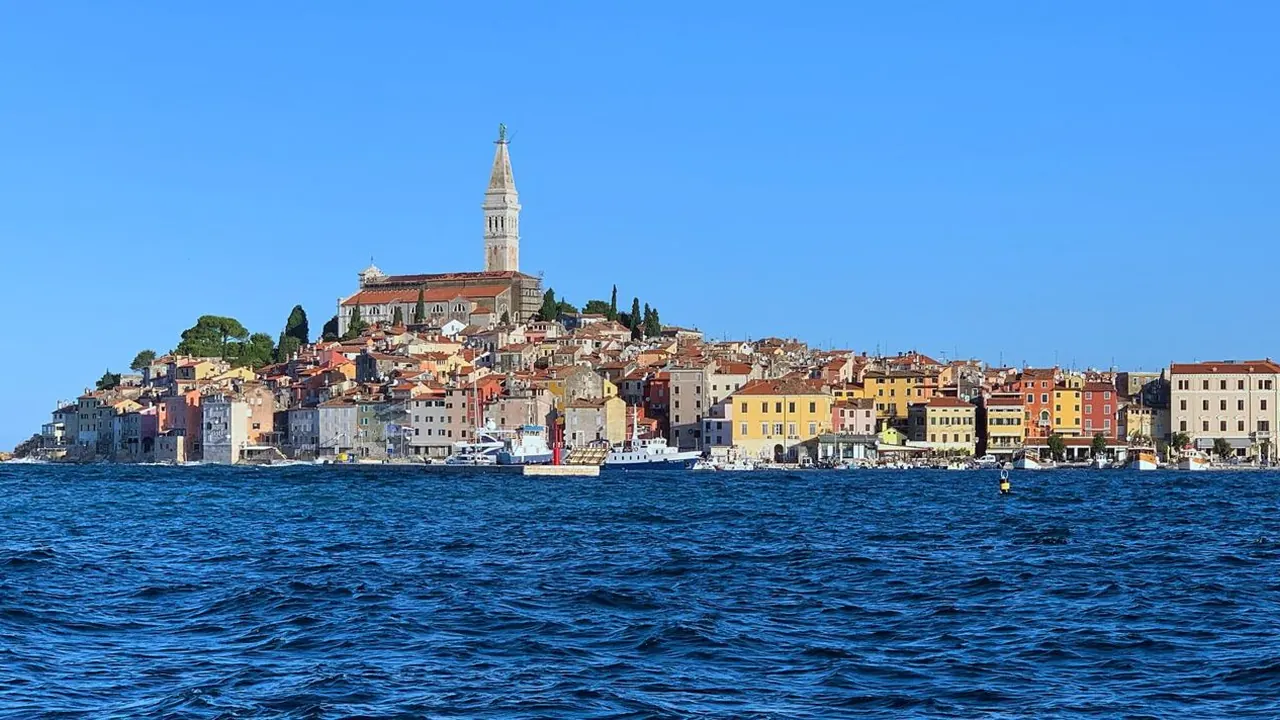
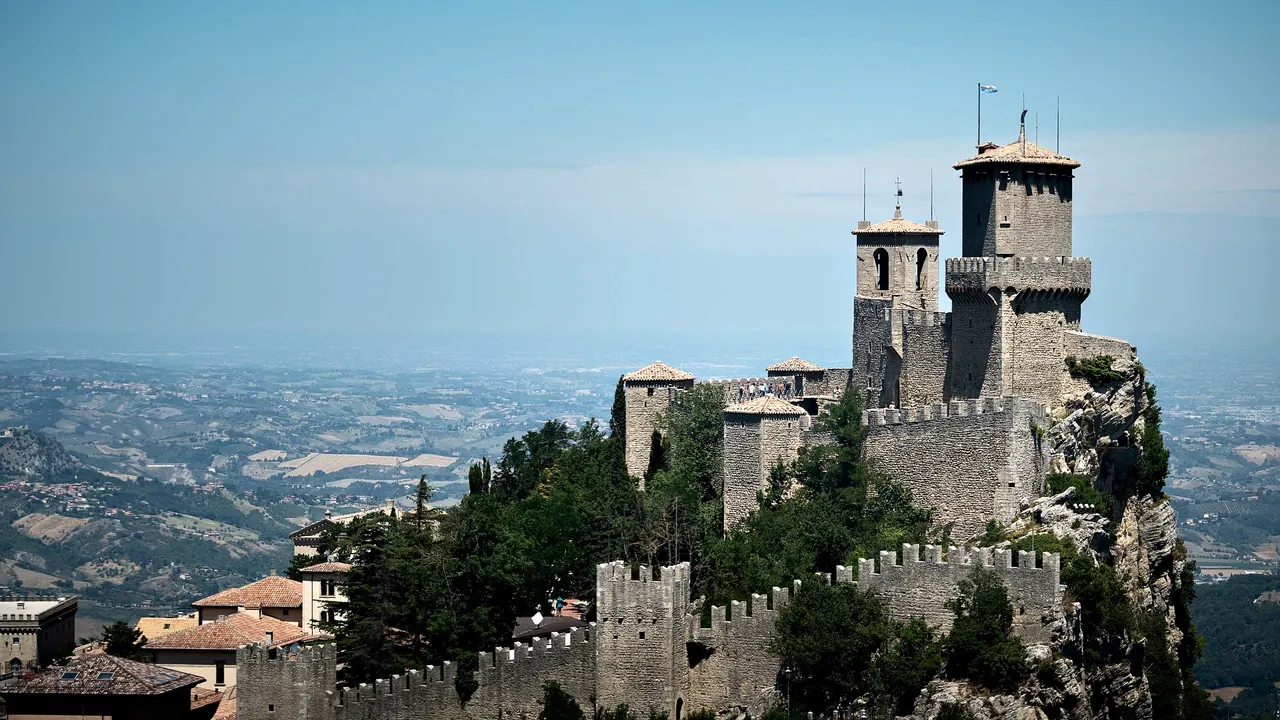
Photos: Rovinj by Vyacheslav Bukharov, CC BY-SA 4.0, cropped; San Marino by Tibor Szabo, Pexels License.
Rovinj or San Marino?
Our verdict in twelve categories, each scored against the same fixed benchmark cities, and the climate month by month, so you can choose for your trip.
Choose Rovinj for
- beaches
- nature and the outdoors
- nightlife
Rovinj suits a slow summer week by the water. You swim off limestone ledges below the old town, paddle among the islands, eat long fish dinners and finish with a drink on the rocks at sunset. Choose it if you want the sea outside the door and a gentle evening scene, and accept that high summer is expensive.
Choose San Marino for
- prices
- culture and sights
- day trips
San Marino works best as a hilltop base for exploring rather than as a resort. If you come for medieval towers, the story of an ancient republic and easy drives to Urbino, San Leo and Ravenna, you will get more from it, and a stay costs less. The catch is that beach days and nights out mean going down to Rimini.
Scoreboard
Twelve categories on one fixed scale from 0 to 100. The shaded stretch is the gap between the two.
Your match
Pick a travel style or drag the sliders, and both match scores follow your weighting.
Wins on beaches and nature and the outdoors with your weighting.
Wins on prices and culture and sights with your weighting.
What matters to you?
Category by category
What the scores mean for a trip.
Beaches & swimming
Rovinj lives on the water. Several kilometres of limestone ledges, pebble coves and bathing platforms run south into the Golden Cape, and you can swim straight off the rocks below the old town walls. There is almost no sand, though, and you need water shoes.
San Marino has no shore of its own. Its beaches are on the Romagna Riviera, about half an hour below the mountain: sandy, shallow and lined with numbered umbrellas. That suits small children better than Rovinj's rocks, but every swim becomes an outing.
Food & drink
Istria gives Rovinj more to work with. It has grilled fish, scampi buzara, truffle pasta, peppery olive oil and Malvazija and Teran wines from the hinterland, as well as a few ambitious kitchens and countryside konobas that are worth the drive.
San Marino serves the hill cooking of Romagna and Montefeltro: tagliatelle, passatelli in broth, grilled meat and piadina, with Tre Monti wafer cake to finish. The terraces on the summit sell the view more than the food, so the good meals are down in Borgo Maggiore or over the border in Italy.
Culture & sights
In both places the town itself is the main sight, but San Marino has a little more to it. Three towers stand on the cliff edge, linked by a path, and the Palazzo Pubblico, where the Captains Regent are installed, the Basilica and the State Museum together tell the story of a republic that has lasted for centuries.
Rovinj has one beautifully intact Venetian quarter climbing to St Euphemia, whose bell tower you can climb, plus the Batana House, which tells the story of the local fishing boats. It is very photogenic but takes no more than a slow afternoon.
Nightlife
Rovinj at least has evenings out: a handful of cocktail and wine bars by the harbour, sunset drinks on the rocks and a couple of places to dance in high season, although the old town is quiet by midnight. San Marino's summit empties once the coaches leave, leaving dinner and a glass of wine above the lights of the coast. For anything later you have to drive down to the clubs in Rimini and Riccione.
Nature & outdoors
Rovinj has the more varied outdoors, mostly on or beside the sea. There are pine and cedar paths in the Golden Cape, kayaking, paddleboarding and diving around the archipelago's reefs and wrecks, and boat trips into the steep green Lim Fjord.
San Marino's nature is the limestone ridge of Monte Titano, about 740m high. It has cliff-top views to the Adriatic and the Apennines and short walks through the woods down to Borgo Maggiore. It is good for a morning on foot or a drive through the Montefeltro hills, but there is nothing to do on the water.
Day trips
Both make strong bases, but the trips lead into different periods of history. From Rovinj you visit Roman and early Christian Istria: Pula's amphitheatre and Porec's Euphrasian Basilica, the hill towns of Motovun and Hum, the Brijuni islands, and Piran or Trieste across the border.
San Marino looks towards Renaissance Italy and Byzantium, with the fortress of San Leo, Urbino's ducal court, the castle at Gradara and Ravenna's mosaics. Both need a car for most trips, but Bologna and Ravenna are easy by train from Rimini, while Rovinj has no railway at all.
Good for families
Families do roughly as well in either place, in different ways. Rovinj has flat, shaded paths in the Golden Cape, boat trips to the islands and resorts with pools and playgrounds, but its rocky shore needs water shoes and close watching.
San Marino has the sights children get most excited about: towers, battlements and the cable car. Sandy shallows and parks such as Italia in Miniatura and Fiabilandia are on the coast below. In both towns, steep cobbles and steps make pushchairs hard work.
Getting around
Rovinj is easier to manage without wheels. The car-free old town, the harbour, the restaurants and the swimming rocks are all linked by the waterfront promenade, with bikes for the coast paths and taxi boats to the islands. Beyond the town, though, the hill towns and wineries need a car.
San Marino's centre is walkable too, but nearly every street climbs or turns into steps, and the cable car to Borgo Maggiore only helps so much. The bus from Rimini is the one regular link to the outside, and buses between the villages are infrequent.
Shopping & style
Neither is a place to go shopping, but they sell quite different things. Rovinj's best buys are Istrian truffle products, olive oil and wine, and the galleries and studios along Grisia give its lanes an artistic side.
San Marino trades on its lower taxes. Perfume, watches, leather goods and spirits fill the main streets, there is an outlet centre in the valley, and collectors come for the republic's stamps and coins.
Affordability
San Marino is the cheaper place to stay. Hotels are priced like provincial Italy, the trattorias in the lower villages are fairly priced, and fuel and some goods cost less than across the border. Only the view terraces and the most convenient hotels on the summit cost extra.
Rovinj in July and August costs as much as any sought-after Mediterranean resort. Private apartments, the campsites and a visit in late spring or September narrow the gap.
Live music & performing arts
Both are thin on live performance and liven up mainly in summer, each with its own local speciality. Rovinj has bitinada, an unaccompanied local singing tradition tied to the batana boats, as well as concerts in St Euphemia. San Marino has its Medieval Days festival, with costumed musicians, crossbow contests and flag-throwers. For bigger concerts, Rovinj looks to Pula's Roman arena and San Marino to Bologna or Pesaro.
Wellness & relaxation
Rovinj is the easier place to unwind. The larger resort hotels along the Golden Cape have well-equipped spas that take outside guests, and outside high summer, long lunches, late swims and walks in the pines set a slow pace.
San Marino has only a few hotel spas. Its quiet comes in the evening, once the day visitors have left the walls, and a thermal spa means a separate trip to the coast or the Apennine valleys.
When should you go?
Pick your month. The climate figures are measured averages, not a forecast.
Rovinj in July
San Marino in July
Daytime high, °C
Rainfall in the month, mm
Where the figures come from
Rovinj's temperatures are measured 64 km from the centre, at Trieste.
Rovinj has no rain gauge within 25 km of the centre, so its rainfall comes from a gridded climate dataset read at the city rather than from a gauge further away.
San Marino's temperatures are measured 52 km from the centre, at Frontone.
San Marino has no rain gauge within 25 km of the centre, so its rainfall comes from a gridded climate dataset read at the city rather than from a gauge further away.
Temperature and rainfall are climate normals, averaged over the years shown. Rovinj: 1991-2020 normals, Trieste (63.7 km from centre). San Marino: 1991-2020 normals, Frontone (51.5 km from centre).
The two share the same Adriatic pattern: hot July and August with highs of 29°C to 30°C, then a wetter, cooler autumn, with November the rainiest month in both. Rovinj is the place for the sea. The water is pleasant for swimming from June to September and peaks around 26°C in August, and July brings the most sunshine of the year.
San Marino is a couple of degrees colder in winter, and its spring is clearly wetter than Istria's. For walking the summit and the hill towns, May, June and September are the most comfortable months, because the steep streets are hot work on midsummer afternoons. The same months suit Rovinj's cobbled lanes: warm enough to swim but not too hot for the climb to St Euphemia.
Which traveller are you?
On a beach and sun trip, Rovinj is the clear choice. You can swim every day from rock ledges and pine-shaded coves in very clear water, with quieter island coves a taxi boat away. From San Marino, every swim is a trip down to Rimini's rows of umbrellas.
For a culture and arts trip, San Marino comes out slightly ahead. Its three cliff-top towers, the Palazzo Pubblico and the history of one of the world's oldest republics give you more to see than Rovinj's single handsome quarter, and Urbino and Ravenna are both within a drive.
On a tight budget, San Marino is easier on the wallet. Hotels and trattorias in the lower villages charge provincial Italian prices. Rovinj charges resort rates in July and August, and harbourside fish sold by weight adds up quickly.
Before you go
| Measure | Rovinj | San Marino |
|---|---|---|
| Official language | Croatian | Italian |
| Currency | Euro (EUR) | Euro (EUR) |
| Sockets | CF230 V, 50 Hz | CFL230 V, 50 Hz |
| Driving side | Right | Right |
| Time zone | UTC+1, UTC+2 in summer | UTC+1, UTC+2 in summer |
| Emergency number | 112 | 112 |
| Elevation | 0 m | 675 m |
| Main airport | Pula Airport (PUY)31 km from centre34 non-stop destinations | Bologna Guglielmo Marconi Airport (BLQ)114 km from centre98 non-stop destinations |
| Public holidays this year | 14 days | 18 days |
By the numbers
| Measure | Rovinj | San Marino |
|---|---|---|
| City population | 12,968 | 4,040 |
| People per km² | - | 569 |
| Museums within 10 km | 1 | 19 |
| UNESCO World Heritage sites within 50 km | 1 | 2 |
| Swim season, months above 21 °C | 4 months | 4 months |
Where else could you go?
Every comparison below shares a destination with this one, so you can follow Rovinj or San Marino somewhere new.
- Pulavs Rovinj
- Piranvs Rovinj
- Triestevs Rovinj
- Assisivs San Marino
- Florencevs San Marino
- Bolognavs San Marino