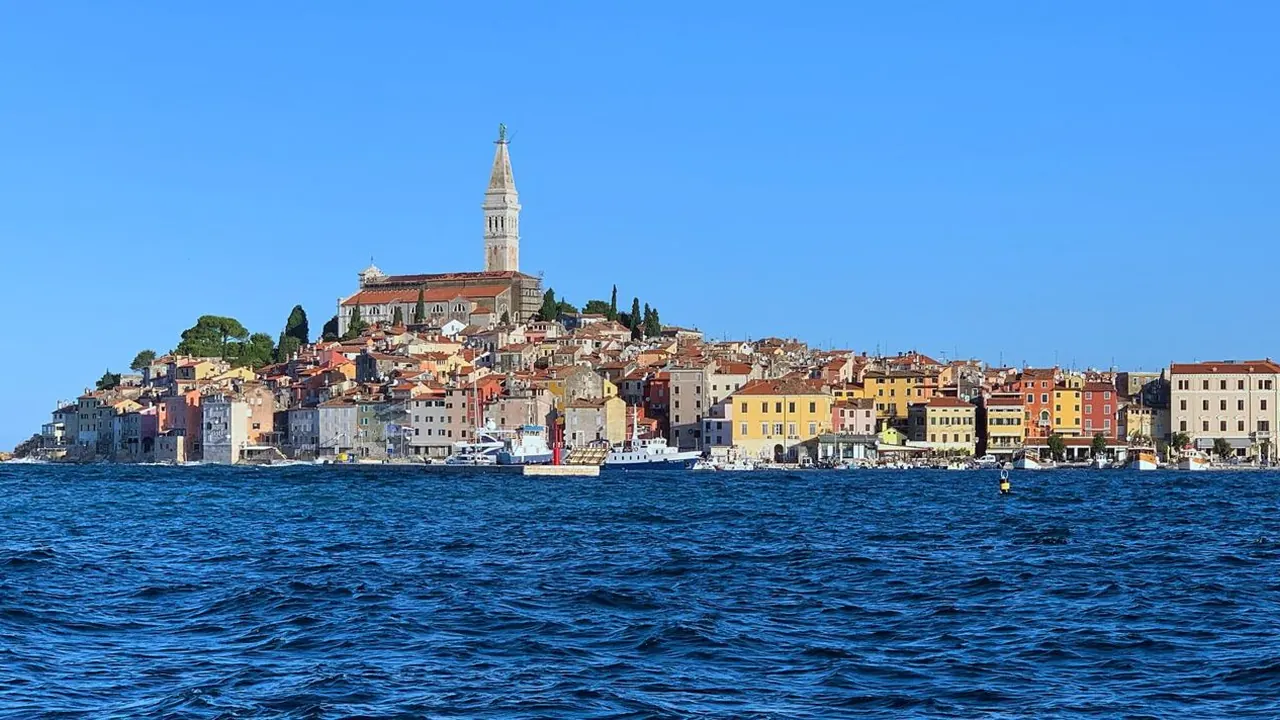
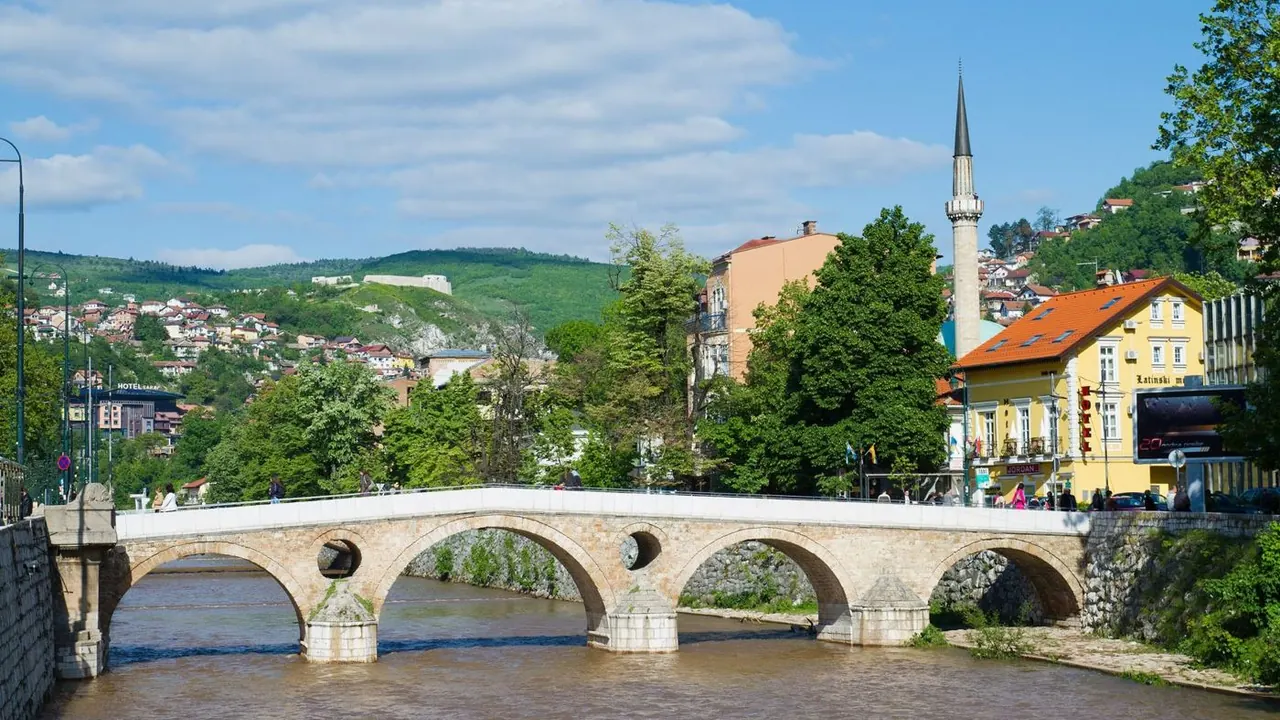
Photos: Rovinj by Vyacheslav Bukharov, CC BY-SA 4.0, cropped; Sarajevo by Tumi-1983, CC0.
Rovinj or Sarajevo?
Our verdict in twelve categories, each scored against the same fixed benchmark cities, and the climate month by month, so you can choose for your trip.
Choose Rovinj for
- beaches
- families
- day trips
Rovinj is the choice for a slow summer by the sea. You get clear water off the rocks below a Venetian old town, quiet island coves a taxi boat away, and the Roman and medieval sights of Istria within an easy drive. It suits couples and families who want swimming, long dinners and a pretty town, and who don't mind higher prices and quiet nights.
Choose Sarajevo for
- prices
- culture and sights
- live music and the arts
Travellers who care more about history, mountains and a cheap, sociable city should head to Sarajevo. The Ottoman bazaar, the Austro-Hungarian avenues and the story of the 1990s siege are all within walking distance, the Olympic peaks are close, and money goes much further. There is no sea, though, so this is a city break or a mountain trip rather than a beach vacation.
Scoreboard
Twelve categories on one fixed scale from 0 to 100. The shaded stretch is the gap between the two.
Your match
Pick a travel style or drag the sliders, and both match scores follow your weighting.
Wins on beaches and families with your weighting.
Wins on prices and culture and sights with your weighting.
What matters to you?
Category by category
What the scores mean for a trip.
Beaches & swimming
This is no contest. Rovinj's shore is rock and pine rather than sand. Flat ledges, pebble coves and concrete bathing platforms run for kilometres into the Golden Cape park, the water is very clear, and you can swim right under the old town walls. Bring water shoes, and families who want soft sand will be disappointed.
Sarajevo sits in a mountain valley about three hours from the Adriatic. Swimming there means cold rivers, Jablanica lake in summer or a pool, so if you love beaches, add a few days on the coast to the trip.
Food & drink
Sarajevo has the more memorable food, though the range is narrow. Ćevapi in somun bread with kajmak from the Baščaršija grills, burek sold by weight in pita bakeries and slow dishes such as begova čorba give the city a clear food identity. Bosnian coffee with rahat lokum is part of the daily rhythm.
Rovinj eats well in a different way: grilled fish, scampi buzara, truffle pasta and peppery Istrian oil with Malvazija and Teran wines, plus a few refined restaurants and country konobas. Its weak points are the tourist menus along the harbour and the shortage of cheap everyday food.
Culture & sights
Sarajevo has much more to see. Baščaršija, with the Sebilj fountain and the Gazi Husrev-beg Mosque, gives way within minutes to Austro-Hungarian avenues, two cathedrals and the Old Synagogue. The Latin Bridge, the Tunnel of Hope and the Sarajevo Haggadah add history of real weight.
In Rovinj the main sight is the town itself: pastel Venetian houses climbing to St Euphemia, the Balbi Arch and the Batana House. It is very photogenic, but a slow afternoon covers it.
Nightlife
Neither is a party town, but Sarajevo stays out later. The café-bars around Ferhadija get louder as the evening goes on, and cheap drinks and a student crowd keep cellar bars and small clubs open past midnight at weekends, all year round.
A night in Rovinj means a sunset drink on the rocks and a few waterfront cocktail bars in summer. The old town is quiet by midnight and little stays open out of season.
Nature & outdoors
Both have outdoor country close at hand, but Sarajevo's is on a bigger scale. A cable car climbs from the Old Town to Trebević and the abandoned Olympic bobsleigh track. Jahorina and Bjelašnica, under an hour away, offer winter skiing and summer hiking on open ridges, and the stone village of Lukomir above the Rakitnica canyon takes you into real high country.
Rovinj's outdoors is gentler and centred on the sea: flat paths through the Golden Cape pines, kayaking and diving around the archipelago, and boat trips up the Lim Fjord. There are no mountains, and spring and autumn are the best seasons.
Day trips
Rovinj has more places within easy reach. Pula's Roman amphitheatre and the Euphrasian Basilica in Porec are each about forty minutes away, and the hill towns of Motovun, Groznjan and Hum sit among the vineyards. Piran and Trieste are reachable across the border, though you need a car for most of this.
Sarajevo has fewer trips, but some of them are grand. You can take the train along the Neretva gorge to Mostar's bridge, and visit Konjic with Tito's bunker, Blagaj, Počitelj or the Višegrad bridge. Roads are slow and winding, so each outing takes most of a day.
Good for families
Rovinj suits children better, largely because of the sea. There are island boat trips, gelato on the harbour, shaded pushchair paths in the Golden Cape park, and resorts and campsites with pools and playgrounds. The rocky shore and steep cobbles call for water shoes and patience.
Sarajevo is warmly welcoming to children, and the cable car, the zoo at Pionirska dolina and the carriage ride to Vrelo Bosne make good half days out. Most of the remaining sights are about war and history, and grill smoke and winter smog are hard on small lungs.
Getting around
Both have centres you can walk, but they work differently. Rovinj is a small car-free old town where the harbour, the restaurants and the swimming rocks are all a short walk apart, and taxi boats serve the islands. Beyond the town there is no railway, and a car becomes almost essential.
Sarajevo is a proper city, with a tram running along the valley from Baščaršija to Ilidža, plus buses, trolleybuses and cheap taxis. The flat centre is easy on foot. The hillside neighbourhoods are steep, though, and the mountains need a taxi or a tour.
Shopping & style
Shopping in Rovinj is small and seasonal, and mostly about taking the region home with you: truffle products, Istrian olive oil, Malvazija and Teran wine. The galleries and artists' studios along steep Grisia give the old town some character, but there are no fashion streets, and the choice thins out once summer ends.
Baščaršija gives Sarajevo the better browsing. On Kazandžiluk you can still hear coppersmiths hammering out coffee sets and trays, and the Bezistan and the lanes around it sell kilims, leather slippers and filigree jewellery, though it pays to look past the souvenir stock. Malls and high-street chains cover anything practical.
Affordability
Sarajevo is far cheaper. Grill meals, pastries, coffee, trams and central guesthouses all cost well below Western European levels, and only the Old Town and the summer film festival push prices up a little.
Rovinj is one of the pricier stops on the Croatian coast. Rooms near the old town cost high-summer rates, and fish sold by weight on the harbour adds up quickly. Private apartments, campsites and travelling in late spring or September keep the bill down.
Live music & performing arts
Sarajevo has a stage life worth planning an evening around. The National Theatre puts on drama, opera and ballet, the Philharmonic gives regular concerts, MESS brings theatre in autumn and there is a jazz festival in November, with sevdah sung in traditional restaurants. Rovinj has little beyond summer concerts in St Euphemia, music on the harbour and the occasional bitinada singing, so for anything bigger you go to Pula's arena.
Wellness & relaxation
The two are evenly matched, but they help you unwind in different ways. Rovinj has the spa areas of its resort hotels, and above all a slow pace in May, June and September, with late swims and walks in the pines, though in high summer the centre is crowded.
Sarajevo has a real thermal tradition at Ilidža, at the end of the tram line, where sulphurous springs used since Roman times feed warm pools, with the streams of Vrelo Bosne nearby. Winter smog makes the city less restful.
When should you go?
Pick your month. The climate figures are measured averages, not a forecast.
Rovinj in July
Sarajevo in July
Daytime high, °C
Rainfall in the month, mm
Where the figures come from
Rovinj's temperatures are measured 64 km from the centre, at Trieste.
Rovinj has no rain gauge within 25 km of the centre, so its rainfall comes from a gridded climate dataset read at the city rather than from a gauge further away.
Temperature and rainfall are climate normals, averaged over the years shown. Rovinj: 1991-2020 normals, Trieste (63.7 km from centre). Sarajevo: 1991-2020 normals, Sarajevo-Bejelave (2 km from centre).
Rovinj is a summer place. From June to September the days are warm, up to 29°C, and the sea is pleasant for long swims, reaching 26°C in August. July is the sunniest month. Autumn turns wet, with September to November the rainiest stretch. Winters are mild but grey and too cool for swimming. May and late September are the best months for walking and cycling without the summer heat.
Sarajevo has the more continental climate of a mountain valley. Summer highs of 28°C are warm for sightseeing but rarely oppressive. In December and January the highs are only about 4°C, which brings cold streets and the ski season on the nearby mountains. Rain is spread fairly evenly through the year, so no month is reliably dry. May, June and September are the most comfortable months for exploring on foot.
Which traveller are you?
For a beach and sun trip, Rovinj wins outright. You swim off limestone ledges and pebble coves in the Golden Cape park or take a taxi boat to the islands. Sarajevo is three hours from the coast and has only rivers, a lake and pools.
On a culture and arts trip, Sarajevo gives far more. Mosques, cathedrals and the Old Synagogue stand a few streets apart, and the Latin Bridge and the siege sites tell modern history. The National Theatre and the autumn festivals fill your evenings.
On a tight budget, Sarajevo is the easy pick. Ćevapi, burek and bazaar coffee cost little, trams and taxis are cheap, and central guesthouses cost well below Western European levels. In high summer, Rovinj charges what a sought-after Mediterranean resort charges.
Before you go
| Measure | Rovinj | Sarajevo |
|---|---|---|
| Official language | Croatian | Croatian, Serbian, Bosnian |
| Currency | Euro (EUR) | Convertible Mark (BAM) |
| Sockets | CF230 V, 50 Hz | CF230 V, 50 Hz |
| Driving side | Right | Right |
| Time zone | UTC+1, UTC+2 in summer | UTC+1, UTC+2 in summer |
| Emergency number | 112 | 112 |
| Elevation | 0 m | 518 m |
| Main airport | Pula Airport (PUY)31 km from centre34 non-stop destinations | Sarajevo International Airport (SJJ)7 km from centre38 non-stop destinations |
| Public holidays this year | 14 days | 8 days |
By the numbers
| Measure | Rovinj | Sarajevo |
|---|---|---|
| City population | 12,968 | 275,524 |
| People per km² | - | 1,947 |
| Museums within 10 km | 1 | 25 |
| UNESCO World Heritage sites within 50 km | 1 | 1 |
| Swim season, months above 21 °C | 4 months | - |
Where else could you go?
Every comparison below shares a destination with this one, so you can follow Rovinj or Sarajevo somewhere new.