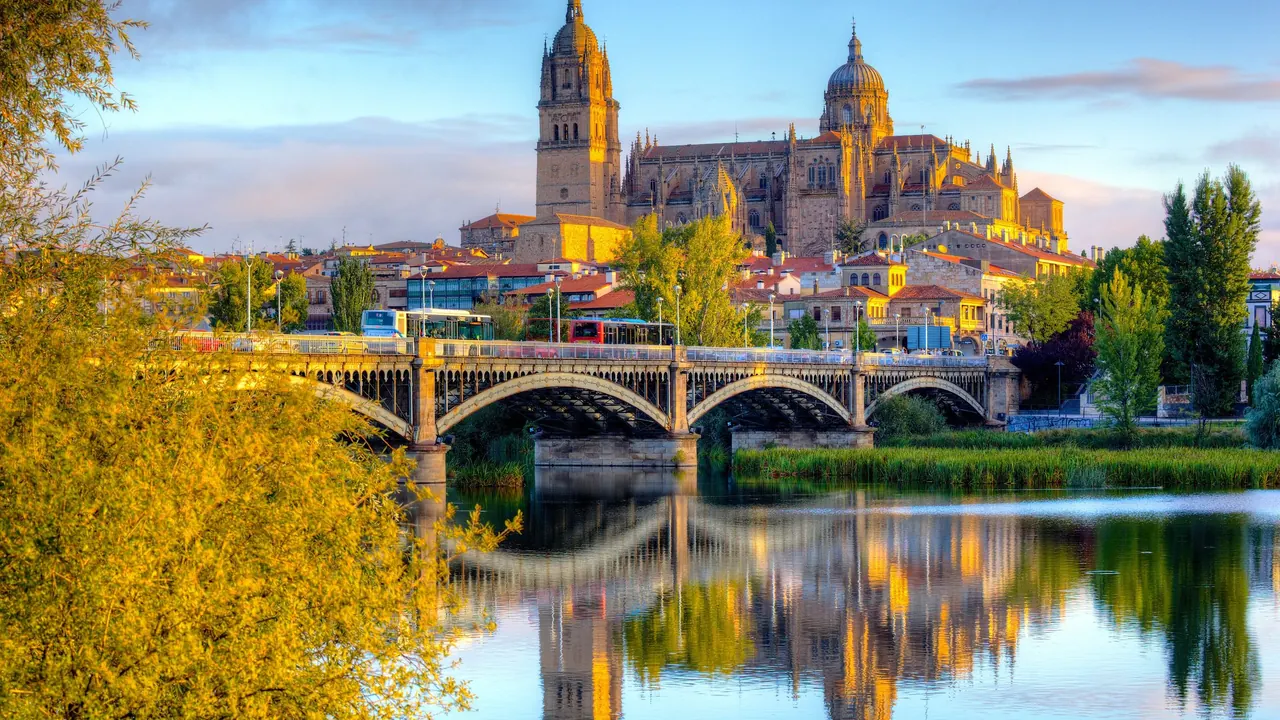
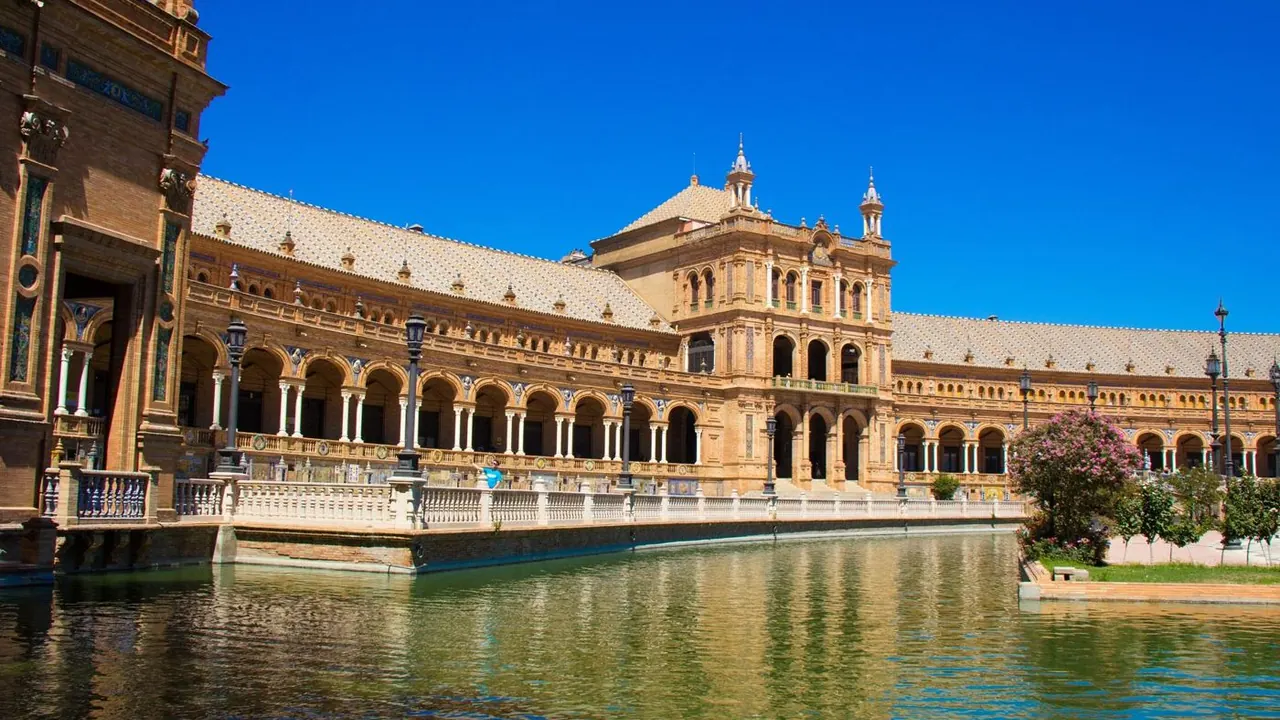
Photos: Salamanca by Jiuguang Wang, CC BY-SA 3.0 ES, cropped; Seville by Tibor Kovacs, CC BY 2.0, cropped.
Salamanca or Seville?
Our verdict in twelve categories, each scored against the same fixed benchmark cities, and the climate month by month, so you can choose for your trip.
Choose Salamanca for
- prices
- getting around
- wellness
Salamanca suits a shorter, cheaper and calmer trip. Its golden sandstone old town can be seen properly in two or three days on foot. Tapas often come free with a drink, and the student bars keep evenings lively without much cost. It is also the cooler choice in high summer, and it makes a good base for the walled towns and mountain villages of Old Castile.
Choose Seville for
- live music and the arts
- shopping
- food and drink
Seville is the richer destination, and the better choice for most first visits to Spain. The Alcázar, the cathedral and the Murillo paintings go deeper than anything in Salamanca, and so does the city's food. Flamenco and opera give it a performing life Salamanca cannot match, and Córdoba, Jerez and Cádiz are within reach by train. The cost is heat and crowds at the wrong time of year.
Scoreboard
Twelve categories on one fixed scale from 0 to 100. The shaded stretch is the gap between the two.
Your match
Pick a travel style or drag the sliders, and both match scores follow your weighting.
Wins on prices and getting around with your weighting.
Wins on live music and the arts and shopping with your weighting.
What matters to you?
Category by category
What the scores mean for a trip.
Beaches & swimming
Neither city is a beach destination, but Seville can at least get you to the sea. The Huelva sands at Matalascañas and Mazagón are about an hour and a quarter away by car, and the long beaches of Cádiz province lie further on, so a full day at the coast or a few nights there fits easily into a stay.
Salamanca is a long day's drive from any coast. Swimming there means municipal pools or the river beaches along the Tormes and in the province's reservoirs.
Food & drink
Both cities eat at the bar counter, but Seville does it with more range and conviction. Salamanca's strengths are ham and meat: ibérico from nearby Guijuelo, hornazo, farinato sausage, roast suckling pig and morucha beef, washed down with Toro reds. Fish and seafood barely feature.
Seville adds what Salamanca lacks: fried fish from the Cádiz coast, salmorejo, spinach with chickpeas and manzanilla from the sherry towns. Old tiled bars in Triana and El Arenal sit beside more inventive kitchens around the Alameda. Neither city offers much international or top-end cooking.
Culture & sights
Both old centres are UNESCO-listed, and Salamanca's has a beauty of its own. It is built in a single warm sandstone, with the baroque Plaza Mayor, the carved University façade and twin cathedrals whose towers you can climb, all seen in two or three days. Its museums are modest apart from Casa Lis.
Seville goes further. The Mudéjar courtyards of the Alcázar, the vast Gothic cathedral with its minaret-turned-belfry and the Archivo de Indias are world-class on their own. The Museo de Bellas Artes, Casa de Pilatos and Plaza de España then fill another day or two.
Nightlife
The two are evenly matched, but the nights feel different. Salamanca's run on its students. From Thursday to Saturday the bars around the Plaza Mayor and Calle Bordadores fill with locals and foreign Spanish-learners, and they end in dance bars and small clubs well past 3am. In high summer, when term is over, it goes quiet.
Seville's evenings are older and more outdoor: dinner at ten, terraces in little squares, a mixed and LGBT-friendly crowd on the Alameda de Hércules and riverside bars once the summer heat breaks. Neither city is a place for serious clubbing.
Nature & outdoors
Each city has about as much countryside within reach, but the landscapes differ. From Salamanca you head for mountains and gorges: the chestnut forests of the Sierra de Francia and Las Batuecas, the high summits of the Sierra de Béjar, and the granite canyon of the Arribes del Duero on the Portuguese border. Almost all of it needs a car.
Seville's great outing is for wildlife rather than hiking. The Doñana marshes and dunes have flamingos, migrating birds and a slim chance of seeing a lynx, and they are usually explored on guided off-road trips. The Sierra de Aracena offers gentler walks, and in town you can row or kayak on the old river channel.
Day trips
Salamanca makes a good base for Old Castile. Walled Ávila, Romanesque Zamora and the border fortress of Ciudad Rodrigo are each about an hour away. Further out, the half-timbered villages of La Alberca and Mogarraz reward a driver, though many of these places are awkward without a car.
Seville's options are bigger and easier to reach. Córdoba's Great Mosque is under an hour by high-speed train, and Jerez and Cádiz are also on the railway. The Roman ruins of Itálica and the hilltop town of Carmona are close by, and the white villages begin at Arcos de la Frontera.
Good for families
Seville has more to keep children busy. There are rowing boats at Plaza de España, a maze in the Alcázar gardens, an aquarium, and a theme park with a summer water park on La Cartuja. The catch is July and August, when 40°C days make outings with small children hard going.
Salamanca has nothing built for children. Its appeal is small-scale: hunting for the frog and the astronaut carved in the stone, climbing the cathedral towers and walking by the Tormes. It works best as a short stop on a wider family trip.
Getting around
Both are walking cities and equally easy to get around. Salamanca is the smaller of the two, about 20 minutes on foot from the Plaza Mayor to the Roman bridge, though its cobbles and gentle slopes are hard work with a pushchair.
Seville's centre is flat but more spread out. A tram, a metro line and a good public bike scheme help with the longer distances, and in summer the real obstacle is the midday heat rather than the distance.
Shopping & style
Seville is the better place to shop, mostly for its crafts. Triana's pottery workshops sell hand-painted tiles, and the streets around Sierpes and Cuna supply flamenco dresses, shawls, fans and guitars to locals preparing for the Fair.
In Salamanca the high-street chains line Calle Toro and Calle Zamora. The local buys worth carrying home are charro silver filigree and ham and cheese from the Mercado Central. Neither city caters for luxury shoppers.
Affordability
Salamanca is the easier city on the wallet. Its huge student population keeps bar prices low, a drink at the counter often comes with a free tapa, and old-town guesthouses stay moderately priced for most of the year.
Seville is reasonable too, and summer rooms are a bargain for anyone who can bear the heat. Hotel rates climb steeply during Holy Week and the April Fair, though. In both cities, cathedral and monument tickets are the main sightseeing cost, but Seville offers free entry to some sights at certain times.
Live music & performing arts
Here the gap is wide. Seville is the home of flamenco, with performances every night in the tablaos of Santa Cruz and Triana and in local peñas, and the Bienal brings the leading performers in autumn of even-numbered years. The Teatro de la Maestranza adds opera and the city's symphony orchestra.
Salamanca has touring shows at the Teatro Liceo and university choral concerts, and its most memorable music is free: caped student tunas singing under the arcades of the Plaza Mayor. There is no opera or resident orchestra.
Wellness & relaxation
Neither city has a bathing tradition of its own, and both offer Arab-style bath houses and hotel spas. Salamanca has the edge for real spa waters, with the old balneario at Ledesma half an hour away and the Roman thermal springs of Baños de Montemayor about an hour south. Its old town is also quiet outside the late weekend hours, with cloisters such as those of San Esteban and Las Dueñas to sit in.
Seville's calm lies in tiled courtyards and the Alcázar gardens. Its bath houses in old mansions make an atmospheric evening, but narrow streets can be noisy at night.
When should you go?
Pick your month. The climate figures are measured averages, not a forecast.
Salamanca in July
Seville in July
Daytime high, °C
Rainfall in the month, mm
Temperature and rainfall are climate normals, averaged over the years shown. Salamanca: 1991-2020 normals, Salamanca / Matacan (13.9 km from centre). Seville: 1991-2020 (sunshine 1981-2010, rainfall 1981-2010) normals, Sevilla / San Pablo (8.1 km from centre).
The two cities follow different calendars. Salamanca sits high on the Castilian plain, and its winters are cold, with January highs around 9°C. June and September are its best months for walking: warm, sunny and fairly dry. May is just as pleasant for temperature, but it is one of the wetter months of the year, and October is the wettest. July and August reach about 31°C. That is hot but manageable in the morning and evening, and they are the driest and sunniest months of the year.
Seville is much warmer all year. Winter afternoons are mild, around 16°C, but winter is also the wet season, with December bringing about 95mm. March to May is the best time for the streets, and so are October and early November, though autumn brings the first heavy rain. In July and August highs of 36°C make walking at midday an ordeal. In high summer Salamanca is the more comfortable city, and in winter Seville is.
Which traveller are you?
On a culture and arts trip, Seville is the clear pick. Plan three or four days, with the monuments in the cool of the morning, an afternoon with Murillo and Zurbarán and a flamenco night or an opera at the Maestranza. Salamanca's sights and stages run out sooner.
For a shopping trip, Seville rewards an empty suitcase. Give one morning to Triana's workshops and another to the streets around Sierpes, and include a Thursday if you can, for the Feria flea market. In Salamanca, a small bag holds everything worth carrying home.
On a trip on a tight budget, Salamanca makes the money last. Make dinner a crawl between counters rather than a sit-down meal, choose one or two paid monuments rather than all of them, and use the coaches for cheap days out to Zamora or Ávila.
Before you go
| Measure | Salamanca | Seville |
|---|---|---|
| Official language | Spanish | Spanish |
| Currency | Euro (EUR) | Euro (EUR) |
| Sockets | CF230 V, 50 Hz | CF230 V, 50 Hz |
| Driving side | Right | Right |
| Time zone | UTC+1, UTC+2 in summer | UTC+1, UTC+2 in summer |
| Emergency number | 112 | 112 |
| Elevation | 798 m | 18 m |
| Main airport | Adolfo Suárez Madrid–Barajas Airport (MAD)184 km from centre239 non-stop destinations | Seville Airport (SVQ)9 km from centre96 non-stop destinations |
| Public holidays this year | 12 days | 12 days |
By the numbers
| Measure | Salamanca | Seville |
|---|---|---|
| City population | 146,110 | 689,423 |
| People per km² | 3,690 | 4,896 |
| Museums within 10 km | 13 | 24 |
| UNESCO World Heritage sites within 50 km | 1 | 1 |
Where else could you go?
Every comparison below shares a destination with this one, so you can follow Salamanca or Seville somewhere new.