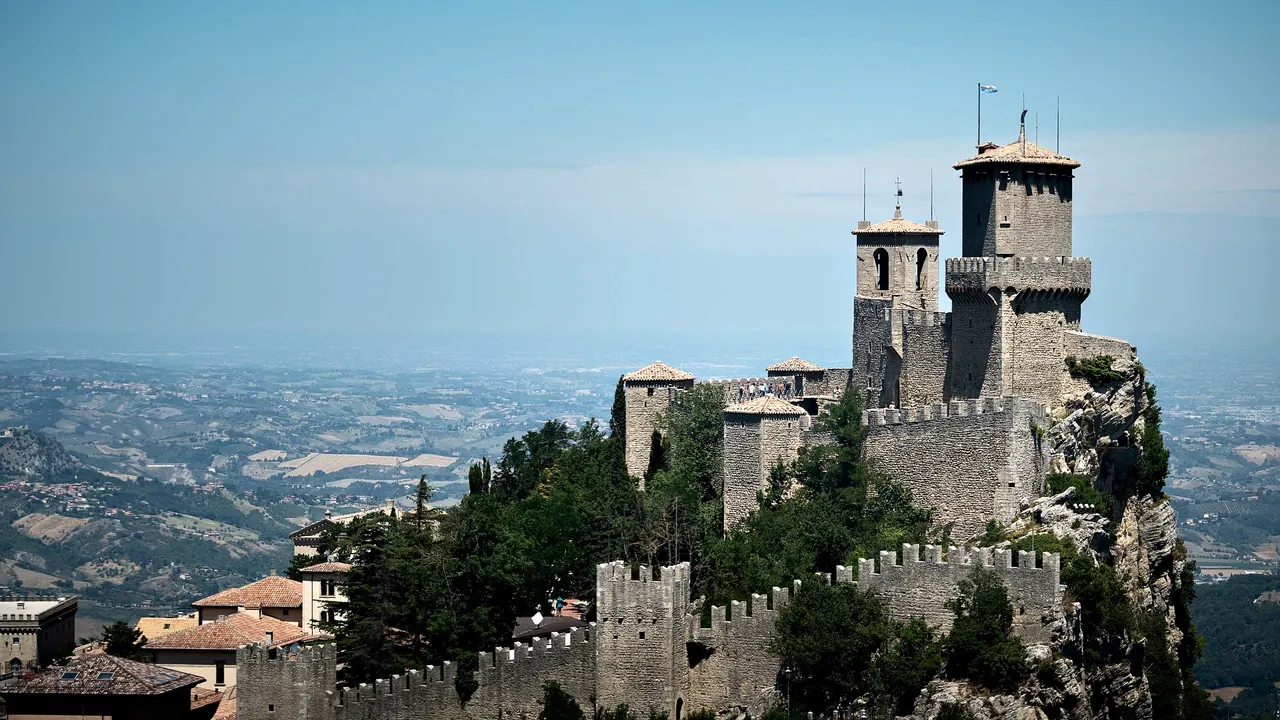
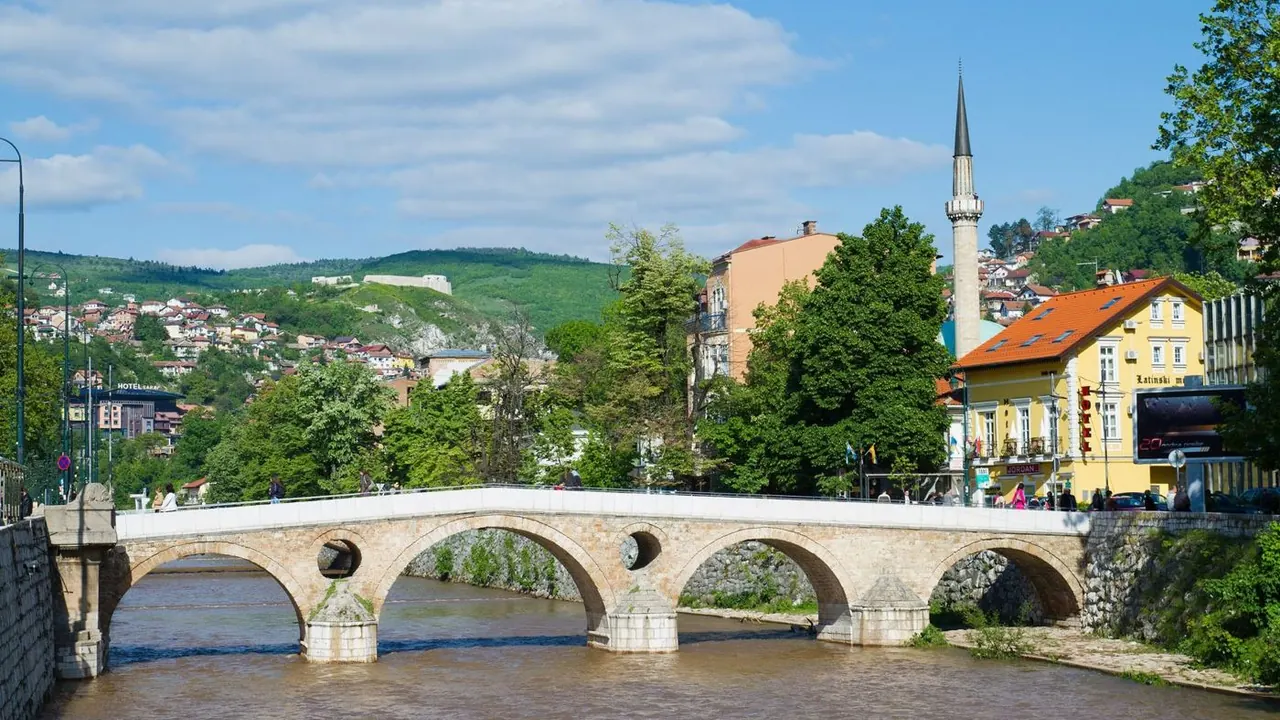
Photos: San Marino by Tibor Szabo, Pexels License; Sarajevo by Tumi-1983, CC0.
San Marino or Sarajevo?
Our verdict in twelve categories, each scored against the same fixed benchmark cities, and the climate month by month, so you can choose for your trip.
Choose San Marino for
- beaches
- day trips
- families
San Marino suits a traveller with a car who wants a small, quiet hilltop base and plans to spend most days elsewhere. The walled summit takes half a day to see. After that the place works as a starting point for Urbino, San Leo, Ravenna and the Romagna shore, and families can split their time between battlements in the morning and sandy beaches in the afternoon. In the evening it is calm rather than lively.
Choose Sarajevo for
- nightlife
- nature and the outdoors
- prices
Sarajevo is the place to choose if the city itself is the reason for the trip. Ottoman bazaar lanes, Austro-Hungarian avenues and the memory of the siege sit within a short walk of each other, and the food has a strong character of its own. There are real mountains for hiking or skiing less than an hour away, it costs far less day to day, and the café-bars keep evenings sociable. It suits curious, budget-minded travellers who don't need a beach.
Scoreboard
Twelve categories on one fixed scale from 0 to 100. The shaded stretch is the gap between the two.
Your match
Pick a travel style or drag the sliders, and both match scores follow your weighting.
Wins on beaches and day trips with your weighting.
Wins on nightlife and nature and the outdoors with your weighting.
What matters to you?
Category by category
What the scores mean for a trip.
Beaches & swimming
San Marino has no shore of its own, but it can make the Adriatic part of the trip. The long sandy beaches of Rimini and Riccione are about half an hour down the mountain, with rows of umbrellas, beach clubs and warm, shallow water in high summer. It works well as a day out from the summit.
Sarajevo lies in an inland valley about three hours from the coast, so a day at the beach isn't realistic. Swimming there means cold mountain rivers, Jablanica lake or a pool. If the sea matters to you, add a few days on the Croatian or Montenegrin coast.
Food & drink
Sarajevo is the better place to eat. Its Ottoman-Balkan cooking is narrow but done with real care, from ćevapi in somun bread on the grills of Baščaršija to burek sold by weight and lamb cooked slowly under a metal lid. Bosnian coffee, served in a copper džezva with rahat lokum, is an experience in itself.
San Marino serves the honest pasta, piadina and grilled meat of the surrounding Romagna hills. The summit terraces, though, often rely on the view more than the cooking. The better meals are in the family trattorias of Borgo Maggiore and the villages below.
Culture & sights
San Marino's sight is the republic itself. It has three towers on the crest of Monte Titano, a cliffside path linking Guaita and Cesta, and the Palazzo Pubblico, which tells the story of one of the world's oldest republics. It is striking, but most visitors finish it in half a day.
Sarajevo has more depth and more layers. You can walk from the mosques and covered markets of Baščaršija into Austro-Hungarian streets with Orthodox and Catholic cathedrals and the Old Synagogue, then on to the Latin Bridge of 1914. The Tunnel of Hope and the War Childhood Museum bring the 1990s siege close, and this is a city that fills several days.
Nightlife
After the day coaches leave, San Marino goes quiet, with a few wine bars and the lights of the coast below. For a real night out you have to drive down to the Riviera clubs in Rimini and Riccione.
Sarajevo has a proper evening life, though it is sociable rather than wild. The café-bars around Ferhadija fill from the afternoon, and students keep the cellar bars and small clubs open past midnight at weekends. Drinks are cheap, and evenings tend to end over rakija.
Nature & outdoors
Sarajevo is surrounded by mountains. A cable car from the Old Town climbs Trebević past the old Olympic bobsleigh track. The ski slopes of Jahorina and Bjelašnica are under an hour away, and summer ridge walks lead to Lukomir above the Rakitnica canyon, with rafting on the Neretva further south.
San Marino's limestone ridge, at about 740m, has good short walks between the towers and down through the woods to Borgo Maggiore, with views to the sea. Beyond the border, the Marecchia valley is lovely for a drive or a quiet bike ride, but there are no long trails or adventure sports.
Day trips
San Marino has more good outings close by. The rock fortress of San Leo is about half an hour away, Renaissance Urbino about an hour, and Ravenna's mosaics a little further. Gradara, Santarcangelo and Rimini's Roman arch are nearer still. Most of these need a car, but the density is hard to beat.
Sarajevo's star trip is Mostar, reached by a scenic train through the Neretva gorge, with Konjic, Blagaj and Počitelj along the same route. Travnik and the bridge at Višegrad add more Ottoman heritage. The roads are slow and winding, though, so each outing takes a full day.
Good for families
San Marino has the edge for children. They usually love the towers, battlements and the cable car ride. With a car, a morning on the mountain combines easily with Italia in Miniatura, waterparks or a shallow beach in the afternoon, although the steep streets are hard work with a pushchair.
Sarajevo welcomes children warmly, and its flat Old Town is easy to walk with them. The Trebević cable car, the streams at Vrelo Bosne and the small zoo make good outings. Its main sights are about history and war, however, and winter smog is hard on small lungs.
Getting around
Sarajevo is easier to get around. The Old Town and the Austro-Hungarian centre are flat and compact, a historic tram line runs along the valley floor to Ilidža, and taxis are plentiful and cheap. Away from that corridor the buses are harder to follow, and the hillside districts are steep.
San Marino's car-free centre can be walked in under half an hour, but nearly every street climbs or drops by steps. Without a car, the link to the outside world is the bus from Rimini, and the surrounding hill towns are realistically reached only by driving.
Shopping & style
Sarajevo has more character for shoppers. You can hear coppersmiths hammering coffee sets on Kazandžiluk, and the Bezistan and nearby lanes sell kilims, slippers and filigree jewellery, though it pays to look past the souvenir stock.
San Marino's appeal is mostly about tax. Perfume, watches, leather and spirits line the main streets, and there is an outlet centre on the valley floor. The rest is souvenir crossbows, ceramics and collectors' stamps and coins, with little local craft of any depth.
Affordability
Sarajevo is one of the cheapest capitals in Europe for a visitor. Grilled food, pastries, coffee, trams and museum tickets all cost very little, and central guesthouses are well below Western European rates.
San Marino is middling, with prices similar to provincial central Italy. Hotels and trattorias in the lower villages are fair, but the summit terraces and the most convenient hotels charge more for their views.
Live music & performing arts
Sarajevo has a real, if modest, stage season. The Austro-Hungarian National Theatre puts on drama, opera and ballet, and the Philharmonic gives regular concerts. The MESS theatre festival and the November jazz festival are worth timing a visit around, and sevdah love songs can be heard in traditional restaurants.
San Marino has little beyond a small theatre and open-air music in summer. The exception is the costumed Medieval Days festival, with its crossbow contests and flag-throwers. For opera, people go to Bologna or Pesaro.
Wellness & relaxation
Sarajevo has an actual place to unwind. The thermal springs at Ilidža, used since Roman times, are at the end of the tram line, and the shaded avenue at Vrelo Bosne is close by. The local habit of lingering for an hour over one coffee also slows the pace, though winter smog can take the edge off.
San Marino's relaxation is simply quiet. Evening walks along the walls are calm once the crowds have gone. Spa options are limited to a few hotels, and thermal baths mean a separate trip down to the coast or into the Apennines.
When should you go?
Pick your month. The climate figures are measured averages, not a forecast.
San Marino in July
Sarajevo in July
Daytime high, °C
Rainfall in the month, mm
Where the figures come from
San Marino's temperatures are measured 52 km from the centre, at Frontone.
San Marino has no rain gauge within 25 km of the centre, so its rainfall comes from a gridded climate dataset read at the city rather than from a gauge further away.
Temperature and rainfall are climate normals, averaged over the years shown. San Marino: 1991-2020 normals, Frontone (51.5 km from centre). Sarajevo: 1991-2020 (rainfall 1971-2000) normals, Sarajevo-Bejelave (2 km from centre).
San Marino is at its best from June to early September. July reaches about 30°C on the mountain, and the Adriatic below warms to about 26°C in August, so this is the season for combining the towers with afternoons on the beach. May and late September are the more comfortable months for walking the steep streets. From September the rain builds steadily to about 105mm in November, and the winter months are cold and grey on the ridge.
Sarajevo follows a similar curve but is a little cooler in summer and colder in winter, with daytime highs of only about 4°C in December and January. Rain is spread fairly evenly through the year, and June is slightly the wettest month. The long sunny days run from June to August, peaking at about 257 hours of sunshine in July, and that makes summer the best time for the mountains and the café terraces. Late spring and early autumn are good for exploring the city on foot, and winter suits skiers more than sightseers.
Which traveller are you?
For a beach and sun trip, San Marino is the clear choice. The sandy, shallow beaches of Rimini and Riccione are about half an hour below the mountain, while from Sarajevo the Adriatic is about three hours away, too far for a day by the sea.
On an outdoors trip, Sarajevo wins easily. The Trebević cable car starts at the edge of the Old Town, and the Olympic mountains offer skiing in winter and ridge hiking to Lukomir in summer. San Marino has pleasant walks on its ridge, but nothing on that scale.
On a tight budget, Sarajevo goes much further. Ćevapi, pastries, coffee, trams and central guesthouses all cost very little. San Marino has the prices of provincial Italy, and you pay extra to stay or eat on the summit.
Before you go
| Measure | San Marino | Sarajevo |
|---|---|---|
| Official language | Italian | Croatian, Serbian, Bosnian |
| Currency | Euro (EUR) | Convertible Mark (BAM) |
| Sockets | CFL230 V, 50 Hz | CF230 V, 50 Hz |
| Driving side | Right | Right |
| Time zone | UTC+1, UTC+2 in summer | UTC+1, UTC+2 in summer |
| Emergency number | 112 | 112 |
| Elevation | 675 m | 518 m |
| Main airport | Bologna Guglielmo Marconi Airport (BLQ)114 km from centre98 non-stop destinations | Sarajevo International Airport (SJJ)7 km from centre38 non-stop destinations |
| Public holidays this year | 18 days | 8 days |
By the numbers
| Measure | San Marino | Sarajevo |
|---|---|---|
| City population | 4,040 | 275,524 |
| People per km² | 569 | 1,947 |
| Museums within 10 km | 19 | 26 |
| UNESCO World Heritage sites within 50 km | 2 | 1 |
| Swim season, months above 21 °C | 4 months | - |
Where else could you go?
Every comparison below shares a destination with this one, so you can follow San Marino or Sarajevo somewhere new.
- Mostarvs Sarajevo
- Assisivs San Marino
- Florencevs San Marino
- Bolognavs San Marino
- Sienavs San Marino
- Dubrovnikvs Sarajevo