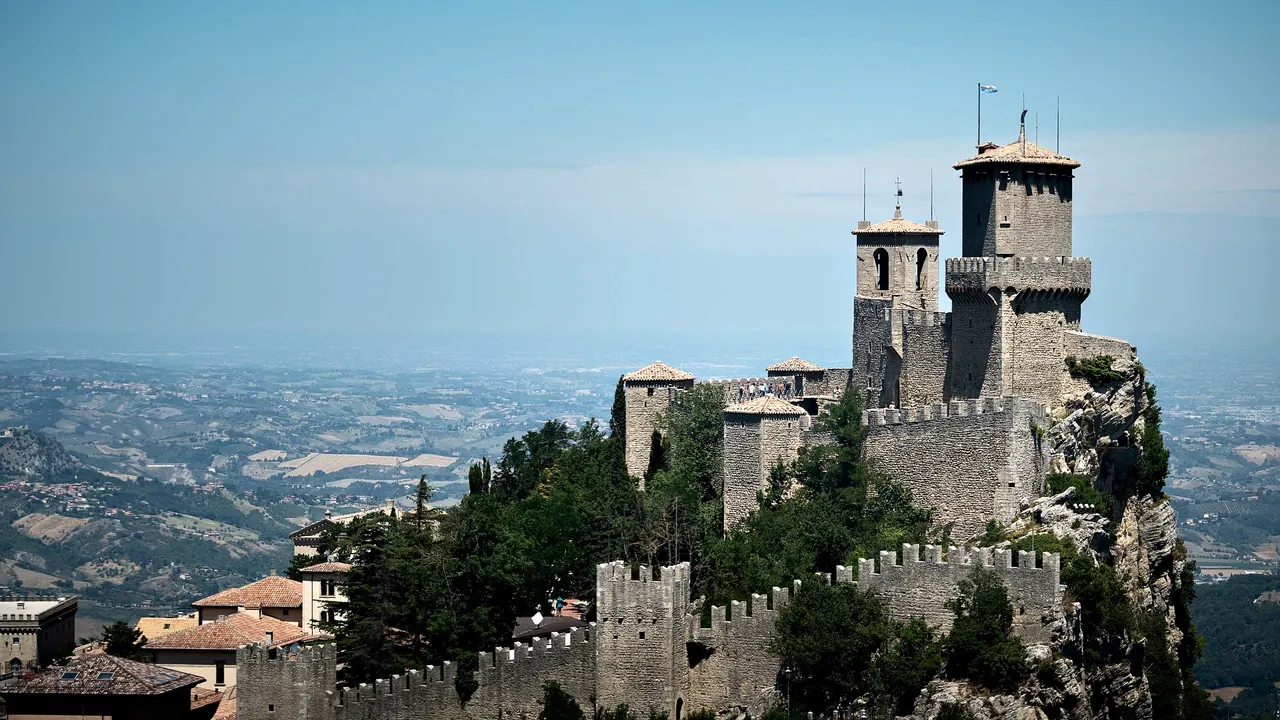
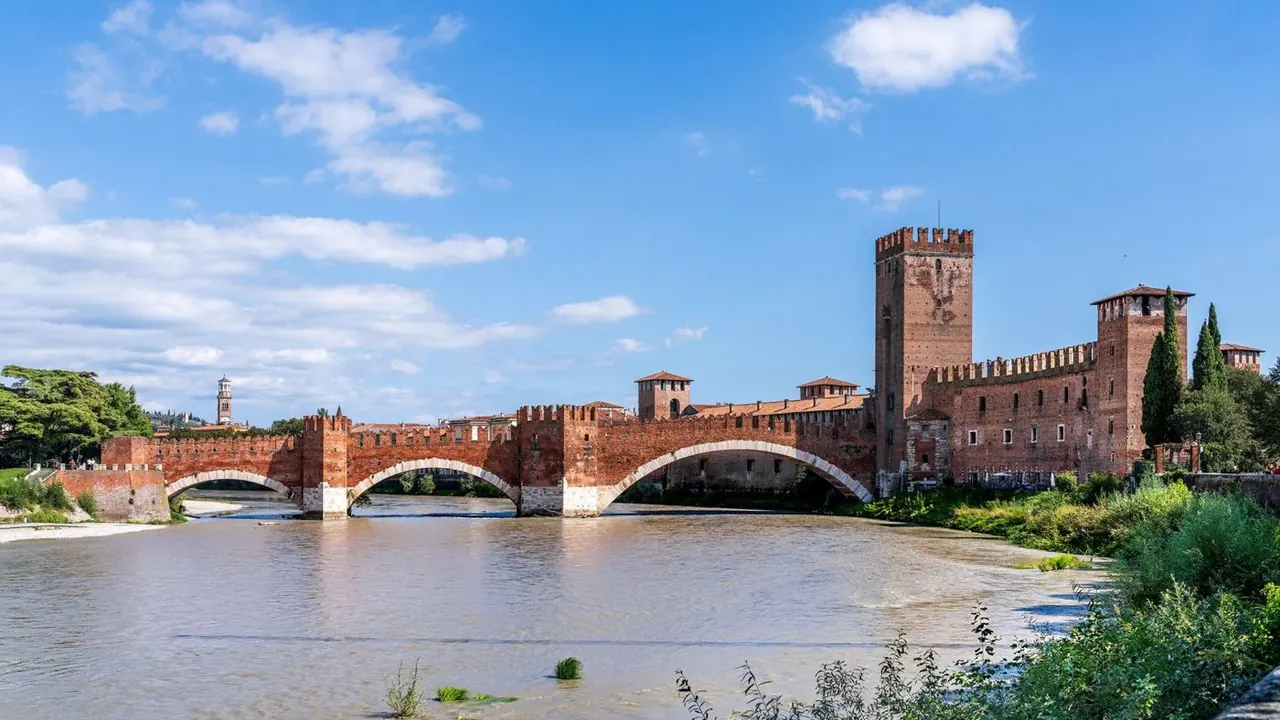
Photos: San Marino by Tibor Szabo, Pexels License; Verona by NorbertNagel, CC BY-SA 4.0, cropped.
San Marino or Verona?
Our verdict in twelve categories, each scored against the same fixed benchmark cities, and the climate month by month, so you can choose for your trip.
Choose San Marino for
- prices
- beaches
San Marino suits a traveller who wants one dramatic place rather than a full city. The walled town and its three towers on Monte Titano take half a day, and the summit goes quiet once the coaches have left. With a car, it works as a calm hilltop base between the sandy Romagna beaches and the Montefeltro, with San Leo and Urbino close by. Rooms and meals also cost a little less than in Verona.
Choose Verona for
- live music and the arts
- food and drink
- culture and sights
Verona is the better pick for almost any trip built around a city. It has a Roman, medieval and Renaissance centre that rewards two or three days, opera under the stars in the Arena, and serious wine country right outside the gates. The centre is flat and easy to walk. The rail line puts Venice, Padua, Vicenza and Lake Garda within easy reach, so you can stay a week without hiring a car.
Scoreboard
Twelve categories on one fixed scale from 0 to 100. The shaded stretch is the gap between the two.
Your match
Pick a travel style or drag the sliders, and both match scores follow your weighting.
Wins on prices and beaches with your weighting.
Wins on live music and the arts and food and drink with your weighting.
What matters to you?
Category by category
What the scores mean for a trip.
Beaches & swimming
Neither city is on the water, and from both the swimming is a side trip about half an hour away. What you find there is very different. Below San Marino is the Adriatic: long sandy beaches at Rimini and Riccione, with rows of umbrellas and shallow sea that suits small children.
From Verona you go to Lake Garda instead. The water is calm and clear with no tides, and you swim from lidos, grassy lawns, small pebble beaches or the flat limestone shelves at Sirmione. Choose San Marino for sand and sea, Verona for a lake swim.
Food & drink
Verona eats and drinks far better. Its osterie around Piazza delle Erbe and in Veronetta serve Veneto dishes such as risotto all'Amarone, bigoli with duck, and bollito misto with pearà. Valpolicella, Amarone and Soave are all made within a short drive, which makes an evening glass at a wine counter part of the visit.
San Marino's Romagna cooking of piadina, passatelli and hand-rolled pasta is honest enough. But the summit terraces live off the view, and the better meals are down in Borgo Maggiore or across the border.
Culture & sights
San Marino's appeal is the setting itself: a medieval town on a cliff edge, Guaita and Cesta linked by a path along the rock, and the story of an ancient republic told in the Palazzo Pubblico and the Basilica. It is striking, but you can see it in half a day.
Verona has far more to see. The Arena and the Roman theatre, the Scaliger tombs, the Romanesque front of San Zeno and Scarpa's Castelvecchio make a UNESCO-listed centre that fills two or three unhurried days.
Nightlife
After dark San Marino offers little more than a quiet dinner on the walls with the lights of the coast below. For a real night out you have to drive down to the clubs and seafront bars of the Riviera.
Verona's nights are modest, but they do happen in town. Aperitivo spills across Piazza delle Erbe and along Corso Porta Borsari, and the student bars of Veronetta stay busy later. In summer the opera crowd leaving the Arena keeps the centre going towards midnight.
Nature & outdoors
San Marino has one fine ridge of limestone, Monte Titano, which rises to about 740m. Its footpaths circle the mountain and look out over the Romagna plain, and the gentle Marecchia valley lies beyond. It makes a lovely morning walk, but there is little more to do outdoors.
Verona has much more within reach. The Valpolicella hills are good for walks among the vines, a long cycle route follows the Adige north, and the Lessinia offers beech woods and gorges. Monte Baldo and the north end of Lake Garda add ridge hikes, paragliding and some of Europe's best windsurfing.
Day trips
Both make good bases, but Verona's day trips are richer and much easier to reach. Venice, Padua, Vicenza and Mantua are all short train rides away, and the Garda towns and Valpolicella cellars are close at hand.
San Marino has its own fine circuit: the fortress at San Leo, Urbino's Renaissance palace, Gradara and Ravenna's mosaics. The catch is that most of these need a car, because the only regular bus runs down to Rimini.
Good for families
Verona is easier with children. Gardaland and the Parco Natura Viva safari park are both about half an hour away, and the calm southern shore of Lake Garda suits paddling. In town, the flat, largely car-free centre is easy with a pushchair, and the Arena tends to capture young imaginations.
San Marino has the cable car and battlements that children love. But its steep streets and steps are hard work with a pushchair, and the waterparks, Fiabilandia and Italia in Miniatura are all down on the coast.
Getting around
The difference here is the slope. In Verona the centre inside the river loop is flat, and the Arena, the churches and Castelvecchio are all a short stroll apart. Trains to Venice, Milan and Peschiera then cover most excursions.
San Marino is also walkable end to end, but almost every street climbs or drops, often by steps, and the cable car links the summit to Borgo Maggiore. Without a car you depend on the bus up from Rimini and infrequent village buses.
Shopping & style
Verona has a real shopping street. Via Mazzini, paved in marble, is lined with Italian fashion labels, and the side streets have jewellers and shoe shops. Amarone, Garda olive oil and pandoro make good things to carry home.
San Marino's shopping is mostly souvenirs, collectors' stamps and coins, and lower-tax perfume, watches and spirits, plus an outlet centre on the valley floor. It is a place for bargains on branded goods rather than for browsing.
Affordability
San Marino is slightly kinder on the wallet. Its prices are those of provincial central Italy, hotels are moderate outside August, and lower taxes make fuel and spirits cheaper. Only the summit terraces and the hotels closest to the towers charge extra.
In Verona, everyday eating at Veronetta osterie and wine counters is fair, and you walk everywhere. Rooms in the historic centre are expensive, though, and become scarce and dear on opera nights and during the big trade fairs.
Live music & performing arts
This is where the two differ most. In Verona, summer evenings mean grand Verdi and Puccini productions in the Roman Arena, with candles lit across the stone tiers. The Teatro Filarmonico runs an opera and concert season in the cooler months, and the Roman theatre hosts Shakespeare, dance and jazz.
San Marino has a small theatre, some open-air music and its Medieval Days festival of crossbows and flag-throwers. For a proper concert, visitors go to Pesaro or Bologna.
Wellness & relaxation
Verona has thermal water close by. Sirmione's lakeside spa and the warm spring-fed lake near Lazise are easy outings, and the Caldiero springs east of the city have been used since Roman times. Long lunches and the Giardino Giusti set a slow pace in town.
San Marino has only a few hotel spas. What it offers instead is quiet: once the day visitors leave, the walls are yours for an evening walk above the plain.
When should you go?
Pick your month. The climate figures are measured averages, not a forecast.
San Marino in July
Verona in July
Daytime high, °C
Rainfall in the month, mm
Where the figures come from
San Marino's temperatures are measured 52 km from the centre, at Frontone.
San Marino has no rain gauge within 25 km of the centre, so its rainfall comes from a gridded climate dataset read at the city rather than from a gauge further away.
Temperature and rainfall are climate normals, averaged over the years shown. San Marino: 1991-2020 normals, Frontone (51.5 km from centre). Verona: 1991-2020 normals, Verona / Villafranca (11.6 km from centre).
Both places have hot summers and cold, damp winters, with daytime highs of about 30°C in July and August. In San Marino those are the beach months. The Adriatic below the mountain is good for swimming from late June to mid-September and is warmest in August at about 26°C. Autumn is the wettest time on the mountain, with rain building to around 105mm in November. Late May, June and early September are the most comfortable months for walking the walls and the cliff path between the towers.
Verona warms up a little earlier, and May is already pleasantly warm. July is by far its sunniest month, with around 310 hours of sun, but that heat makes midday in the stone streets hard going in high summer. April, May, September and early October are the best months for sightseeing. Its late winter is drier than San Marino's, with February the driest month of the year. In both cities the rain picks up from September.
Which traveller are you?
For a culture and arts trip, choose Verona. The Arena, the Roman theatre, San Zeno and Castelvecchio fill several days, and summer evenings bring opera on the ancient tiers. San Marino's towers and Palazzo Pubblico are memorable but take only an afternoon.
For a food and nightlife trip, Verona is again the clear choice. Its osterie serve risotto all'Amarone and bigoli, Valpolicella and Soave are made close by, and aperitivo fills Piazza delle Erbe. San Marino goes silent after dark, and its summit terraces sell the view more than the cooking.
On a tight budget, San Marino goes a little further. Hotels outside August and trattorias in Borgo Maggiore are fairly priced, and fuel and spirits are cheaper than in Italy. In Verona, rooms inside the river loop are the big expense, especially on opera nights.
Before you go
| Measure | San Marino | Verona |
|---|---|---|
| Official language | Italian | Italian |
| Currency | Euro (EUR) | Euro (EUR) |
| Sockets | CFL230 V, 50 Hz | CFL230 V, 50 Hz |
| Driving side | Right | Right |
| Time zone | UTC+1, UTC+2 in summer | UTC+1, UTC+2 in summer |
| Emergency number | 112 | 112 |
| Elevation | 675 m | 59 m |
| Main airport | Bologna Guglielmo Marconi Airport (BLQ)114 km from centre98 non-stop destinations | Verona Villafranca Valerio Catullo Airport (VRN)10 km from centre96 non-stop destinations |
| Public holidays this year | 18 days | 13 days |
By the numbers
| Measure | San Marino | Verona |
|---|---|---|
| City population | 4,040 | 255,588 |
| People per km² | 569 | 1,285 |
| Museums within 10 km | 19 | 18 |
| UNESCO World Heritage sites within 50 km | 2 | 5 |
| Swim season, months above 21 °C | 4 months | - |
Where else could you go?
Every comparison below shares a destination with this one, so you can follow San Marino or Verona somewhere new.
- Paduavs Verona
- Assisivs San Marino
- Florencevs San Marino
- Venicevs Verona
- Bergamovs Verona
- Bolognavs San Marino