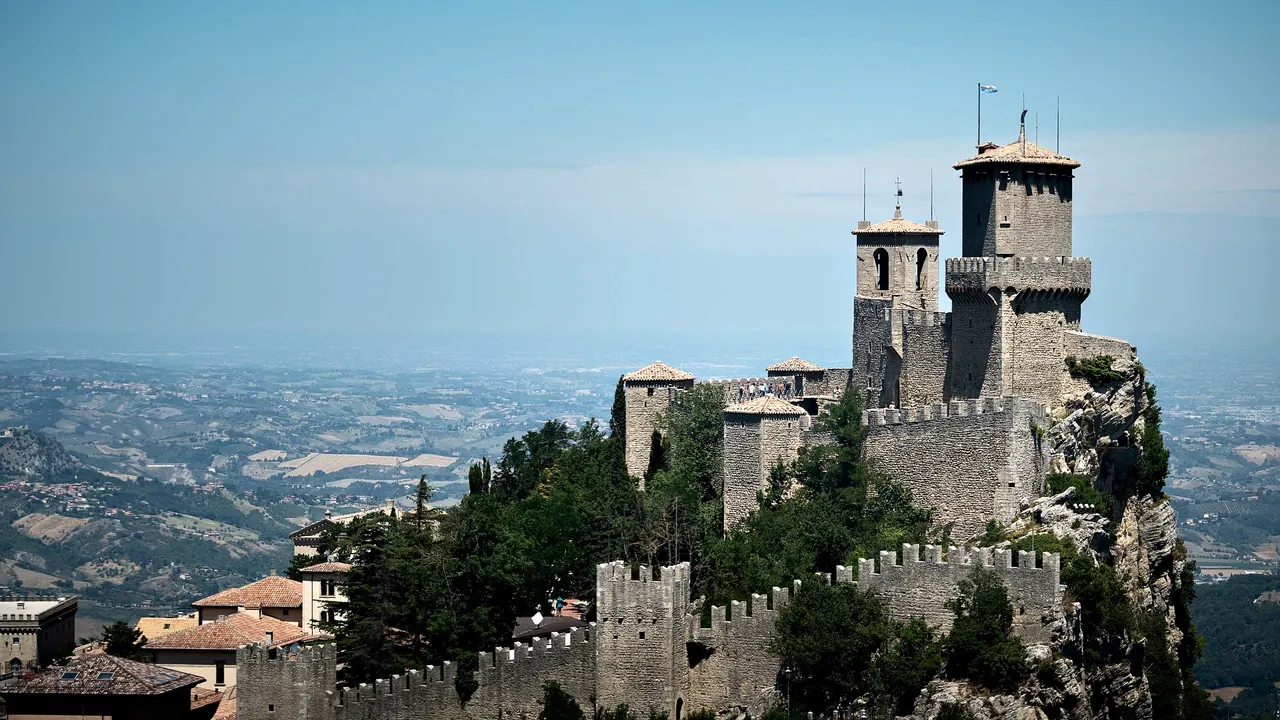
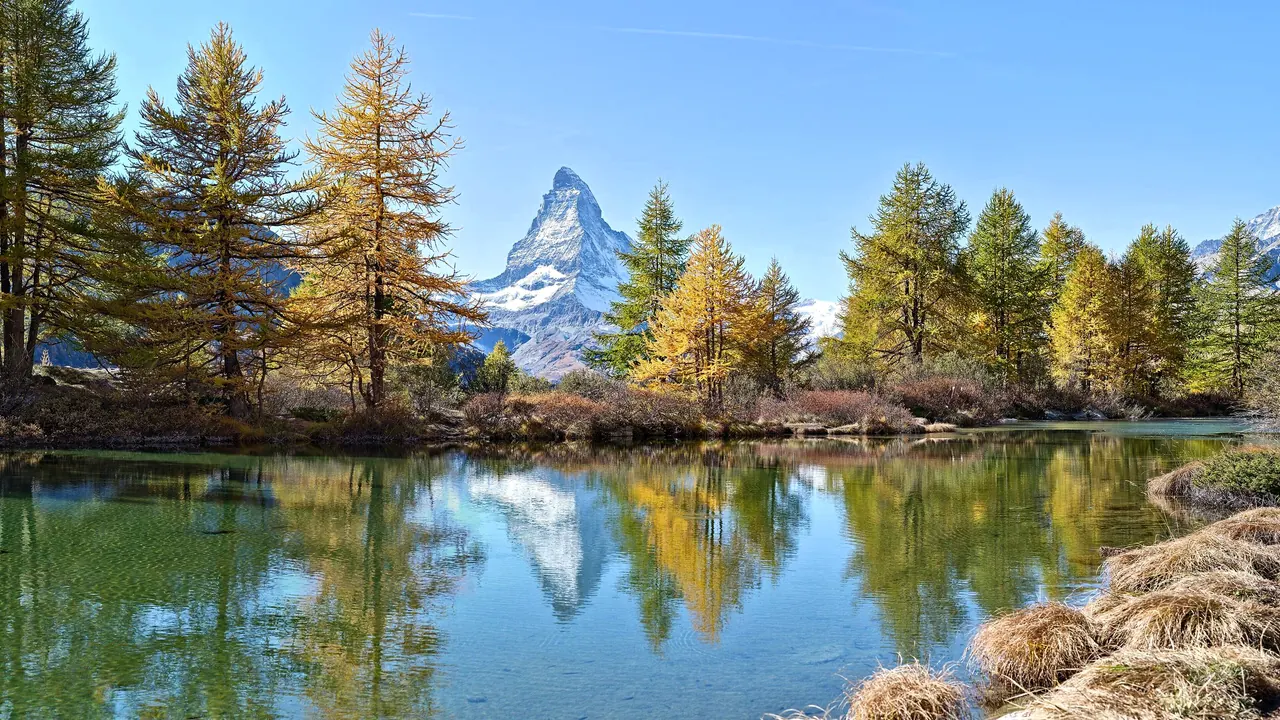
Photos: San Marino by Tibor Szabo, Pexels License; Zermatt by Roy Egloff, CC BY-SA 4.0, cropped.
San Marino or Zermatt?
Our verdict in twelve categories, each scored against the same fixed benchmark cities, and the climate month by month, so you can choose for your trip.
Choose San Marino for
- prices
- beaches
- day trips
San Marino suits a summer trip through central Italy, with a car if possible, by a traveller who likes mixing history, coast and countryside. The walled town on Monte Titano takes half a day. The real draw is what lies around it: Urbino, Ravenna, San Leo and the Rimini shore are all within easy reach, and prices stay at a sensible provincial Italian level.
Choose Zermatt for
- nature and the outdoors
- getting around
- wellness
Zermatt is the choice when the mountains themselves are the point of the trip. The Matterhorn stands over a car-free village, with lifts climbing to glaciers and high trails, skiing in winter and serious hiking in summer. In return you pay some of the highest prices in the Alps, and there is little to do away from the slopes.
Scoreboard
Twelve categories on one fixed scale from 0 to 100. The shaded stretch is the gap between the two.
Your match
Pick a travel style or drag the sliders, and both match scores follow your weighting.
Too close to call, 1 point apart
Wins on prices and beaches with your weighting.
Wins on nature and the outdoors and getting around with your weighting.
What matters to you?
Category by category
What the scores mean for a trip.
Beaches & swimming
San Marino has no shore of its own, but the long sandy beaches of Rimini and Riccione are half an hour down the hill. They have numbered umbrellas, beach clubs and shallow, warm water in high summer, so a beach day is easy to add. It works as an outing rather than a seaside stay.
Zermatt has nothing of the kind. There is no sea and no bathing lake, and the tarns that reflect the Matterhorn stay icy even in August, so swimming means a hotel pool.
Food & drink
Neither place is a destination for food, and they offer two quite different kitchens. San Marino serves Romagna hill cooking: hand-rolled pasta, passatelli in broth, piadina and the Tre Monti wafer cake, washed down with local Sangiovese. The good meals are in family trattorias in Borgo Maggiore rather than on the view terraces at the top.
Zermatt eats Valais Alpine food, meaning raclette, fondue, air-dried beef and wines like Petite Arvine. Its best moments are long lunches at chalets in Findeln or Furi with the Matterhorn in view. It also has a few ambitious village kitchens, but cheap eating is scarce and many places close between seasons.
Culture & sights
San Marino has the more substantial sights. The medieval town runs along a cliff edge, with the Guaita and Cesta towers linked by a rock path, the Palazzo Pubblico and the basilica. All of it tells the story of one of the world's oldest republics, and it fills a satisfying half day.
Zermatt's heritage is almost entirely about mountaineering. There is the Matterhorn Museum on the 1865 first ascent, the climbers' cemetery and the old larch barns of the Hinterdorf. It is moving, but it takes a morning, and nobody chooses Zermatt for its monuments.
Nightlife
Zermatt has the livelier evenings, though only in winter. Après-ski fills the slope-side bars from late afternoon, and a few main-street bars and small clubs go past midnight on busy weekends. In summer the hikers turn in after dinner.
On top of Monte Titano there is essentially nothing after the day visitors leave, apart from a quiet glass of wine above the lights of the coast. For a real night out you have to drive down to the Riviera clubs in Rimini and Riccione.
Nature & outdoors
This is Zermatt's great strength. Dozens of four-thousand-metre peaks, the Gorner Glacier and lifts to the Gornergrat and Glacier Paradise give it some of the highest terrain in Europe, with skiing in winter and marmot-filled trails, the Europaweg and guided summits in summer.
San Marino's single limestone ridge at about 740m is pretty, with woodland paths between the towers and wide views to the Adriatic. The Montefeltro hills beyond are good for gentle cycling or a drive, but it is scenery for a morning rather than a trip built around the outdoors.
Day trips
San Marino makes the far better base for exploring. Rimini's Roman arch and bridge are just below the mountain, and the fortress of San Leo and Gradara castle are close by. Urbino's Renaissance court is about an hour's drive, Ravenna's mosaics a little further, and Bologna is within reach by train from the coast.
The hill towns really need a car, though, because the only regular bus goes down to Rimini. From Zermatt, every outing begins with the long train ride down the valley. Sion's castle hills and Brig's Stockalper Palace are worth seeing, but most visitors sensibly spend their spare days up in the mountains.
Good for families
Families do about equally well in both, in different ways. In San Marino children get towers, battlements and the cable car. The real draw is the coast below, with Italia in Miniatura, Fiabilandia, waterparks and shallow beaches, best reached with a car. The steep summit streets are hard work with a pushchair.
Zermatt's car-free streets make it calm and safe. Ski schools, nursery slopes, marmots and cog railways keep children busy, but rainy days are hard to fill and the thin air at the highest viewpoints can be too much for small children.
Getting around
Zermatt is far simpler once you arrive. You come in by train, the village is closed to ordinary cars, and the cog railway, funicular and gondolas all start within walking distance, with smooth links into the Swiss rail network.
San Marino's centre is walkable but almost every street involves steps or a climb. Without a car you depend on the bus up from Rimini and rare local services, and the surrounding hill towns are realistically reached only by driving.
Shopping & style
San Marino's shops live off lower taxes, while Zermatt's live off wealthy skiers. Lower taxes than in Italy fill San Marino's streets with perfume, watches, leather and spirits for Italian visitors. A fashion outlet sits on the valley floor, and collectors come for the republic's stamps and coins.
Zermatt's one main street pairs Swiss watch and jewellery boutiques with cowbells and chocolate. Its genuinely useful offer is the well-stocked ski and mountaineering outfitters, and neither place has much independent design to browse.
Affordability
The gap here is wide. San Marino costs about what provincial central Italy does: moderate hotels outside August, fairly priced trattorias in the lower villages and cheap entry to the sights. Only the summit view terraces carry a premium.
Zermatt is among the most expensive places in the Alps. Plain hotel rooms, terrace lunches and the lift tickets every visitor needs all add up fast, and only self-catering, picnics or a bed down in Täsch soften the bill.
Live music & performing arts
Both are thin, but Zermatt has a little more to plan around. Zermatt Unplugged brings acoustic sets by well-known singers to the mountain stages in spring, and a late-summer chamber festival fills the village church with serious classical musicians. The rest of the year it is bands in après-ski bars.
San Marino offers a small theatre, open-air music in the squares and the costumed Medieval Days in summer. For opera, people head to Bologna or Rossini's Pesaro.
Wellness & relaxation
Zermatt is the better place to unwind. It has a high concentration of excellent hotel spas with pools, saunas and mountain views, some of which sell day passes, and the car-free village has clean air and no traffic noise, although the mood in peak weeks is more active than slow.
San Marino has only a few hotel spas. Its restful moments come on evening walks along the walls once the summer crowds have left, and the thermal baths are a separate excursion down on the coast or in the Apennines.
When should you go?
Pick your month. The climate figures are measured averages, not a forecast.
San Marino in July
Zermatt in July
Daytime high, °C
Rainfall in the month, mm
Where the figures come from
San Marino's temperatures are measured 52 km from the centre, at Frontone.
San Marino has no rain gauge within 25 km of the centre, so its rainfall comes from a gridded climate dataset read at the city rather than from a gauge further away.
Zermatt has no weather station within reach, so its figures come from a gridded climate model rather than a measured record, and read a broad area rather than the city itself.
Temperature and rainfall are climate normals, averaged over the years shown. San Marino: 1991-2020 normals, Frontone (51.5 km from centre). Zermatt: 1991-2020 normals, TerraClimate 4 km grid at the town, no weather station within 90 km.
San Marino has a full Italian summer. From June to early September the days are properly warm, with highs around 30°C in July, and the Adriatic below reaches about 25°C, so this is the season for combining the summit with the beach. May and late September are more comfortable for walking the steep streets and the hill towns. Rain builds through the autumn and peaks in November at about 105mm, and winter days on the mountain are cool and grey.
Zermatt runs on an entirely different calendar. Even in July and August the village only reaches about 14°C, which is good walking weather and right for the high trails, and from December to February the highs stay below freezing at around -2°C, which is when the ski season runs. Spring and autumn are cold and fairly wet, and November is the wettest month. For a warm-weather vacation San Marino is the clear pick, and for snow it has to be Zermatt.
Which traveller are you?
For a beach and sun trip, San Marino is the only real option. The sandy Rimini and Riccione shore with its warm summer sea is half an hour below the mountain, while Zermatt has nowhere to swim except a hotel pool.
On a trip on a tight budget, choose San Marino. Hotels and lower-village trattorias are priced like provincial Italy. Zermatt is among the most expensive places in the Alps, and every lift and mountain terrace adds to the bill.
For an outdoors trip, Zermatt is in a different league. Lifts climb to over 3,800m, hundreds of kilometres of marked trails run past the Matterhorn and glaciers, and the skiing crosses into Italy. San Marino offers pleasant morning walks around one limestone ridge.
Before you go
| Measure | San Marino | Zermatt |
|---|---|---|
| Official language | Italian | French, German, Italian, Romansh |
| Currency | Euro (EUR) | Swiss Franc (CHF) |
| Sockets | CFL230 V, 50 Hz | CJ230 V, 50 Hz |
| Driving side | Right | Right |
| Time zone | UTC+1, UTC+2 in summer | UTC+1, UTC+2 in summer |
| Emergency number | 112 | 112 |
| Elevation | 675 m | 1,624 m |
| Main airport | Bologna Guglielmo Marconi Airport (BLQ)114 km from centre98 non-stop destinations | Geneva International Airport (GVA)128 km from centre150 non-stop destinations |
| Public holidays this year | 18 days | 9 days |
By the numbers
| Measure | San Marino | Zermatt |
|---|---|---|
| City population | 4,040 | 6,023 |
| People per km² | 569 | 25 |
| Museums within 10 km | 19 | 2 |
| UNESCO World Heritage sites within 50 km | 2 | 2 |
| Swim season, months above 21 °C | 4 months | - |
Where else could you go?
Every comparison below shares a destination with this one, so you can follow San Marino or Zermatt somewhere new.
- Chamonixvs Zermatt
- Interlakenvs Zermatt
- Luganovs Zermatt
- Assisivs San Marino
- Florencevs San Marino
- Lausannevs Zermatt