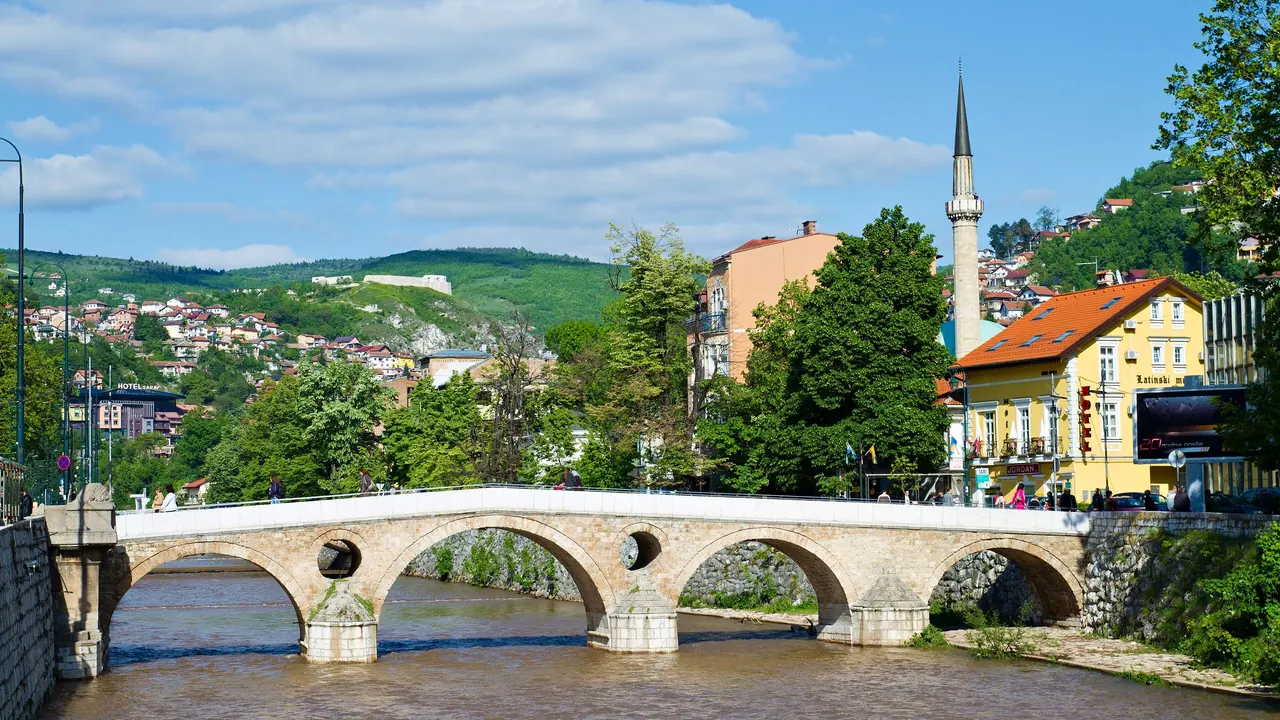
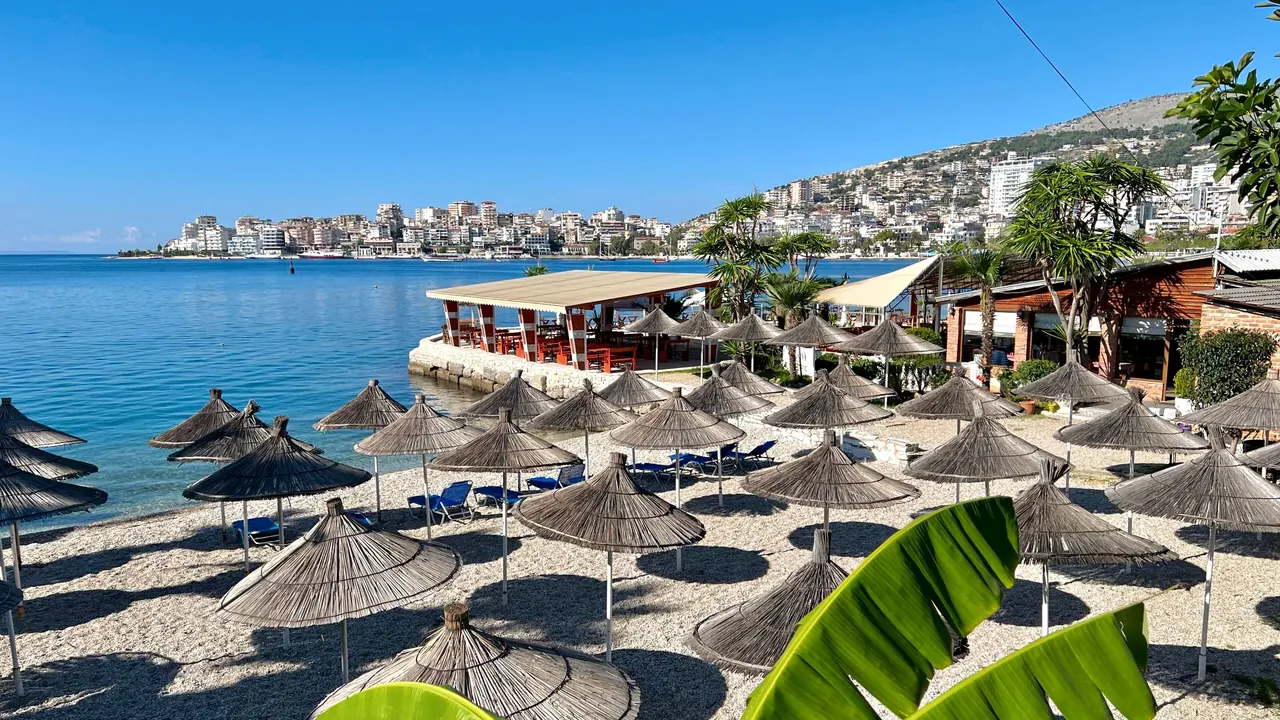
Photos: Sarajevo by Tumi-1983, CC0; Saranda by Sharon Hahn Darlin, CC BY 2.0, cropped.
Sarajevo or Saranda?
Our verdict in twelve categories, each scored against the same fixed benchmark cities, and the climate month by month, so you can choose for your trip.
Choose Sarajevo for
- culture and sights
- live music and the arts
- shopping
Sarajevo suits the traveller who wants a city to explore rather than a shore to lie on. Ottoman bazaar lanes, Austro-Hungarian avenues, siege memorials and grills turning out ćevapi are all a short walk apart. The mountains rise straight from the edge of town, and the city is the cheaper of the two, with a real stage and festival life that Saranda lacks.
Choose Saranda for
- beaches
- day trips
- families
Pick Saranda if the sea is the point of the trip. The clear Ionian coves at Ksamil and the quieter bays up the Riviera are what it does best, and its short list of outings is strong: Butrint, Gjirokaster and a ferry to Corfu. The town itself has little to see, eat or buy beyond the seafront, so treat it as a sunny base for beach days and excursions.
Scoreboard
Twelve categories on one fixed scale from 0 to 100. The shaded stretch is the gap between the two.
Your match
Pick a travel style or drag the sliders, and both match scores follow your weighting.
Wins on culture and sights and live music and the arts with your weighting.
Wins on beaches and day trips with your weighting.
What matters to you?
Category by category
What the scores mean for a trip.
Beaches & swimming
There is no real contest here. Sarajevo sits in an inland mountain valley about three hours from the coast, so swimming means cold rivers, Jablanica lake or a pool.
Saranda is built around the water: pebble beaches below the promenade, the pale coves and islets of Ksamil a short ride south, and longer bays such as Lukova and Borsh up the Riviera. The catch is crowding in July and August, when the sunbeds are packed close together and it pays to start early or take a boat out to the islets.
Food & drink
Sarajevo eats better, and its food has more character. Baščaršija's ćevapi grills, pita bakeries selling burek by weight and slow dishes like begova čorba make a cuisine worth travelling for, and Bosnian coffee from a džezva with rahat lokum is part of every day.
Saranda keeps it simpler: Butrint lagoon mussels, grilled fish and octopus, with olive oil on everything. The family taverns in the back streets beat the seafront terraces, but there is little coffee or wine culture and the choice soon runs out. Neither city offers much fine dining.
Culture & sights
For sights, Sarajevo is in a different league. Within a few streets you pass from the Gazi Husrev-beg Mosque and the Sebilj to the Orthodox and Catholic cathedrals, the Old Synagogue and the Latin Bridge of 1914. The siege years come alive at the Tunnel of Hope and the War Childhood Museum.
Saranda is a modern resort town, and its own sights fit into a morning: the mosaic floors of the ancient synagogue, fragments of the old city wall, and Lekuresi Castle for the view across to Corfu. Its serious history lies outside town.
Nightlife
Neither city is a big night out. Sarajevo has a slight edge because its scene runs all year: café-bars around Ferhadija get louder as the evening goes on, and students keep the cellar bars and small clubs busy at weekends.
Saranda's nightlife is seasonal and louder while it lasts. In July and August the promenade becomes a strip of cocktail bars with music playing, and beach clubs at Ksamil keep DJs going late. Outside those months, a night out comes down to a drink by the water.
Nature & outdoors
Both have fine settings, but Sarajevo's mountains give you more to do. A cable car climbs from the Old Town to Trebević and the overgrown Olympic bobsleigh track. Jahorina and Bjelašnica offer skiing in winter and ridge walking in summer, and the stone village of Lukomir looks down into the Rakitnica canyon.
Saranda's nature is coastal and gentler: the lagoon and reed beds of Butrint for birdwatching, the Blue Eye spring inland, and sea kayaking along the Riviera. Summer heat limits walking there to spring and autumn, while Sarajevo's summers are the best season for the hills.
Day trips
Saranda's excursions are easier to reach and more rewarding. Butrint's layered ancient city is half an hour away and Gjirokaster's stone tower houses about an hour and a quarter. Corfu's Venetian old town is less than an hour away by ferry.
Sarajevo has one outstanding outing: Mostar and its rebuilt bridge, reached by the scenic train through the Neretva gorge, with Konjic, Blagaj and Počitelj on the same route. Beyond that, Travnik and the Višegrad bridge mean long, winding roads, and most trips need a car or a tour.
Good for families
Both cities welcome families warmly and neither has much built for children, so the choice depends on what your children enjoy. Sarajevo has the cable car, carriage rides to Vrelo Bosne and a small zoo, but its main sights are heavy with war history and winter smog is hard on young lungs.
Saranda's draw is the calm, sheltered water at Ksamil and the evening promenade with ice cream and rides. Against that, the streets are steep, summer traffic is chaotic and the beaches are packed in August. A pool hotel in June or September makes it much easier.
Getting around
Sarajevo is easier to manage without a car. The flat centre is walkable, a tram runs along the valley from Baščaršija to Ilidža, and cheap taxis cover the rest, though the buses up into the hillside districts are harder to work out.
In Saranda the promenade links the beaches, restaurants and port on foot, and buses run to Ksamil and Butrint. With no printed timetables, though, you have to ask locals when they leave. For the Blue Eye or Gjirokaster you really need a hire car or an organised trip, on narrow roads that jam in summer.
Shopping & style
Sarajevo has a shopping street worth seeking out in Kazandžiluk, where coppersmiths still hammer out coffee sets. The Bezistan and the lanes around it add carpets, leather slippers and filigree, though you need to tell real craft from souvenir stock.
Saranda sells beachwear and trinkets along the promenade. Its best buys are things to eat and drink, such as olive oil, mountain honey and raki. For copperwork or carved stone, Gjirokaster's bazaar is the better place.
Affordability
Both are cheap by European standards, and Sarajevo is the more consistent bargain. Food, trams, taxis and museums cost little all year, and only the Old Town and the summer film festival push prices up a little.
Saranda is good value for most of the year, but July and August are different: sunbeds at Ksamil, seafront hotels and the busy terraces all cost noticeably more. Late spring or September brings the same sea for much less.
Live music & performing arts
Sarajevo has a real stage life and Saranda hardly has one. The National Theatre puts on drama, opera and ballet, and the Philharmonic plays regularly. MESS in autumn and the November jazz festival are worth timing a trip around, and sevdah, the city's slow love songs, can be heard in traditional restaurants.
In Saranda the most you can expect is a summer concert on the seafront, an occasional performance in Butrint's ancient theatre or live Albanian music in a restaurant.
Wellness & relaxation
Sarajevo is the better choice for rest, thanks to the thermal springs at Ilidža, used since Roman times and reachable by tram. The shaded avenue at Vrelo Bosne and the habit of lingering over coffee add to the calm, though winter smog spoils it.
Saranda has no bathing tradition, so wellness there means a hotel spa or a massage at a beach resort. How restful it feels depends on when you go: loud in July and August, slow and easy in May, June and late September.
When should you go?
Pick your month. The climate figures are measured averages, not a forecast.
Sarajevo in July
Saranda in July
Daytime high, °C
Rainfall in the month, mm
Where the figures come from
Saranda's temperatures are measured 30 km from the centre, at Kerkyra Airport.
Saranda has no rain gauge within 25 km of the centre, so its rainfall comes from a gridded climate dataset read at the destination rather than from a gauge further away.
Temperature and rainfall are climate normals, averaged over the years shown. Sarajevo: 1991-2020 (rainfall 1971-2000) normals, Sarajevo-Bejelave (2 km from centre). Saranda: 1991-2020 normals, Kerkyra Airport (29.8 km from centre).
Sarajevo has four distinct seasons. Winter is cold, with highs around 4°C in December and January, which suits the ski slopes but leaves the valley grey. Late spring to early autumn is the time for walking the streets and the hills, and July and August peak near 28°C, warm but rarely oppressive. Rain falls fairly evenly through the year, so no month is reliably dry, though summer brings by far the most sunshine.
Saranda's year splits more sharply. Summers are hot, sunny and almost rainless, with highs of 32°C in July and August, fine on the beach but heavy for sightseeing at midday. The sea is warm enough to swim from June into October and reaches about 25°C in August. In autumn the rain arrives in earnest and peaks at about 234mm in December, though winters stay mild. May, June and September give the best balance of sun, warm water and comfortable walking.
Which traveller are you?
On a beach and sun trip, Saranda wins outright. Ksamil's clear coves and islets, the quieter Riviera bays to the north and a long swimming season give it everything Sarajevo cannot offer, since Sarajevo is three hours from the nearest coast.
For a culture and arts trip, Sarajevo is the clear choice. A mosque, cathedrals and a synagogue share a few walkable streets, and the siege museums add weight. Theatre, opera and festivals also fill the evenings, while in Saranda evenings offer little beyond the bars.
Skiers should head for Sarajevo in winter. Jahorina and Bjelašnica, the slopes of the 1984 Olympics, are under an hour's drive away and have reliable snow. Saranda's mild, rainy winter has no slopes and gives visitors little reason to come.
Before you go
| Measure | Sarajevo | Saranda |
|---|---|---|
| Official language | Croatian, Serbian, Bosnian | Albanian |
| Currency | Convertible Mark (BAM) | Lek (ALL) |
| Sockets | CF230 V, 50 Hz | CF220 V, 50 Hz |
| Driving side | Right | Right |
| Time zone | UTC+1, UTC+2 in summer | UTC+1, UTC+2 in summer |
| Emergency number | 112 | 112 |
| Elevation | 518 m | 0 m |
| Main airport | Sarajevo International Airport (SJJ)7 km from centre38 non-stop destinations | Corfu Ioannis Kapodistrias International Airport (CFU)32 km from centre88 non-stop destinations |
| Public holidays this year | 8 days | 14 days |
By the numbers
| Measure | Sarajevo | Saranda |
|---|---|---|
| Population | 275,524 | 22,613 |
| People per km² | 1,947 | 383 |
| Museums within 10 km | 26 | 0 |
| UNESCO World Heritage sites within 50 km | 1 | 3 |
| Swim season, months above 21 °C | - | 5 months |
Where else could you go?
Every comparison below shares a destination with this one, so you can follow Sarajevo or Saranda somewhere new.
- Corfuvs Saranda
- Mostarvs Sarajevo
- Dubrovnikvs Sarajevo
- Kalambakavs Saranda
- Ohridvs Saranda
- Kotorvs Sarajevo