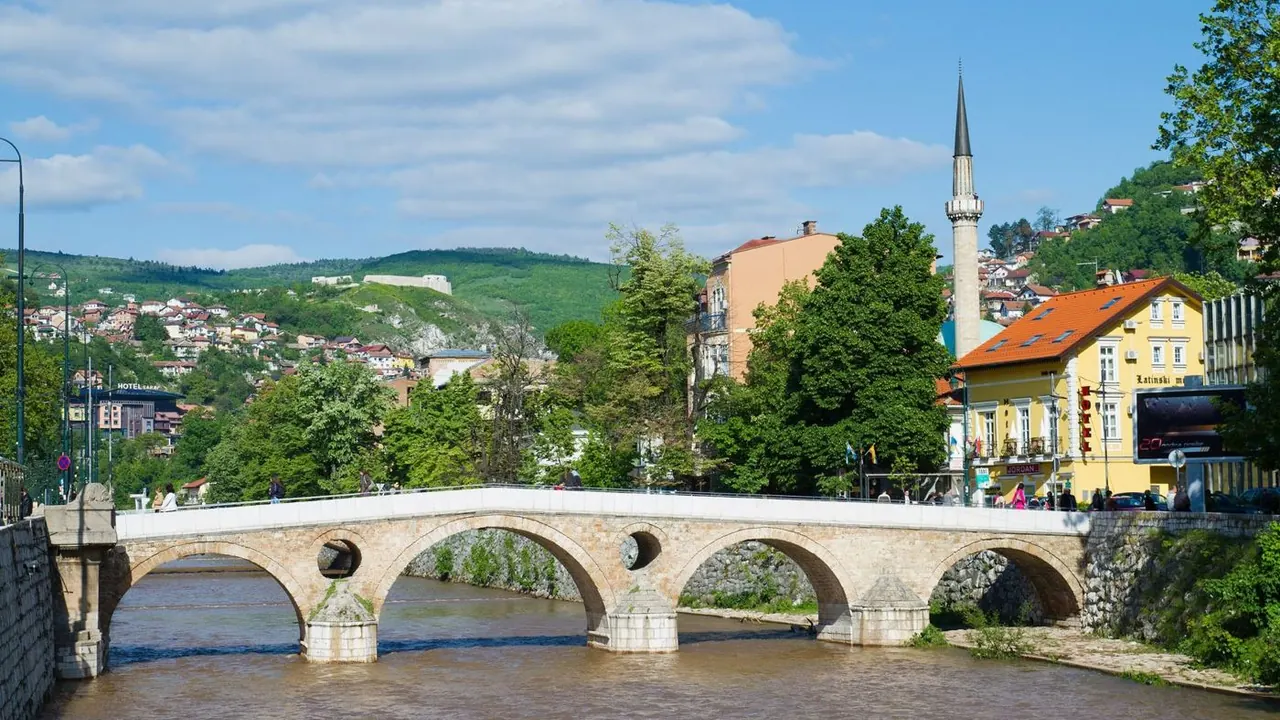
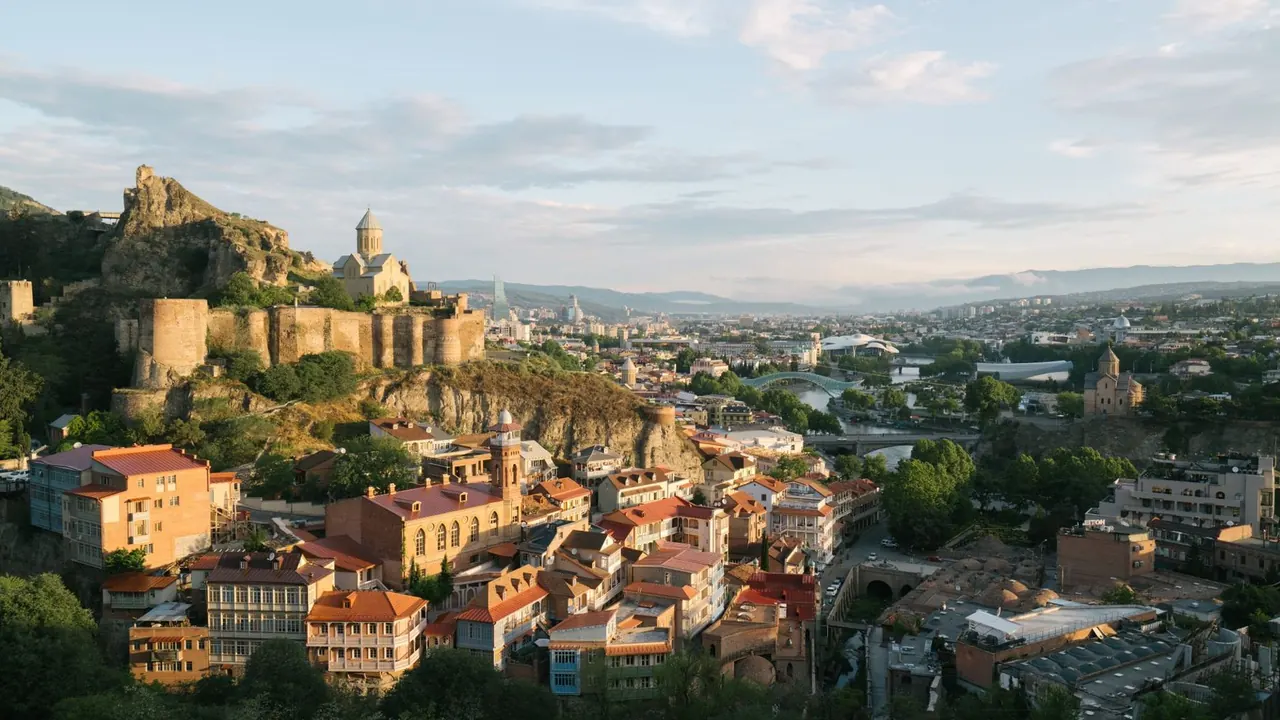
Photos: Sarajevo by Tumi-1983, CC0; Tbilisi by ArtHouse Studio, Pexels License.
Sarajevo or Tbilisi?
Our verdict in twelve categories, each scored against the same fixed benchmark cities, and the climate month by month, so you can choose for your trip.
Choose Sarajevo for
- nature and the outdoors
- getting around
- culture and sights
Sarajevo suits the traveller who wants mountains close to the old streets. A cable car climbs from the edge of the Old Town to Trebević, the Olympic slopes are under an hour away, and the flat, compact centre and valley tram make it an easy city to find your way around. It is a quieter, more reflective trip, built around Ottoman and Austro-Hungarian quarters standing side by side and the memory of the siege.
Choose Tbilisi for
- nightlife
- wellness
- live music and the arts
Choose Tbilisi if the evenings matter as much as the days. Georgian cooking and qvevri wine, serious techno clubs, the sulphur baths of Abanotubani and polyphonic singing give it more to do after dark and more ways to unwind. The outings to Mtskheta, Kakheti and David Gareja are also richer. In return you get steeper streets and hotter summers.
Scoreboard
Twelve categories on one fixed scale from 0 to 100. The shaded stretch is the gap between the two.
Your match
Pick a travel style or drag the sliders, and both match scores follow your weighting.
Wins on nature and the outdoors and getting around with your weighting.
Wins on nightlife and wellness with your weighting.
What matters to you?
Category by category
What the scores mean for a trip.
Beaches & swimming
Neither city works for a beach trip, and from both the sea means a separate journey: the Adriatic is about three hours from Sarajevo and the Black Sea about five from Tbilisi. In summer, Sarajevo locals cool off in cold mountain rivers and at Jablanica lake. Tbilisi has the Tbilisi Sea reservoir and the small hill lakes, which are welcome in its fiercer July heat. Sarajevo is easier to pair with a few days on the coast.
Food & drink
Both cities feed you well, but Tbilisi has the wider table. Sarajevo's cooking is careful Ottoman-Balkan comfort food: ćevapi from the Baščaršija grills, burek sold by weight, lamb slow-cooked under a lid, and the long ritual of Bosnian coffee with rahat lokum. It is satisfying, but the range is narrow.
Georgian cuisine has more depth. There are dumplings, cheese breads, walnut and pomegranate sauces, piles of fresh herbs and the toastmaster-led supra, and alongside the food comes a wine tradition thousands of years old, poured in the bars of Sololaki. If eating and drinking are the point of the trip, Tbilisi gives you more.
Culture & sights
The two are evenly matched, but they differ in character. Sarajevo's strength is how close its faiths and empires sit: the mosques and covered markets of Baščaršija give way within minutes to Habsburg avenues, cathedrals and the Old Synagogue. The twentieth century is very present here, from the Latin Bridge of 1914 to the Tunnel of Hope.
Tbilisi is more about old architecture and the Orthodox church. It has sixth-century Anchiskhati, carved wooden balconies under Narikala, faded Art Nouveau entrance halls in Sololaki and the Colchian gold of the National Museum. Sarajevo moves you more, and Tbilisi gives you more to look at as you walk.
Nightlife
Tbilisi is the far stronger place to go out. It has a techno scene known across Europe, with big clubs in industrial and Soviet-era buildings running past dawn, plus wine bars in Sololaki and courtyard bars near Marjanishvili.
Sarajevo's evenings are gentler and centre on café-bars around Ferhadija, a few student cellar bars and small clubs, and rakija late into the night. They are sociable and cheap, but if you want to dance, Tbilisi is the city to choose.
Nature & outdoors
Sarajevo has the mountains on its doorstep. The cable car rises from the Old Town to Trebević and the old Olympic bobsleigh track, Jahorina and Bjelašnica are under an hour away for skiing or summer ridge walks, and Lukomir, Vrelo Bosne and Neretva rafting are all within reach.
Tbilisi's own hills, Mtatsminda and the forested national park, are pleasant but tamer. The big landscapes of the Greater Caucasus are about two hours up the Military Road, and Kazbegi really needs a night away.
Day trips
From Sarajevo, the standout is Mostar, about two hours south by a scenic train through the Neretva gorge, with Konjic and its old stone bridge as a stop on the way. Blagaj's dervish house and the fortress village of Počitelj lie just beyond Mostar and can be added to the same day. Elsewhere, slow, winding roads make Travnik and Višegrad more of an effort.
Tbilisi has the richer and easier choice. UNESCO-listed Mtskheta is only half an hour away, and Kakheti's family wineries, walled Sighnaghi and the Alaverdi and Gremi monasteries fill a full day. The rock-cut town of Uplistsikhe and the cave monastery of David Gareja in the semi-desert add real variety.
Good for families
Tbilisi is a little better with children. The funicular up to the Mtatsminda amusement park and its Ferris wheel is a proper treat, and Georgians are happy to have children in restaurants late into the evening. On the other hand, the steep cobbles, underpass stairs and summer heat are hard work with a pushchair.
Sarajevo's flat Old Town is easier underfoot, and the cable car and carriage rides to Vrelo Bosne are good outings. But the main sights are about history and war, which little of the city softens for children, and winter smog is unkind to small lungs.
Getting around
Sarajevo is the simpler city to get around. Its long, narrow valley keeps the layout easy to grasp, the historic centre is flat, and one tram line runs the length of the valley floor from Baščaršija to Ilidža.
Tbilisi's centre is walkable too, but the walking is uphill and on broken pavements. The two-line metro covers the main axis, and most visitors end up using ride-hailing apps. Aggressive traffic and underpasses at the big crossings make it more tiring on foot.
Shopping & style
Neither city is a shopping destination, and both are best for local crafts. In Sarajevo, that means the coppersmiths hammering coffee sets on Kazandžiluk and the carpets and slippers of the Bezistan. Tbilisi has the Dry Bridge flea market for Soviet curios and old silver, cloisonné enamel jewellery, qvevri wine to carry home, and a few local designers in Vera and Sololaki.
Affordability
Both are among the easiest cities in Europe on the budget, and a stay costs about the same in either. In Sarajevo, the cheapest pleasures are a plate of ćevapi or a bazaar coffee, though prices rise in the Old Town during the summer film festival. In Tbilisi, a Georgian meal with wine and the free churches keep costs down, while boutique hotels and cocktail bars come closer to Western prices.
Live music & performing arts
Tbilisi gives a visitor more to watch. Georgian folk dance ensembles and the ancient polyphonic singing, best heard in church, need no translation, and neither do the Gabriadze marionette plays. The Moorish-style Opera and Ballet Theatre adds a full classical season.
Sarajevo has the National Theatre, the Philharmonic and sevdah in small venues, but its stage life peaks during the MESS theatre festival and the November jazz festival. Outside those, there is little to plan around.
Wellness & relaxation
Bathing is part of Tbilisi's identity. In the sulphur bathhouses of Abanotubani, you book a private room with its own hot pool and a vigorous kisi scrub, a ritual that has barely changed in centuries.
Sarajevo has thermal water too, at the Ilidža spa at the end of the tram line, but its historic hammam no longer works as a bath. Its calmer moments come from the shaded avenue at Vrelo Bosne and an unhurried coffee. Neither city is especially restful otherwise, with Tbilisi's traffic and Sarajevo's winter smog.
When should you go?
Pick your month. The climate figures are measured averages, not a forecast.
Sarajevo in July
Tbilisi in July
Daytime high, °C
Rainfall in the month, mm
Temperature and rainfall are climate normals, averaged over the years shown. Sarajevo: 1991-2020 normals, Sarajevo-Bejelave (2 km from centre). Tbilisi: 1991-2020 normals, Tbilisi (13.8 km from centre).
Sarajevo has the milder summer. July and August reach about 28°C with plenty of sunshine, which is comfortable for walking the Old Town and good for the mountains, while winters drop to around 4°C, cold for sightseeing but right for skiing. Rain is spread through the whole year with no dry season, and the wettest stretch is autumn into early winter.
Tbilisi runs hotter and drier. July and August climb to about 32°C, which makes its steep lanes hard going by midday, so May, late September and October are the best months to walk the city. Winters are a little milder than in Sarajevo, and rainfall is much lower, falling to about 15mm in January. June is the wettest month.
Which traveller are you?
On a food and nightlife trip, Sarajevo offers fine ćevapi and sociable café-bars, but Tbilisi goes much further. Khinkali, khachapuri and amber qvevri wine fill the evenings in Sololaki, and at weekends techno clubs keep going until well after dawn.
For an outdoors trip, Sarajevo is the better base because the mountains fit into a single day: ski or mountain-bike the open ridges and still be back in the bazaar for dinner. From Tbilisi, Gudauri's slopes and paragliding mean a longer drive north.
For a relaxing and wellness trip, Tbilisi suits better. Sarajevo's Ilidža spa makes a pleasant afternoon, but Tbilisi is named after its warm springs, and a soak in a private sulphur bath followed by a long courtyard lunch sets the pace there.
Before you go
| Measure | Sarajevo | Tbilisi |
|---|---|---|
| Official language | Croatian, Serbian, Bosnian | Georgian |
| Currency | Convertible Mark (BAM) | Lari (GEL) |
| Sockets | CF230 V, 50 Hz | CF220 V, 50 Hz |
| Driving side | Right | Right |
| Time zone | UTC+1, UTC+2 in summer | UTC+4 |
| Emergency number | 112 | 112 |
| Elevation | 518 m | 575 m |
| Main airport | Sarajevo International Airport (SJJ)7 km from centre38 non-stop destinations | Tbilisi International Airport (TBS)15 km from centre64 non-stop destinations |
| Public holidays this year | 8 days | 17 days |
By the numbers
| Measure | Sarajevo | Tbilisi |
|---|---|---|
| City population | 275,524 | 1,331,485 |
| People per km² | 1,947 | 1,849 |
| Museums within 10 km | 25 | 29 |
| UNESCO World Heritage sites within 50 km | 1 | 1 |
Where else could you go?
Every comparison below shares a destination with this one, so you can follow Sarajevo or Tbilisi somewhere new.