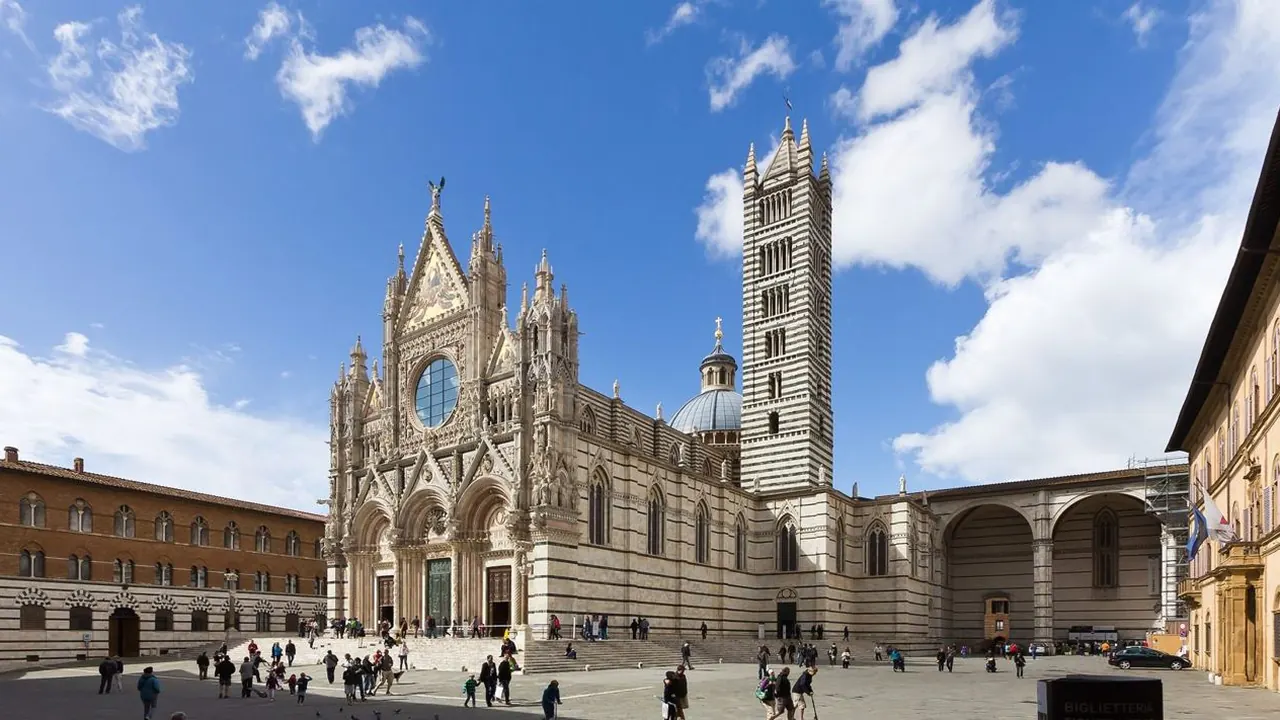
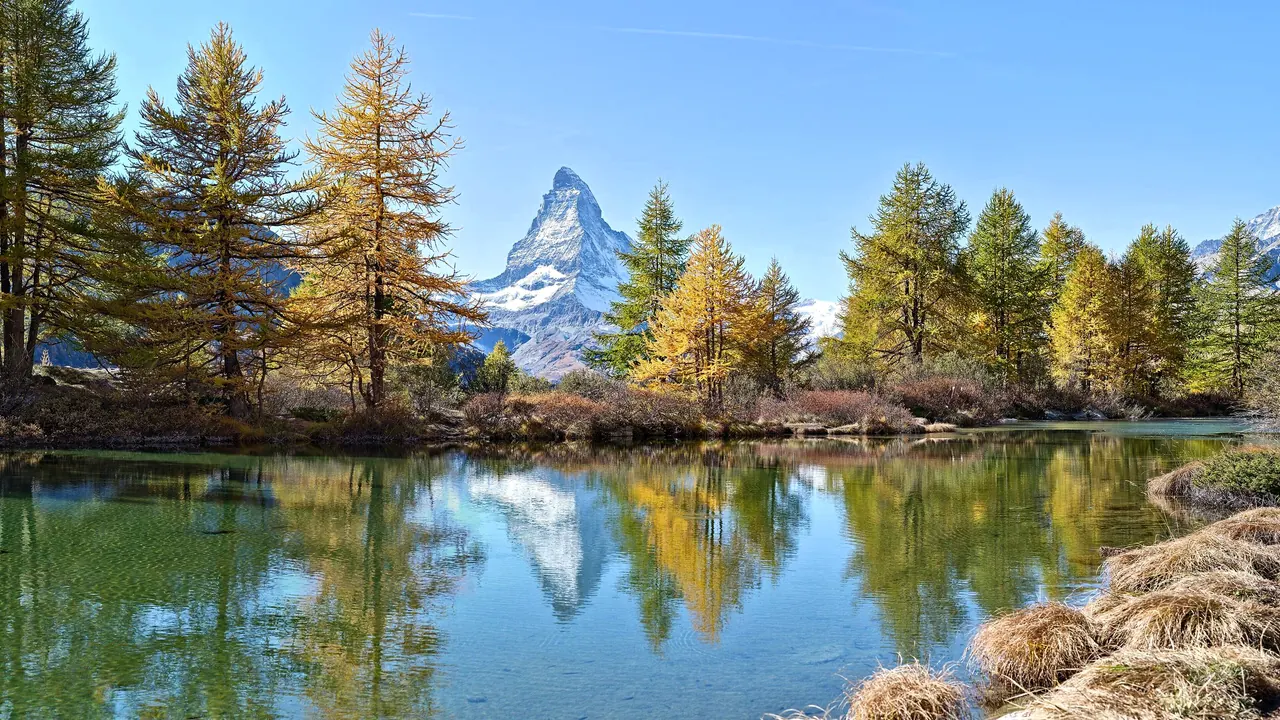
Photos: Siena by Raimond Spekking, CC BY-SA 4.0, cropped; Zermatt by Roy Egloff, CC BY-SA 4.0, cropped.
Siena or Zermatt?
Our verdict in twelve categories, each scored against the same fixed benchmark cities, and the climate month by month, so you can choose for your trip.
Choose Siena for
- day trips
- culture and sights
- prices
Siena suits a traveller who comes for art, history and the table. Its medieval centre, with the Duomo and Lorenzetti's frescoes, rewards several days of slow sightseeing, and Sienese cooking with Tuscan wine is part of every one of them. It also makes an excellent base for San Gimignano, the Chianti villages and the Val d'Orcia, and it costs a great deal less.
Choose Zermatt for
- nature and the outdoors
- getting around
- families
Choose Zermatt if the mountains are the whole point of the trip. The Matterhorn rises over a car-free village, and cog railways and gondolas carry you up into glacier country. The same slopes serve skiers in winter and hikers in summer. You will pay heavily for it, though, and there are few monuments or towns nearby to fill a day away from the peaks.
Scoreboard
Twelve categories on one fixed scale from 0 to 100. The shaded stretch is the gap between the two.
Your match
Pick a travel style or drag the sliders, and both match scores follow your weighting.
Wins on day trips and culture and sights with your weighting.
Wins on nature and the outdoors and getting around with your weighting.
What matters to you?
Category by category
What the scores mean for a trip.
Beaches & swimming
Neither place is a beach destination, but Siena can at least reach the sea. The Maremma coast around Castiglione della Pescaia is well over an hour away by car, which is enough for a long day out or a few nights added to the trip. Zermatt has no sea and no bathing lake, and its mountain tarns stay too cold to swim in even in August, so in either town a swim means a hotel or agriturismo pool.
Food & drink
Siena eats better and with more character. Hand-rolled pici, ribollita, cinta senese pork and a long baking tradition of panforte and ricciarelli fill the family osterie of the contrade. Chianti Classico, Brunello and Vino Nobile from the surrounding vineyards are poured by the glass.
Zermatt's best meals are the long lunches in mountain chalets around Findeln and Furi, reached on skis or on foot, and the village has a few ambitious kitchens too. The Valais menu of raclette, fondue and air-dried beef is narrower, cheap eating is hard to find, and many places close between seasons.
Culture & sights
This is where the two differ most. Siena's whole centre is a medieval monument. It runs from the sloping Campo and the Palazzo Pubblico, with Lorenzetti's Good and Bad Government, to the Duomo's inlaid floor and the museum complex of Santa Maria della Scala. The seventeen contrade give each quarter its own identity.
Zermatt's heritage is the story of mountaineering: the Matterhorn Museum on the first ascent of 1865, the climbers' graves beside the church and the larch barns of the Hinterdorf. It holds your interest for a morning, and the Gornergrat railway is a sight in itself, but nobody comes for the monuments.
Nightlife
Both are quiet after dark, and the difference is in the kind of evening. In Siena it means a long dinner, wine on the Campo and a few student pubs, with the streets only coming alive around the Palio, when the contrade dine outdoors. Zermatt is louder but only in winter, when slope-side après-ski bars and a few small clubs on the main street stay busy at weekends; in summer the hikers turn in early.
Nature & outdoors
For dramatic scenery, Zermatt is in another league. Lifts reach the Matterhorn, a ring of four-thousand-metre peaks and the Gorner Glacier. Winter brings skiing across into Italy, and summer opens the Five Lakes walk, the Europaweg suspension bridge and guided climbs.
Siena's countryside is gentler but very beautiful: the bare clay hills and cypress-lined lanes of the Crete Senesi, the rolling fields of the Val d'Orcia, and white gravel strade bianche that cyclists ride straight from the edge of town. It is at its best for riding and walking in spring and autumn, but there are no high mountains.
Day trips
Siena has a long list of places worth a day out. Florence is a fast bus ride away, and San Gimignano, Monteriggioni, the Chianti villages and Volterra are all close. To the south are Pienza, Montalcino and Montepulciano, with abbeys such as San Galgano and Sant'Antimo in between, though a car makes the hill towns much easier.
From Zermatt every outing starts with the long train ride down the valley, and there are only a few places to go: Sion with its two castle hills, Brig's Stockalper Palace and Saas-Fee in the next valley. Most visitors spend their free days up the mountain instead.
Good for families
Zermatt is the easier choice with children, as long as the family likes to ski or walk. The car-free streets, children's ski schools and nursery slopes at Sunnegga, marmot spotting and the novelty of the cog railways keep children busy. The thin air at the highest viewpoints is hard on small children, though, and rainy days are difficult to fill.
Siena is safe and welcomes children in its trattorie, and older ones enjoy climbing the Torre del Mangia. But the steep streets are hard work with a pushchair and nothing is built for children, so families usually stay at a countryside farmhouse with a pool.
Getting around
You walk everywhere in both, but Zermatt runs more smoothly. You arrive by train via Täsch, the village is a compact car-free strip with electric taxis, and the cog railway, the Sunnegga funicular and the gondolas all start within walking distance. You never need a car to reach the mountains.
Siena's centre is also traffic-free, but it sits on three ridges with steep, stepped lanes, and escalators climb up from the station in the valley. Regional trains are slow, so buses are the better link to Florence, and most visitors hire a car for the wine country.
Shopping & style
Neither is a shopping destination, but Siena has a little more to browse. Banchi di Sopra and Via di Città sell Italian clothes, shoes and leather, the local specialities are majolica, contrada scarves, panforte and pecorino, and a large weekly market sets up by the Fortezza Medicea. Zermatt's one main street is mostly Swiss watches and jewellery for wealthy skiers, plus outfitters with genuinely good mountain gear, but there is no market and few independent shops.
Affordability
Siena is by far the cheaper of the two. Rooms inside the walls are in demand, especially around the Palio and in summer, and museum tickets add up. Osteria lunches with house wine are good value, though, and an agriturismo outside town costs less again.
Zermatt is one of the most expensive places in the Alps. Even plain hotels are steep in season, a meal on a mountain terrace costs far more than in most of Europe, and the lifts every visitor uses are expensive. Self-catering, supermarket picnics and a bed down the valley in Täsch soften the cost, but only partly.
Live music & performing arts
Siena has a real musical life for a town of its size: the Accademia Chigiana's summer concerts in palaces and churches, performances from Siena Jazz, and drama and music through the winter at the Teatro dei Rinnovati and the Teatro dei Rozzi. Zermatt has no theatre or concert hall. Outside Zermatt Unplugged in spring and its late-summer chamber music festival, live music there means a band in an après-ski bar.
Wellness & relaxation
Both make for a restful stay, but in different ways. Around Siena the draw is thermal water: the travertine pools of Rapolano Terme half an hour away, the steaming medieval bath at Bagno Vignoni and the free limestone pools of Bagni San Filippo, often combined with a rural spa hotel. Zermatt has no springs, but it has many excellent hotel spas with mountain views, and the car-free quiet and clear air are restful in themselves, though in peak weeks the mood is active rather than slow.
When should you go?
Pick your month. The climate figures are measured averages, not a forecast.
Siena in July
Zermatt in July
Daytime high, °C
Rainfall in the month, mm
Where the figures come from
Siena's temperatures are measured 45 km from the centre, at Arezzo.
Siena has no rain gauge within 25 km of the centre, so its rainfall comes from a gridded climate dataset read at the city rather than from a gauge further away.
Zermatt has no weather station within reach, so its figures come from a gridded climate model rather than a measured record, and read a broad area rather than the city itself.
Temperature and rainfall are climate normals, averaged over the years shown. Siena: 2006-2017 (rainfall 1991-2020) normals, Arezzo (45 km from centre). Zermatt: 1991-2020 normals, TerraClimate 4 km grid at the town, no weather station within 90 km.
Siena is at its best in spring and early autumn. In May and September the days are warm and comfortable for climbing its streets. July and August reach about 31°C, which makes the steep lanes hard going at midday, but they are also the driest months and ideal for a farmhouse pool. Rain arrives in October and peaks in November at around 127mm, and winter is cool but still fine for museums and churches.
Zermatt runs on a different calendar. From December to March the daytime high stays below freezing, around -2°C in midwinter, and this is the skiing season. Summer is short and fresh, with highs near 14°C in July and August: good walking weather, but never warm. Precipitation is spread fairly evenly through the year. November is the wettest month in both places, so late autumn suits neither.
Which traveller are you?
On a culture and arts trip, Siena is the clear pick. Its UNESCO-listed centre, the Duomo, Duccio's Maestà and the Sienese painting in the Pinacoteca fill two or three full days. Zermatt's mountaineering museum and old larch barns fill a morning.
For an outdoors trip, Zermatt wins outright. The Matterhorn, glacier lifts above 3,800m, skiing across into Italy and hundreds of kilometres of summer trails outclass Siena's gentle clay hills and gravel cycling roads, lovely as those are.
On a trip on a tight budget, Siena is far easier. Osteria lunches with house wine, a centre you can walk and the option of an agriturismo stay keep costs reasonable. In Zermatt the rooms, terrace meals and lift tickets are steep even if you self-cater.
Before you go
| Measure | Siena | Zermatt |
|---|---|---|
| Official language | Italian | French, German, Italian, Romansh |
| Currency | Euro (EUR) | Swiss Franc (CHF) |
| Sockets | CFL230 V, 50 Hz | CJ230 V, 50 Hz |
| Driving side | Right | Right |
| Time zone | UTC+1, UTC+2 in summer | UTC+1, UTC+2 in summer |
| Emergency number | 112 | 112 |
| Elevation | 322 m | 1,624 m |
| Main airport | Florence Airport, Peretola (FLR)55 km from centre46 non-stop destinations | Geneva International Airport (GVA)128 km from centre150 non-stop destinations |
| Public holidays this year | 13 days | 9 days |
By the numbers
| Measure | Siena | Zermatt |
|---|---|---|
| City population | 52,812 | 6,023 |
| People per km² | 446 | 25 |
| Museums within 10 km | 30 | 2 |
| UNESCO World Heritage sites within 50 km | 5 | 2 |
Where else could you go?
Every comparison below shares a destination with this one, so you can follow Siena or Zermatt somewhere new.