South Africa
Johannesburg
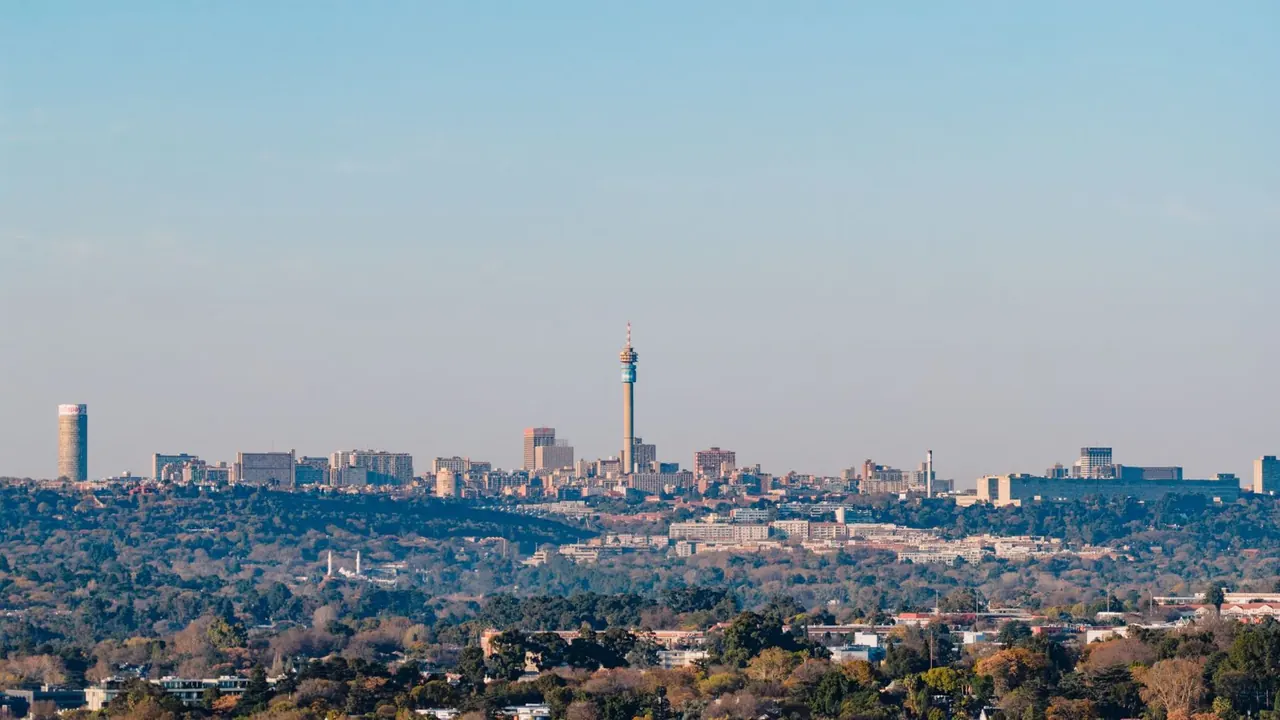
The Johannesburg skyline and the Hillbrow Tower
- Affordable cities72
- Nightlife62
- Food & drink58
Photo: K, Pexels License
Match
47
Every category weighted equally
- Beach & sun42
- Culture & arts49
- Food & nightlife49
- Family trip44
- Outdoors47
- Relax & unwind42
- Shopping & style49
- On a budget50
Johannesburg in twelve categories
Our verdict on each, scored 0 to 100 against the same fixed benchmark cities, so a score means the same thing on every page.
Beaches & swimming. Scores 5 out of 100.
Food & drink. Scores 58 out of 100.
Culture & sights. Scores 56 out of 100.
Nightlife. Scores 62 out of 100.
Nature & outdoors. Scores 55 out of 100.
Day trips. Scores 52 out of 100.
Good for families. Scores 42 out of 100.
Getting around. Scores 18 out of 100.
Shopping & style. Scores 58 out of 100.
Affordability. Scores 72 out of 100.
Live music & performing arts. Scores 55 out of 100.
Wellness & relaxation. Scores 28 out of 100.
Johannesburg category by category
Beaches & swimming
5Johannesburg sits on the high inland plateau, a long drive or a flight from the nearest sea, so beaches play no part in a stay here. Swimming means a hotel or garden pool, which the long sunny summers make welcome. Locals who want the water head to the dams around Hartbeespoort or fly to the coast for a separate vacation.
Food & drink
58Eating in Johannesburg is about meat over fire and the mix of people who have settled here. In Soweto and the townships, shisa nyama butcheries grill to order on weekend afternoons, served with pap and chakalaka, while bunny chow, kotas stuffed with chips and polony, and vetkoek are the city's street food. Fordsburg has Indian and Middle Eastern cooking, and Portuguese and Mozambican kitchens bring peri-peri chicken and prawns.
In the northern suburbs, Parkhurst, Greenside, Rosebank and Sandton have a polished restaurant scene with good steak, South African wines from the Cape and some serious fine dining. Weekend food markets in the inner city and Rosebank are a pleasant way to graze. The range is wide, but much of it is spread across suburbs reached by car.
Culture & sights
56Johannesburg's sights tell the story of a gold-rush city and of apartheid and its end. The Apartheid Museum is the essential visit, a long and sobering walk through the twentieth century. Constitution Hill turns an old prison complex into the home of the Constitutional Court, and in Soweto the Hector Pieterson Memorial and Vilakazi Street, once home to Nelson Mandela and Desmond Tutu, make history very local.
Beyond that, the Origins Centre and the Wits Art Museum at the university, the Johannesburg Art Gallery and the Art Deco and early skyscraper fabric of the inner city are worth time. The city is young, little more than a century old, and has no old town to wander, so sightseeing means moving between scattered sites, often with a guide.
Nightlife
62Johannesburg goes out hard, and its soundtrack is local: South African house and amapiano drive the dance floors, from Sandton's polished clubs to weekend afternoon sessions at Soweto shisa nyamas that roll on into the night. Braamfontein's student rooftops, Melville's 7th Street bars and the lounges of Rosebank and Sandton each have their own crowd, and Friday and Saturday nights run late.
The catch is getting there and back. Nights out are scattered across suburbs, and nobody walks between them after dark, so plan rides in advance. Going with locals, or to well-known areas, makes the city's nightlife far easier to enjoy.
Nature & outdoors
55The city lies on open Highveld grassland at about 1,750m, with a dry, sunny winter and summer afternoon thunderstorms. It is one of the world's most heavily treed cities, and the Walter Sisulu Botanical Garden, with its waterfall and nesting black eagles, and the Klipriviersberg reserve give easy walks close to town.
The real draws are within reach by car. The Magaliesberg hills, about an hour away, offer hiking, mountain biking, ballooning and kloofing, and Pilanesberg, a game reserve in an old volcanic crater about two and a half hours out, holds lions, elephants and rhino. Smaller reserves nearer town offer a first safari, though Kruger needs several days.
Day trips
52Pretoria is the obvious outing, about an hour away by the Gautrain, with the Union Buildings on their terraced hill, the Voortrekker Monument and jacaranda-lined streets that turn purple in spring. The Cradle of Humankind, a World Heritage Site about an hour north-west, has the Sterkfontein Caves and Maropeng visitor centre, where some of the oldest human ancestors were found.
Cullinan, an old diamond-mining village with its working mine, and the resort complex of Sun City make further days out. Beyond these the list runs short, and most other trips from Johannesburg are into the bush rather than to towns.
Good for families
42There is a fair amount for children: the Gold Reef City theme park built around an old gold mine, Johannesburg Zoo, the Sci-Bono Discovery Centre, a bird park, and lion and rhino parks on the city's edge where younger children can see big animals without a long safari. South African culture is warm towards children, and big malls with play areas are part of family life.
The difficulty is the city itself. Everything is spread out, a car is needed, and the streets are not places to stroll with a pushchair. Families usually stay in the northern suburbs, move between sights by car and treat Johannesburg as a stop on the way to a game reserve.
Getting around
18Johannesburg is a city of cars. Sights are spread across a vast metropolitan area, pavements are patchy and walking between districts, especially after dark, is not advised. The Gautrain is the one easy piece: a clean, safe rail line linking the airport, Sandton, Rosebank, the city centre and Pretoria.
Beyond it, the Rea Vaya buses and the minibus taxis that most residents use are hard going for a visitor. In practice people use ride-hailing apps, a hired car or a guide, and keep walking to compact areas such as Rosebank, Braamfontein or Melville in daylight.
Shopping & style
58Johannesburg is Africa's big shopping city, and most of it happens in malls. Sandton has the continent's heaviest concentration of international luxury brands around Nelson Mandela Square, and other large malls ring the northern suburbs. Rosebank's Sunday rooftop market and craft stalls are the best place for beadwork, wire art, textiles and carvings from across southern Africa.
For something more personal, Parkhurst and the converted industrial spaces of the inner city have local design studios, fashion labels and galleries. There is little high-street wandering, and shoppers move from one enclosed centre to the next by car.
Affordability
72For most foreign visitors Johannesburg is good value. Restaurant meals, South African wine and craft beer cost well below Western European levels, and comfortable hotels and guesthouses in the northern suburbs are reasonably priced for the standard. Museum entry is modest.
The extra costs come from the city's shape: ride-hailing or a hired car is needed to go almost anywhere, guided tours of Soweto or the inner city add up, and the safest, most convenient areas such as Sandton charge more. Imported goods and luxury shopping are not cheap.
Live music & performing arts
55Johannesburg's stage has a strong local voice. The Market Theatre in Newtown, famous for the protest theatre staged there under apartheid, still puts on new South African drama, and the Soweto Theatre brings plays and music to the township. Joburg Theatre and the large casino-complex theatres in the north stage musicals, ballet and touring productions.
Music is the deeper side: jazz runs back to Sophiatown, and jazz clubs and the annual Joy of Jazz festival keep it alive, alongside gospel, kwaito and house. Classical music and opera exist on a small scale, with the Johannesburg Philharmonic giving seasons, but this is not a city of opera houses.
Wellness & relaxation
28Johannesburg has no bathing tradition, and the city's pace is fast and business-driven. What it does have is a good supply of day spas and hotel spas in the northern suburbs, where massages and treatments are reasonably priced, and leafy suburbs with quiet guesthouses and gardens.
For real rest, people leave town: the Magaliesberg hills and the bush lodges within a couple of hours offer spa retreats, long lunches and silence that the city itself does not.
When should you go?
Pick a month to see what it is like. The climate figures are measured averages, not a forecast.
Johannesburg in July
Daytime high, °C
Rainfall in the month, mm
The whole year
Shaded against this city’s own year: the deepest cell is its best month for that figure and the palest its weakest.
Temperature and rainfall are climate normals, averaged over the years shown. Johannesburg: 2005-2019 (sunshine 1991-2020, rainfall 1991-2020) normals, Johannesburg B / Roosevelt Park (7.3 km from centre).
Before you go
| Measure | Johannesburg |
|---|---|
| Official language | English, Zulu, Xhosa, Afrikaans, Venda, Northern Sotho, Swazi, Tswana, Tsonga, Sesotho, Southern Ndebele, South African Sign Language |
| Currency | Rand (ZAR) |
| Sockets | CMN230 V, 50 Hz |
| Driving side | Left |
| Time zone | UTC+2 |
| Emergency number | 112 |
| Elevation | 1,753 m |
| Main airport | O.R. Tambo International Airport (JNB)22 km from centre84 non-stop destinations |
| Public holidays this year | 13 days |
By the numbers
| Measure | Johannesburg |
|---|---|
| City population | 4,803,262 |
| People per km² | 2,922 |
| Museums within 10 km | 14 |
| UNESCO World Heritage sites within 50 km | 2 |
Compare Johannesburg with
Every comparison with a written verdict behind it.