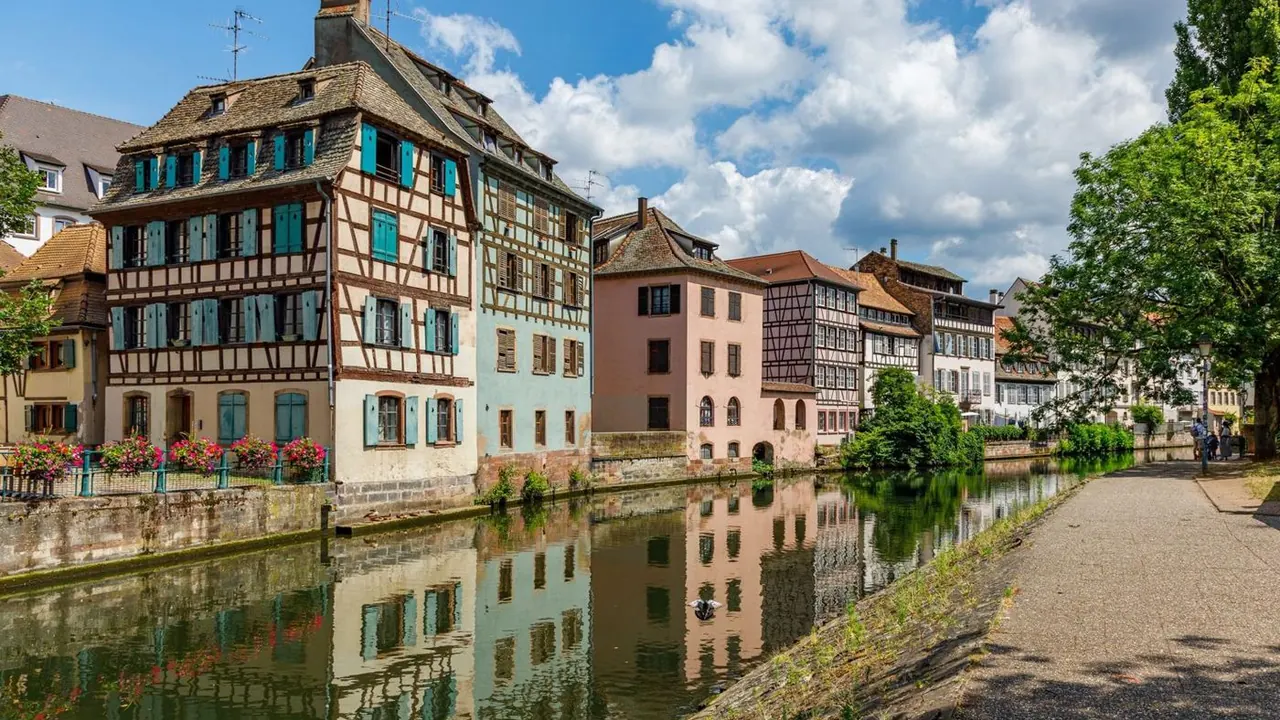
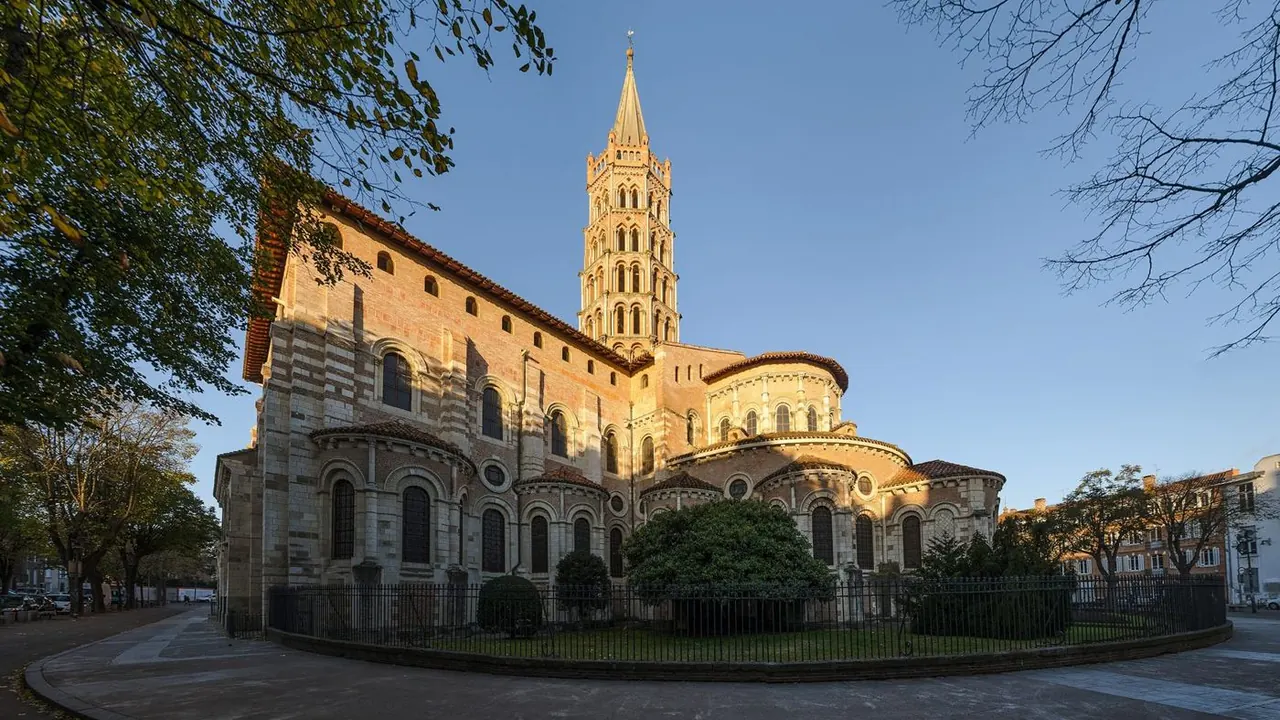
Photos: Strasbourg by Edoardo Colombo, Pexels License; Toulouse by ZbebVial, CC BY-SA 3.0, cropped.
Strasbourg or Toulouse?
Our verdict in twelve categories, each scored against the same fixed benchmark cities, and the climate month by month, so you can choose for your trip.
Choose Strasbourg for
- wellness
- getting around
- day trips
Strasbourg suits the traveller who wants a compact, easy city with plenty around it. The cathedral island and Petite France reward slow walking, trams and bikes make a car unnecessary, and the Alsace wine villages, Colmar and the German side of the Rhine give you a different outing every day. Add the old public bathhouse and the thermal baths of Baden-Baden, and it makes a calm, well-organised base for a week.
Choose Toulouse for
- nightlife
- prices
- live music and the arts
For evenings out and southern warmth, Toulouse is the better pick. Its huge student population keeps Place Saint-Pierre and the riverside terraces full long after Strasbourg has gone quiet, and its winters are noticeably milder. The rose-brick centre also comes with something Strasbourg has nothing like: aerospace museums and a space centre that children love. Carcassonne and Albi make strong day trips, and the Pyrenees are close enough for mountain walking or skiing.
Scoreboard
Twelve categories on one fixed scale from 0 to 100. The shaded stretch is the gap between the two.
Your match
Pick a travel style or drag the sliders, and both match scores follow your weighting.
Wins on wellness and getting around with your weighting.
Wins on nightlife and prices with your weighting.
What matters to you?
Category by category
What the scores mean for a trip.
Beaches & swimming
Neither city has a beach, and neither is worth choosing for swimming. Strasbourg's gravel-pit lakes such as the Baggersee are on the tram line, which makes a hot afternoon easy, while Toulouse's lakes at Sesquières and La Ramée are on the city's edge and its nearest sea, the Mediterranean at Gruissan, is a long day out.
Food & drink
Both are cities of hearty, rich cooking, and they are equally good to eat in, but the flavours differ. Strasbourg has the Franco-German table of choucroute, baeckeoffe and tarte flambée, eaten in wood-panelled winstubs with a pichet of Alsace white, and a stronger fine-dining tier in the city and the nearby villages.
Toulouse is duck country, with cassoulet, confit and magret, red wines from Fronton and Gaillac, and Armagnac to finish. Its everyday strength is the set lunch, best eaten at the counters above the Victor Hugo market. In both cities the range of other cuisines is limited.
Culture & sights
Strasbourg has the edge. Its whole centre is UNESCO-listed, from the pink sandstone cathedral with its astronomical clock to the half-timbered lanes of Petite France and the imperial avenues of the Neustadt, and the Palais Rohan puts three museums under one roof.
Toulouse is a different kind of city to look at, built in uniform rose-red brick, with Saint-Sernin and the palm-tree vault of the Jacobins as its high points. Its unusual extra is aerospace, with aircraft museums and the space centre on the outskirts, which Strasbourg cannot match.
Nightlife
Toulouse goes out far more. Place Saint-Pierre on the Garonne is packed with cheap bars and terraces that spill onto the quays, the Carmes and Daurade streets add wine and cocktail bars for an older crowd, and there is a real electronic scene, though it quietens in July and August.
Strasbourg's evenings are bar-based and gentler, in the student streets of the Krutenau and around Place Saint-Étienne or on the summer terraces by the river. There are few clubs, and on weeknights the city is largely asleep by midnight.
Nature & outdoors
The two are close, and both sit on flat plains with the real landscape an hour or more away. Strasbourg has two ranges to choose from, the Vosges above the vineyards to the west and the Black Forest to the east, plus some of the best level cycling in France along the Rhine.
Toulouse looks south to the Pyrenees, which are higher and wilder, with serious hiking, cycling climbs and ski stations, but they are a longer drive. Nearer to the city, the Canal du Midi towpaths and the Aveyron gorges fill the gap.
Day trips
Strasbourg is the better base. Colmar is half an hour away by train, the wine-route villages such as Riquewihr and Eguisheim lie between them, and across the Rhine come Baden-Baden, Freiburg and Heidelberg, with Basel and Nancy also on the rail network. Two countries' worth of outings make a long stay easy to fill.
Toulouse has fewer but very strong options. Carcassonne's walled Cité and brick Albi are each about an hour by train, and Moissac's cloister is close by, but much of the rest, from Cordes-sur-Ciel to Foix, works best with a car.
Good for families
Both work well with children, in different ways. Strasbourg's appeal is gentle and outdoor: boat trips round the Grande Ile, the storks and rowing boats of the Orangerie, and Europa-Park, one of Europe's largest theme parks, an hour away.
Toulouse wins on attractions inside the city, above all the Cité de l'espace with its full-size Ariane rocket, and the chance to walk through a Concorde. July and August heat is the drawback there.
Getting around
Strasbourg is the easier city to move around. The old town island takes about twenty minutes to cross on foot, trams reach almost everywhere a visitor goes, even across the border to Kehl, and the separated cycle lanes often make a bike the fastest choice.
Toulouse's centre inside the boulevards is also flat and walkable, and its two automated metro lines are quick. But the space centre, the aircraft museum and the lakes need a bus or a drive, and its rural day trips depend more on a car.
Shopping & style
There is little to separate them: both have mainstream chains and a department store in the centre, independents in the older lanes and no luxury district. The difference is in what you take home. Strasbourg offers Alsace wine, Soufflenheim pottery and a Christmas market of crafts, while Toulouse is better for violet sweets, Armagnac and its sprawling Sunday market around Saint-Sernin.
Affordability
Costs are much the same: both are cheaper than Paris but far from budget cities. In Strasbourg the trap is hotel prices during the Christmas market and the European Parliament sessions, while in Toulouse it is the big trade fairs, and the set lunch is the best way to eat well for less.
Live music & performing arts
Both have a full season of opera and orchestral music, so the difference is in emphasis. Toulouse is strongest in classical music, with the Capitole's own opera and ballet company, a well-regarded orchestra in the round Halle aux Grains, and summer piano recitals in the Jacobins cloister.
Strasbourg leans more towards the new and the theatrical, with the Théâtre National de Strasbourg and the autumn Musica festival of contemporary music, alongside the Opéra national du Rhin.
Wellness & relaxation
Strasbourg is far better for a restful stay. Its early twentieth-century Bains municipaux offer tiled pools, a hammam and saunas in the centre, and the Friedrichsbad and Caracalla baths of Baden-Baden are an easy outing across the Rhine.
Toulouse has no bathing tradition of its own, just hotel spas and summer open-air pools. Its relaxation comes from long lunches and slow rides along the Canal du Midi, and the Pyrenean spa towns are really an overnight trip.
When should you go?
Pick your month. The climate figures are measured averages, not a forecast.
Strasbourg in July
Toulouse in July
Daytime high, °C
Rainfall in the month, mm
Temperature and rainfall are climate normals, averaged over the years shown. Strasbourg: 1991-2020 normals, Strasbourg (9.1 km from centre). Toulouse: 1991-2020 normals, Toulouse / Blagnac (7 km from centre).
Strasbourg has a proper continental winter, with daytime highs around 5°C in January and short, grey days through December and January, so the cold months suit the Christmas markets and winstub dinners better than long walks. Spring warms quickly, and from June to August the afternoons reach the mid twenties, warm enough for the lakes. Early summer is also its wettest stretch, with May the rainiest month at 77mm, so September is often the most comfortable time to visit.
In spring the two cities are much alike, but Toulouse is several degrees warmer in winter and again from July through the autumn. Winter highs of about 10°C, with more sunshine than Strasbourg gets, leave December to February mild enough for walking, and October stays pleasant for sightseeing. July and August reach 28°C to 29°C, sunny and fairly dry, which is good for the lakes and terraces but hot for walking the streets at midday. Its wettest spell comes in April and May, not in high summer.
Which traveller are you?
For a food and nightlife trip, Toulouse is the stronger choice. Both cities cook rich, hearty regional food, but Toulouse's large student crowd fills Place Saint-Pierre and the Carmes wine bars late into the night, while Strasbourg's evenings mostly end around midnight.
On a relaxing and wellness trip, Strasbourg comes out ahead. It has its own historic bathhouse with hammam and saunas, the thermal baths of Baden-Baden are under an hour away, and quiet canal-side walks set the pace. Toulouse's nearest hot springs need an overnight trip into the Pyrenees.
For a short city break, Strasbourg is easier to fit into a few days. The cathedral, Petite France and the museums of the Palais Rohan all sit on one small, largely car-free island, and the tram from the station drops you at the centre straight away.
Before you go
| Measure | Strasbourg | Toulouse |
|---|---|---|
| Official language | French | French |
| Currency | Euro (EUR) | Euro (EUR) |
| Sockets | CE230 V, 50 Hz | CE230 V, 50 Hz |
| Driving side | Right | Right |
| Time zone | UTC+1, UTC+2 in summer | UTC+1, UTC+2 in summer |
| Emergency number | 112 | 112 |
| Elevation | 132 m | 115 m |
| Main airport | Strasbourg Airport (SXB)10 km from centre43 non-stop destinations | Toulouse-Blagnac Airport (TLS)7 km from centre84 non-stop destinations |
| Public holidays this year | 11 days | 11 days |
By the numbers
| Measure | Strasbourg | Toulouse |
|---|---|---|
| City population | 293,771 | 514,819 |
| People per km² | 3,752 | 4,352 |
| Museums within 10 km | 21 | 24 |
| UNESCO World Heritage sites within 50 km | 1 | 2 |
Where else could you go?
Every comparison below shares a destination with this one, so you can follow Strasbourg or Toulouse somewhere new.