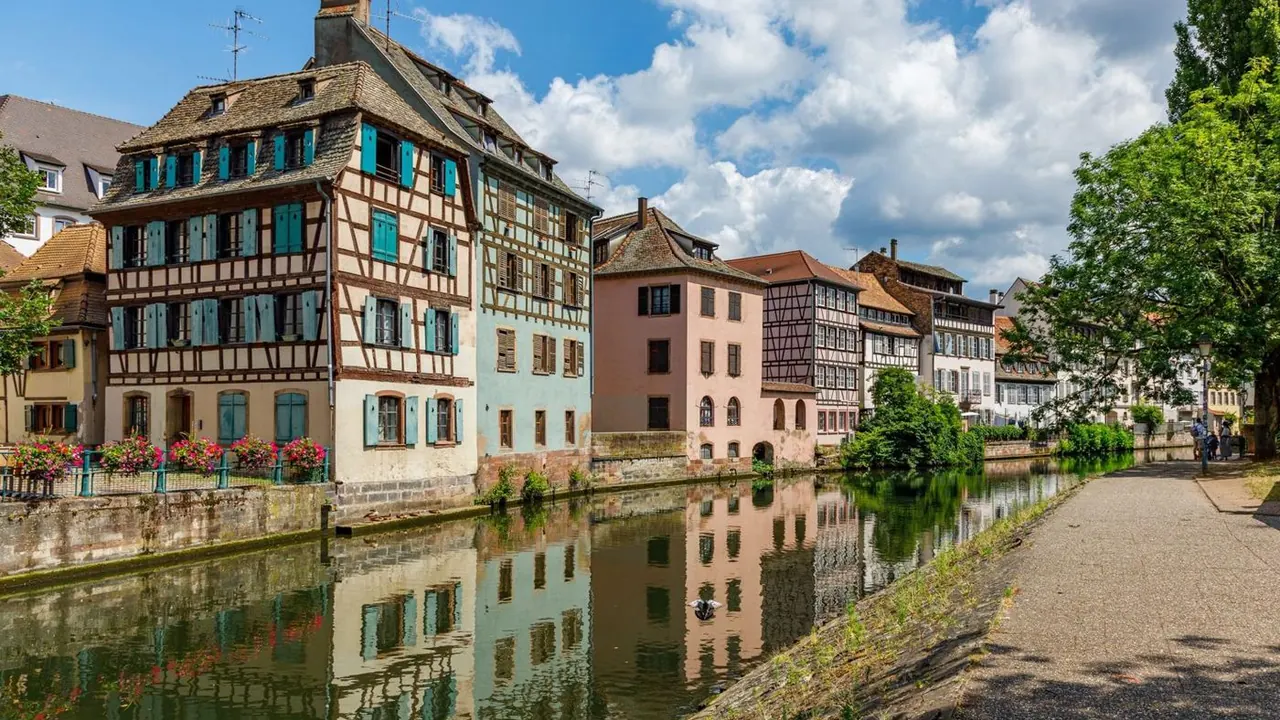
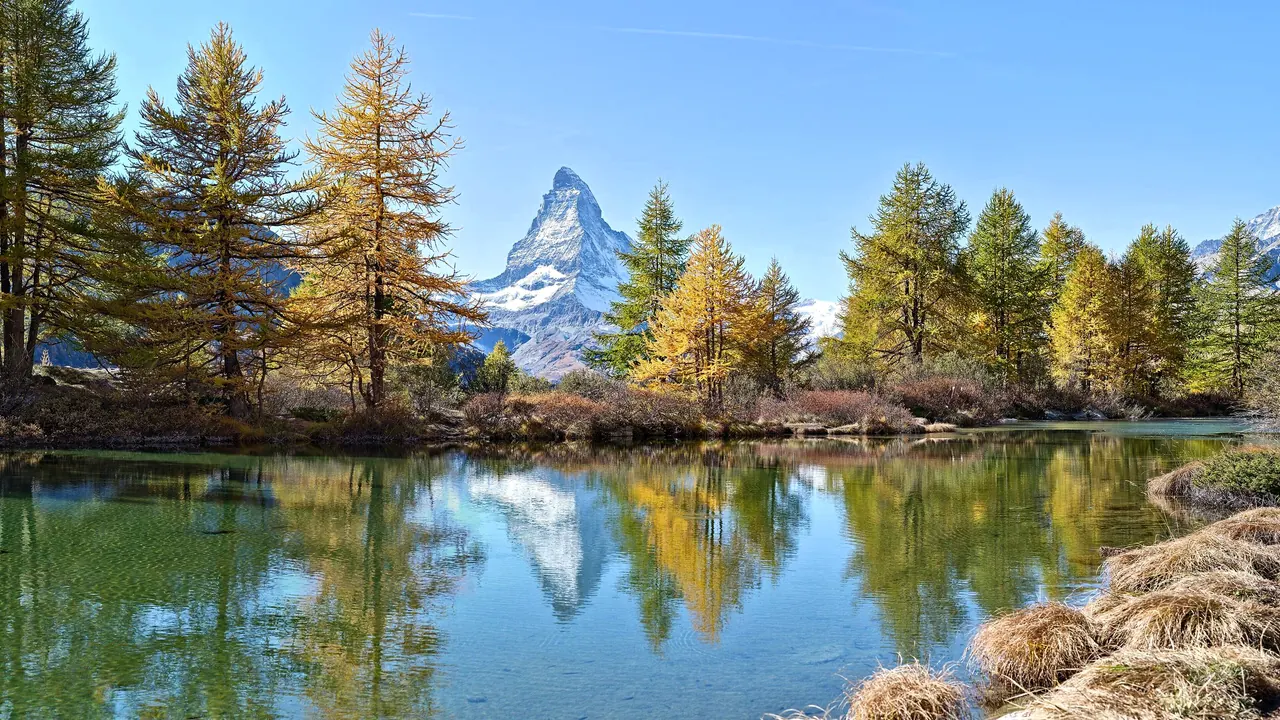
Photos: Strasbourg by Edoardo Colombo, Pexels License; Zermatt by Roy Egloff, CC BY-SA 4.0, cropped.
Strasbourg or Zermatt?
Our verdict in twelve categories, each scored against the same fixed benchmark cities, and the climate month by month, so you can choose for your trip.
Choose Strasbourg for
- culture and sights
- day trips
- prices
Strasbourg suits travellers who want a city to explore. It has a cathedral and an old town island, serious museums, an opera house and a leading theatre, winstub dinners with Alsace wine, and a different town or wine village within easy reach each day. It is flat and simple to manage with children, costs far less, and works well in any season, from summer river terraces to the December market.
Choose Zermatt for
- nature and the outdoors
If the mountains are the whole point of the trip, Zermatt is the place. The Matterhorn stands straight over a car-free village, and lifts carry you up to glaciers, high trails and skiing that carries on onto the glacier in summer. There are few sights, the evenings are quiet and every day is expensive, so it rewards skiers, hikers and climbers far more than sightseers.
Scoreboard
Twelve categories on one fixed scale from 0 to 100. The shaded stretch is the gap between the two.
Your match
Pick a travel style or drag the sliders, and both match scores follow your weighting.
Wins on culture and sights and day trips with your weighting.
Wins on nature and the outdoors with your weighting.
What matters to you?
Category by category
What the scores mean for a trip.
Beaches & swimming
Neither city has a sea, but Strasbourg at least has somewhere to swim. In July and August the gravel-pit lakes around the city, such as the Baggersee, which you can reach by tram, are lifeguarded and have grassy banks for an afternoon in the sun. Zermatt's mountain tarns are lovely for photographing the Matterhorn but stay far too cold to swim in, so a swim there means a hotel pool.
Food & drink
Strasbourg eats better and more widely. Its winstubs serve choucroute, baeckeoffe and tarte flambée with Riesling from the vineyards just to the south, the covered market sells Munster and charcuterie, and there is a strong fine-dining tier. It is weakest on other cuisines and on the tourist menus around the cathedral.
Zermatt's best meals are up on the mountain, with long lunches at chalets in hamlets such as Findeln and Furi, reached on skis or on foot with the Matterhorn in view. The Valais menu of raclette, fondue and air-dried beef is good but narrow, cheap meals are hard to find, and many kitchens close between seasons.
Culture & sights
There is a wide gap here. Strasbourg has a UNESCO-listed ensemble: the pink sandstone cathedral with its astronomical clock, the timber-framed Grande Ile, the locks of Petite France and the imperial avenues of the German Neustadt. It also has the three museums of the Palais Rohan, the cathedral sculpture museum and a large modern art museum.
Zermatt's heritage is all about mountaineering. The underground Matterhorn Museum, the climbers' graves by the church and the larch-wood barns of the Hinterdorf fill a morning, and the Gornergrat railway of 1898 is the only other historic sight.
Nightlife
Both cities have modest evenings, but Strasbourg's last all year. The university keeps the bars of the Krutenau and Place Saint-Étienne lively, and in summer the riverside terraces stay full late, though there are few clubs and weeknights wind down by midnight. Zermatt's nightlife is winter après-ski: loud slope-side bars from late afternoon and a few late bars on the main street. In summer, with hikers up early, evenings end after dinner.
Nature & outdoors
Zermatt is one of the great Alpine settings. The Matterhorn rises straight above the village, with dozens of four-thousand-metre peaks around it and the Gorner Glacier below. Lifts reach high terrain in both seasons, for skiing across into Italy in winter and hundreds of kilometres of trails among marmots and ibex in summer.
Strasbourg's outdoors is gentler and mostly further off. The city itself is flat, with the Orangerie park, storks in the Rhine forests and excellent level cycling. Proper hills start about an hour away, in the Vosges around Mont Sainte-Odile or the higher ridges of the Black Forest.
Day trips
Strasbourg is a far better base for getting about. Colmar is half an hour away by train, and the Alsace wine route runs through Riquewihr, Eguisheim and Kaysersberg below Haut-Koenigsbourg. Across the Rhine are Freiburg and Heidelberg, and Basel and Nancy are both within reach by rail.
From Zermatt every outing starts with the long train ride down the valley. Sion's castle hills and Brig's Stockalper Palace make worthwhile days, but most visitors would rather spend a spare day higher up the mountain.
Good for families
Strasbourg gives children more to do. There are boat trips through Petite France, storks and rowing boats in the Orangerie, the hands-on science centre Le Vaisseau and the clock's moving figures, and Europa-Park is about an hour away across the border.
Zermatt's car-free streets make it calm and safe, and it works well for families who ski or hike together, with nursery slopes at Sunnegga and marmots to spot in summer. A wet day is hard to fill, though, and the thin air at the highest viewpoints can be too much for small children.
Getting around
Both cities are easy to get around without a car, in very different ways. Strasbourg's compact island centre is largely pedestrianised, with trams reaching the station, the European quarter and across the Rhine to Kehl, and separated bike lanes that often make cycling the quickest option. In Zermatt you walk the narrow village strip, and electric taxis, a funicular and a chain of lifts take you to the mountains. Getting there and away is slower, with more than an hour by train down the valley.
Shopping & style
Strasbourg has more to browse. Chain stores and a department store sit around Place Kléber, and independent shops, delicatessens and bookshops line the lanes near the cathedral. The regional things to take home are Soufflenheim pottery, printed linens and Alsace wine, and the Christmas market adds crafts in December.
Zermatt's shopping is a single main street of watch boutiques, souvenir shops and very good mountain outfitters. It is useful if you need gear, but there is little else.
Affordability
Strasbourg costs what a large French regional city does, and Zermatt is in another bracket altogether. In Strasbourg, meals, wine by the pichet and trams are fairly priced and many sights are free, and hotels are the one cost to watch during the Christmas market and Parliament sessions.
In Zermatt, plain hotel rooms, terrace drinks and the lifts everyone relies on all cost well above most of Europe. Self-catering and sleeping down the valley in Täsch help, but only so far.
Live music & performing arts
Strasbourg has a proper arts season. The Opéra national du Rhin plays on Place Broglie, and the city has a philharmonic orchestra, the Théâtre National de Strasbourg and the autumn Musica festival of contemporary music, as well as jazz, dance and touring bands.
Zermatt has no theatre or concert hall at all. Its music comes from two festivals, Zermatt Unplugged in spring and a chamber music series in late summer, and otherwise from the bands in après-ski bars.
Wellness & relaxation
The two are fairly even here, but the kind of rest differs. Strasbourg has a public bathing tradition: the tiled pools, hammam and saunas of the early twentieth-century Bains municipaux, with Baden-Baden's thermal baths under an hour away. Zermatt has no springs but a dense cluster of excellent hotel spas with mountain views, a few of them open to day visitors, plus the quiet of a village without traffic, though the mood stays active rather than slow.
When should you go?
Pick your month. The climate figures are measured averages, not a forecast.
Strasbourg in July
Zermatt in July
Daytime high, °C
Rainfall in the month, mm
Where the figures come from
Zermatt has no weather station within reach, so its figures come from a gridded climate model rather than a measured record, and read a broad area rather than the city itself.
Temperature and rainfall are climate normals, averaged over the years shown. Strasbourg: 1991-2020 normals, Strasbourg (9.1 km from centre). Zermatt: 1991-2020 normals, TerraClimate 4 km grid at the town, no weather station within 90 km.
Strasbourg is at its best from May to September. July and August bring highs of about 26°C and the most sunshine of the year, which is warm enough for the gravel-pit lakes and long evenings on the terraces. May is the wettest month at around 77mm, though the rain comes and goes rather than settling in. Winter is cold and grey, with very little sun from November to January, but the old town is still pleasant to walk and the rich Alsatian food suits the season.
Zermatt follows a different calendar. In winter, highs in the village stay below freezing, at around -2°C, which is exactly what skiers want. Summer highs reach only about 14°C, cool enough for long hikes and cold once you go higher up. Late spring and autumn fall between the two seasons, and November is Zermatt's wettest month at about 130mm, which makes it the poorest time to go there.
Which traveller are you?
For a culture and arts trip, Strasbourg is the clear pick. The cathedral, Petite France, the Neustadt and the Palais Rohan museums fill two or three days, and the opera, philharmonic and national theatre fill the evenings. Zermatt's heritage takes a morning.
On an outdoors trip, Zermatt is in a different league. Lifts climb to over 3,800m among four-thousand-metre peaks, with glacier skiing, the Five Lakes walk and guided ascents. Strasbourg offers riverside cycling and the gentler Vosges an hour away.
On a tight budget, choose Strasbourg. Winstub meals, wine by the pichet, cheap trams and free old town streets keep costs reasonable. In Zermatt, rooms, mountain meals and the lift passes every visitor needs make it one of the most expensive places in the Alps.
Before you go
| Measure | Strasbourg | Zermatt |
|---|---|---|
| Official language | French | French, German, Italian, Romansh |
| Currency | Euro (EUR) | Swiss Franc (CHF) |
| Sockets | CE230 V, 50 Hz | CJ230 V, 50 Hz |
| Driving side | Right | Right |
| Time zone | UTC+1, UTC+2 in summer | UTC+1, UTC+2 in summer |
| Emergency number | 112 | 112 |
| Elevation | 132 m | 1,624 m |
| Main airport | Strasbourg Airport (SXB)10 km from centre43 non-stop destinations | Geneva International Airport (GVA)128 km from centre150 non-stop destinations |
| Public holidays this year | 11 days | 9 days |
By the numbers
| Measure | Strasbourg | Zermatt |
|---|---|---|
| City population | 293,771 | 6,023 |
| People per km² | 3,752 | 25 |
| Museums within 10 km | 21 | 2 |
| UNESCO World Heritage sites within 50 km | 3 | 2 |
Where else could you go?
Every comparison below shares a destination with this one, so you can follow Strasbourg or Zermatt somewhere new.
- Baden-Badenvs Strasbourg
- Colmarvs Strasbourg
- Freiburgvs Strasbourg
- Chamonixvs Zermatt
- Interlakenvs Zermatt
- Luganovs Zermatt