Thailand
Hua Hin
A red and blue fishing boat on the sand of Hua Hin beach
- Affordable cities80
- Wellness & relaxation80
- Beaches72
Photo: allPhoto Bangkok, Pexels License
Match
53
Every category weighted equally
- Beach & sun60
- Culture & arts44
- Food & nightlife46
- Family trip59
- Outdoors59
- Relax & unwind60
- Shopping & style47
- On a budget56
Hua Hin in twelve categories
Our verdict on each, scored 0 to 100 against the same fixed benchmark cities, so a score means the same thing on every page.
Beaches & swimming. Scores 72 out of 100.
Food & drink. Scores 60 out of 100.
Culture & sights. Scores 30 out of 100.
Nightlife. Scores 36 out of 100.
Nature & outdoors. Scores 63 out of 100.
Day trips. Scores 55 out of 100.
Good for families. Scores 68 out of 100.
Getting around. Scores 35 out of 100.
Shopping & style. Scores 37 out of 100.
Affordability. Scores 80 out of 100.
Live music & performing arts. Scores 15 out of 100.
Wellness & relaxation. Scores 80 out of 100.
Hua Hin category by category
Beaches & swimming
72Hua Hin is a beach town first. The main beach runs for several kilometres of pale sand south from the old fishing pier towards the temple hill at Khao Takiab, backed by resort gardens rather than a promenade, with horse rides along the tideline and deckchairs under the casuarinas. The Gulf of Thailand is warm all year, often 28°C or more, and usually calm, which makes for easy swimming. It is not crystal clear, though: the water is often milky, the beach narrows at high tide, and jellyfish appear at certain times of year.
For quieter sand, Khao Tao and the long, empty stretches towards Pranburi are a short drive south, and Suan Son Pradipat is a pine-shaded favourite with Thai families. The driest, calmest months run from about December to April. The rainiest stretch falls in autumn, but even then the Gulf coast gets less rain than the Andaman side.
Food & drink
60Eating here means seafood and night markets. The fishing heritage shows in the restaurants on stilts over the water near the old pier, where you choose crab, squid and whole fish by weight and have them grilled or stir-fried with chilli and basil. The night market on Dechanuchit Road and the weekend craft markets on the southern side of town are the easiest places to graze on satay, mango sticky rice and grilled river prawns. The town's food is good Thai cooking at a provincial level rather than a destination in itself. Away from the markets, many restaurants serve a long-staying European crowd, and the fine-dining options sit mostly inside the larger resorts.
Culture & sights
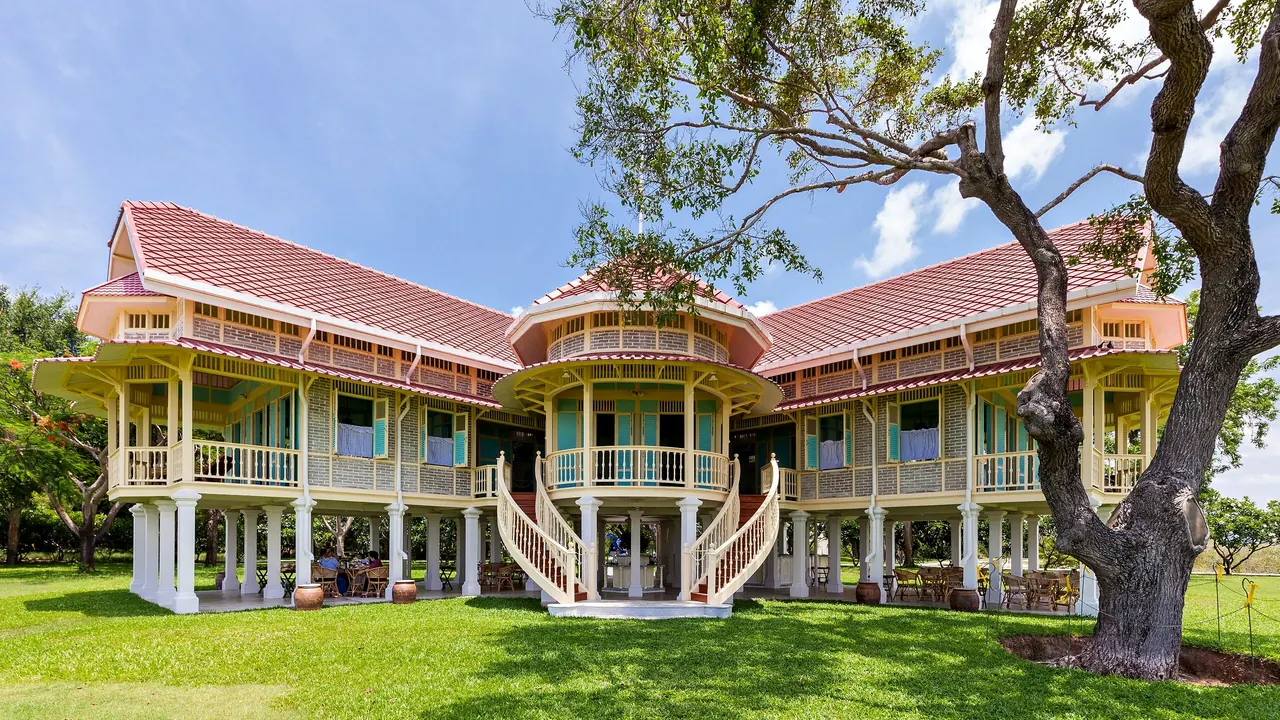
30Hua Hin grew up as a royal seaside retreat in the early twentieth century, and that history is what there is to see. The red-and-cream railway station with its royal waiting pavilion is the town's emblem. The Klai Kangwon palace, which gives the town its royal identity, is a working residence that visitors can rarely enter. The airy teak seaside palace of Maruekhathaiyawan, on the coast towards Cha-am, is the best historic building to visit. Wat Khao Takiab on its monkey-filled hill and the giant seated monk at Wat Huay Mongkol round out a short list. A day or two covers it, and there are no museums of note.
Nightlife
36Evenings centre on a few lanes in the old town around Soi Bintabaht, packed with open-fronted beer bars, sports screens and hostess bars that cater largely to older Western men. Around them are a handful of rooftop and beachfront bars for a sunset drink, and some resort lounges. It stays lively past midnight in these few blocks, but the scene is small and much of the same, and anyone after clubs or a varied night out will find little. Most visitors end the evening at a night market or their resort.
Nature & outdoors
63The landscape around Hua Hin is better than the town suggests. An hour south, Khao Sam Roi Yot National Park rises in jagged limestone peaks out of marshes and mangroves. A short boat ride and a steep climb lead to the Phraya Nakhon cave, where a royal pavilion stands in a shaft of light, and the wetlands are good for birdwatching. Inland, Kaeng Krachan, Thailand's largest national park, protects rainforest with gibbons, hornbills and wild elephants, and the Pala-U waterfall is on its southern edge.
Closer to town, the breezy months from about February to May make Hua Hin one of the country's best spots for kitesurfing. Viewpoints on Khao Hin Lek Fai and Khao Takiab give wide views over the bay. Heat keeps most outdoor activity to early mornings.
Day trips
55The best outing is Phetchaburi, about an hour north. It is an old provincial town with the hilltop palace of Phra Nakhon Khiri, the Khao Luang cave temple full of Buddha images lit from above, and some of the finest old temple murals in the country. Further north, within about two hours, the Damnoen Saduak floating market and the canal town of Amphawa, with its evening market and wooden shophouses, make a long but rewarding day. Cha-am is an easy seaside alternative close by, and there are vineyards in the hills inland. Bangkok is better treated as a separate stay than a day trip.
Good for families
68Hua Hin works well as a family beach stay. The sea is warm and gentle, many resorts have large pools, kids' clubs and gardens on the sand, and Thai staff and strangers alike are warmly welcoming to children. Two big water parks on the edge of town fill a day each, and the themed sheep farms and mock-European parks inland are popular with younger children. Pony rides on the beach and the monkeys at Khao Takiab are easy treats. The drawbacks are the midday heat, a busy main highway with few safe crossings, and pavements unsuited to pushchairs. Most families base themselves in a resort and go out by car or taxi.
Getting around
35The town is a long ribbon along the Phetkasem highway, with resorts spread over many kilometres of coast. The old centre, between the railway station, the night market and the pier, is compact enough to walk, but pavements are uneven and crossing the highway can be daunting. Green shared songthaews run up and down the main road and are the easiest way along the strip; for anything else visitors use taxis, ride-hailing, tuk-tuks or a hired scooter. The national parks, palaces and Phetchaburi are easiest with a car and driver. Trains and buses connect to Bangkok, but the journey takes a good few hours.
Shopping & style
37Shopping here means markets more than shops. The weekend art-and-craft markets on the southern side of town are the most enjoyable, with handmade jewellery, ceramics, clothing and food stalls under the trees in the evening. The central night market mainly sells T-shirts, souvenirs and copies. A couple of large modern malls cover everyday brands, cinemas and supermarkets, and tailors line the tourist streets. There is no fashion, design or luxury shopping of any depth, so it suits browsing rather than a serious shopping trip.
Affordability
80Hua Hin is very affordable by Western standards. Market meals, shared songthaews, massages and simple guesthouses cost very little, the temples are free, and mid-range hotels with pools are good value. Costs rise along the beachfront, where the big resorts and luxury retreats charge international rates, and in the restaurants and bars that cater to long-staying foreigners. Imported wine and spirits are heavily taxed. Thai weekenders push up room rates on Fridays and Saturdays and over long weekends and national festivals, so a midweek stay is usually cheaper.
Live music & performing arts
15There is very little to attend. Live music means cover bands in the bars and hotel lounges and the occasional Thai dance show staged for resort guests. The town has a long association with jazz, through a royal connection and a beach jazz festival held in some years, but there is no regular concert, theatre or classical programme. Visitors who care about performance should treat this as a beach stay and expect nothing formal in the evenings.
Wellness & relaxation
80Slowing down is what Hua Hin does best. The town has long been a place where Thais and foreigners come to rest, and it is home to some of Asia's best-known destination spas: residential retreats offering detox programmes, yoga, fitness coaching and traditional treatments in seafront gardens. Below that level, almost every resort has a spa, and Thai massage shops line the streets, from simple air-conditioned rooms to garden pavilions. Massages under the trees on the beach are part of the day for many visitors.
The pace suits it too: early swims, long lunches, afternoons by the pool and quiet evenings. What it lacks is a real bathing tradition such as hot springs or bathhouses. The wellness here is massage, spa and rest.
When should you go?
Pick a month to see what it is like. The climate figures are measured averages, not a forecast.
Hua Hin in July
Daytime high, °C
Rainfall in the month, mm
The whole year
Shaded against this city’s own year: the deepest cell is its best month for that figure and the palest its weakest.
Where the figures come from
Hua Hin's sunshine is measured 83 km from the centre, at Prachuap Khirikhan.
Temperature and rainfall are climate normals, averaged over the years shown. Hua Hin: 1961-1990 (sunshine 1981-2010, rainfall 1981-2010) normals, Hua Hin (1.8 km from centre).
Before you go
| Measure | Hua Hin |
|---|---|
| Official language | Thai |
| Currency | Baht (THB) |
| Sockets | ABCF220 V, 50 Hz |
| Driving side | Left |
| Time zone | UTC+7 |
| Emergency number | Police 191, ambulance 1669, fire 199 |
| Elevation | 9 m |
| Main airport | Suvarnabhumi Airport (BKK)150 km from centre150 non-stop destinations |
By the numbers
| Measure | Hua Hin |
|---|---|
| City population | 59,369 |
| People per km² | 687 |
| Museums within 10 km | 0 |
| UNESCO World Heritage sites within 50 km | 0 |
| Swim season, months above 21 °C | 12 months |
Compare Hua Hin with
Every comparison with a written verdict behind it.