Uruguay
Montevideo
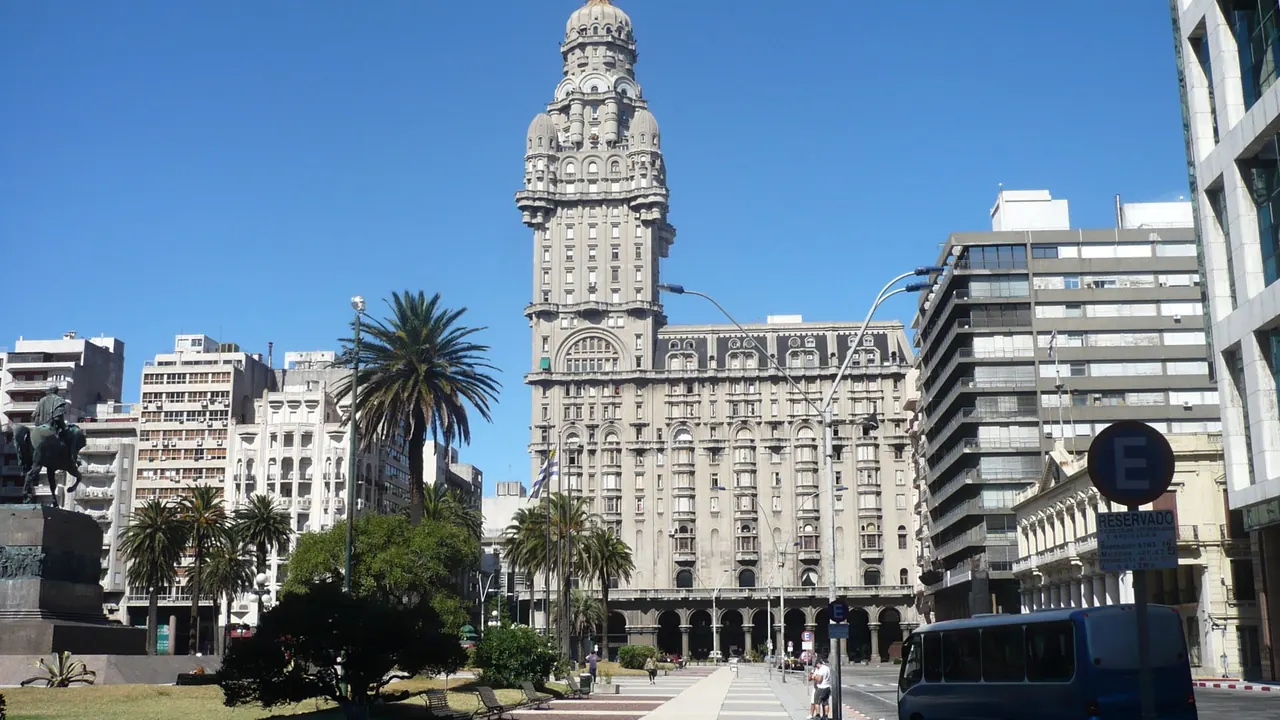
Palacio Salvo under a blue sky
- Food & drink57
- Live music & the arts57
- Beaches55
Photo: Andrés Franchi Ugart…, CC BY-SA 3.0, cropped
Match
49
Every category weighted equally
- Beach & sun48
- Culture & arts51
- Food & nightlife51
- Family trip49
- Outdoors48
- Relax & unwind47
- Shopping & style49
- On a budget48
Montevideo in twelve categories
Our verdict on each, scored 0 to 100 against the same fixed benchmark cities, so a score means the same thing on every page.
Beaches & swimming. Scores 55 out of 100.
Food & drink. Scores 57 out of 100.
Culture & sights. Scores 54 out of 100.
Nightlife. Scores 50 out of 100.
Nature & outdoors. Scores 34 out of 100.
Day trips. Scores 55 out of 100.
Good for families. Scores 55 out of 100.
Getting around. Scores 54 out of 100.
Shopping & style. Scores 36 out of 100.
Affordability. Scores 42 out of 100.
Live music & performing arts. Scores 57 out of 100.
Wellness & relaxation. Scores 38 out of 100.
Montevideo category by category
Beaches & swimming
55Montevideo faces the Río de la Plata, and a string of sandy city beaches runs along the Rambla: Ramírez and Pocitos near the centre, then Buceo, Malvín and the wider, quieter sands of Carrasco further east. In January and February, with water at about 22°C to 24°C, locals spend late afternoons here with mate and folding chairs, and beach life sets the rhythm of the summer.
The catch is that this is a wide estuary, not the open sea. The water is often brownish with silt, only mildly salty, and swimming is sometimes advised against after heavy rain or during algae blooms. For clear Atlantic water and surf beaches, travellers head east along the coast, which is a longer day out. Outside summer the beaches are for walking only.
Food & drink
57Eating in Montevideo means beef cooked over wood embers. The parrilla is the centre of the table, and the Mercado del Puerto, a 19th-century iron market hall in the Ciudad Vieja filled with smoking grills, is the classic place to try it, ideally with a glass of medio y medio, the local blend of sparkling and white wine. The chivito, a towering steak sandwich, is the national snack, and empanadas, milanesas and fainá fill the gaps.
Uruguay's red wine is Tannat, and wineries in the surrounding countryside supply it to every table. Mate is everywhere, carried in thermoses through the streets, while the old cafés of the centre serve coffee and pastries. Beyond meat and Italian-influenced dishes the range is narrow, with little street food and fewer international kitchens than a visitor might expect.
Culture & sights
54The sights cluster in the Ciudad Vieja and along Avenida 18 de Julio. Plaza Independencia is framed by the Palacio Salvo, a tall, eccentric 1920s tower, and the old citadel gate, with the neoclassical Teatro Solís a few steps away. The old town holds the cathedral, colonial houses, faded Art Deco and eclectic façades, and small museums including one devoted to the painter Joaquín Torres García, plus a moving museum on the 1972 Andes air crash.
Further out, the Palacio Legislativo is a grand marble parliament building, and the Museo Nacional de Artes Visuales in Parque Rodó and the Blanes museum show Uruguayan painting. It is a pleasant two or three days of sightseeing with character rather than landmarks of world rank, and parts of the old town feel neglected.
Nightlife
50Montevideo keeps Rioplatense hours: dinner at ten, bars filling around midnight and clubs not starting until two. Pocitos and Punta Carretas have bars and pubs on tree-lined streets, Cordón and Parque Rodó draw a younger, student crowd, and the Ciudad Vieja has a cluster of bars and late venues around Bacacay and Ciudadela streets.
The scene is relaxed and friendly rather than wild, and it is a city of around 1.3 million, so choice is limited and weeknights are quiet. In summer much of the party crowd moves east to the coastal resorts. Parts of the old town are best reached by taxi late at night.
Nature & outdoors
34The great outdoor asset is the Rambla, a waterfront promenade of more than 20km that follows the estuary shore from the port to Carrasco, used every evening for walking, running and cycling, with wide skies and sunsets over the water. Parque Rodó, Parque Batlle and the Prado add old trees and gardens, and the Cerro de Montevideo, a low hill across the bay, gives a view back over the city.
Beyond that the land is flat and farmed. The nearest hills are the modest sierras around Piriápolis and Minas, about an hour and a half away, good for gentle walks rather than real hiking. Kitesurfing and windsurfing work on windy days along the estuary, but anyone after mountains or wilderness will find little here.
Day trips
55The essential day trip is Colonia del Sacramento, a UNESCO-listed Portuguese colonial town of cobbled lanes, a lighthouse and riverside sunsets, roughly two and a half hours west by bus. East along the coast, Piriápolis is an old-fashioned seaside town with a grand early 20th-century hotel and hills behind it, and Punta del Este, the country's glamorous resort, lies about two hours away, with the hand sculpture on its beach and Casapueblo, the white cliffside building of Carlos Páez Vilaró, nearby.
Closer in, the Canelones wine country is under an hour away, with family wineries offering Tannat tastings, and the small town of Atlántida makes an easy coastal outing. It is a pleasant mix, though the best stops sit at the edge of an easy day.
Good for families
55Montevideo is an easy, unhurried city with children. Uruguayans take kids everywhere, including to late dinners, and the Rambla is ideal for scooters, bikes and long walks with stops on the city beaches, where the estuary water is shallow and calm. Parque Rodó has a small, old-fashioned amusement park and a lake with pedal boats, and the city's parks are full of playgrounds.
What it lacks is anything big made for children: there is no major aquarium, science museum or theme park, so a family stay leans on outdoor time and the beaches in summer. Traffic is manageable, distances are moderate and the pace is gentle.
Getting around
54Montevideo has no metro or tram, so public transport means buses. The network covers the city thoroughly and a rechargeable card works on every line, but routes are confusing to a newcomer and journeys are slow at busy times. Taxis and ride-hailing are easy and widely used by visitors.
The Ciudad Vieja and the centre along Avenida 18 de Julio are flat and walkable, and the Rambla makes cycling or walking between the coastal neighbourhoods pleasant. The city is long and stretched along the shore, though, so getting from the old town to Pocitos or Carrasco usually means a bus or a cab. A car is unnecessary in the city but handy for the coast and countryside.
Shopping & style
36Shopping is modest. The Sunday street market on Tristán Narvaja in Cordón is the one to see, a long sprawl of antiques, books, old records, mate gourds and bric-à-brac. Uruguayan specialities are leather goods, hand-knitted wool garments, silver-trimmed mate cups and gaucho knives, found in craft shops in the Ciudad Vieja and along 18 de Julio.
For everything else, locals go to large shopping malls in Punta Carretas, a converted former prison, and Pocitos. There is no luxury street to speak of, and imported fashion and electronics are expensive, so most visitors shop for crafts and leave it there.
Affordability
42Montevideo surprises travellers who expect South American prices. Restaurants, hotels and supermarket goods cost roughly what they would in Southern Europe, and imported items such as electronics, clothing and spirits are noticeably dearer. Hotels in Pocitos and Punta Carretas are priced like a European capital in summer.
Some things soften the bill: city buses are cheap, many museums are free, a set lunch menu is good value, and a grilled steak with local wine costs less than the same meal in most Western cities. It is a mid-priced city overall, not a budget one.
Live music & performing arts
57Montevideo's most distinctive live tradition is Carnaval, one of the longest anywhere, stretching over more than a month of the southern summer. Murga troupes perform satirical choral theatre on neighbourhood stages called tablados, and candombe drumming, rooted in the Afro-Uruguayan communities of Barrio Sur and Palermo, fills the streets for the Llamadas parades. Drum groups also practise in these neighbourhoods on weekend evenings through much of the year, and passers-by are welcome to follow along.
The Teatro Solís, a grand 19th-century neoclassical house on Plaza Independencia, hosts opera, theatre and the city's philharmonic, while the SODRE's modern auditorium is home to the national ballet and symphony orchestra. Tango belongs to both shores of this estuary, and milongas and tango shows run all year, alongside a small independent theatre scene in the centre. Outside summer the programme is modest in size.
Wellness & relaxation
38Montevideo has no bathing or spa tradition of its own; massages and spa treatments are mostly found in upmarket hotels. Uruguay's thermal springs lie in the far north of the country, much too far for a day out.
What the city does have is a slow pace. People sit on the Rambla walls at sunset passing mate around, cafés are unhurried and even the centre feels unpressured. Travellers looking for treatments will be disappointed, but those wanting a quiet, low-stress city stay will find it restful.
When should you go?
Pick a month to see what it is like. The climate figures are measured averages, not a forecast.
Montevideo in July
Daytime high, °C
Rainfall in the month, mm
The whole year
Shaded against this city’s own year: the deepest cell is its best month for that figure and the palest its weakest.
Temperature and rainfall are climate normals, averaged over the years shown. Montevideo: 1991-2020 normals, Carrasco (19.2 km from centre).
Before you go
| Measure | Montevideo |
|---|---|
| Currency | Peso Uruguayo (UYU) |
| Sockets | CFIL230 V, 50 Hz |
| Driving side | Right |
| Time zone | UTC-3 |
| Emergency number | 911 |
| Elevation | 41 m |
| Main airport | Carrasco General Cesáreo L. Berisso International Airport (MVD)17 km from centre15 non-stop destinations |
| Public holidays this year | 15 days |
By the numbers
| Measure | Montevideo |
|---|---|
| City population | 1,302,954 |
| People per km² | 1,785 |
| Museums within 10 km | 36 |
| UNESCO World Heritage sites within 50 km | 1 |
| Swim season, months above 21 °C | 4 months |
Compare Montevideo with
Every comparison with a written verdict behind it.