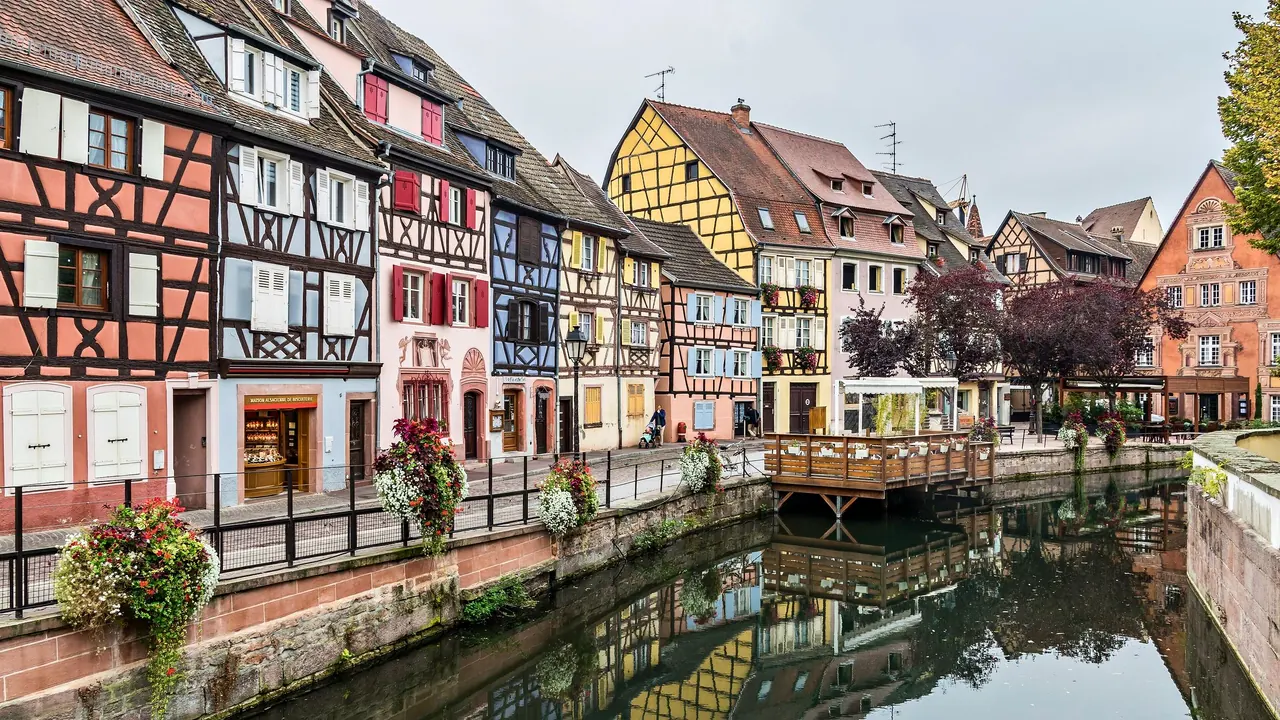
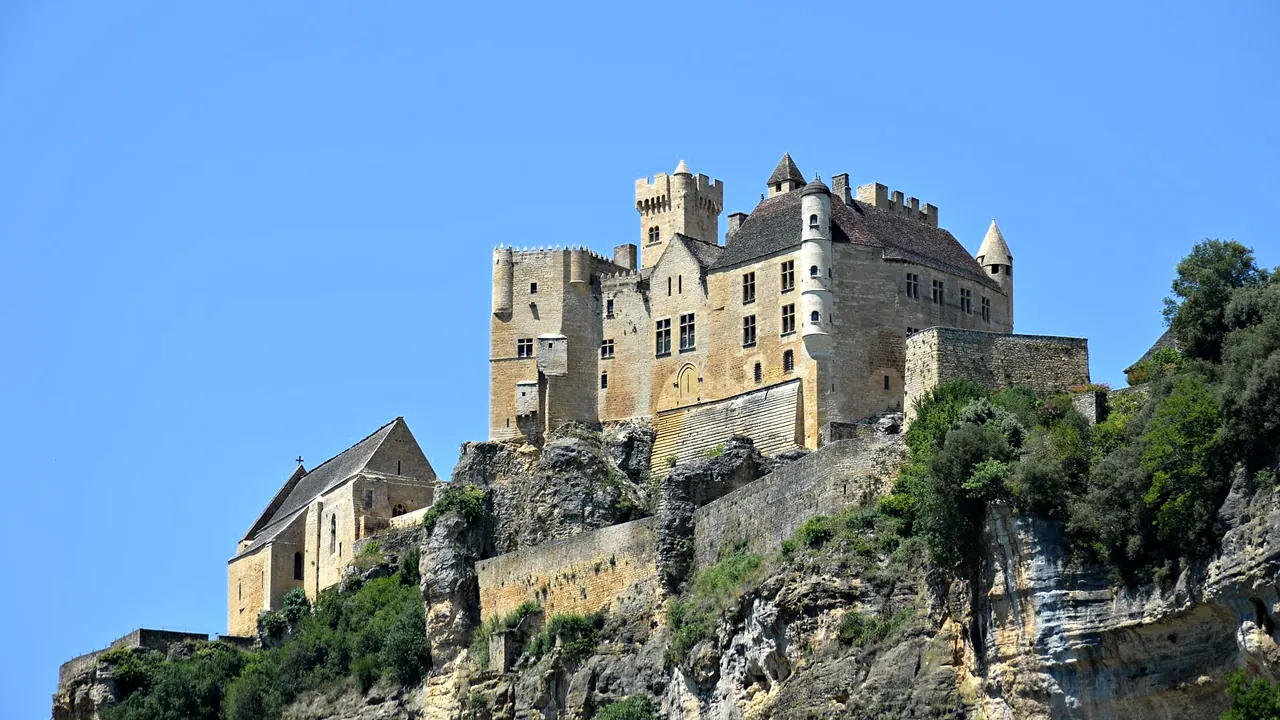
Photos: Alsace by Krzysztof Golik, CC BY-SA 4.0, cropped; Dordogne by Edouard CHASSAIGNE, Pexels License.
Alsace or Dordogne?
Our verdict in twelve categories, each scored against the same fixed benchmark cities, and the climate month by month, so you can choose for your trip.
Choose Alsace for
- live music and the arts
- nightlife
- getting around
Alsace suits travellers who want a region with a city in it. Strasbourg gives you a cathedral, museums, opera and an evening out, and the wine villages along the foot of the Vosges are a short train ride or drive away. It works for families with children of any age, for walkers heading up into the Vosges, and for anyone who likes the idea of crossing the Rhine for a day in Germany or Switzerland. Spas and December's Christmas markets make it a destination outside summer too.
Choose Dordogne for
- beaches
- prices
The Dordogne is the better pick for a slow rural summer built around a rented stone house, a pool and the river. Its pull is the prehistoric caves of the Vézère, castles facing each other across the water, canoeing below the cliffs and long market mornings in Sarlat. You will need a car the whole time, the evenings are quiet and there is little to do indoors, but for unhurried countryside with deep history it has a character Alsace cannot match.
Scoreboard
Twelve categories on one fixed scale from 0 to 100. The shaded stretch is the gap between the two.
Your match
Pick a travel style or drag the sliders, and both match scores follow your weighting.
Wins on live music and the arts and nightlife with your weighting.
Wins on beaches and prices with your weighting.
What matters to you?
Category by category
What the scores mean for a trip.
Beaches & swimming
Neither region is a place for a beach, being far from any sea. Alsace has the least to offer. Its swimming is in flooded gravel pits on the Rhine plain, a few cold lakes up in the Vosges and the town pools, good for a hot afternoon and nothing more.
The Dordogne gives swimmers rather more. Gravel banks below Beynac, La Roque-Gageac and Saint-Léon-sur-Vézère let you swim in the river between passing canoes, and lakes such as Rouffiac have supervised sandy shores. After rain the rivers run high and brown, though, so many visitors end up at their rented house's pool.
Food & drink
Both are serious eating regions, but Alsace has more range. The winstub serves choucroute, baeckeoffe and flammekueche. The Route des Vins lets you taste Riesling, Gewurztraminer and crémant at the growers' cellars, there is a strong beer culture, and starred restaurants are spread through the wine villages as well as Strasbourg.
The Dordogne's table is richer in one direction: duck and goose confit, foie gras, cèpes, walnuts and winter truffles from the Périgord Noir, with Bergerac and sweet Monbazillac to drink. Its markets are better than anything in Alsace, especially Sarlat's on Saturday. After a week of duck, though, the narrow repertoire starts to show.
Culture & sights
They are equally strong but in different ways. Alsace's heritage is urban and artistic. It has Strasbourg's sandstone cathedral and astronomical clock on a UNESCO-listed island, the Isenheim Altarpiece in Colmar, Haut-Koenigsbourg on its hill and Mulhouse's national museums, so a few days go on churches, galleries and old quarters.
The Dordogne's heritage lies in the landscape. The Vézère valley holds painted caves, rock shelters and cliff dwellings, and the Dordogne river is lined with castles such as Beynac and Castelnaud. Sarlat's golden-stone old town and bastides like Monpazier complete the picture. It is the place for prehistory and medieval castles rather than great art collections.
Nightlife
Alsace has the only real nightlife of the two, and it is all in Strasbourg. Students fill the beer and wine bars of Krutenau, the quays are lively on summer evenings and there are a few clubs. Nights are still early by city standards.
In the Dordogne a night out means dinner on a terrace and then quiet. The highlights are summer night markets and village fêtes with communal tables and dancing in the square.
Nature & outdoors
Alsace has the more varied outdoors, because it has real hills. The Vosges climb to the Grand Ballon at 1,424m, the Route des Crêtes runs along high pastures with views to the Black Forest, and the GR5 and dense waymarked trails make it good walking country. There is easy cycling on the plain and some modest skiing in winter.
The Dordogne is lower and softer, river country of limestone cliffs, oak woods and walnut orchards. It is best seen from a canoe drifting past the castles or from Marqueyssac's gardens above the valley. It suits paddlers and easy walkers more than anyone looking for hills.
Day trips
With Germany and Switzerland on its doorstep, Alsace gives you the wider range of outings. Wine villages lie a few kilometres apart and the main towns share a railway line, while Basel, Freiburg, Baden-Baden and even Heidelberg make easy days out. Nancy's Place Stanislas is a train ride to the west.
The Dordogne's outings are rural, and nearly all of them need a car. Domme on its cliff, Rocamadour about an hour from Sarlat, Saint-Cirq-Lapopie in the Lot valley and Saint-Émilion to the west are all fine trips, and Bordeaux is possible for a long day.
Good for families
Alsace is easier with children, and particularly with young ones. Europa-Park is within an hour, and near Ribeauvillé there are free-roaming macaques, falconry shows and a stork park. Mulhouse has its train and car museums and a zoo, and Strasbourg has a science centre and boat trips through Petite France.
The Dordogne works best for children aged eight to fourteen, who can canoe, try on armour at Castelnaud and explore prehistoric sites. Long drives, summer heat and steep troglodyte steps make it harder with toddlers and pushchairs.
Getting around
Alsace is far easier without a car. Frequent trains link Strasbourg, Sélestat, Colmar and Mulhouse, and Strasbourg has trams and one of France's best cycle networks. You only really need a car for the wine route and the Vosges crests.
In the Dordogne you need a car from the first day. Buses are sparse and the sights are scattered across the countryside. In July and August the riverside road through La Roque-Gageac jams, and parking fills early at Sarlat on market day.
Shopping & style
Alsace offers more to buy. Strasbourg has proper shopping streets around Place Kléber, and the region has distinctive crafts in Betschdorf stoneware, Soufflenheim baking moulds and kelsch linen. In December, the Christmas markets make shopping a reason to visit.
In the Dordogne, shopping means loading the car with foie gras, confit, walnut oil and Bergerac wine from the markets at Sarlat, Issigeac and Ribérac. Summer brocantes add some interest, but there is no fashion shopping.
Affordability
Costs are broadly similar, but they peak at different times. In Alsace, Strasbourg hotels charge city rates and get scarce and expensive during the Christmas markets and Parliament sessions. Village guesthouses are kinder on the budget, as are winstub portions and wine bought from the growers.
In the Dordogne, rented houses with pools near Sarlat cost the most in July and August, and cave, castle and canoe fees add up for a family. June and September cost noticeably less, and campsites and set lunches keep spending modest.
Live music & performing arts
The real difference is between a year-round season and a summer one. In Strasbourg, the Opéra national du Rhin, the Philharmonic and the Théâtre National de Strasbourg run full programmes, and autumn brings festivals of jazz and contemporary music. Outside the city there is much less.
The Dordogne's stages come alive in July and August. Sarlat's theatre festival, Périgueux's mime and street-theatre festival and classical concerts in Romanesque churches are the highlights. For the rest of the year there is almost nothing, and there is no opera or orchestra.
Wellness & relaxation
Thermal water is what separates them. In the north of Alsace, Niederbronn-les-Bains and Morsbronn have spa complexes built on their springs, many vineyard and valley hotels have spas of their own, and the baths of Baden-Baden are an easy crossing away.
The Dordogne relaxes you through its pace rather than its spas: a farmhouse pool, long lunches and quiet riverside evenings. This works best in the Périgord Vert and in late spring or September, because the August crowds around Sarlat spoil it.
When should you go?
Pick your month. The climate figures are measured averages, not a forecast.
Alsace in July
Dordogne in July
Daytime high, °C
Rainfall in the month, mm
Temperature and rainfall are climate normals, averaged over the years shown. Alsace: 1991-2020 normals, Ihringen (20.8 km from centre). Dordogne: 1991-2020 normals, Gourdon (21.2 km from centre).
Both regions have their warmest months in July and August, but the Dordogne is a little warmer and noticeably sunnier through most of the year, reaching 28°C in high summer against about 27°C in Alsace. Alsace has the sharper continental swing. Its winters are cold and grey, around 6°C with very little sun in December, while the Dordogne stays milder at about 10°C. Alsace is wettest in late spring and summer, with May the peak at 87mm, so pack for thundery showers in June and July. In the Dordogne the rain is spread more evenly through the year, with drier summers and damper winters.
For swimming in lakes or rivers, late June to the end of August works in both, and the Dordogne holds on into early September. For walking village streets and vineyards, May, June and September are the most comfortable months in both regions, and the Dordogne also stays pleasant well into October. Winter weather is against Alsace, though December has the Christmas markets. In the Dordogne, the midsummer heat makes castle steps and cliff paths hard going in the middle of the day.
Which traveller are you?
On a beach and sun trip, neither region gives you a real beach, and Alsace's lakes only cool a hot afternoon. For inland sun, choose the Dordogne in July or August, book a house with a pool and treat river swims as a bonus.
On a family trip with young children, Alsace has more for them: Europa-Park, the free-roaming macaques near Kintzheim, and Mulhouse's railway museum and zoo. Hire a car, though the drives are short. The Dordogne's caves and canoes suit older children better.
For travellers drawn by prehistory and cave art, the Dordogne has something Alsace cannot offer. In the Vézère valley you can see the Lascaux replica, the painted cave of Font-de-Gaume and the National Museum of Prehistory at Les Eyzies. Book the original caves well ahead.
Before you go
| Measure | Alsace | Dordogne |
|---|---|---|
| Official language | French | French |
| Currency | Euro (EUR) | Euro (EUR) |
| Sockets | CE230 V, 50 Hz | CE230 V, 50 Hz |
| Driving side | Right | Right |
| Time zone | UTC+1, UTC+2 in summer | UTC+1, UTC+2 in summer |
| Emergency number | 112 | 112 |
| Main airport | Strasbourg Airport (SXB)43 non-stop destinations | Bergerac Dordogne-Périgord airport (EGC)9 non-stop destinations |
| Public holidays this year | 11 days | 11 days |
By the numbers
| Measure | Alsace | Dordogne |
|---|---|---|
| Population | - | 417,614 |
| People per km² | - | 46 |
Where else could you go?
Every comparison below shares a destination with this one, so you can follow Alsace or Dordogne somewhere new.
- Black Forestvs Alsace
- Swiss Alpsvs Alsace
- Burgundyvs Alsace
- French Alpsvs Alsace
- Lake Maggiorevs Alsace
- Lake Comovs Alsace