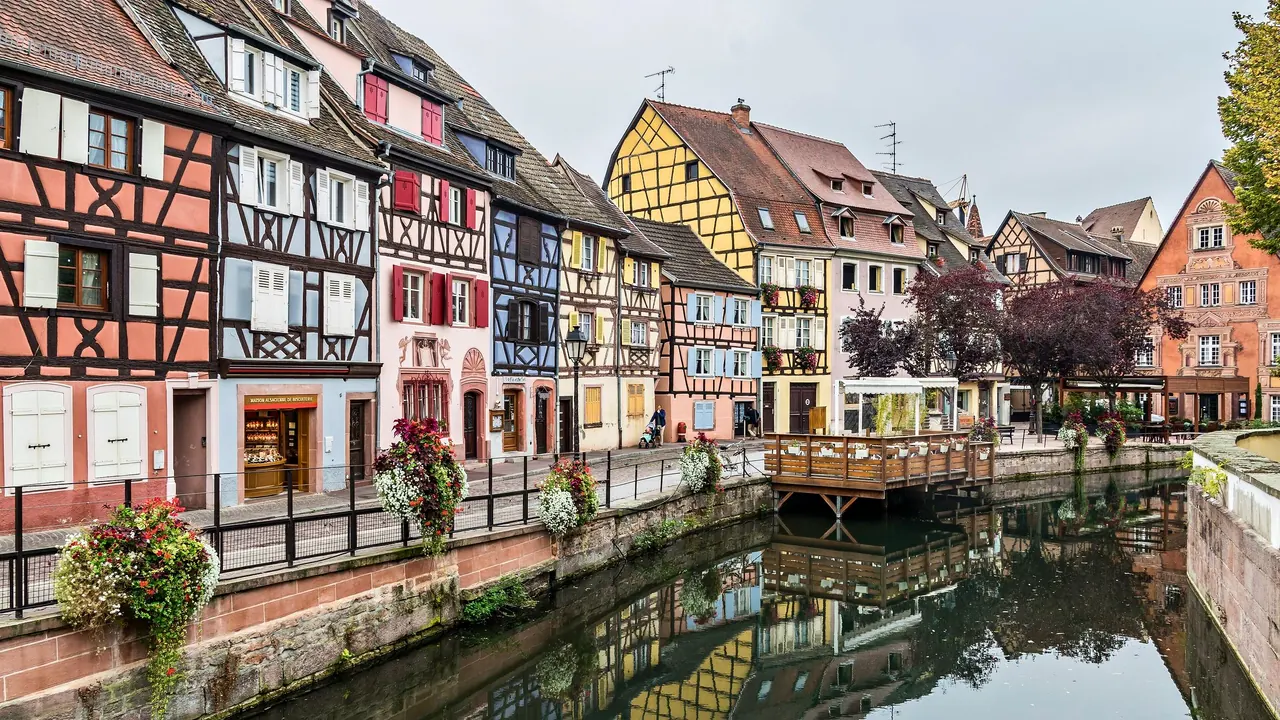
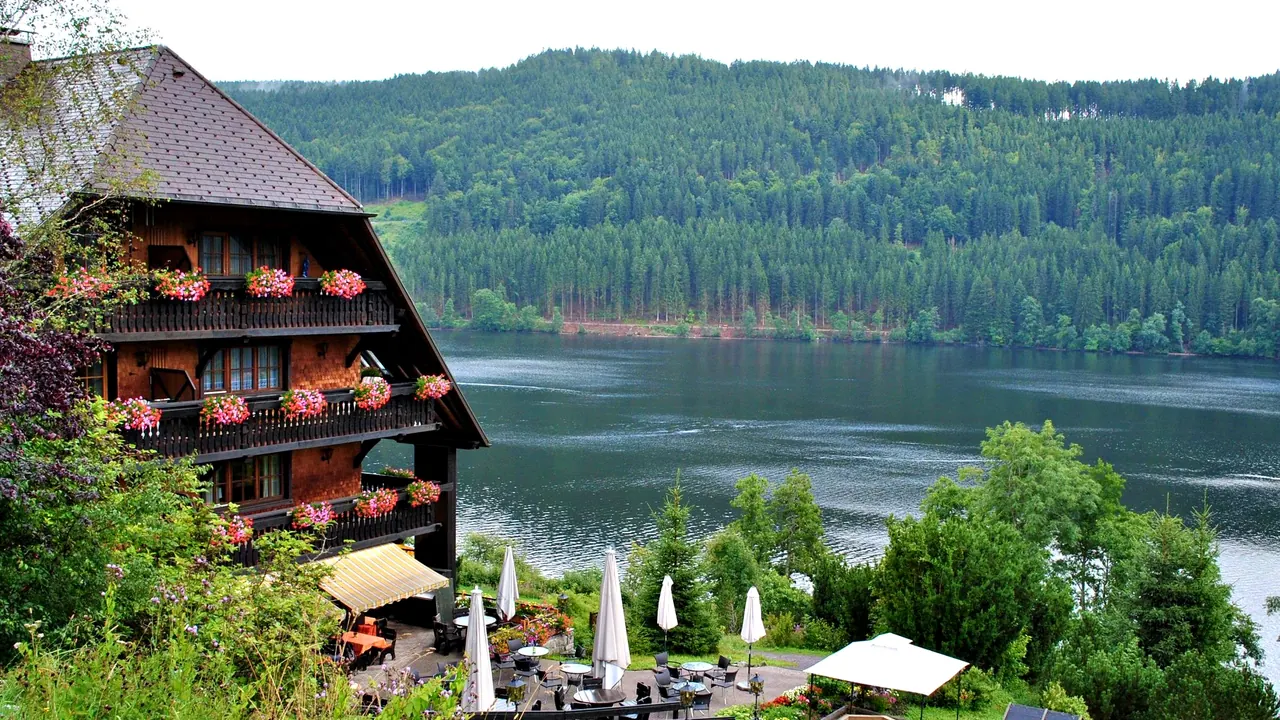
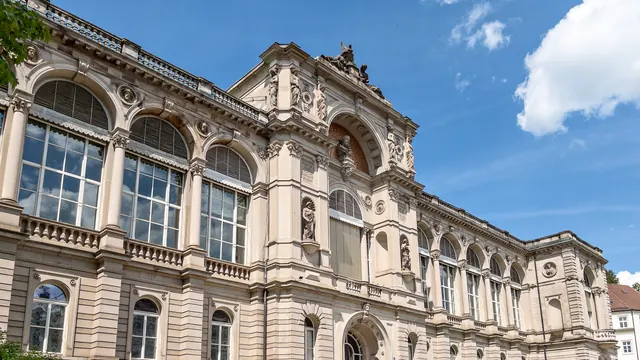
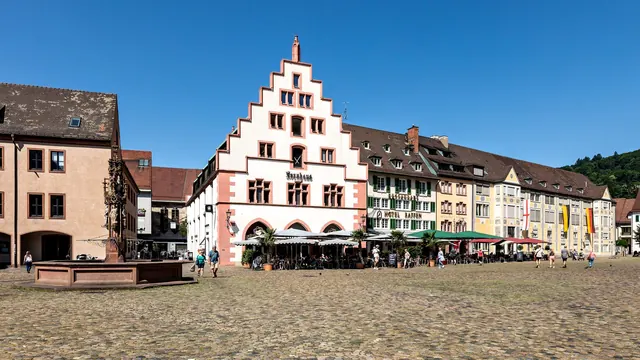
Photos: Alsace by Krzysztof Golik, CC BY-SA 4.0, cropped; Black Forest by Ignaz Wiradi, CC BY-SA 3.0, cropped.
Alsace or Black Forest?
Our verdict in twelve categories, each scored against the same fixed benchmark cities, and the climate month by month, so you can choose for your trip.
Choose Alsace for
- culture and sights
- shopping
- getting around
Alsace suits travellers who want towns, wine and a good table. Strasbourg's cathedral island and Colmar's Isenheim Altarpiece give it far more culture than the forest across the Rhine. The wine villages lie a few kilometres apart along the foot of the Vosges, and trains down the plain mean you can see a lot with little driving. It is the better choice for couples and friends who want to eat well, look at things and end the evening in a winstub.
Choose Black Forest for
- wellness
- beaches
- nature and the outdoors
If rest and walking come first, the Black Forest is the better pick. Baden-Baden's baths and the ring of smaller spa towns make it a true spa destination. The Feldberg, the Westweg and the gorges also give longer, wilder hiking than the Vosges. You give up some culture, shopping and ease of transport, but Strasbourg and Colmar are within an hour's reach anyway.
Scoreboard
Twelve categories on one fixed scale from 0 to 100. The shaded stretch is the gap between the two.
Your match
Pick a travel style or drag the sliders, and both match scores follow your weighting.
Too close to call, level with your weighting
Wins on culture and sights and shopping with your weighting.
Wins on wellness and beaches with your weighting.
What matters to you?
Category by category
What the scores mean for a trip.
Beaches & swimming
Neither region is a swimming destination, but the Black Forest at least has proper lakes. Titisee and Schluchsee have bathing areas, small beaches and boat hire, so a swim after a hike is easy to fit in.
Alsace has flooded gravel pits on the Rhine plain, a few cool Vosges reservoirs and the town pools. They are fine for cooling off in July, but there is less to them.
Food & drink
The two share a border kitchen, so flammekueche turns up on both banks of the Rhine, but Alsace has the richer table. Food and wine are the heart of a stay there: winstubs serving choucroute and baeckeoffe, bakeries full of kougelhopf, and the 170km wine road where you taste Riesling, Gewurztraminer and crémant at the grower's door.
The Black Forest answers with smoked ham, trout, its cherry cake, Kirschwasser from small distilleries, Kaiserstuhl Pinot Noir and the cluster of top restaurants in Baiersbronn. It eats very well, but the good places are more spread out, and food is less of a reason in itself to go.
Culture & sights
Here Alsace is well ahead. Strasbourg alone has more than anything across the river: the cathedral with its astronomical clock, the UNESCO-listed island and Neustadt, Petite France and the Palais Rohan museums. Colmar's Isenheim Altarpiece, Haut-Koenigsbourg castle and the big car and railway museums in Mulhouse add more.
The Black Forest's heritage is scattered and smaller in scale. Its main pieces are Freiburg's Minster and car-free old town, Baden-Baden's spa quarter, Maulbronn monastery and half-timbered towns such as Gengenbach and Schiltach. Its most distinctive sights explain country life, at the Vogtsbauernhof open-air museum and the clock museum in Furtwangen.
Nightlife
Going out in either region mostly means one university city, and Alsace's is the bigger of the two. Strasbourg has beer and wine bars in the student quarter of Krutenau and around the cathedral, a few late cocktail bars and clubs, and quays that fill up on summer evenings. Colmar and Mulhouse have a handful of bars, and in the wine villages the night ends over a bottle at the winstub.
The Black Forest's version is Freiburg, on the south-western edge of the forest. Its student pubs, wine bars and few clubs keep the old town lively on weekends in term time, and its beer gardens are busy in summer. Beyond Freiburg the forest goes quiet after dinner, and Baden-Baden's casino and a few elegant bars are the only other choice.
Nature & outdoors
The Vosges and the Black Forest face each other as mirror ranges across the Rhine plain, but the forest is the bigger walking destination. It climbs higher at the Feldberg and has the Westweg running its full length. It adds a national park of moorland around the Schliffkopf, real gorges in the Wutach and Ravenna valleys, and strong mountain biking around Todtnau.
The Vosges are gentler. Their pleasures are the Route des Crêtes, the GR5, ruined castles on the spurs, walks through the vineyards and easy cycling on the plain. Both regions have small-scale winter skiing.
Day trips
Each region is the other's best day trip, and both make excellent bases. From Alsace, the wine villages can be strung three or four to a day, with Basel, Freiburg and Baden-Baden just over the border. From the Black Forest, Strasbourg's Petite France and the villages around Colmar are about an hour away.
The difference is in the outer ring. Alsace reaches west to Nancy's Place Stanislas. The forest reaches south-east to Lake Constance, the monastery island of Reichenau and the Rhine Falls, and north to Speyer's cathedral and Karlsruhe's palace.
Good for families
Both regions are easy and safe with children, and they share Europa-Park, which sits at Rust on the German bank within an hour of Strasbourg or Colmar. Alsace adds animals and museums: macaques and eagle shows near Kintzheim, the Mulhouse zoo and railway museum, and village life at the Ungersheim ecomuseum.
The Black Forest leans outdoors, with summer toboggan runs, treetop walks, cable cars up the Feldberg, pedal boats on Titisee and farm stays. In both regions you will need a car for much of it.
Getting around
Alsace is easier without a car. Frequent trains run down the plain between Strasbourg, Sélestat, Colmar and Mulhouse, and Strasbourg has trams and one of France's best cycle networks. You only really need a car for the wine villages and the Route des Crêtes.
In the Black Forest, the hills break up the network. The Rhine valley line and the scenic Schwarzwaldbahn and Höllentalbahn work well, and the free transport cards many hosts give out help. But buses to villages and trailheads are sparse, and the winding mountain roads are slow.
Shopping & style
Alsace has more to buy. Strasbourg's streets around Place Kléber give it a wider choice than Freiburg's old town. Its crafts run from Betschdorf stoneware and Soufflenheim baking moulds to kelsch linen. In December its Christmas markets, which Strasbourg has held since the sixteenth century, make shopping the point of the visit.
The Black Forest's signature buy is the cuckoo clock from the workshops around Triberg, with wood carvings, blown glass and fruit brandy alongside. Its one edge is Baden-Baden's small quarter of upmarket fashion and jewellery shops, the kind of luxury Alsace mostly lacks.
Affordability
Costs are much the same on both banks of the Rhine, and in both regions the savings are in the countryside. In Alsace that means chambres d'hôtes, flats in the wine villages and wine bought straight from the growers. Strasbourg's hotels get scarce and dear in December and during European Parliament sessions.
The Black Forest's farm stays and inns are similarly reasonable, and the free transport cards can save on a hire car. Its expensive end is Baden-Baden, the famous restaurants of the north and a family's tickets for Europa-Park and the baths.
Live music & performing arts
Both regions offer serious classical music, but in different forms. Alsace spreads it across a full season: the Opéra national du Rhin, the Strasbourg Philharmonic and the Théâtre National de Strasbourg mean a good evening most weeks, with jazz and contemporary music festivals in the autumn.
The Black Forest's music centres on Baden-Baden's Festspielhaus, which brings in international orchestras and ballet and peaks with its Easter festival. Freiburg's theatre and baroque ensemble fill in the rest. In the villages, Alsace has its choirs and the forest has the masked Fastnacht processions before Lent.
Wellness & relaxation
This is where the two differ most. The Black Forest is spa country through and through: the Friedrichsbad and Caracalla baths in Baden-Baden, then Badenweiler, Bad Wildbad and Bad Krozingen. Add hotel saunas, forest bathing trails and a slow pace built around walks and long dinners.
Alsace has quieter thermal waters at Niederbronn-les-Bains and Morsbronn, and spa hotels among the vines. Its calm comes mostly from slow days in a wine village. For serious bathing, visitors to Alsace cross the Rhine to Baden-Baden.
When should you go?
Pick your month. The climate figures are measured averages, not a forecast.
Alsace in July
Black Forest in July
Daytime high, °C
Rainfall in the month, mm
Temperature and rainfall are climate normals, averaged over the years shown. Alsace: 1991-2020 normals, Ihringen (20.8 km from centre). Black Forest: 1991-2020 normals, Freiburg (0.6 km from centre).
The two regions face each other across the Rhine and have almost the same calendar. July and August are the warmest months, with highs around 27°C and the longest, sunniest days. That is warm enough for an afternoon swim in a lake and still fine for walking. May, June and September are the most comfortable months for the wine villages and the forest trails. In winter, highs stay near 6°C: cold, but fine for the Christmas markets.
The real difference is rain. Alsace, sheltered by the Vosges, is noticeably drier all year, with January at around 32mm. In the Black Forest, where most visitors stay, every month is wetter, and rain peaks in May at about 103mm. Both get much the same sunshine, brightest from June to August and dim from November to January.
Which traveller are you?
For a culture and arts trip, Alsace packs more into less travel. Strasbourg and Colmar each fill days of sightseeing and lie half an hour apart by train, and the walled wine villages are sights in their own right. The forest's heritage comes in smaller, scattered pieces.
On a relaxing and wellness trip, the Black Forest lets the baths set the pace. You can stay in a spa town, soak in the mornings and walk the parks or the forest in the afternoons. In Alsace, rest comes from the slow life of a wine village more than from the waters.
For an outdoors trip, the Black Forest makes walking the main event, with full days in higher, wilder country and routes that take several days. In Alsace, walks in the Vosges and cycling on the Rhine plain fit in between tastings and village visits rather than filling the week.
Before you go
| Measure | Alsace | Black Forest |
|---|---|---|
| Official language | French | German |
| Currency | Euro (EUR) | Euro (EUR) |
| Sockets | CE230 V, 50 Hz | CF230 V, 50 Hz |
| Driving side | Right | Right |
| Time zone | UTC+1, UTC+2 in summer | UTC+1, UTC+2 in summer |
| Emergency number | 112 | 112 |
| Main airport | Strasbourg Airport (SXB)43 non-stop destinations | EuroAirport Basel–Mulhouse–Freiburg (BSL)112 non-stop destinations |
| Public holidays this year | 11 days | 12 days |
Where else could you go?
Every comparison below shares a destination with this one, so you can follow Alsace or Black Forest somewhere new.
- Swiss Alpsvs Black Forest
- Swiss Alpsvs Alsace
- Burgundyvs Alsace
- Lake Maggiorevs Black Forest
- French Alpsvs Black Forest
- French Alpsvs Alsace