Germany
Freiburg
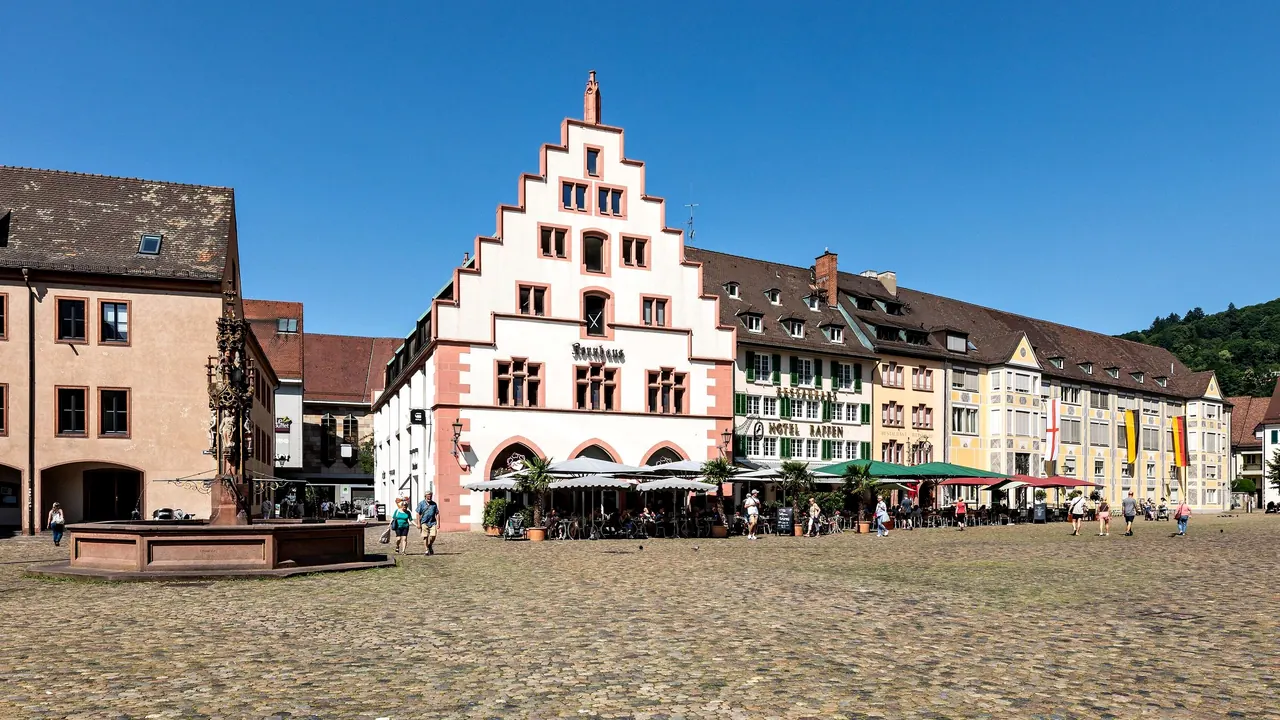
The Münsterplatz with the red Kornhaus
- Nature & outdoors81
- Getting around80
- Day trips78
Photo: Dietmar Rabich, CC BY-SA 4.0, cropped
Match
56
Every category weighted equally
- Beach & sun53
- Culture & arts58
- Food & nightlife53
- Family trip59
- Outdoors62
- Relax & unwind56
- Shopping & style55
- On a budget55
Freiburg in twelve categories
Our verdict on each, scored 0 to 100 against the same fixed benchmark cities, so a score means the same thing on every page.
Beaches & swimming. Scores 18 out of 100.
Food & drink. Scores 58 out of 100.
Culture & sights. Scores 55 out of 100.
Nightlife. Scores 40 out of 100.
Nature & outdoors. Scores 81 out of 100.
Day trips. Scores 78 out of 100.
Good for families. Scores 76 out of 100.
Getting around. Scores 80 out of 100.
Shopping & style. Scores 38 out of 100.
Affordability. Scores 42 out of 100.
Live music & performing arts. Scores 45 out of 100.
Wellness & relaxation. Scores 63 out of 100.
Freiburg category by category
Beaches & swimming
18Freiburg is far from any sea, so swimming here means lakes and outdoor pools. On hot summer days locals cycle to the flooded gravel pits on the Rhine plain west of the city, where the water gets pleasantly warm and the shores are grassy rather than sandy. In the Black Forest, Titisee and Schluchsee are about an hour away and make a scenic swim, though the water stays cool. The city's open-air pools fill up in July and August. Pleasant for a cooling dip, but nobody comes here for beach life.
Food & drink
58Freiburg eats in the Baden style, with French influence, more delicate than much of German cooking. Look for Flammkuchen, Schäufele with potato salad, Black Forest ham, trout from mountain streams and asparagus in spring, all washed down with dry Pinot Noir and Pinot Gris from the Kaiserstuhl and Markgräflerland just outside town. The farmers' market around the Münster runs every morning except Sunday, and its stalls selling a long grilled sausage in a bread roll are a local ritual.
The old town has wood-panelled taverns, wine bars and cafés serving proper Black Forest gateau, and the surrounding region has some of Germany's best fine dining. The international range is limited, however, and away from the market and the taverns the choice soon begins to repeat itself.
Culture & sights
55The city's centrepiece is the red sandstone Münster, a Gothic cathedral whose open-lace tower dominates the old town and can be climbed for views to the Black Forest. Around it, the historic market square holds the oxblood-red Historisches Kaufhaus, and the medieval Martinstor and Schwabentor gates frame streets lined with the Bächle, small stone channels of running water that are Freiburg's signature.
Much of the centre was carefully rebuilt after wartime bombing, so it feels historic rather than truly old. The Augustinermuseum, in a former monastery, holds fine medieval sculpture and painting, and the university quarter and the old town hall square fill out a compact, rewarding day or two. There is little beyond that.
Nightlife
40With tens of thousands of students in a city of about 230,000, Freiburg has a livelier evening than its size suggests. The lanes of the old town around the Martinstor fill with student pubs, wine bars and beer gardens, and in summer people gather on the squares and along the Dreisam river until late. A handful of clubs cover techno, indie and student nights. It is a friendly, relaxed night out rather than a destination in itself, and term-time is noticeably livelier than the semester break.
Nature & outdoors
81The Black Forest starts at the edge of town. The Schlossberg rises right behind the old town, and a cable car from the southern suburbs climbs to the Schauinsland at about 1,280m, with trails along the ridge and views to the Alps on clear days. The Feldberg, the highest peak in the region at about 1,490m, is about an hour away for summer hiking and winter skiing and snowshoeing, and gorges such as the Ravenna valley make fine day walks.
To the west, the volcanic vineyard hills of the Kaiserstuhl offer gentle cycling among terraces, and the Rhine plain is flat and laced with bike paths. Mountain biking is excellent. The mild, sunny climate makes spring and autumn ideal, and winters bring reliable snow on the higher slopes.
Day trips
78Freiburg sits in the corner where Germany, France and Switzerland meet, and that is its great advantage. Basel, with its art museums and Rhine-side old town, is about 45 minutes by train. Across the Rhine, Colmar and the half-timbered wine villages of Alsace, such as Riquewihr and Eguisheim, are about an hour by car, and Strasbourg with its cathedral and Petite France quarter is roughly an hour and a half away.
Closer to home there is Breisach with its hilltop minster, the Renaissance wine town of Staufen, the abbey of St. Peter in the hills and the wine villages of the Kaiserstuhl and Markgräflerland. The elegant spa town of Baden-Baden is about an hour north by fast train. For variety in a small radius, few German cities do better.
Good for families
76Freiburg is an easy, safe city to manage with children: small, green, flat in the centre and full of families on bikes. Kids love dangling their feet in the Bächle channels and chasing toy boats along them. The Mundenhof animal park on the western edge is free and wide open, and the Schauinsland cable car makes an exciting ride up the mountain.
The big draw is Europa-Park at Rust, Germany's largest theme park and resort, about 40 minutes north. Add summer swimming lakes, the Steinwasen park with its suspension bridge in the hills and gentle Black Forest walks, and a week passes easily. Indoor options on rainy days are few.
Getting around
80The old town is small and largely car-free, and almost everything a visitor wants to see lies within a twenty-minute walk. A dense tram network serves the suburbs and the cable car station, and Freiburg is one of Germany's great cycling cities, with bike lanes everywhere and a flat centre. Regional trains climb into the Black Forest through the Höllental valley and run along the Rhine plain to Basel and the spa towns. Many hotels in the region give guests a card that covers local buses and trains. Only the Alsace wine villages and some valleys are noticeably easier with a car.
Shopping & style
38Shopping is pleasant but modest. The main pedestrian street, Kaiser-Joseph-Strasse, has the usual German chains and department stores, while the side lanes of the old town and the Gerberau and Konviktstrasse quarters hold independent boutiques, bookshops and organic stores. The Münster market is good for local wine, schnapps, ham and crafts, and Black Forest cuckoo clocks and wood carvings are sold throughout town. There is no luxury shopping to speak of, and for serious retail people go to Basel.
Affordability
42Freiburg is moderately expensive to stay in. Hotel rooms are scarce for the demand and cost more than you might expect in a city of this size, above all on summer weekends and during trade fairs. Some visitors stay in the Black Forest villages nearby instead, where rooms are easier to find.
Day-to-day costs are kinder. Market snacks, wine taverns and restaurants in the student quarter are reasonably priced, tram fares are moderate, and the main sights, including the Münster itself, cost little or nothing. Trips across the border into Switzerland are noticeably more expensive.
Live music & performing arts
45For a city of its size, Freiburg has a solid year-round stage. The municipal Theater Freiburg presents opera, drama and dance in repertory, and the Konzerthaus hosts touring orchestras and the city's own Freiburger Barockorchester, one of Europe's leading period-instrument ensembles. Students keep a small jazz and live music club scene going, and each summer the long-running Zelt-Musik-Festival fills a tent village on the edge of town with concerts. It is a good programme for an evening out, but not a reason to come.
Wellness & relaxation
63Southern Baden is spa country, and Freiburg makes a calm base for it. A mineral thermal bath with saunas lies on the city's eastern edge. About twenty minutes south, the spa town of Bad Krozingen has a large thermal complex with warm outdoor pools and an extensive sauna area, and Badenweiler, a little further on, combines a modern thermal bath with the ruins of a Roman one. The grand bathhouses of Baden-Baden are about an hour away by train.
The city itself sets a restorative pace: unhurried café terraces, leafy riverside paths along the Dreisam, and wine villages a short ride away. Most visitors find it easy to slow down here.
When should you go?
Pick a month to see what it is like. The climate figures are measured averages, not a forecast.
Freiburg in July
Daytime high, °C
Rainfall in the month, mm
The whole year
Shaded against this city’s own year: the deepest cell is its best month for that figure and the palest its weakest.
Temperature and rainfall are climate normals, averaged over the years shown. Freiburg: 1991-2020 normals, Freiburg (0.6 km from centre).
Before you go
| Measure | Freiburg |
|---|---|
| Official language | German |
| Currency | Euro (EUR) |
| Sockets | CF230 V, 50 Hz |
| Driving side | Right |
| Time zone | UTC+1, UTC+2 in summer |
| Emergency number | 112 |
| Elevation | 278 m |
| Main airport | EuroAirport Basel–Mulhouse–Freiburg (BSL)50 km from centre112 non-stop destinations |
| Public holidays this year | 12 days |
By the numbers
| Measure | Freiburg |
|---|---|
| City population | 238,299 |
| People per km² | 1,558 |
| Museums within 10 km | 13 |
| UNESCO World Heritage sites within 50 km | 2 |
Compare Freiburg with
Every comparison with a written verdict behind it.
- Annecy
- Antibes
- Antwerp
- Baden-Baden
- Basel
- Bergamo
- Berlin
- Bern
- Bologna
- Bruges
- Brussels
- Cannes
- Cesky Krumlov
- Chamonix
- Colmar
- Cologne
- Como
- Cortina d'Ampezzo
- Dijon
- Dresden
- Dusseldorf
- Frankfurt
- Geneva
- Genoa
- Ghent
- Hallstatt
- Hamburg
- Heidelberg
- Innsbruck
- Interlaken
- Karlovy Vary
- La Spezia
- Lausanne
- Leipzig
- Lille
- Lubeck
- Lucerne
- Lugano
- Luxembourg
- Lyon
- Maastricht
- Milan
- Monaco
- Munich
- Nice
- Nuremberg
- Padua
- Paris
- Portofino
- Rotterdam
- Salzburg
- Strasbourg
- Stuttgart
- Turin
- Utrecht
- Venice
- Verona
- Zermatt
- Zurich