France
Colmar
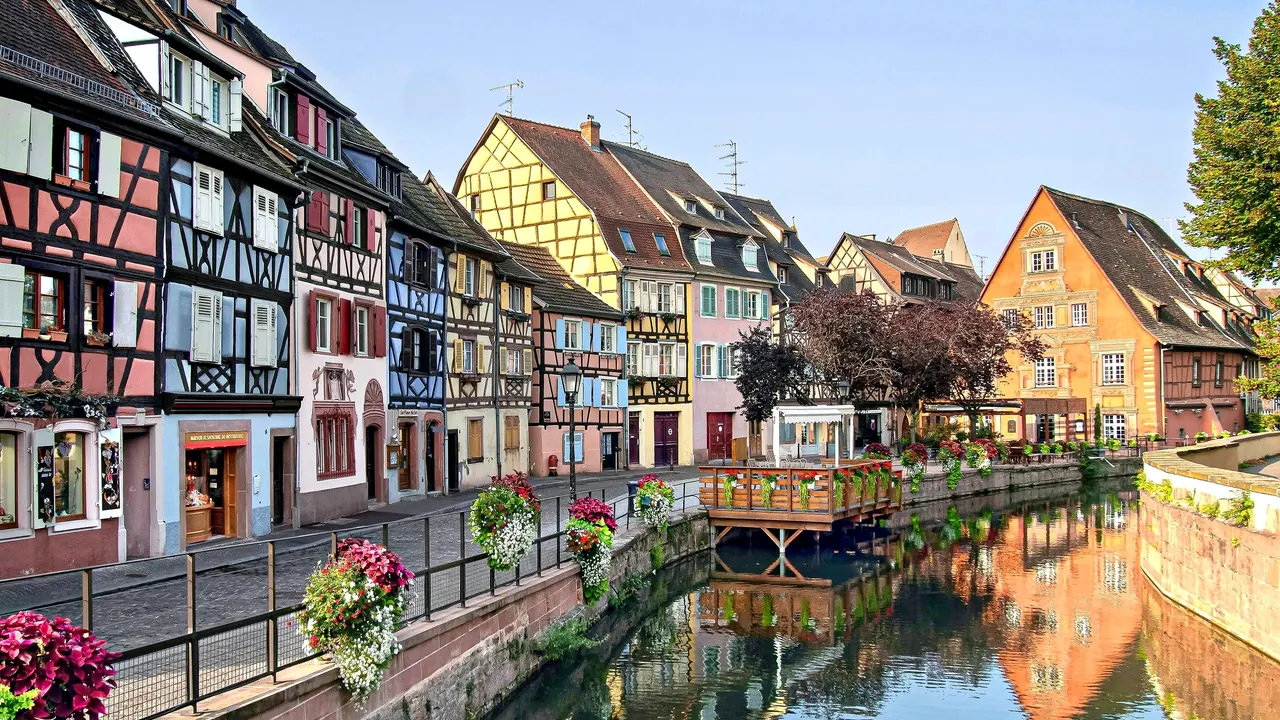
A canal in Little Venice lined with half-timbered houses
- Day trips85
- Nature & outdoors69
- Culture & sights64
Photo: Rolf Kranz, CC BY-SA 4.0, cropped
Match
48
Every category weighted equally
- Beach & sun43
- Culture & arts52
- Food & nightlife44
- Family trip52
- Outdoors55
- Relax & unwind46
- Shopping & style48
- On a budget47
Colmar in twelve categories
Our verdict on each, scored 0 to 100 against the same fixed benchmark cities, so a score means the same thing on every page.
Beaches & swimming. Scores 6 out of 100.
Food & drink. Scores 63 out of 100.
Culture & sights. Scores 64 out of 100.
Nightlife. Scores 17 out of 100.
Nature & outdoors. Scores 69 out of 100.
Day trips. Scores 85 out of 100.
Good for families. Scores 63 out of 100.
Getting around. Scores 62 out of 100.
Shopping & style. Scores 37 out of 100.
Affordability. Scores 46 out of 100.
Live music & performing arts. Scores 28 out of 100.
Wellness & relaxation. Scores 32 out of 100.
Colmar category by category
Beaches & swimming
6Colmar is far from any coast, deep in the Alsace plain between the Vosges and the Rhine. Summer swimming means the municipal pools or a small lake in the Vosges valleys, such as those around the Route des Crêtes. Nobody should come here for the water.
Food & drink
63Eating in Colmar means Alsace, a cuisine with one foot in France and one in Germany. Winstubs with wood panelling serve choucroute garnie, baeckeoffe stewed in earthenware, tarte flambée, fleischschnacka and munster cheese from the valleys above town, followed by kougelhopf or, in December, bredele biscuits. The covered market by the Lauch canal is good for cheeses, charcuterie and gingerbread.
Wine is the other half of it. Colmar calls itself the capital of Alsace wine, and the Riesling, Gewurztraminer and Pinot Gris of the surrounding slopes are poured everywhere, with cellar tastings a short drive away in the villages. A handful of ambitious restaurants in town and along the wine route add a fine-dining tier. Beyond the regional cooking the choice is narrow, and the most photographed streets have plenty of tired menus.
Culture & sights
64The old town is one of the most complete late-medieval and Renaissance townscapes in France: half-timbered houses painted in ochre, blue and green, the gabled Maison Pfister, the Maison des Têtes with its carved faces, the old customs house of the Koïfhus, and the canals and flower boxes of Petite Venise and the tanners' quarter. Spared the worst of the wars, it reads as a single whole rather than a few showpieces.
The great reason to come is the Unterlinden Museum, a former convent that holds Grünewald's Isenheim Altarpiece, one of the most powerful paintings of the late Middle Ages. Add Schongauer's Madonna of the Rose Bush in the Dominican church, the collegiate church of Saint Martin and the museum in the birthplace of Bartholdi, sculptor of the Statue of Liberty. It is a rich set, but compact, and two days covers it well.
Nightlife
17Evenings in Colmar are about a long dinner and a glass of Alsace wine. A few wine bars, pubs and brasseries around the old town and Petite Venise stay open after dinner, and summer terraces stay pleasant late, but the streets grow quiet early and there is little in the way of clubs. The Christmas market season and the summer wine fair bring crowds, though not a late-night scene. Anyone wanting a proper night out takes the train to Strasbourg.
Nature & outdoors
69Colmar sits where the vineyards climb out of the Rhine plain onto the eastern slopes of the Vosges, and the landscape changes quickly. Within half an hour you are walking marked paths through the vines between wine villages, and a little further up the valleys of Munster and Kaysersberg lead to the Route des Crêtes, the high ridge road past the Hohneck and the Grand Ballon, with long views to the Black Forest and, on clear days, the Alps.
The Vosges are rounded, forested mountains with summer pastures, glacial lakes and dense networks of waymarked trails, plus modest skiing in winter. The flat plain and the wine route make good cycling country, and the Black Forest across the Rhine is about an hour away. Autumn, with the harvest and turning vines, is the finest season. A car makes all of this much easier.
Day trips
85Colmar is an excellent base. Strasbourg, with its cathedral and the island of the Grande Île, is about half an hour by train. Closer still are the wine villages that make Alsace famous: Eguisheim with its concentric lanes, walled Riquewihr, Kaysersberg under its ruined castle, Ribeauvillé and Turckheim, each a few kilometres apart along the Route des Vins. The rebuilt castle of Haut-Koenigsbourg looks down over the plain from its ridge.
Across the borders, Basel, with its museums and Rhine old town, is under an hour away, and Freiburg and its minster are around an hour. Mulhouse adds big museums of cars and railways, and Breisach and the Kaiserstuhl wine slopes sit just over the Rhine. The villages are best reached by car or bike, since buses between them are thin.
Good for families
63The town itself is small, flat, safe and easy with children: flat-bottomed boat rides through Petite Venise, the little tourist train, storks nesting on rooftops and, in December, Christmas markets with a dedicated children's market. The attractions made for kids lie outside town, but there are many of them.
Near the wine villages are a stork and otter park at Hunawihr, the Montagne des Singes with its free-roaming macaques and an eagle show at Kintzheim, and the castle of Haut-Koenigsbourg. Mulhouse has a zoo and two large museums of trains and cars, and Europa-Park, one of Europe's biggest theme parks, is about an hour's drive across the Rhine. For most of these you need a car.
Getting around
62Within Colmar everything is walkable: the old town, Petite Venise and the main museums sit within a few minutes of each other, and the station is a short walk from the centre. Regional trains reach Strasbourg and Mulhouse quickly, with connections on to Basel. The difficulty is everything in between. The wine villages and the Vosges are served by limited buses, so most visitors hire a car or a bicycle, and the vineyard roads make cycling between villages a real pleasure.
Shopping & style
37Shopping in Colmar is about regional things to take home: wine bought directly from producers, kougelhopf moulds and glazed pottery from Soufflenheim and Betschdorf, printed Alsatian table linen, gingerbread and foie gras. The lanes around the Grand'Rue and Rue des Marchands have independent boutiques and plenty of souvenir shops, and the covered market is good for food gifts. The Christmas markets, spread across several squares, are the high point of the year. Fashion and big-name retail are limited.
Affordability
46Colmar costs what you would expect of a well-known French provincial town, moderate for Western Europe. Set lunch menus, regional wine and local buses are reasonable, and wine tastings in the villages are often free or cheap. Rooms are the weak point: the town is small, demand is high in summer, and during the Christmas market weeks hotels in and near the old town are expensive and book out early. Staying outside the centre or in a nearby village eases the cost.
Live music & performing arts
28Colmar has a small Italian-style municipal theatre with a season of plays, opera and concerts, and the Opéra national du Rhin tours here. The town's calendar is built around festivals: an international classical music festival in early July, a jazz festival in autumn and the big concerts that come with the summer wine fair. Outside those weeks the offer is thin, and serious opera, orchestral concerts or theatre mean a trip to Strasbourg or Basel.
Wellness & relaxation
32There is no bathing tradition in Colmar, and spa options come down to hotel spas in town and in the surrounding wine villages. What the place does offer is a gentle pace once the day-trippers leave: quiet evenings by the canals, long lunches and unhurried walks through the vines. It suits a restful few days well, but anyone looking for thermal baths or a spa culture will find little here.
When should you go?
Pick a month to see what it is like. The climate figures are measured averages, not a forecast.
Colmar in July
Daytime high, °C
Rainfall in the month, mm
The whole year
Shaded against this city’s own year: the deepest cell is its best month for that figure and the palest its weakest.
Temperature and rainfall are climate normals, averaged over the years shown. Colmar: 1991-2020 normals, Ihringen (21.1 km from centre).
Before you go
| Measure | Colmar |
|---|---|
| Official language | French |
| Currency | Euro (EUR) |
| Sockets | CE230 V, 50 Hz |
| Driving side | Right |
| Time zone | UTC+1, UTC+2 in summer |
| Emergency number | 112 |
| Elevation | 185 m |
| Main airport | EuroAirport Basel–Mulhouse–Freiburg (BSL)55 km from centre112 non-stop destinations |
| Public holidays this year | 11 days |
By the numbers
| Measure | Colmar |
|---|---|
| City population | 66,970 |
| People per km² | 1,006 |
| Museums within 10 km | 9 |
| UNESCO World Heritage sites within 50 km | 3 |
Compare Colmar with
Every comparison with a written verdict behind it.
- Annecy
- Antibes
- Antwerp
- Avignon
- Baden-Baden
- Basel
- Bern
- Biarritz
- Bordeaux
- Bruges
- Brussels
- Cannes
- Chamonix
- Cologne
- Como
- Cortina d'Ampezzo
- Dijon
- Dusseldorf
- Frankfurt
- Geneva
- Genoa
- Ghent
- Hallstatt
- Heidelberg
- Innsbruck
- Interlaken
- La Spezia
- Lausanne
- Lille
- Lucerne
- Lyon
- Maastricht
- Marseille
- Milan
- Monaco
- Montpellier
- Munich
- Nantes
- Nice
- Nuremberg
- Paris
- Portofino
- Rotterdam
- Saint-Tropez
- Salzburg
- Strasbourg
- Stuttgart
- The Hague
- Toulouse
- Turin
- Utrecht
- Venice
- Verona
- Zurich