France
Alsace
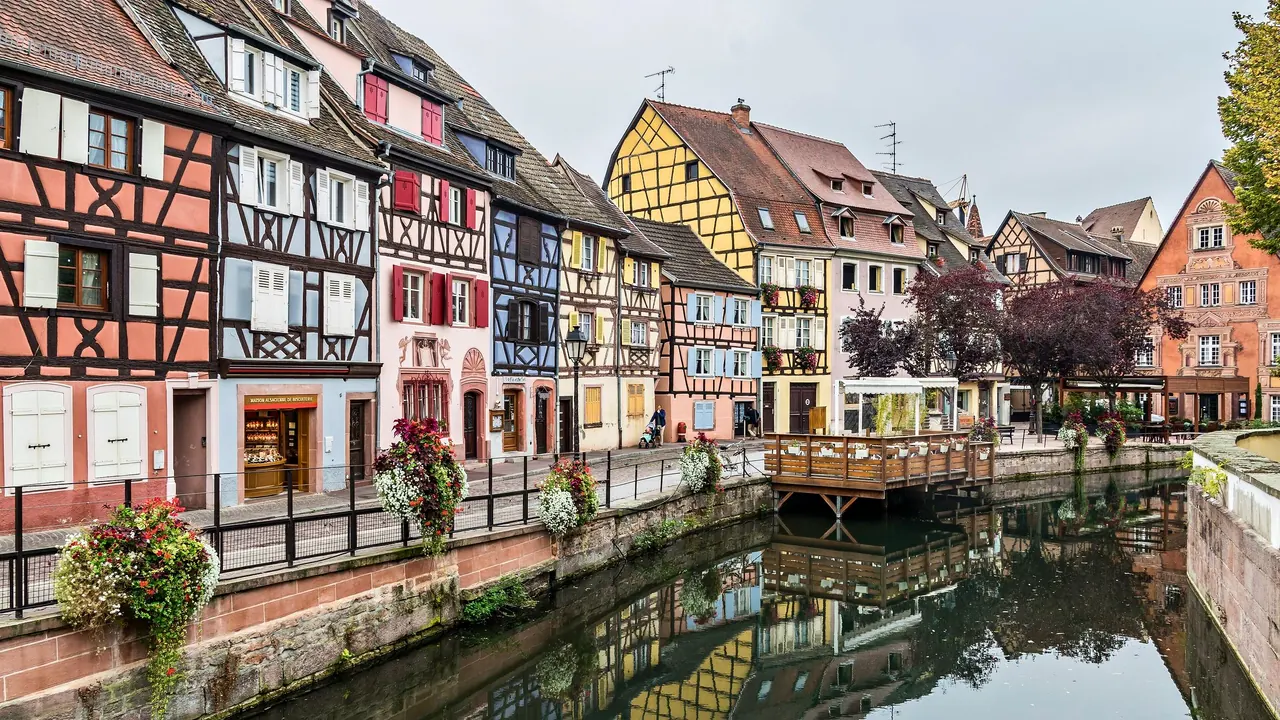
Little Venice in Colmar from the bridge on rue des Ecoles
- Day trips83
- Families80
- Food & drink78
Photo: Krzysztof Golik, CC BY-SA 4.0, cropped
Match
59
Every category weighted equally
- Beach & sun53
- Culture & arts65
- Food & nightlife58
- Family trip61
- Outdoors63
- Relax & unwind58
- Shopping & style61
- On a budget58
Alsace in twelve categories
Our verdict on each, scored 0 to 100 against the same fixed benchmark cities, so a score means the same thing on every page.
Beaches & swimming. Scores 8 out of 100.
Food & drink. Scores 78 out of 100.
Culture & sights. Scores 78 out of 100.
Nightlife. Scores 36 out of 100.
Nature & outdoors. Scores 68 out of 100.
Day trips. Scores 83 out of 100.
Good for families. Scores 80 out of 100.
Getting around. Scores 68 out of 100.
Shopping & style. Scores 55 out of 100.
Affordability. Scores 45 out of 100.
Live music & performing arts. Scores 55 out of 100.
Wellness & relaxation. Scores 58 out of 100.
Alsace category by category
Beaches & swimming
8Alsace is landlocked and several hundred kilometres from any sea. Summer swimming means the lakes: flooded gravel pits on the Rhine plain with small sandy shores and lifeguards in July and August, a few cool reservoirs and glacial lakes high in the Vosges, and outdoor pools in the towns. The water is pleasant from late June to August, but these are places for a cooling afternoon, not a reason to come. Anyone wanting a beach on this trip should look elsewhere.
Food & drink
78Alsace cooks its own way, with a German accent and French technique. The winstub, a wood-panelled wine tavern, is where to meet it: choucroute garnie, baeckeoffe stewed in a sealed earthenware dish, flammekueche from a wood oven, munster cheese and fleischschnacka. Bakeries sell kougelhopf and bretzels, and in December every kitchen turns out bredele biscuits and pain d'épices. The region also has more starred and serious restaurants than its size suggests, spread through the wine villages as much as Strasbourg.
The Route des Vins runs for 170km past growers' cellars where you taste Riesling, Gewurztraminer, Pinot Gris and crémant at the source, and Alsace brews much of France's beer. Strasbourg has the widest range; Colmar and villages such as Kaysersberg and Riquewihr suit a slower, wine-led stay. What it lacks is street food and much international variety.
Culture & sights
78Strasbourg carries the most weight. Its red sandstone cathedral, with a spire that was the tallest building in the world for over two centuries and an astronomical clock inside, stands over a medieval island centre listed by UNESCO along with the German imperial Neustadt. Petite France's half-timbered tanners' houses, the Palais Rohan museums and the European Parliament district fill out a few days.
Colmar adds the Unterlinden Museum and its Isenheim Altarpiece, one of the great works of the late Middle Ages, around an old town of canals and painted façades. Further out stand the rebuilt castle of Haut-Koenigsbourg above the plain, Romanesque churches at Rosheim and Murbach, and in Mulhouse the vast national car and railway museums. Walled wine villages such as Riquewihr and Eguisheim are heritage in their own right.
Nightlife
36Going out happens almost entirely in Strasbourg, a university city whose student quarter of Krutenau and the streets around the cathedral fill with beer bars, wine bars and a few late cocktail spots. There are a small number of clubs, and the quays are lively on summer evenings. Colmar and Mulhouse have a handful of bars. In the wine villages the evening ends with dinner and a bottle at the winstub. Nights here are sociable but early and modest, and a fair number of young locals cross the Rhine or head to Basel for a bigger night.
Nature & outdoors
68The Vosges rise steeply behind the vineyards, a ridge of forested, rounded summits topping out at the Grand Ballon at 1,424m. The Route des Crêtes follows the high pastures with long views across the Rhine plain to the Black Forest and, on clear days, the Alps. Marked trails are dense and well kept, from short vineyard walks between villages to the long-distance GR5, and ruined castles crown many of the spurs.
The flat plain is good cycling country, with routes along the Rhine, the canals and the wine road. Winter brings modest skiing and snowshoeing on the ballons. The northern Vosges around Wissembourg have sandstone outcrops and quiet forest. It is gentle, green walking country rather than high mountains.
Day trips
83Whichever town you stay in, the rest of Alsace is close. The wine villages line up along the foot of the Vosges a few kilometres apart, Kaysersberg, Riquewihr, Ribeauvillé, Eguisheim, Turckheim and Obernai, each with its walls, gates and cellars, so a day can link three or four. Strasbourg and Colmar are about half an hour apart by train, and Sélestat and Mulhouse lie on the same line.
The borders add a second ring. Basel, with its museums and old town, is close to Mulhouse. Freiburg and the spa town of Baden-Baden are an easy crossing into Germany, and Heidelberg is reachable in about two hours. To the west, Nancy's Place Stanislas is about an hour and a half from Strasbourg by train.
Good for families
80Alsace is easy and safe with children, and it has more made for them than it first appears. Europa-Park, one of the largest theme parks in Europe, lies just across the Rhine within an hour of Strasbourg or Colmar. Near Kintzheim and Ribeauvillé, a cluster of parks makes a day: macaques roaming free on a forest hillside, eagle and falcon shows at a castle, and storks and otters at a wildlife park.
Mulhouse has the national railway and car museums and a good zoo, Strasbourg a hands-on science centre for younger children and boat trips through Petite France, and the open-air ecomuseum at Ungersheim shows village life. December's Christmas markets enchant children, though the crowds are heavy. Much of this needs a car.
Getting around
68The spine is easy. Frequent regional trains run down the plain linking Strasbourg, Sélestat, Colmar and Mulhouse, and Strasbourg itself has a good tram network, a walkable centre and one of the best cycle networks in France. Colmar's old town is small enough to cover on foot.
The wine villages and the Vosges are another matter. Buses reach some villages but infrequently, and the Route des Crêtes is a car road. Most visitors who want the wine route hire a car, and distances are short and roads good, so it is no burden; cycling between villages is a pleasant alternative. Parking in the most visited villages fills up in summer and December.
Shopping & style
55Strasbourg has the region's shopping streets, with department stores, French chains and independent boutiques around Place Kléber and the cathedral quarter. The more distinctive buys are regional: salt-glazed grey-and-blue stoneware from Betschdorf, painted earthenware baking moulds from Soufflenheim, kelsch checked linen, printed tablecloths, and wine, crémant and eaux-de-vie bought straight from growers along the wine route.
In December the Christmas markets, held in Strasbourg since the sixteenth century and in Colmar, Kaysersberg and many villages, turn shopping into the main event, with ornaments, gingerbread and crafts in wooden chalets. The rest of the year the villages lean heavily on souvenirs, and there is little luxury.
Affordability
45Alsace is moderately expensive. Strasbourg's hotels are priced like those of a major French city, and in the Christmas market season and during European Parliament sessions rooms in Strasbourg and Colmar become scarce and dear. Guesthouses, chambres d'hôtes and self-catering flats in the wine villages are better value, especially outside December. A winstub meal is reasonable for the size of the portions, and wine bought straight from the growers is good value. Car hire adds to the cost for anyone exploring the wine route.
Live music & performing arts
55Strasbourg carries the performing arts. The Opéra national du Rhin stages a full season in the city's opera house and also in Colmar and Mulhouse, the Philharmonic Orchestra of Strasbourg plays in a large concert hall, and the Théâtre National de Strasbourg is one of France's leading drama houses. The city has well-regarded festivals of contemporary music and jazz in the autumn.
Colmar hosts a classical festival in summer, and wine villages put on concerts in churches. Alsace has a strong choral and brass band tradition at village level. A visitor can find a good opera or concert most weeks in Strasbourg, but outside it the offer is thin.
Wellness & relaxation
58Alsace has a quiet bathing tradition of its own in the north, where Niederbronn-les-Bains and Morsbronn have thermal waters and modern spa complexes. Many of the region's country hotels in the vineyards and the Vosges valleys have spas, and the great thermal baths of Baden-Baden are within an hour of Strasbourg across the Rhine.
The pace is the other half of it. A stay in a wine village, with a morning walk through the vines, a long lunch and an evening tasting in a cool cellar, is unhurried by nature, and the Vosges valleys are calm and green. Strasbourg in December is anything but restful.
Where to stay in Alsace
Strasbourg is the natural base for a first visit, especially without a car. The cathedral, Petite France and the museums are all reachable on foot or by tram. The city has the region's widest choice of food, nearly all of its nightlife and an opera or concert most weeks. It suits culture lovers, couples and anyone arriving by train, and Colmar is about half an hour away on the regional line.
Colmar is smaller and calmer. Its old town of canals is easy to cover on foot, and it sits in the middle of the wine route, so it works as a base with or without a car. For a slower stay built around wine, choose a village such as Kaysersberg, Riquewihr or Eguisheim. Evenings there end at the winstub, and guesthouses and self-catering flats cost less than city hotels. The villages suit food lovers, walkers and families, with the animal parks near Kintzheim close by, but you will need a car.
The Vosges valleys suit walkers and anyone after quiet, with trails starting near the door. Mulhouse is handy for its museums and for Basel. Alsace is compact, so one base can cover a week. Splitting the stay between Strasbourg and a wine village works well for a second visit. In December, rooms in Strasbourg and Colmar run short, and a village stay is often the easier choice.
When should you go?
Pick a month to see what it is like. The climate figures are measured averages, not a forecast.
Alsace in July
Daytime high, °C
Rainfall in the month, mm
The whole year
Shaded against this destination’s own year: the deepest cell is its best month for that figure and the palest its weakest.
Temperature and rainfall are climate normals, averaged over the years shown. Alsace: 1991-2020 normals, Ihringen (20.8 km from centre).
Before you go
| Measure | Alsace |
|---|---|
| Official language | French |
| Currency | Euro (EUR) |
| Sockets | CE230 V, 50 Hz |
| Driving side | Right |
| Time zone | UTC+1, UTC+2 in summer |
| Emergency number | 112 |
| Main airport | Strasbourg Airport (SXB)43 non-stop destinations |
| Public holidays this year | 11 days |
Compare Alsace with
Every comparison with a written verdict behind it.
- Austrian Alps
- Bavaria
- Black Forest
- Bordeaux
- Brittany
- Burgundy
- Cinque Terre
- Corsica
- Dolomites
- Dordogne
- French Alps
- French Riviera
- Lake Como
- Lake Garda
- Lake Maggiore
- Loire Valley
- Normandy
- Piedmont
- Provence
- Swiss Alps