Photos: Alsace by Krzysztof Golik, CC BY-SA 4.0, cropped; Dolomites by Chensiyuan, CC BY-SA 4.0, cropped.
Alsace or Dolomites?
Our verdict in twelve categories, each scored against the same fixed benchmark cities, and the climate month by month, so you can choose for your trip.
Choose Alsace for
- culture and sights
- live music and the arts
- prices
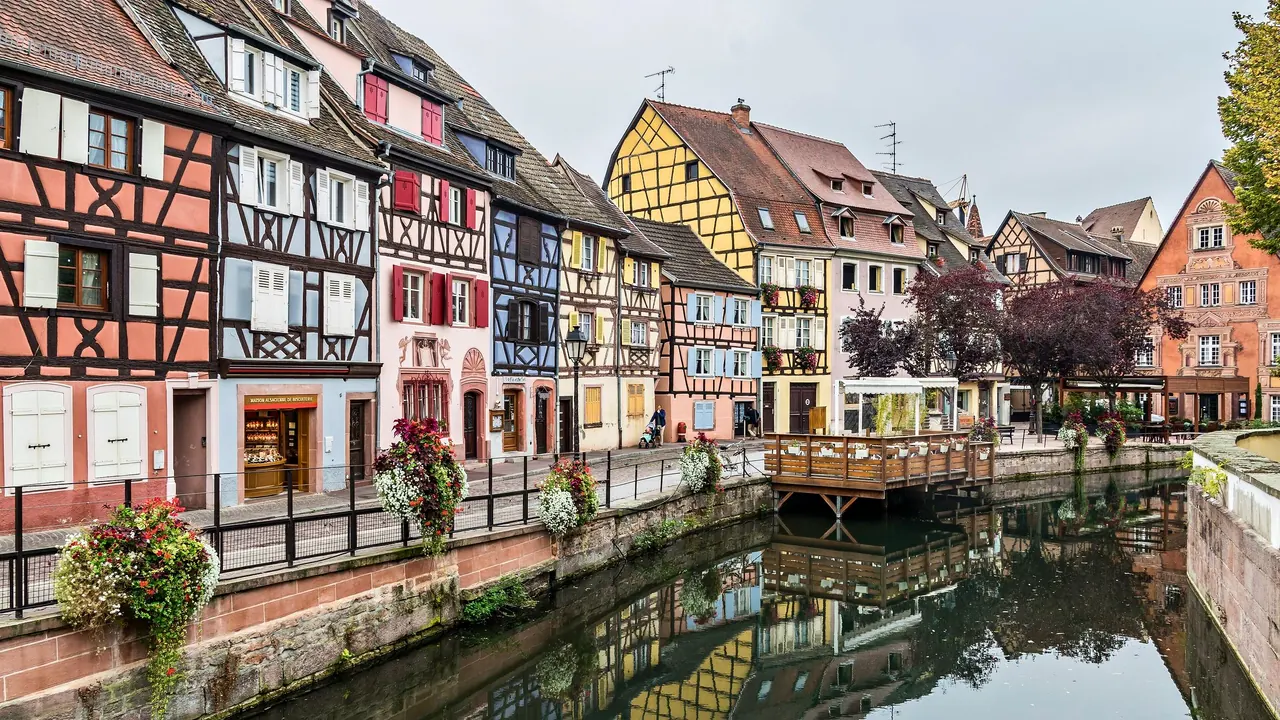
Alsace suits travellers who want plenty to see and eat without much effort. Strasbourg's cathedral and old island centre, Colmar's altarpiece and a string of walled wine villages are all close together, with winstub dinners and growers' cellars along the way. It also costs less, works better with young children and is easier to get around by train. It is the better choice for a culture-and-food trip, a family week or a December Christmas-market trip, and its mountains are gentle walking country rather than a reason to come.
Choose Dolomites for
- nature and the outdoors
- beaches
- wellness
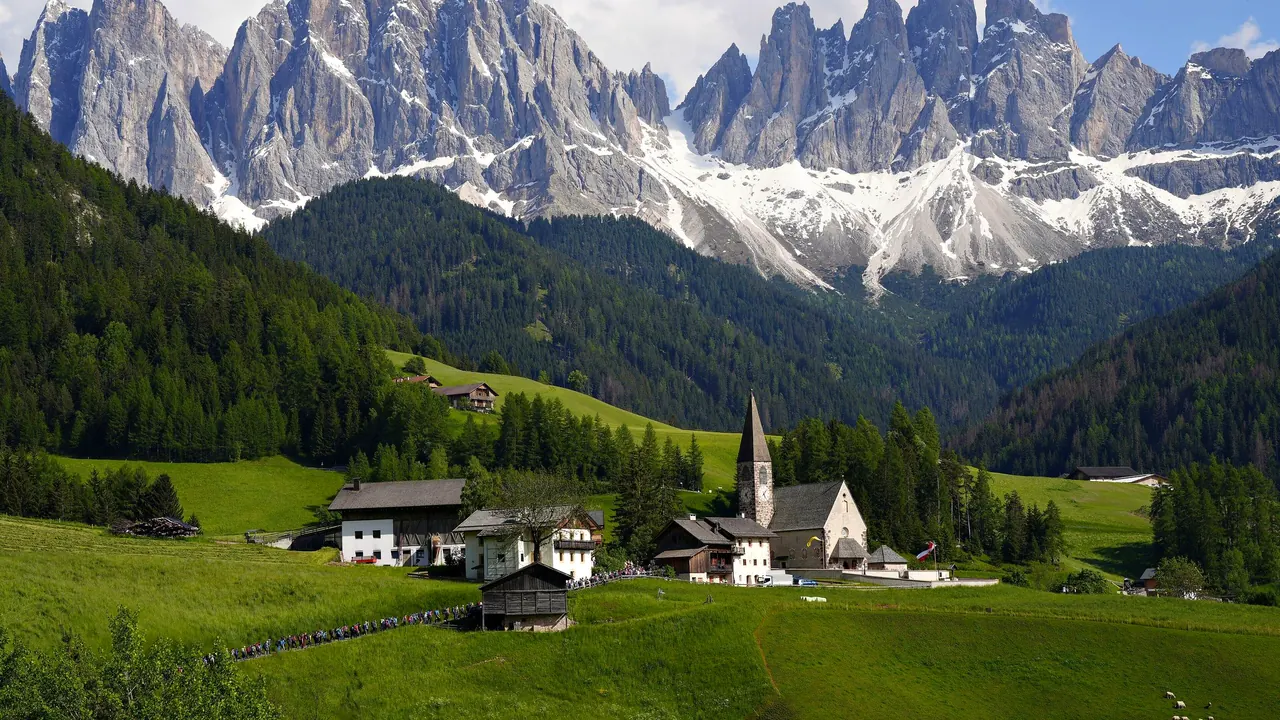
The Dolomites are for people who come for the landscape. Pale limestone towers rise above high meadows, lifts run up from almost every village, and there are hut lunches at altitude, via ferrata routes and one of the largest linked ski areas in Europe. Hotel spas built to face the rock walls make the rest days count. You give up museums, evenings out and easy travel between valleys, and you pay more in high season, but no walker or skier will regret it.
Scoreboard
Twelve categories on one fixed scale from 0 to 100. The shaded stretch is the gap between the two.
Your match
Pick a travel style or drag the sliders, and both match scores follow your weighting.
Wins on culture and sights and live music and the arts with your weighting.
Wins on nature and the outdoors and beaches with your weighting.
What matters to you?
Category by category
What the scores mean for a trip.
Beaches & swimming
Neither is a place for a beach, but the Dolomites give swimmers a little more. Lake Caldaro on the South Tyrolean wine route warms to around 24°C in midsummer and has lidos with lawns, and the northern tip of Lake Garda is about an hour from Trento.
In Alsace the options are flooded gravel pits on the Rhine plain with small sandy edges, cool reservoirs in the Vosges and town pools. They are fine for an afternoon in the heat and nothing more.
Food & drink
Alsace has the deeper table. Choucroute, baeckeoffe and flammekueche are served in wood-panelled winstubs, the 170km Route des Vins passes growers' cellars, and starred restaurants are spread through the wine villages as well as Strasbourg. Its beer tradition is a bonus.
The Dolomites' best meal is often lunch on a hut terrace after a morning on the trail: speck, canederli and strudel, followed by a proper Italian espresso. Alta Badia has more refined kitchens than its size suggests, and Lagrein from around Bolzano is worth seeking out. Both regions pour fine Gewürztraminer, but outside the two valley cities the cooking here stays more local.
Culture & sights
Alsace is clearly richer. Strasbourg's red sandstone cathedral and astronomical clock, Petite France, the Palais Rohan museums, Colmar's Unterlinden Museum and the national railway and car museums in Mulhouse can fill a week of sightseeing.
In the Dolomites the landscape itself is the UNESCO listing. The built heritage is concentrated in Bolzano, home of Ötzi the Iceman, Trento's frescoed castle and the cathedral town of Bressanone, with First World War tunnels on the passes. It all makes good rainy-day outings, not the main point of the trip.
Nightlife
Neither region is built for late nights, but Alsace has a little more going on. That is almost all in Strasbourg, where the student bars of Krutenau, wine bars near the cathedral and the summer quays offer a sociable evening.
In the Dolomites the evening's main event is après-ski in winter at the foot of the slopes in Selva, Canazei or Cortina, mostly early and over by dinner. Summer villages go quiet by eleven.
Nature & outdoors
This is where the Dolomites far outclass Alsace. Peaks such as the Tre Cime, the Sassolungo and the Marmolada glacier rise straight from the meadows, lifts carry walkers up from almost every village, and the range offers everything from easy rambles on the Alpe di Siusi to week-long hut routes and via ferrata. In winter the Sella Ronda and the Dolomiti Superski network take over.
The Vosges are softer and greener, with forested ballons reaching 1,424m at the Grand Ballon, well-marked trails between vineyards and ruined castles, and flat cycling along the Rhine and the canals. It is pleasant country to walk in, not a landscape you would build a trip around.
Day trips
Alsace makes day trips easier. Its wine villages lie a few kilometres apart at the foot of the Vosges, so you can link three or four in a day, and across the borders Basel, Freiburg and Baden-Baden are short hops, with Heidelberg also within reach.
The Dolomites have good outings too, mainly from Bolzano in the Adige valley: Merano, Bressanone, Trento and the wine route, with Verona and Innsbruck further out. From the high valleys, though, every excursion starts on a winding pass road.
Good for families
Alsace offers more for children, especially in poor weather. Europa-Park is less than an hour away across the Rhine, there are free-roaming macaques and falconry shows near Kintzheim, and Mulhouse has its train and car museums and a zoo. Many of these are only practical by car.
The Dolomites are excellent in summer. Flat paths across the Alpe di Siusi, huts with farm animals and playgrounds, and hotels with children's clubs make walking easy for small legs, and the ski schools run well in winter. There are no theme parks or zoos, though, so a wet day is harder to fill.
Getting around
Alsace is easier to get around. Frequent trains run along the plain, Strasbourg and Colmar are about half an hour apart, and Strasbourg has trams and excellent cycle lanes. Only the wine route and the Route des Crêtes really need a car, and the distances are short.
In the Dolomites, trains and a single regional pass cover the Adige and Puster valleys, and lifts link whole areas once you arrive. Getting from one valley to another means slow hairpin passes that are busy in high summer, so anyone touring several areas usually hires a car.
Shopping & style
Both regions have well-known Christmas markets, and Strasbourg's go back to the sixteenth century. Beyond December, Alsace has more to offer: Place Kléber's department stores and boutiques, plus Betschdorf stoneware, Soufflenheim baking moulds and kelsch linen.
The Dolomites focus on craft and food. You can buy carved figures from Ortisei's woodworking workshops, loden from Bolzano's arcaded Laubengasse, and speck, grappa and mountain cheese to take home. Cortina's short row of luxury shops is the exception in a range that is otherwise mostly outdoor gear.
Affordability
Alsace is the cheaper of the two, though it is not a bargain. Strasbourg's hotels charge big-city French rates, especially in December and during Parliament sessions, but guesthouses in the wine villages and wine bought at the cellar door help.
The Dolomites are expensive in the ski season and in July and August, with Cortina and Alta Badia at the top end, and lift passes and hut stays add to the bill. Fassa, Fiemme and the valley towns cost less, and June or September brings room rates down.
Live music & performing arts
Alsace has more to attend. The Opéra national du Rhin performs in three cities, the Théâtre National de Strasbourg is among France's leading stages, and the autumn brings jazz and contemporary music festivals.
The Dolomites' big draw is the setting. Trentino's mountain festival puts musicians on alpine meadows and hut terraces, and Merano holds concerts in its old spa halls. Outside summer, the orchestras of Bolzano and Trento are most of what is on.
Wellness & relaxation
The Dolomites have the edge. South Tyrol's mountain hotels are designed around saunas facing the rock and heated outdoor pools in the snow, the hay baths below the Alpe di Siusi are a local tradition, and Merano's thermal baths sit beside its river promenade.
Alsace's version is quieter. There are thermal spas at Niederbronn-les-Bains and Morsbronn, and Baden-Baden is within an hour, but the main appeal is the slow rhythm of a wine-village stay. Avoid Strasbourg in December if rest is the goal.
When should you go?
Pick your month. The climate figures are measured averages, not a forecast.
Alsace in July
Dolomites in July
Daytime high, °C
Rainfall in the month, mm
Temperature and rainfall are climate normals, averaged over the years shown. Alsace: 1991-2020 normals, Ihringen (20.8 km from centre). Dolomites: 1991-2020 normals, Dobbiaco (22.3 km from centre).
Alsace has the warmer summer. From June to August the Rhine plain reaches highs of up to 27°C, and July brings close to 250 hours of sunshine, good weather for vineyard walks and an afternoon at the lakes, though the hottest days can feel heavy in town. May is the wettest month. September and early October stay mild, a pleasant time to walk the wine villages. Winter is short of light, grey and chilly, and in December people come for the markets, not the weather.
The Dolomites, measured where most visitors stay, are much cooler. Summer highs reach about 22°C, comfortable for walking but rarely warm enough for a long swim. Summer is also the wettest time of year, with rain peaking at 130mm in July and staying high in June and August, so expect showers on the high routes. September is the steadier window, drier and still mild. From December to February highs sit close to freezing, the heart of the ski season, and March is a milder end to it at around 8°C.
Which traveller are you?
On a culture and arts trip, choose Alsace. Strasbourg's cathedral and UNESCO-listed centre, Colmar's Isenheim Altarpiece and a full opera and drama season give you far more to see and attend than the Dolomites' valley towns, which are better kept for a rainy day.
For an outdoors trip, choose the Dolomites without hesitation. Hut-to-hut routes such as the Alta Via 1, via ferrata on the high rock, cycling over the great passes and winter skiing across a dozen linked valleys go well beyond the rounded summits of the Vosges.
On a trip with a tight budget, Alsace is the safer pick. Chambres d'hôtes in the wine villages, generous winstub portions and wine bought from the grower keep costs down, while the Dolomites add lift passes, hut stays and expensive resorts in their peak seasons.
Before you go
| Measure | Alsace | Dolomites |
|---|---|---|
| Official language | French | Italian |
| Currency | Euro (EUR) | Euro (EUR) |
| Sockets | CE230 V, 50 Hz | CFL230 V, 50 Hz |
| Driving side | Right | Right |
| Time zone | UTC+1, UTC+2 in summer | UTC+1, UTC+2 in summer |
| Emergency number | 112 | 112 |
| Main airport | Strasbourg Airport (SXB)43 non-stop destinations | Venice Marco Polo Airport (VCE)103 non-stop destinations |
| Public holidays this year | 11 days | 13 days |
Where else could you go?
Every comparison below shares a destination with this one, so you can follow Alsace or Dolomites somewhere new.
- Black Forestvs Alsace
- Austrian Alpsvs Dolomites
- Swiss Alpsvs Alsace
- Lake Gardavs Dolomites
- Bavariavs Dolomites
- Istriavs Dolomites