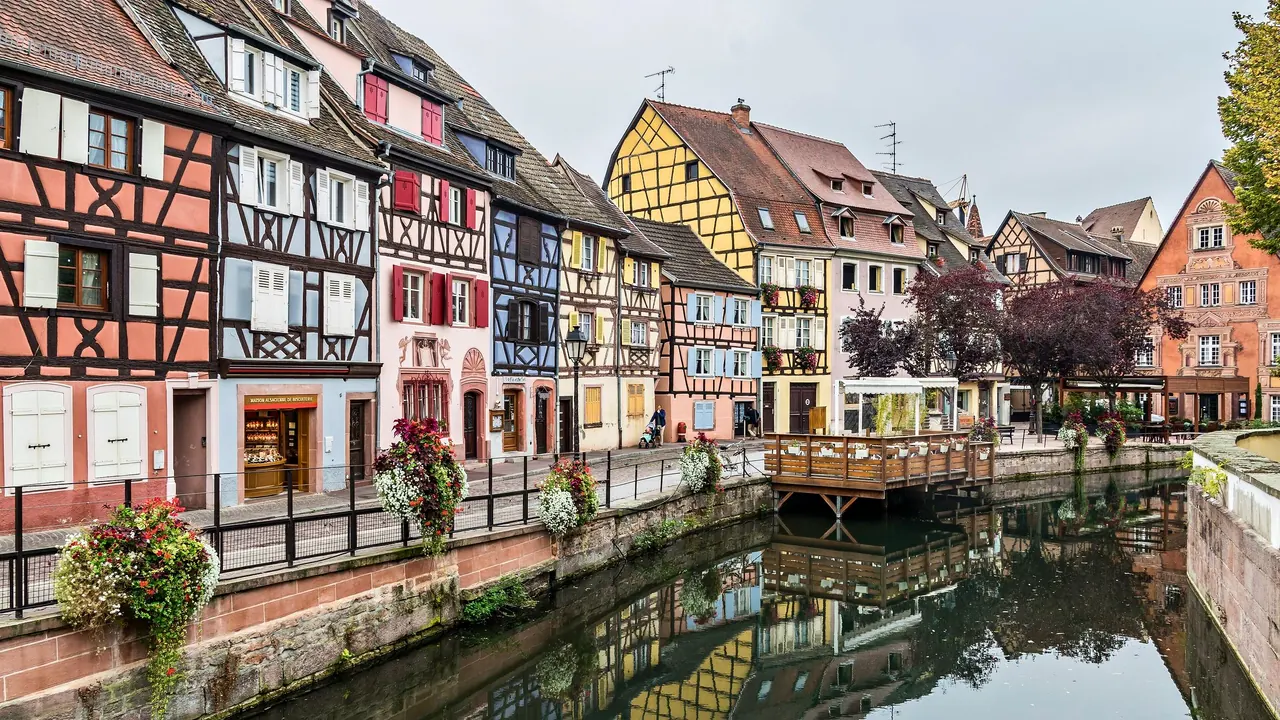
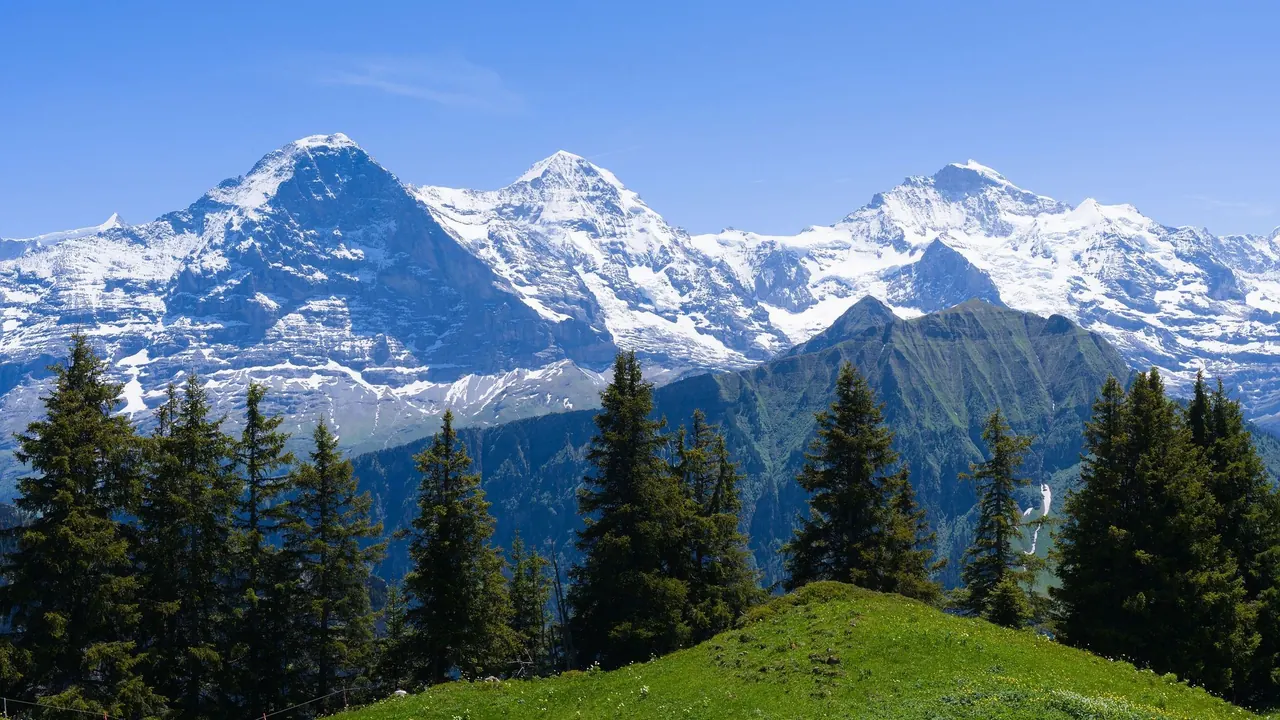
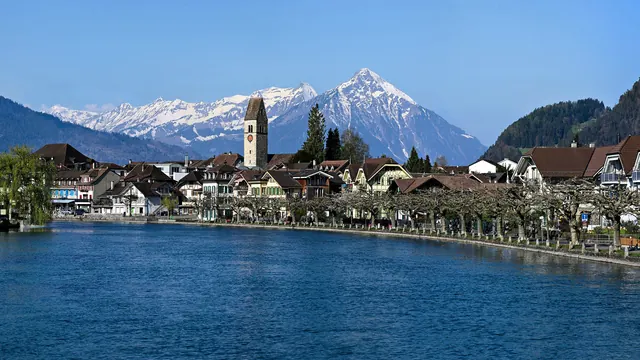
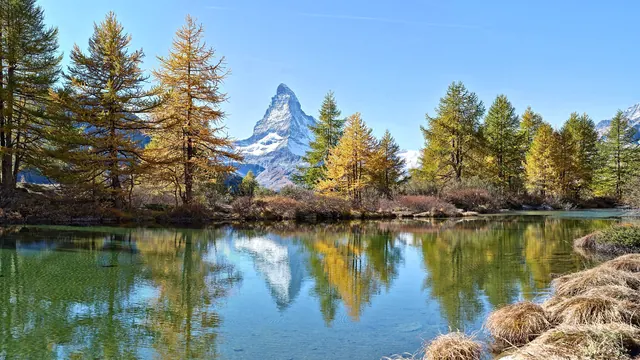
Photos: Alsace by Krzysztof Golik, CC BY-SA 4.0, cropped; Swiss Alps by Jean-Paul Wettstein, Pexels License.
Alsace or Swiss Alps?
Our verdict in twelve categories, each scored against the same fixed benchmark cities, and the climate month by month, so you can choose for your trip.
Choose Alsace for
- prices
- culture and sights
- food and drink
Alsace is the better choice for a trip built around towns, food and wine. Strasbourg's cathedral and Petite France, Colmar's Isenheim Altarpiece and a chain of walled wine villages give it far more to see and eat. It also costs a good deal less, it is easier with children, and it lies close enough to Basel and Freiburg that a week can cross two borders without much effort.
Choose Swiss Alps for
- nature and the outdoors
- wellness
- beaches
Choose the Swiss Alps when the mountains themselves are the reason for the trip. The Jungfrau, the Matterhorn and the Engadine offer walking and skiing on a scale the rounded Vosges cannot match, and trains, postbuses and cable cars take you into high country without a car. The thermal baths at Leukerbad and Vals make it a deeply restful place. In return you accept a very high bill and thin culture, so it suits travellers who would rather spend their days on a trail than in a museum.
Scoreboard
Twelve categories on one fixed scale from 0 to 100. The shaded stretch is the gap between the two.
Your match
Pick a travel style or drag the sliders, and both match scores follow your weighting.
Wins on prices and culture and sights with your weighting.
Wins on nature and the outdoors and wellness with your weighting.
What matters to you?
Category by category
What the scores mean for a trip.
Beaches & swimming
Neither has a sea, but the Alps make more of their lakes. There are clean lidos with jetties on Lake Thun and Lake Brienz, the beautiful Caumasee near Flims, and in Ticino Lake Lugano and Lake Maggiore warm to about 23°C in high summer.
Alsace offers flooded gravel pits on the Rhine plain with small sandy shores, a few cool Vosges lakes and town pools. That is enough for a hot afternoon, but not a reason to go.
Food & drink
Alsace eats far better and more widely. Its winstubs serve choucroute, baeckeoffe and flammekueche, and it has an unusual density of serious restaurants spread through the wine villages. The 170km wine route lets you taste Riesling and crémant in the growers' own cellars.
The Alps are mostly fondue, raclette and rösti on hut terraces, with interesting Valais wines and expensive fine dining in Zermatt or St Moritz. Away from the smart resorts, the choice often comes down to a few hotel dining rooms.
Culture & sights
Alsace is much richer here. Strasbourg's cathedral, with its astronomical clock, stands over a medieval island centre, and the Palais Rohan museums and the German imperial Neustadt add more. Colmar holds the Isenheim Altarpiece, and walled villages such as Riquewihr and Eguisheim are heritage in their own right.
In the Alps the heritage is built into the landscape: sgraffito houses in the Engadine, the World Heritage Albula and Bernina railway lines, and the castles of Sion and Bellinzona. It makes for pleasant sightseeing between walks, but there is no great museum to plan a day around.
Nightlife
Both are modest, and they differ in when and where. Alsace's nights happen in Strasbourg all year, with beer and wine bars in the student quarter of Krutenau and on the quays in summer.
In the Alps, going out means après-ski. It happens in winter only, in a handful of resorts: loud in Verbier, glossy in St Moritz and Gstaad. Out of season most villages are asleep by eleven.
Nature & outdoors
The Alps are in another league. The Eiger, Mönch and Jungfrau, the Matterhorn and the Aletsch glacier are reachable by lift, so a hiker can be in high country without a full day's climb. Winter brings some of the best skiing anywhere.
Alsace offers gentler pleasures: the Route des Crêtes across the Vosges, well-marked trails between vineyards and castle ruins, and flat cycling along the Rhine. The Grand Ballon tops out at 1,424m, and the skiing there is modest.
Day trips
Alsace packs its outings closer together. The wine villages sit only a few kilometres apart, so one day can take in three or four. Strasbourg and Colmar are half an hour apart by train, and Basel, Freiburg and Baden-Baden lie just over the borders.
From the Bernese Oberland, the Alps reach Bern, Thun and Lucerne by scenic train, with Gruyères and the Lavaux vineyards further west. There are plenty of choices, but the journeys are longer and fewer of the places are famous in their own right.
Good for families
Alsace has more built for children. Europa-Park is within an hour, there is the macaque forest near Kintzheim, falconry shows at a castle, and Mulhouse has its train museum and zoo. The catch is that much of it needs a car.
The Alps rely on the setting instead: ski schools, summer toboggan runs, cable cars and lake steamers, and car-free villages such as Wengen where children can wander safely. There is no big theme park or zoo, though, and altitude needs care with very young children.
Getting around
The Alps make car-free travel easier. Trains, postbuses, steamers and lifts run on connected timetables to almost every village, and Zermatt and Mürren ban cars outright. The weak point is crossing between the big regions, which takes a long day with several changes.
Alsace has a good rail spine through the plain, plus trams and excellent cycle routes in Strasbourg. The wine villages and the Vosges ridge, however, really call for a hire car.
Shopping & style
Alsace gives you more to buy. Strasbourg has department stores and boutiques around Place Kléber, and the region has its own crafts: Betschdorf stoneware, Soufflenheim baking moulds and kelsch linen. The Christmas markets, held in Strasbourg since the sixteenth century, turn December into a shopping event.
In the Alps, shopping means luxury streets in St Moritz and Gstaad, serious mountain gear in Zermatt, and cheese, air-dried meat and Brienz woodcarving to take home.
Affordability
Alsace is not cheap, as Strasbourg's hotels show, but it is far easier on the wallet. Wine-village guesthouses, hearty winstub meals and wine bought from the growers keep a week reasonable.
The Swiss Alps are among the costliest places in the world to visit, and mountain railways and cable cars add a heavy bill on top of the hotels. Self-catering and travel passes help, but only up to a point.
Live music & performing arts
Alsace offers live performance all year. The Opéra national du Rhin and the Strasbourg Philharmonic perform most weeks, and the Théâtre National de Strasbourg is one of France's leading drama houses.
The Alps have no resident opera or theatre, and their music comes in summer festivals instead. The Verbier Festival and the Menuhin Festival around Gstaad are both distinguished, but outside them there is little beyond alphorn evenings.
Wellness & relaxation
Alsace has only two small spa towns, Niederbronn-les-Bains and Morsbronn in the far north, plus spa hotels scattered through the vineyards and Vosges valleys. For a grand bathing house it leans on Baden-Baden, an hour away across the Rhine. Most of its calm comes from the slow pace of a wine-village base, and Strasbourg at Christmas is the opposite of that.
The Alps are on a different scale. Whole resorts exist for bathing, from Leukerbad's open-air pools below the Valais cliffs to Bad Ragaz and Scuol, and the big hotels in St Moritz and Gstaad add serious spas. With car-free villages and mountain air on top, rest comes with the setting and needs no planning.
When should you go?
Pick your month. The climate figures are measured averages, not a forecast.
Alsace in July
Swiss Alps in July
Daytime high, °C
Rainfall in the month, mm
Where the figures come from
Swiss Alps has no rain gauge within 25 km of the centre, so its rainfall comes from a gridded climate dataset read at the destination rather than from a gauge further away.
Swiss Alps's sunshine is measured 66 km from the centre, at Sion.
Temperature and rainfall are climate normals, averaged over the years shown. Alsace: 1991-2020 normals, Ihringen (20.8 km from centre). Swiss Alps: 2005-2020 (sunshine 1961-1990, rainfall 1991-2020) normals, Meiringen / Unterbach (19.5 km from centre).
On the Alsace plain the warm season comes earlier and runs hotter. Highs reach 27°C in August, and May to September is good for walking the vineyards and cycling the plain, although May is the wettest month at 87mm. The lakes are pleasant for a swim from late June to August. Winters are cold and short of sun but fairly dry, which suits December's Christmas markets better than outdoor days.
Around the main Alpine valley bases, summer is milder, with highs of about 24°C in July. That is ideal for hiking, and the high passes and trails open fully from late June. Summer is also the wettest time of year, with up to 127mm a month from June to August, so plan some flexible days. September and October stay noticeably sunnier here than in Alsace, which makes early autumn a fine time for walking. Winter's cold is what the ski resorts rely on.
Which traveller are you?
For a culture and arts trip, Alsace is the clear pick. Strasbourg's UNESCO-listed centre, the Unterlinden Museum in Colmar, the Mulhouse car and railway museums and year-round opera and drama offer far more than the Alps' small painter museums and summer festivals.
On an outdoors trip, go to the Swiss Alps. Glaciers, the Lauterbrunnen valley, the Swiss National Park, trails that start from cable-car stations and some of the world's best ski areas outclass the gentle forested ridges and cycle routes of the Vosges.
On a trip with a tight budget, Alsace is the only realistic option. Guesthouses in the wine villages, generous winstub meals and wine bought from the growers keep costs manageable, while in the Alps hotels, mountain lifts and even simple meals all cost a great deal.
Before you go
| Measure | Alsace | Swiss Alps |
|---|---|---|
| Official language | French | French, German, Italian, Romansh |
| Currency | Euro (EUR) | Swiss Franc (CHF) |
| Sockets | CE230 V, 50 Hz | CJ230 V, 50 Hz |
| Driving side | Right | Right |
| Time zone | UTC+1, UTC+2 in summer | UTC+1, UTC+2 in summer |
| Emergency number | 112 | 112 |
| Main airport | Strasbourg Airport (SXB)43 non-stop destinations | Zürich Airport (ZRH)226 non-stop destinations |
| Public holidays this year | 11 days | 10 days |
Where else could you go?
Every comparison below shares a destination with this one, so you can follow Alsace or Swiss Alps somewhere new.
- Black Forestvs Alsace
- Lake Maggiorevs Swiss Alps
- French Alpsvs Swiss Alps
- Lake Comovs Swiss Alps
- Black Forestvs Swiss Alps
- Piedmontvs Swiss Alps