France
Strasbourg
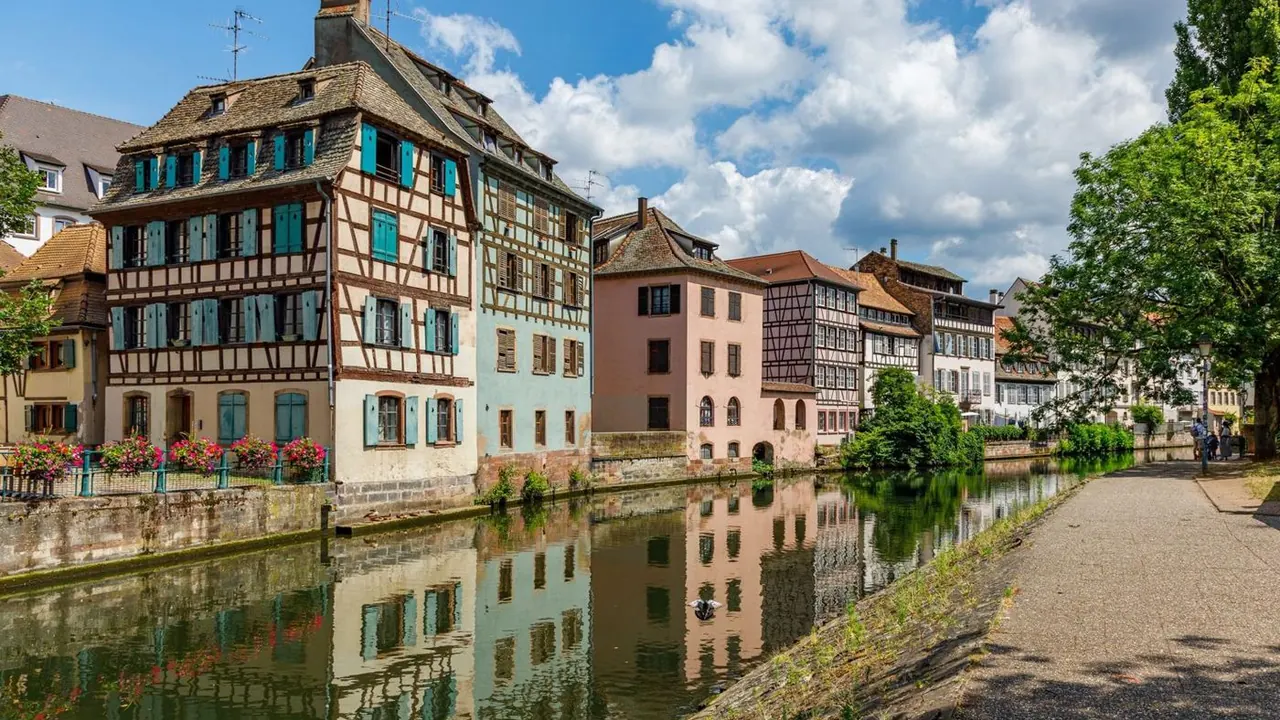
Half-timbered houses on the canal, Petite France
- Day trips80
- Getting around79
- Culture & sights70
Photo: Edoardo Colombo, Pexels License
Match
57
Every category weighted equally
- Beach & sun51
- Culture & arts63
- Food & nightlife57
- Family trip57
- Outdoors59
- Relax & unwind55
- Shopping & style59
- On a budget55
Strasbourg in twelve categories
Our verdict on each, scored 0 to 100 against the same fixed benchmark cities, so a score means the same thing on every page.
Beaches & swimming. Scores 10 out of 100.
Food & drink. Scores 66 out of 100.
Culture & sights. Scores 70 out of 100.
Nightlife. Scores 40 out of 100.
Nature & outdoors. Scores 62 out of 100.
Day trips. Scores 80 out of 100.
Good for families. Scores 66 out of 100.
Getting around. Scores 79 out of 100.
Shopping & style. Scores 52 out of 100.
Affordability. Scores 44 out of 100.
Live music & performing arts. Scores 56 out of 100.
Wellness & relaxation. Scores 55 out of 100.
Strasbourg category by category
Beaches & swimming
10Strasbourg is far inland, with no sea anywhere within reach. In summer, locals swim in the old gravel-pit lakes around the city. The best known is the Baggersee on the southern edge, which the tram reaches. Lac Achard, the Ballastière and the gravel pit at Reichstett to the north are also lifeguarded in July and August. They have grassy banks for lying out and calm, fresh water. The Rhine itself is not safe for swimming. The lakes are fine for a hot afternoon, but nobody comes to Strasbourg for the beach.
Food & drink
66Alsatian food draws on both French and German cooking: choucroute garnie heaped with sausages and pork, baeckeoffe stew baked in a sealed earthenware dish, tarte flambée straight from the oven, and kougelhopf and pretzels in the morning. The classic setting is the winstub, a wood-panelled wine tavern serving hearty plates with a pichet of Riesling, Sylvaner or Pinot Gris from the vineyards just to the south. Foie gras is a local speciality, and there is a strong fine-dining tier in the city and the nearby villages.
The covered market and the street markets are good for cheese, charcuterie and Munster, and the city brews a lot of beer. In December the streets fill with mulled wine and spiced bredele biscuits. The weak spots are the restaurants around the cathedral and Petite France, which mostly serve the same tourist menus, and a fairly limited choice of other cuisines. The food is rich and filling, which suits winter better than high summer.
Culture & sights
70The pink sandstone cathedral is the centrepiece. Its single spire stood over the city for centuries, and inside are the astronomical clock and fine medieval glass. It sits on the Grande Ile, the old town island enclosed by arms of the Ill, which is lined with timber-framed houses. Petite France, the former tanners' and millers' quarter, has half-timbered houses leaning over the locks, and the covered bridges and the Vauban dam stand guard at its edge. The German-built Neustadt, with its imperial avenues and grand public buildings, completes the UNESCO-listed ensemble.
The Palais Rohan holds three museums under one roof: fine arts, decorative arts and archaeology. The Oeuvre Notre-Dame museum keeps the cathedral's original sculptures, and the Alsatian Museum shows regional life in a group of old houses. Modern and contemporary art has its own large museum by the river. The European Parliament and the Council of Europe in the institutional quarter add a modern side. The main sights can be seen in two or three unhurried days.
Nightlife
40Going out in Strasbourg centres on bars. Its large university keeps the Krutenau quarter and the streets around Place Saint-Étienne busy, with student bars, beer cellars and a few cocktail bars. In summer, terraces along the quays and by the river stay full well into the evening. There are only a handful of clubs, and much of the city is quiet by midnight on weeknights. For a big night out, locals tend to head elsewhere, and visitors will find the evenings pleasant but rarely late.
Nature & outdoors
62The city itself is flat, with green space along the Ill and the Rhine, the large Orangerie park and the riverside forests of the Rhine plain, which are home to storks, herons and beavers. It is one of the best cycling cities in France, and long, level routes follow the Rhine and the canals into the countryside and across into Germany.
The real outdoors lies within about an hour in either direction. To the west, the Vosges rise above the vineyards, with forest trails, sandstone castle ruins, the ridge walk at Mont Sainte-Odile and rounded summits such as the Champ du Feu, which gets some snow in winter. To the east, the Black Forest offers more serious hiking among dense fir woods and on higher ridges. A car makes both much easier to reach, though trains and buses do go to the main trailheads.
Day trips
80Strasbourg is an excellent base for day trips. Colmar, about half an hour south by train, has canals, half-timbered streets and the Unterlinden Museum with the Isenheim Altarpiece. Between the two cities runs the Alsace wine route, where villages such as Obernai, Riquewihr, Eguisheim and Kaysersberg sit among vineyards with tasting cellars on every lane, and the rebuilt castle of Haut-Koenigsbourg looks down from a ridge above them.
Across the Rhine there is a second set of trips. The spa town of Baden-Baden is under an hour away, Freiburg's old town and minster are a little further, and Heidelberg with its castle ruin is around two hours. Basel, with its art museums, is reachable by train, as is Mulhouse with its large car and railway museums, and Nancy's Place Stanislas lies to the west. Trains cover the cities well. For the wine villages, a car or a bike makes the day much easier.
Good for families
66Strasbourg is easy to manage with children. The centre is flat, compact and mostly car-free, and trams and cycle paths make getting about simple. Boat trips through Petite France and around the Grande Ile are popular with families, and so is the Orangerie park, where storks nest, there are playgrounds and you can hire rowing boats on the lake. Le Vaisseau, a hands-on science centre, is built for children, and the astronomical clock's moving figures usually go down well.
The biggest draw for families is outside the city. Europa-Park, one of Europe's largest theme parks, is about an hour away across the border, and the Vosges have stork and monkey parks and castle ruins to climb. The Christmas market is magical for children, though very crowded. Most museums are aimed at adults.
Getting around
79The historic centre is an island small enough to cross on foot in twenty minutes, and much of it is pedestrianised. A tram network radiates from the centre, reaching the station, the European quarter, the university and the outskirts, and one line runs across the Rhine to Kehl in Germany. Strasbourg is also a cycling city, with an extensive network of separated lanes and bike hire, so a bike is often the quickest way about. A visitor has no need for a car in the city. A car only becomes useful for exploring the wine villages and the hills.
Shopping & style
52Shopping is centred on the old town: the streets around Place Kléber and the Rue des Grandes Arcades for chain stores and a large department store, and the smaller lanes near the cathedral for independent shops, delicatessens and bookshops. Regional things to take home include Alsace wines, Soufflenheim and Betschdorf pottery, printed linens, kougelhopf moulds, gingerbread and foie gras. The Christmas market, one of the oldest in Europe, makes December the peak season for crafts and decorations, though many stalls sell mass-produced goods. There is little luxury or fashion of note, and many locals cross to Kehl for everyday shopping.
Affordability
44Strasbourg costs about what you would expect of a large French regional city. That is much cheaper than the capital, but not a budget destination. Winstub meals and tarte flambée are reasonably priced, wine by the pichet is good value, and trams and bike hire are cheap. Many of the main sights, including the cathedral and the old town streets, are free. Hotel rooms are the main expense. They fill up and get much more expensive during the Christmas market and the weeks when the European Parliament sits, so timing a visit around those makes a real difference.
Live music & performing arts
56Strasbourg has a serious arts calendar for a city of its size. The Opéra national du Rhin performs in the classical opera house on Place Broglie, the Strasbourg Philharmonic plays a full season, and the Théâtre National de Strasbourg, with its drama school attached, is among France's leading stages. The Musica festival each autumn has made the city a centre for contemporary music, and there is a respected jazz festival and a regular programme of dance and experimental theatre. Smaller concert halls host rock and touring bands. There is no local live tradition to stumble across in the street, so evenings out need planning around the season.
Wellness & relaxation
55Strasbourg's own bathing institution is the Bains municipaux, an early twentieth-century public bathhouse with tiled pools, a hammam and saunas that locals use as a matter of course. The bigger draw is just across the Rhine. Baden-Baden, under an hour away, has the Friedrichsbad and Caracalla thermal baths, and the Black Forest has more spa towns besides. The city's pace helps too: quiet canal-side walks, long lunches in a winstub and cycling along the river make for an unhurried stay, except in December, when the Christmas market crowds take over the centre.
When should you go?
Pick a month to see what it is like. The climate figures are measured averages, not a forecast.
Strasbourg in July
Daytime high, °C
Rainfall in the month, mm
The whole year
Shaded against this city’s own year: the deepest cell is its best month for that figure and the palest its weakest.
Temperature and rainfall are climate normals, averaged over the years shown. Strasbourg: 1991-2020 normals, Strasbourg (9.1 km from centre).
Before you go
| Measure | Strasbourg |
|---|---|
| Official language | French |
| Currency | Euro (EUR) |
| Sockets | CE230 V, 50 Hz |
| Driving side | Right |
| Time zone | UTC+1, UTC+2 in summer |
| Emergency number | 112 |
| Elevation | 132 m |
| Main airport | Strasbourg Airport (SXB)10 km from centre43 non-stop destinations |
| Public holidays this year | 11 days |
By the numbers
| Measure | Strasbourg |
|---|---|
| City population | 293,771 |
| People per km² | 3,752 |
| Museums within 10 km | 21 |
| UNESCO World Heritage sites within 50 km | 1 |
Compare Strasbourg with
Every comparison with a written verdict behind it.