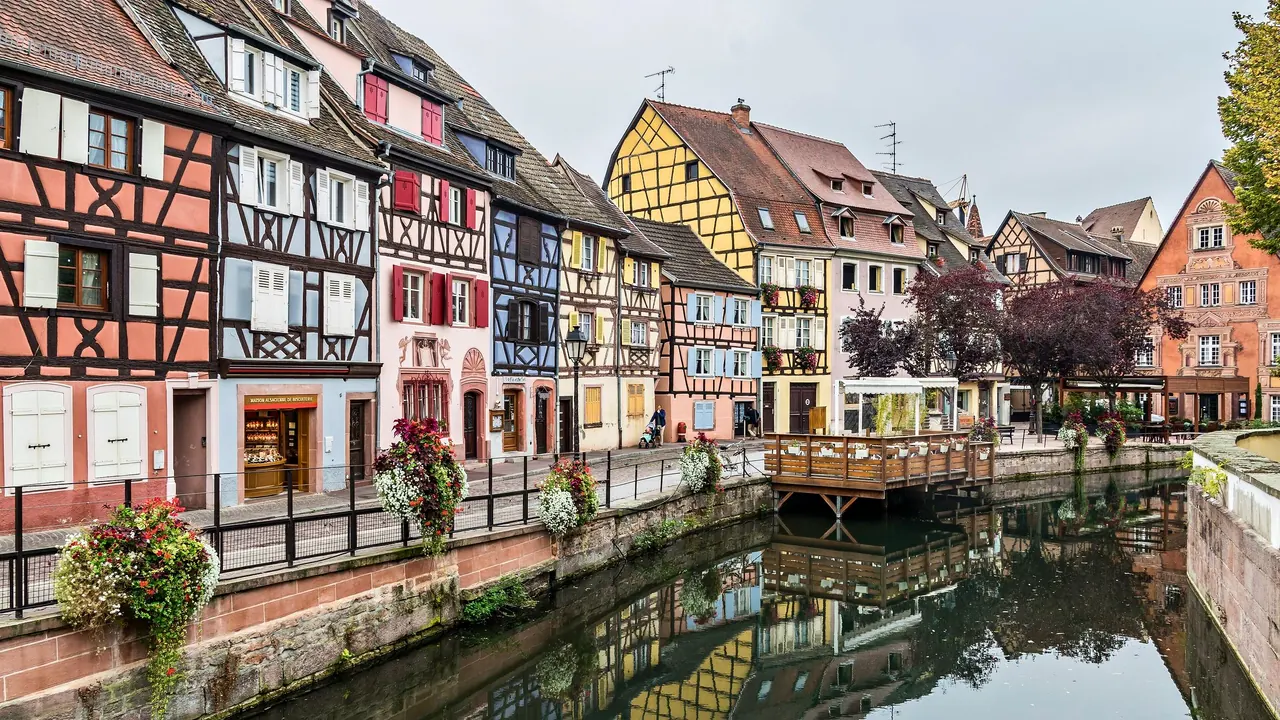
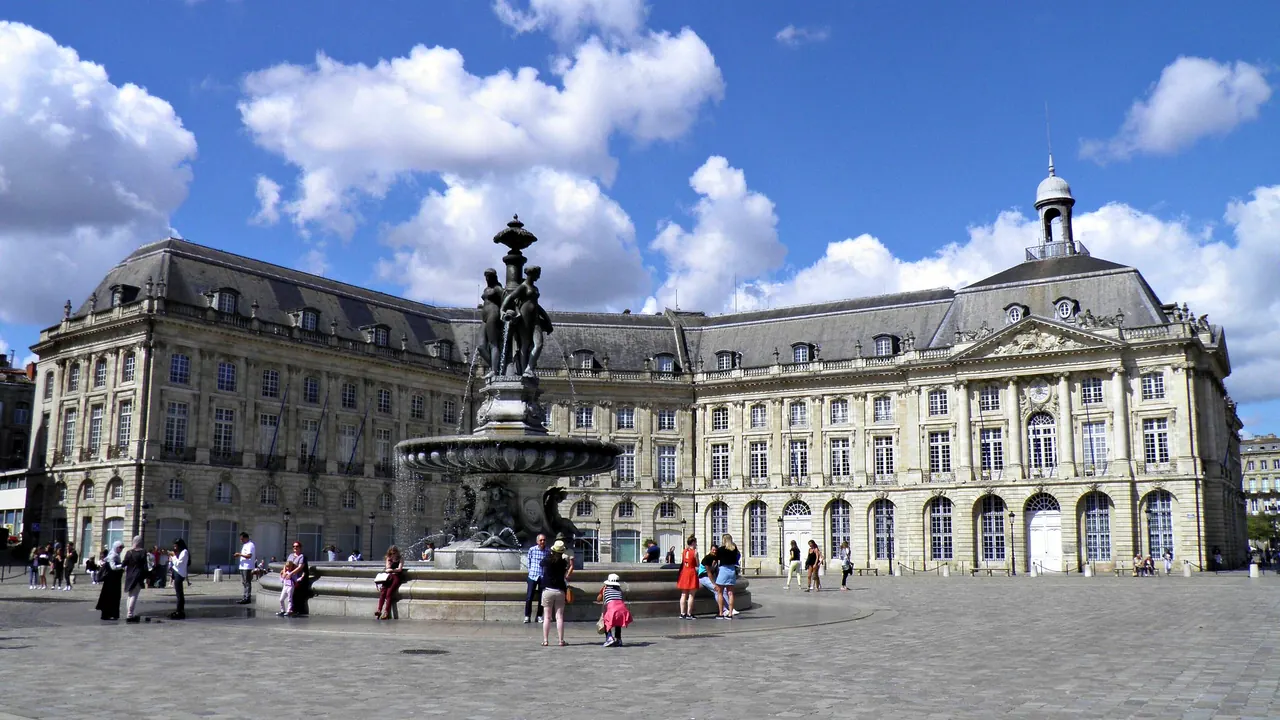
Photos: Alsace by Krzysztof Golik, CC BY-SA 4.0, cropped; Bordeaux by Gzen92, CC BY-SA 4.0, cropped.
Alsace or Bordeaux?
Our verdict in twelve categories, each scored against the same fixed benchmark cities, and the climate month by month, so you can choose for your trip.
Choose Alsace for
- families
- wellness
- culture and sights
Alsace suits a slower trip that moves from place to place: a few days in Strasbourg for the cathedral and Petite France, then a base in a wine village at the foot of the Vosges for cellar tastings, walks to ruined castles and quiet afternoons at a spa. Families do especially well here. Europa-Park, the monkey and eagle parks and Mulhouse's big museums are all within easy reach, as long as you're happy to hire a car.
Choose Bordeaux for
- beaches
- nightlife
- getting around
Choose Bordeaux if you want one city base and no car. Its limestone centre is flat and served by trams, the evenings run later, with wine bars and a strip of clubs, and in summer the Atlantic beaches and the Dune du Pilat are about an hour away. Alsace, far inland, has nothing like them.
Scoreboard
Twelve categories on one fixed scale from 0 to 100. The shaded stretch is the gap between the two.
Your match
Pick a travel style or drag the sliders, and both match scores follow your weighting.
Too close to call, level with your weighting
Wins on families and wellness with your weighting.
Wins on beaches and nightlife with your weighting.
What matters to you?
Category by category
What the scores mean for a trip.
Beaches & swimming
A beach trip needs Bordeaux, which has the Atlantic about an hour west. Lacanau and the Médoc have long, wild sand beaches backed by dunes, with surf and lifeguarded zones. The Arcachon basin and the beaches below the Dune du Pilat have calmer water, gentle enough for small children in July and August.
Alsace has nothing comparable. Its summer swimming is in gravel-pit lakes on the Rhine plain, a few chilly mountain lakes and the town pools. These are fine for cooling off after a hot day of sightseeing, but they are no reason to choose the region.
Food & drink
Both are excellent places to eat, but in different ways. Alsace has a hearty Franco-German cooking of its own, found in wood-panelled winstubs: choucroute, baeckeoffe, flammekueche from a wood oven. Riesling and Gewurztraminer are tasted in growers' cellars along the wine road, and the region's beer adds to them. Its serious restaurants are scattered through the villages as well as Strasbourg.
Bordeaux puts wine first and pours it in the city itself. Wine bars serve Médoc, Saint-Émilion and Sauternes by the glass. Its cooking is south-western and generous: entrecôte grilled over vine cuttings, Landes duck, and oysters from Arcachon eaten at the counters of the Capucins market. In both places, food from beyond France is limited.
Culture & sights
Alsace has the deeper heritage. Strasbourg's red sandstone cathedral and its astronomical clock, the UNESCO-listed island centre, and Colmar's Isenheim Altarpiece would carry a trip on their own. Haut-Koenigsbourg, the Romanesque churches and the national car and railway museums in Mulhouse add further variety.
Bordeaux's great sight is the city as a whole: an 18th-century limestone riverfront, the Place de la Bourse and the Grand Théâtre, best taken in on a slow walk. Its museums, including the Musée d'Aquitaine and the CAPC, are worth a visit but are not famous, and three or four days covers them.
Nightlife
Bordeaux makes for the longer night out. Students fill Place de la Victoire, and the terraces of Saint-Pierre stay busy on warm evenings. On the Quai de Paludate, a row of old warehouses near the station, the clubs open late and stay open until morning.
Alsace goes to bed earlier. Strasbourg's Krutenau quarter and the streets near the cathedral have plenty of beer and wine bars, but there are only a few clubs. In the wine villages the evening ends over a bottle at the winstub, and young locals wanting a bigger night often head to Basel.
Nature & outdoors
Alsace has proper walking country. The Vosges rise behind the vineyards to the Grand Ballon at 1,424m, with the GR5 and many well-kept marked trails, and the Route des Crêtes looks across the Rhine plain towards the Black Forest. In winter there is light skiing and snowshoeing.
The land around Bordeaux is flat: vineyards, river meadows and the Landes pine forest. Its natural highlights are on the coast, an hour away: the Dune du Pilat, birdwatching and kayaking on the Arcachon tidal flats, and surf along the Médoc. It is good cycling country but has no hills to hike.
Day trips
In Alsace the stops are close together. The walled wine villages at the foot of the Vosges lie only a few kilometres apart, so one day can take in Riquewihr, Kaysersberg and Eguisheim, and Strasbourg and Colmar are half an hour apart by train. Across the borders, Basel and Freiburg are within easy reach, and to the west Nancy is about an hour and a half from Strasbourg.
From Bordeaux the trips go out in separate directions and cover longer distances. Saint-Émilion is about forty minutes away by train, the Médoc châteaux run up the estuary, Sauternes lies to the south, Arcachon is on the coast and Cognac is about two hours away. Many of the estates are easiest to visit with a car or a tour.
Good for families
Alsace is far better for children. Europa-Park lies across the Rhine within an hour. Near Kintzheim you can fill a day with macaques on a forest hillside, eagle shows at a castle and a stork park, and Mulhouse adds a zoo and its railway and car museums. You will need a car for most of it.
Bordeaux is pleasant with small children but has less made for them. The Miroir d'eau doubles as a paddling pool, and the Jardin Public has its puppet theatre. The best family days are climbing the Pilat dune and paddling in the Arcachon basin. Teenagers may tire of a trip built around long meals.
Getting around
Bordeaux is the easier trip without a car. The flat centre is largely pedestrianised, the sights lie along a few kilometres of the left bank, and trams reach the Cité du Vin and the station. Only the Médoc and Sauternes estates call for a driver.
In Alsace, the trains along the Rhine plain between Strasbourg, Colmar and Mulhouse are quick and frequent, and Strasbourg has trams and excellent cycle lanes. The wine villages and the Vosges are another matter, though. Buses there are infrequent, so most visitors hire a car, and parking in the popular villages fills up in summer and December.
Shopping & style
The two are evenly matched, but the shopping is different. Alsace is best for regional crafts: Betschdorf stoneware, Soufflenheim baking moulds and kelsch linen. In December its Christmas markets make shopping the main reason to come, though for the rest of the year the villages sell mostly souvenirs.
Bordeaux has more fashion. Luxury labels gather in the Triangle d'Or, Rue Sainte-Catherine has the chains, and Chartrons has antiques. Its wine merchants, who stock rare vintages and ship abroad, are the strongest reason to shop here.
Affordability
Neither is cheap, and they cost much the same. In Alsace, rooms in Strasbourg and Colmar become scarce and expensive in December and during European Parliament sessions. Guesthouses and self-catering flats in the wine villages are better value, but car hire adds to the bill.
In Bordeaux, hotel prices peak in summer and during the big wine events. You can save with set lunches and cheap trams, and the money goes on château tours and good bottles.
Live music & performing arts
Both have a solid regional scene. Strasbourg offers more variety: the Opéra national du Rhin, a leading national drama house and autumn festivals of jazz and contemporary music, with Colmar's classical festival in summer and concerts in village churches.
Bordeaux has one outstanding stage, the gilded Grand Théâtre of 1780, home to the city's opera and ballet. A right-bank hall programmes jazz and world music. The seasons pause in high summer, so this is a city for culture outside July and August.
Wellness & relaxation
Alsace is the better place to unwind. It has thermal waters at Niederbronn-les-Bains and Morsbronn, spa hotels in the vineyards and Vosges valleys, and Baden-Baden's great baths within an hour of Strasbourg. A wine-village stay is calm by nature, though Strasbourg in December is not.
Bordeaux has no bathing tradition. Its speciality is vinotherapy, grape-based treatments at a few spa hotels among the vineyards. Otherwise relaxing means long lunches and walks along the quays, and the nearest thermal springs are at Dax, about an hour and a half away.
When should you go?
Pick your month. The climate figures are measured averages, not a forecast.
Alsace in July
Bordeaux in July
Daytime high, °C
Rainfall in the month, mm
Temperature and rainfall are climate normals, averaged over the years shown. Alsace: 1991-2020 normals, Ihringen (20.8 km from centre). Bordeaux: 1991-2020 normals, Bordeaux / Merignac (9.5 km from centre).
Alsace has the sharper seasons. Winters are cold, with daytime highs around 6°C in December and January, though these are also the driest and greyest months. The wettest spell comes in late spring, peaking in May. From June to August it is warm and sunny, good for the wine road and the Vosges ridges, and September is still mild enough for long days outdoors before the cold returns in November.
Bordeaux is milder all year. Winter highs stay around 11°C, but this is the wet season, with about 114mm of rain in November. Summer is a little hotter, reaching 28°C in August, and July is the driest month. July and August are the months for the beaches. September, at around 24°C, and late spring are the most comfortable times for walking the city.
Which traveller are you?
On a beach and sun trip, landlocked Alsace has only lakes and town pools, so choose Bordeaux. The Atlantic is about an hour away, with surf on the open coast and calmer, warmer water in a sheltered basin.
On a family trip with children, Alsace has far more made for young visitors. Theme parks, animal parks and big museums are all a short drive apart in an easy, safe region. Bordeaux revolves around wine and long meals, and children soon find it slow.
For a relaxing and wellness trip, Alsace has its own tradition of thermal bathing, and its vineyards and quiet valleys set an unhurried pace. Bordeaux has no springs of its own, so unwinding there comes down to hotel spas and the slow rhythm of the city.
Before you go
| Measure | Alsace | Bordeaux |
|---|---|---|
| Official language | French | French |
| Currency | Euro (EUR) | Euro (EUR) |
| Sockets | CE230 V, 50 Hz | CE230 V, 50 Hz |
| Driving side | Right | Right |
| Time zone | UTC+1, UTC+2 in summer | UTC+1, UTC+2 in summer |
| Emergency number | 112 | 112 |
| Elevation | - | 1 m |
| Main airport | Strasbourg Airport (SXB)43 non-stop destinations | Bordeaux–Mérignac Airport (BOD)11 km from centre97 non-stop destinations |
| Public holidays this year | 11 days | 11 days |
By the numbers
| Measure | Alsace | Bordeaux |
|---|---|---|
| Population | - | 267,991 |
| People per km² | - | 5,425 |
| Museums within 10 km | - | 18 |
| UNESCO World Heritage sites within 50 km | - | 4 |
Where else could you go?
Every comparison below shares a destination with this one, so you can follow Alsace or Bordeaux somewhere new.
- Black Forestvs Alsace
- Swiss Alpsvs Alsace
- Biarritzvs Bordeaux
- San Sebastianvs Bordeaux
- Toulousevs Bordeaux
- Basque Countryvs Bordeaux