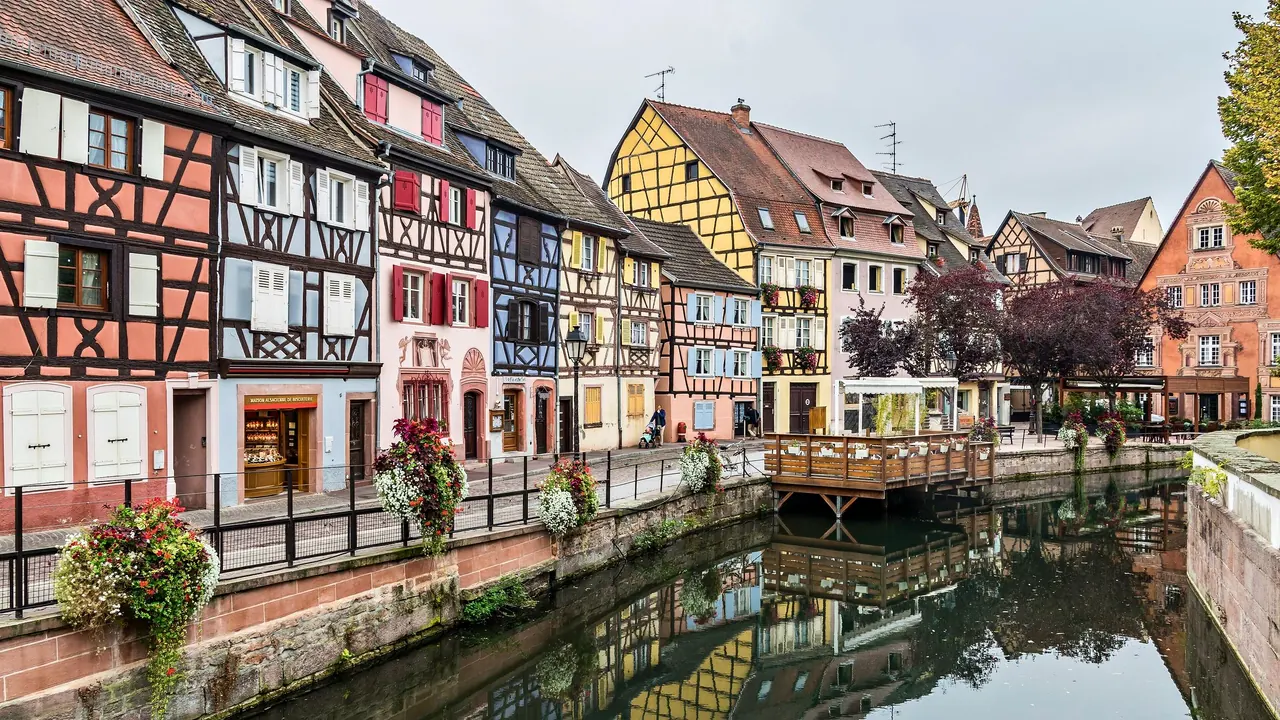
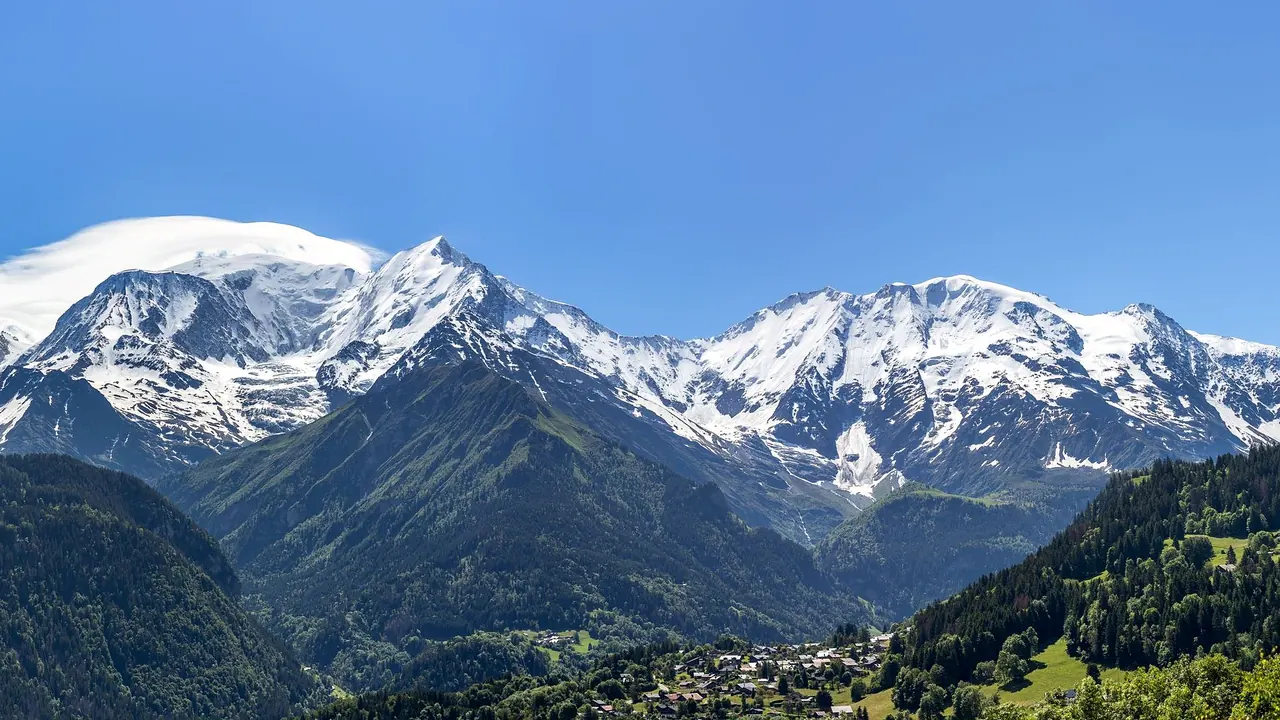
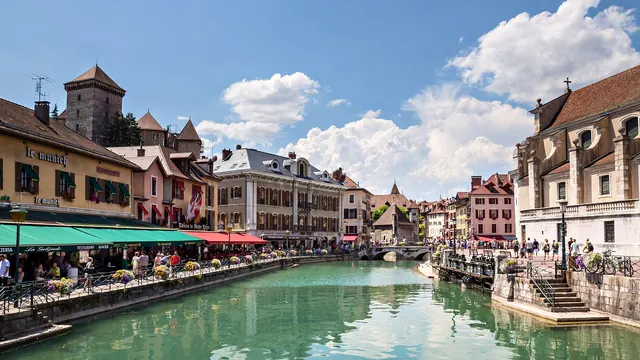
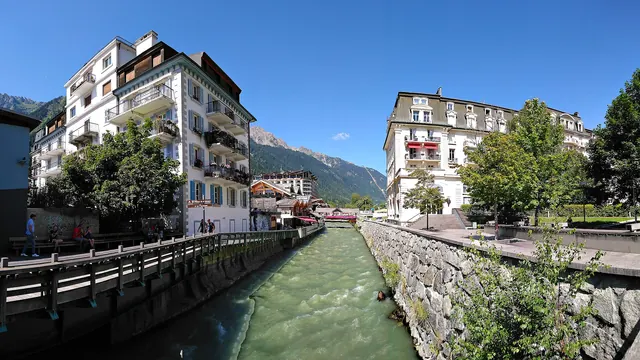
Photos: Alsace by Krzysztof Golik, CC BY-SA 4.0, cropped; French Alps by Marek Piwnicki, Pexels License.
Alsace or French Alps?
Our verdict in twelve categories, each scored against the same fixed benchmark cities, and the climate month by month, so you can choose for your trip.
Choose Alsace for
- culture and sights
- live music and the arts
- getting around
Alsace suits a trip built around eating, drinking and looking. The wine road with its winstubs and growers' cellars, Strasbourg's cathedral and Colmar's Isenheim Altarpiece all lie a short train ride or drive apart. Of the two it is the easier, cheaper and more cultured choice. There is gentle Vosges walking when you want fresh air, though the scenery never matches the Alps.
Choose French Alps for
- beaches
- nature and the outdoors
- nightlife
Choose the French Alps if the landscape itself is the point. Mont Blanc, the Vanoise and Écrins national parks and the huge linked ski areas of the Tarentaise give you a mountain vacation that Alsace cannot. You also get summer swimming in Lake Annecy, a proper après-ski night out in winter and old spa towns such as Aix-les-Bains. In return, expect to pay more and to rely on a car or a transfer.
Scoreboard
Twelve categories on one fixed scale from 0 to 100. The shaded stretch is the gap between the two.
Your match
Pick a travel style or drag the sliders, and both match scores follow your weighting.
Too close to call, 2 points apart
Wins on culture and sights and live music and the arts with your weighting.
Wins on beaches and nature and the outdoors with your weighting.
What matters to you?
Category by category
What the scores mean for a trip.
Beaches & swimming
Neither has a sea, but only the Alps have lake swimming worth planning around. In Alsace there are flooded gravel pits on the Rhine plain and a few cold lakes in the Vosges, good for a hot afternoon and little more.
Lake Annecy is the real thing, with clear water around 23°C in high summer and grassy shores at Sévrier and Talloires. Lac du Bourget, little Aiguebelette and the pebbly lidos at Évian add to it. Even so, it is a pleasant part of a summer stay rather than a beach vacation.
Food & drink
Alsace has the richer table. Its winstubs serve choucroute, baeckeoffe and flammekueche. Along the Route des Vins you taste Riesling and crémant in the growers' own cellars, and serious restaurants are spread through the wine villages as well as Strasbourg.
Savoyard food is good but narrower: fondue, tartiflette and Beaufort or Reblochon bought from the farm, with perch from the lakes and white wines from Savoie. At the very top, in Megève, Courchevel and around Lake Annecy, the Alps match Alsace. Below that level the melted-cheese menu repeats itself in a way Alsatian cooking does not.
Culture & sights
Alsace is well ahead for sights. Strasbourg's sandstone cathedral and its UNESCO-listed island centre and Neustadt are enough to justify a trip. Add Colmar's Unterlinden Museum with the Isenheim Altarpiece, Haut-Koenigsbourg and walled villages such as Riquewihr, and culture becomes the main reason to come.
The Alps offer pleasant half days instead: Annecy's canals and the Palais de l'Isle, the ducal château in Chambéry, Grenoble's fine-arts museum and Briançon's Vauban walls. They round off a mountain stay rather than carry one.
Nightlife
The Alps go out harder, but mostly in winter. From December to April, Val Thorens, Val d'Isère and Méribel start with table-dancing at mountain restaurants and end in clubs in the small hours. In summer the evenings move to Annecy's lakeside terraces and Grenoble's student bars.
Going out in Alsace means Strasbourg, with beer and wine bars in Krutenau and around the cathedral and only a few clubs. In the villages the evening ends at the winstub. It stays much the same all year but finishes early and stays modest.
Nature & outdoors
This is where the two differ most. The Vosges are fine walking country, with the Route des Crêtes along the high pastures, well-marked long-distance trails and ruined castles on the spurs. But they top out at the Grand Ballon at 1,424m, and the skiing is modest.
The Alps work on another scale. Mont Blanc rises above Chamonix, a cable car climbs to the Aiguille du Midi at 3,842m among glaciers and granite spires, ibex roam the Vanoise and Écrins, and the Tarentaise holds vast linked ski areas. Paragliding, via ferrata, rafting and the great cycling climbs over the Galibier and Madeleine add summer options Alsace cannot offer.
Day trips
Alsace makes the easier base for outings. The wine villages are only a few kilometres apart, and Strasbourg and Colmar are half an hour apart by train. Basel, Freiburg, Baden-Baden and Heidelberg are all reachable across the borders.
The Alps work well from Annecy or Lake Geneva, with Geneva, the ferry to Lausanne and Lavaux, Yvoire and Lyon within reach. From Chamonix the Mont Blanc tunnel opens the way to Courmayeur and Aosta. From the deep Tarentaise resorts, though, most of the day goes on winding roads.
Good for families
With Europa-Park just across the Rhine within an hour, plus the macaque forest, eagle shows and stork park near Kintzheim, Alsace has a full week of easy days out for children. Mulhouse adds its railway and car museums, though much of this needs a car.
The Alps suit families who ski. Children's ski schools and car-free resorts such as Avoriaz and Flaine make winter simple, and in summer there is the train to the Mer de Glace, marmot spotting and Annecy's shallow lake beaches. Cold mornings, altitude and long transfer days are harder on small children.
Getting around
Alsace is simpler to get around. Regional trains run the length of the plain, and Strasbourg has trams and excellent cycle routes. Only the wine villages and the Vosges really call for a car, and the distances are short and the roads good.
In the Alps, lifts make getting around within a resort easy. Getting there means a transfer or a drive from Geneva, Lyon or Grenoble, with Saturday queues up the Tarentaise and snow chains in winter. In summer the separate valleys and winding passes make a car close to essential.
Shopping & style
Both are better for regional buys than for fashion, and Alsace has a slight edge. It has Strasbourg's streets around Place Kléber and, in December, the long-established Christmas markets of Strasbourg, Colmar and the villages. Betschdorf stoneware, Soufflenheim baking moulds and wine bought from the growers make good things to take home.
The Alps are more specialised. Chamonix is the place for technical climbing and ski gear, and Courchevel 1850 and Megève have luxury boutiques. Annecy's markets are the place for Opinel knives, Beaufort and Génépi.
Affordability
Neither is cheap, but Alsace is clearly easier on the budget. Outside December and the European Parliament sessions, guesthouses and flats in the wine villages are fair value. Winstub portions are generous, and wine from the growers is good value.
Once lift passes, equipment hire and ski school are added, the big Alpine resorts in winter are among the dearest places to stay in Europe, and Annecy is expensive in summer. Low-season weeks, self-catering, and towns such as Grenoble and Chambéry bring costs back down to ordinary French levels.
Live music & performing arts
Alsace has the stronger stage, almost all of it in Strasbourg. The Opéra national du Rhin, the Philharmonic Orchestra and the Théâtre National de Strasbourg mean there is a good performance most weeks. Autumn jazz and contemporary music festivals and Colmar's summer classical festival add to that.
In the Alps, Grenoble's arts centre provides most of the year-round programme, and the best events come in summer: chamber music at Évian and open-air concerts in Chamonix. In the ski season it mostly comes down to bands in après-ski bars.
Wellness & relaxation
The Alps have the deeper spa tradition. Aix-les-Bains and Évian are grand old resorts built around their waters, and Saint-Gervais has baths in a gorge below Mont Blanc. Smaller towns such as Brides-les-Bains exist mainly for the cure.
Alsace has Niederbronn-les-Bains, spas in vineyard hotels and Baden-Baden across the Rhine. Its real calm, though, comes from the slow pace of a stay in a wine village. Each loses its peace at its busiest time: Strasbourg in December and the ski resorts in full winter swing.
When should you go?
Pick your month. The climate figures are measured averages, not a forecast.
Alsace in July
French Alps in July
Daytime high, °C
Rainfall in the month, mm
Where the figures come from
French Alps's temperatures are measured 35 km from the centre, at Bourg-St-Maurice.
French Alps's station stands 179 m below the place it is measured for, so that place is likely a little cooler than the figures say.
French Alps has no rain gauge within 25 km of the centre, so its rainfall comes from a gridded climate dataset read at the destination rather than from a gauge further away.
Temperature and rainfall are climate normals, averaged over the years shown. Alsace: 1991-2020 normals, Ihringen (20.8 km from centre). French Alps: 1999-2020 (rainfall 1991-2020) normals, Bourg-St-Maurice (35.1 km from centre).
Alsace is warm from June to August, with daytime highs around 27°C, and July and August bring the long sunny days. Even its wettest month, May, sees only 87mm of rain, so late spring through September suits the wine road and the Vosges trails. Winter is cold and grey, around 6°C in December with little sun, and is a time to come for the Christmas markets rather than long walks.
In the French Alps, around the lake and valley towns where most visitors stay, temperatures follow Alsace closely. The difference is the rain. More than 100mm falls in every month, with the most in late autumn and early winter, and higher up much of it falls as snow. July and August are the months for hiking, the high passes and swimming in Lake Annecy, and September is still mild enough for comfortable walking. In winter you come for the slopes, not for strolling round the towns.
Which traveller are you?
On a culture and arts trip, Alsace is the clear choice. Strasbourg's cathedral and UNESCO-listed centre, the Isenheim Altarpiece in Colmar and a full season of opera and theatre fill several days. The Alpine towns are pleasant breaks between mountain outings.
For an outdoors trip, go to the French Alps. Glaciers below Mont Blanc, the Tour du Mont Blanc, ibex in the Vanoise, paragliding over Lake Annecy and some of the largest ski areas anywhere outclass the gentle, green walking of the Vosges.
On a tight budget, Alsace makes your money go further. Wine-village guesthouses, generous winstub meals, wine bought from the growers and trains between the main towns keep costs down. An Alpine ski week quickly adds up with lift passes, equipment hire and resort prices.
Before you go
| Measure | Alsace | French Alps |
|---|---|---|
| Official language | French | French |
| Currency | Euro (EUR) | Euro (EUR) |
| Sockets | CE230 V, 50 Hz | CE230 V, 50 Hz |
| Driving side | Right | Right |
| Time zone | UTC+1, UTC+2 in summer | UTC+1, UTC+2 in summer |
| Emergency number | 112 | 112 |
| Main airport | Strasbourg Airport (SXB)43 non-stop destinations | Geneva International Airport (GVA)150 non-stop destinations |
| Public holidays this year | 11 days | 11 days |
Where else could you go?
Every comparison below shares a destination with this one, so you can follow Alsace or French Alps somewhere new.
- Black Forestvs Alsace
- Swiss Alpsvs French Alps
- Lake Maggiorevs French Alps
- Swiss Alpsvs Alsace
- Piedmontvs French Alps
- Lake Comovs French Alps