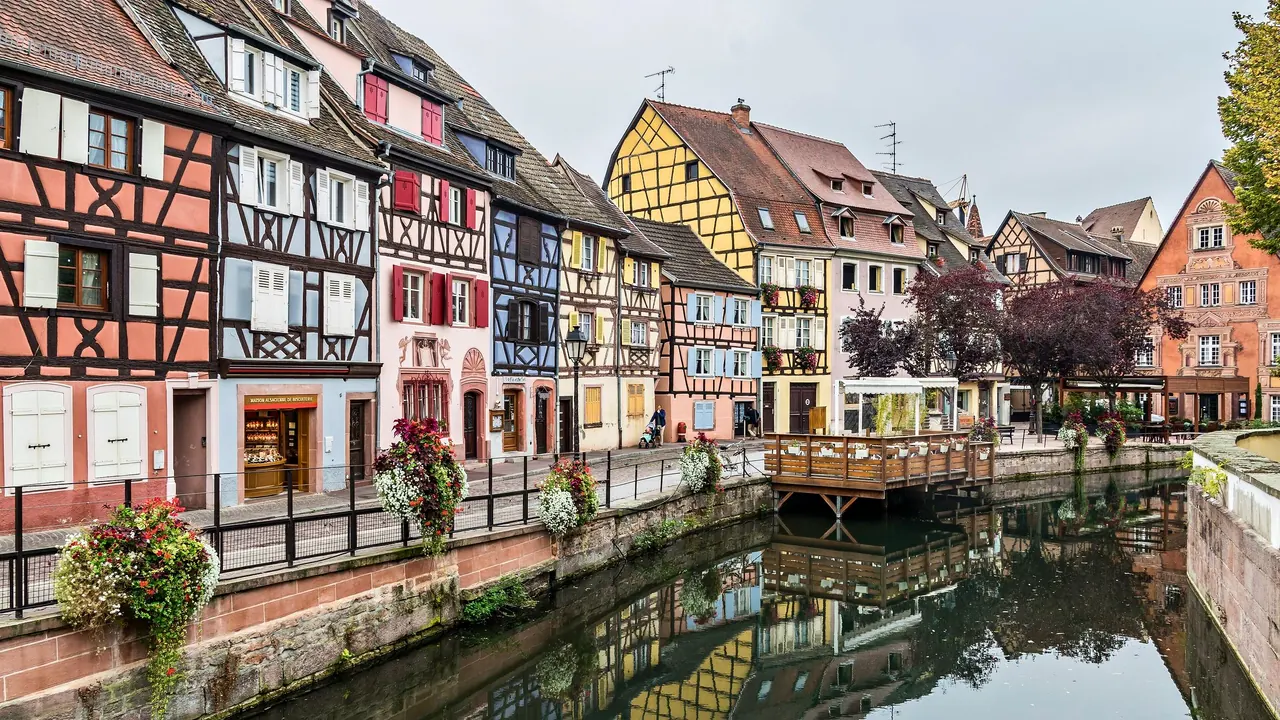
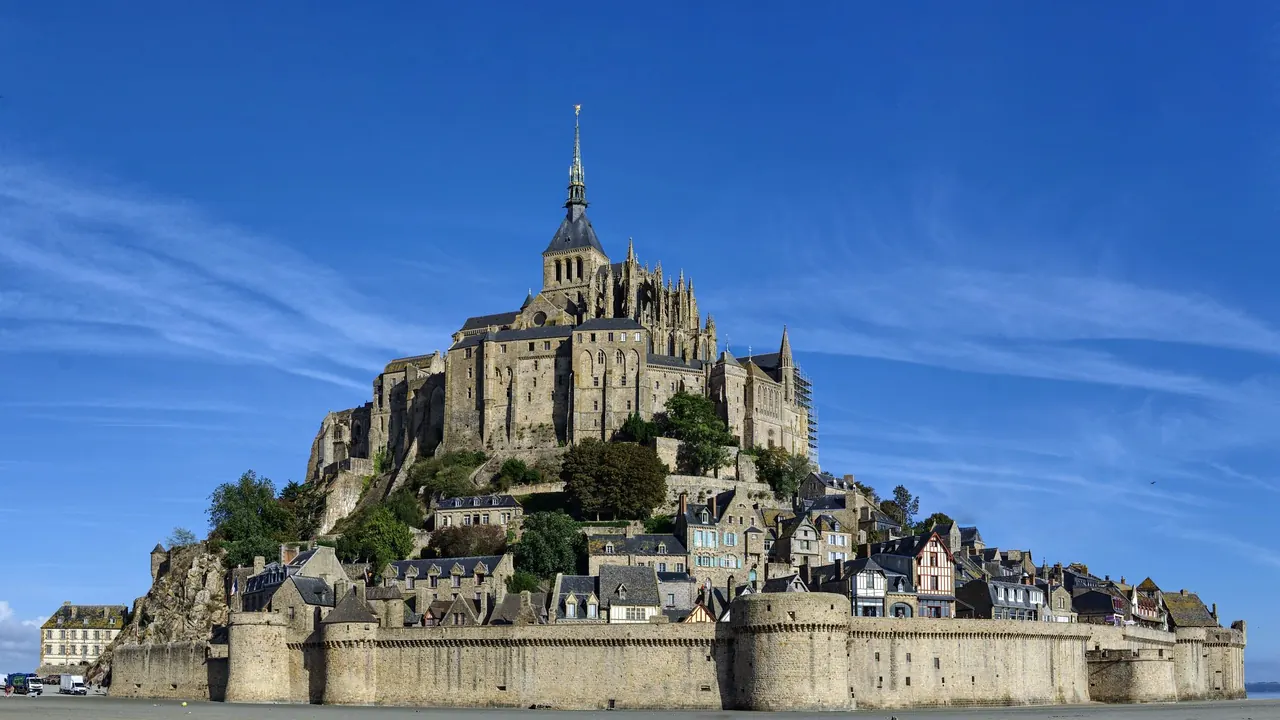
Photos: Alsace by Krzysztof Golik, CC BY-SA 4.0, cropped; Normandy by Jan, Pexels License.
Alsace or Normandy?
Our verdict in twelve categories, each scored against the same fixed benchmark cities, and the climate month by month, so you can choose for your trip.
Choose Alsace for
- families
- live music and the arts
- getting around
Alsace suits travellers who want a compact, easily run trip built around wine and good cooking. The wine villages sit a few kilometres apart along the foot of the Vosges, trains link Strasbourg, Colmar and Mulhouse, and Basel, Freiburg and Europa-Park lie just over the borders. Strasbourg adds opera, theatre and livelier evenings, and families have more to do here. You give up the sea entirely.
Choose Normandy for
- beaches
- prices
Normandy is the better pick for a trip shaped by history and the coast. The draws are Mont-Saint-Michel, the Bayeux Tapestry and the D-Day landing beaches, followed by sandy resorts on the Côte Fleurie and the chalk cliffs at Étretat. The region is spread out and the Channel is cool, so plan on a car and two bases. Alsace has no beaches and nothing to match the landing beaches.
Scoreboard
Twelve categories on one fixed scale from 0 to 100. The shaded stretch is the gap between the two.
Your match
Pick a travel style or drag the sliders, and both match scores follow your weighting.
Wins on families and live music and the arts with your weighting.
Wins on beaches and prices with your weighting.
What matters to you?
Category by category
What the scores mean for a trip.
Beaches & swimming
Neither region is a beach destination, but only Normandy has a coast. The sandy resorts of Deauville, Trouville, Cabourg and Houlgate have a long seaside tradition, and the west Cotentin is wilder and emptier. The cool Channel and the big tides limit swimming to the summer and to high water.
Alsace lies hundreds of kilometres from any sea. Swimming there means lifeguarded gravel-pit lakes on the Rhine plain, a few cold Vosges lakes and town pools. They are good for a hot afternoon and nothing more.
Food & drink
Alsace has the richer table. The winstub serves choucroute, baeckeoffe and flammekueche, there are more serious restaurants than the region's size suggests, and the 170km wine road lets you taste Riesling and crémant in the growers' cellars. Kaysersberg and Riquewihr make a slow, wine-led stay easy.
Normandy's strengths are its ingredients rather than its range: Camembert and Livarot, butter and cream, oysters from Isigny, and cider and calvados from Pays d'Auge farms. Harbour-front seafood in Honfleur or Granville is the high point. Outside Rouen the choice narrows quickly.
Culture & sights
These two are evenly matched, but the heritage is laid out differently. In Alsace it is concentrated and urban: Strasbourg's sandstone cathedral and its UNESCO-listed centre, the Isenheim Altarpiece in Colmar, and walled wine villages that are monuments in their own right.
Normandy's sights are fewer but more famous, and spread further apart. Mont-Saint-Michel, the Bayeux Tapestry, the D-Day beaches and Rouen's cathedral are each worth a journey. Seeing them all means moving between bases.
Nightlife
Both regions have quiet nights, but Alsace has a little more going on because of Strasbourg. Krutenau's student bars, the wine bars near the cathedral and the summer quays give a sociable evening. In Normandy you need to be in Rouen or Caen's Vaugueux quarter to find much open late. Deauville's casino is the region's one smart alternative.
Nature & outdoors
One region has a mountain ridge and the other a coastline, and the ridge gives walkers more. In Alsace the Vosges rise straight behind the vineyards, with the Route des Crêtes, the GR5 and castle-topped spurs looking across to the Black Forest. In winter there is some modest skiing on the ballons.
Normandy is at its best along the shore. Its highlights are Étretat's chalk arches, the granite headlands of Cap de la Hague and the guided walks across the bay of Mont-Saint-Michel. Inland it is flat, hedged bocage, and only the Suisse Normande has real hills.
Day trips
Alsace is the easier base for outings because everything is close. Three or four wine villages fit into a single day, and Basel, Freiburg and Baden-Baden are short trips over the borders.
Normandy has a longer list of outings but greater distances between them. Honfleur, the Pays d'Auge villages, Saint-Malo and summer ferries to Jersey all work from the right base. Paris is under two hours from Rouen by train.
Good for families
Alsace has far more built for children. Europa-Park is just across the Rhine, and near Ribeauvillé there are macaques in the forest, falconry at a castle and a stork park. Mulhouse has its railway museum and zoo, and Strasbourg has boat trips through Petite France.
Normandy is calm and safe but less exciting for children. Its best days are spent on the sand and in rock pools, at Cité de la Mer's submarine in Cherbourg and at Cerza zoo. Cold water and long drives get in the way.
Getting around
Alsace is much easier without a car. One rail line runs down the plain through Strasbourg, Sélestat, Colmar and Mulhouse, and Strasbourg has trams and excellent cycle lanes. You only really need a car for the remoter wine villages and the crest road.
In Normandy, trains reach the main towns, but the landing beaches, Étretat and Mont-Saint-Michel are poorly served by public transport. With Rouen around three hours by road from the Mont, a car and two bases are close to essential.
Shopping & style
In Alsace the typical buys are crafts: grey-and-blue Betschdorf stoneware, Soufflenheim baking moulds and kelsch linen. Strasbourg's streets around Place Kléber add department stores and boutiques, and in December the Christmas markets become the main reason to shop, which gives Alsace the wider choice.
In Normandy, most of what you bring home is edible: calvados, cheese and salted-butter caramels. Beyond that there is lace from Bayeux and Alençon, copper from Villedieu, a few boutiques in Deauville and the galleries of Honfleur.
Affordability
Costs are much the same in both, and each has its expensive spots. In Alsace, rooms in Strasbourg and Colmar get scarce in December and during Parliament sessions, while village guesthouses stay reasonable. In Normandy, Deauville, Honfleur and the area around the Mont cost more in July and August. Normandy's free D-Day sites help the budget, but car hire is harder to avoid there.
Live music & performing arts
Alsace is the stronger choice for an evening out at a performance, almost entirely thanks to Strasbourg. The Opéra national du Rhin, the Philharmonic and the Théâtre National de Strasbourg all perform there, and there are autumn festivals of jazz and contemporary music. Colmar adds a classical festival in summer.
Normandy has Rouen's Théâtre des Arts and stages in Caen and Le Havre. Its standout event is Jazz sous les Pommiers in Coutances, but most evenings there is little to attend.
Wellness & relaxation
Both regions are restful in equal measure, but the waters differ. Alsace has thermal springs at Niederbronn-les-Bains, spa hotels among the vines, and the baths of Baden-Baden across the Rhine. Normandy has seawater cures along the coast from Deauville to Granville, plus the belle-époque spa town of Bagnoles-de-l'Orne. Avoid Strasbourg in December and the Côte Fleurie in August if quiet is the goal.
When should you go?
Pick your month. The climate figures are measured averages, not a forecast.
Alsace in July
Normandy in July
Daytime high, °C
Rainfall in the month, mm
Temperature and rainfall are climate normals, averaged over the years shown. Alsace: 1991-2020 normals, Ihringen (20.8 km from centre). Normandy: 1991-2020 normals, Caen (21 km from centre).
Alsace has the warmer, sunnier summers and the colder winters of the two. From June to August the Rhine plain reaches 27°C, warm enough for an afternoon at a lake, but late spring and summer are also its wettest stretch, with May the wettest month of all. Midwinter highs of about 6°C make for chilly walking, though the winter months are the driest of the year. September and the drier days of late spring are the most comfortable time for the wine route and the Vosges trails.
Normandy stays milder all year. Summer peaks at about 23°C, so it is never too hot for walking the streets, and the sea is warmest in August and September at 18°C, which is bracing even then. The rain comes in autumn and winter, with around 80mm a month from October to December. June to September is the time for the coast, and spring is pleasant for the orchards and the landing beaches.
Which traveller are you?
For a beach and sun trip, only Normandy will do, because Alsace has no coast at all. Go between July and early September, check the tide tables before setting out, and pair beach afternoons with Honfleur's harbour and Pays d'Auge cider farms.
On a family trip with young children, Alsace keeps the outings short. Strasbourg's hands-on science centre needs no car. Ungersheim's open-air village museum and most of the animal parks do, but the drives are brief. In Normandy the attractions lie much further apart.
For a trip built around the D-Day landings, Alsace has nothing comparable, so choose Normandy. Stay in Bayeux or Caen and allow several days with a car for the beaches from Utah to Sword, starting at the Caen Memorial.
Before you go
| Measure | Alsace | Normandy |
|---|---|---|
| Official language | French | French |
| Currency | Euro (EUR) | Euro (EUR) |
| Sockets | CE230 V, 50 Hz | CE230 V, 50 Hz |
| Driving side | Right | Right |
| Time zone | UTC+1, UTC+2 in summer | UTC+1, UTC+2 in summer |
| Emergency number | 112 | 112 |
| Main airport | Strasbourg Airport (SXB)43 non-stop destinations | Caen Carpiquet airport (CFR)10 non-stop destinations |
| Public holidays this year | 11 days | 11 days |
By the numbers
| Measure | Alsace | Normandy |
|---|---|---|
| Swim season, months above 21 °C | - | None |
Where else could you go?
Every comparison below shares a destination with this one, so you can follow Alsace or Normandy somewhere new.
- Black Forestvs Alsace
- Swiss Alpsvs Alsace
- Isle of Wightvs Normandy
- Jurassic Coastvs Normandy
- Burgundyvs Alsace
- Brittanyvs Normandy