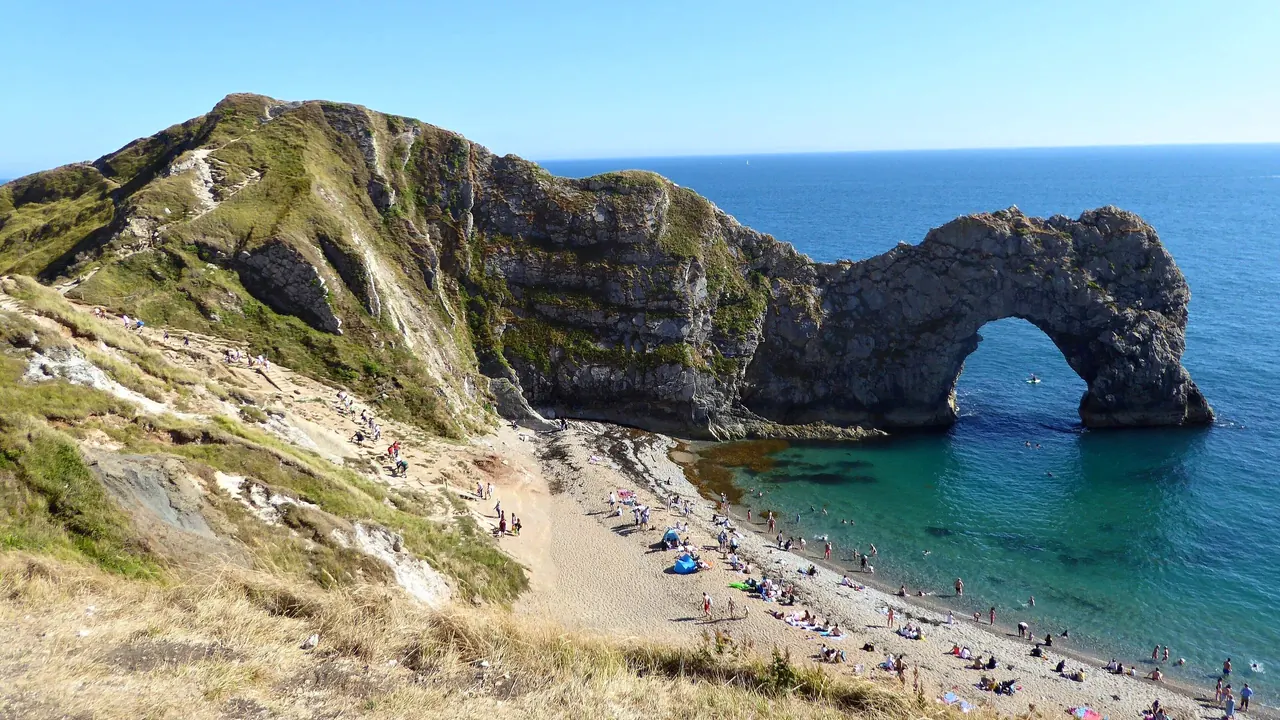
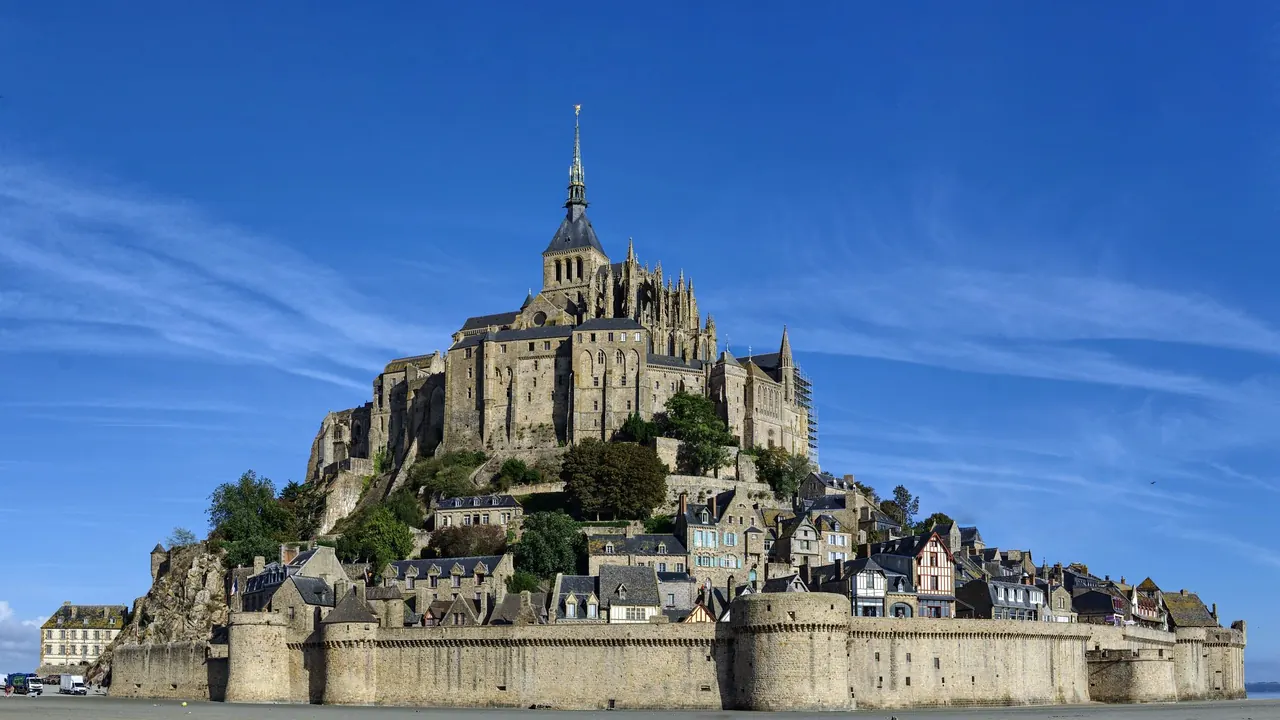
Photos: Jurassic Coast by Ethan Doyle White, CC BY-SA 4.0, cropped; Normandy by Jan, Pexels License.
Jurassic Coast or Normandy?
Our verdict in twelve categories, each scored against the same fixed benchmark cities, and the climate month by month, so you can choose for your trip.
Choose Jurassic Coast for
- nature and the outdoors
- beaches
- families
Choose the Jurassic Coast if the landscape itself is the point of the trip. Its cliffs, arches and fossil beaches make one long outdoor attraction, best seen on foot along the coast path. Children spend whole days looking for ammonites at Charmouth and paddling at Studland. It suits walkers and families who are happy with pub evenings and a cottage base, and who don't need much in the way of museums or restaurants.
Choose Normandy for
- culture and sights
- food and drink
- wellness
Normandy is the stronger pick for travellers who want history, food and variety from a single base. Mont-Saint-Michel, the D-Day beaches, the Bayeux Tapestry and Rouen's cathedral are all within reach. Between sights there are farm cider, Camembert country, harbour oysters and thalassotherapy spas. It is a little cheaper to stay in, easier to drive and fuller in the evenings, but its coastline is gentler and its beaches are ruled by the tides.
Scoreboard
Twelve categories on one fixed scale from 0 to 100. The shaded stretch is the gap between the two.
Your match
Pick a travel style or drag the sliders, and both match scores follow your weighting.
Wins on nature and the outdoors and beaches with your weighting.
Wins on culture and sights and food and drink with your weighting.
What matters to you?
Category by category
What the scores mean for a trip.
Beaches & swimming
The Jurassic Coast is the better place for a beach day. At its two ends, Weymouth's gently shelving bay and Studland's dune-backed sands are good for swimming at any state of the tide. In between, the shingle coves at Lulworth and Durdle Door have clear water that drops off quickly.
Normandy has the more classic resort scene: Deauville, Trouville and Cabourg have boardwalks and striped cabins on wide sand. But the tide pulls the sea back hundreds of metres, so a swim there has to be timed. The Alabaster Coast's shingle under the cliffs is for walking, not bathing. Both seas are cool, so expect quick dips either way.
Food & drink
Normandy eats far better. It is the home of Camembert, Pont-l'Évêque and Livarot. You can buy cider, pommeau and calvados straight from the farm along the Pays d'Auge route, and there are oysters from Saint-Vaast and Isigny, Rouen's pressed duck, and market towns with proper set lunches.
The Jurassic Coast's strength is simpler: crab sandwiches and fish and chips on the harbours at West Bay and Lyme Regis, cream teas and Dorset Blue Vinny cheese. Bridport's market and some serious seafood kitchens around Lyme Bay are the high points, but the quieter villages rarely go beyond the pub menu.
Culture & sights
This is the widest gap between the two. Normandy has several sights known worldwide: Mont-Saint-Michel, the landing beaches from Utah to Sword, the Bayeux Tapestry, Rouen's half-timbered streets and cathedral, William the Conqueror's Caen and Monet's garden at Giverny. A culture-led trip could easily fill a fortnight.
The Jurassic Coast's heritage is smaller and mostly about fossils. There is Mary Anning's Lyme Regis, the Charmouth heritage centre and the ruin of Corfe Castle. Thomas Hardy's Dorchester and the ramparts of Maiden Castle add depth, but they make an afternoon's interest, not the purpose of a visit.
Nightlife
Neither is a place for a big night out, but Normandy has more to do after dinner. Rouen and Caen are university cities, with bars and a few clubs around the cathedral, the Vieux-Marché and the Vaugueux quarter. Deauville adds its casino and smart hotel bars. On the Jurassic Coast, evenings mean a harbour pub and perhaps a folk session. Weymouth's seafront strip is the only real exception, and most villages are quiet by eleven.
Nature & outdoors
The Jurassic Coast is the stronger landscape. It has 95 miles of cliffs showing 185 million years of rock, from red Devon sandstone to Purbeck chalk. Chesil Beach, Durdle Door and Old Harry Rocks lie along a coast path that is steep and rewarding, with fossil hunting, coasteering and sea kayaking on the same shore.
Normandy's best scenery is more scattered. There are the chalk arches of Étretat, the wild granite of Cap de la Hague and guided walks across the bay of Mont-Saint-Michel at low tide. Inland, the bocage is mostly for gentle cycling, and only the Suisse Normande gorges come close to Dorset's drama.
Day trips
Normandy offers far more outings. From a base in Caen or Bayeux you can reach Honfleur's harbour, the Côte Fleurie resorts, cider villages like Beuvron-en-Auge and the Cotentin fishing ports. Saint-Malo, the summer ferry to Jersey and Paris by train under two hours away widen the list further.
The Jurassic Coast's trips mostly head inland to country towns: Exeter's cathedral, abbey-town Sherborne, Shaftesbury, and Salisbury with Stonehenge for a longer day. The chain ferry to Poole and Brownsea Island and the Swanage steam railway are its most distinctive outings.
Good for families
Both are safe, calm and full of self-catering cottages, and the Jurassic Coast has a slight edge with children. Fossil hunting at Charmouth gives them a hands-on adventure that Normandy can't match. Studland's shallow water and Weymouth's donkeys and sandcastles add a traditional seaside day, and the tank museum and steam railway cover a wet one.
Normandy's appeal for families is more spread out: Cité de la Mer's walk-through submarine in Cherbourg, the Cerza safari zoo and the ramparts of Mont-Saint-Michel for older children. These mean longer drives, and some D-Day sites are heavy going for young children.
Getting around
Normandy is the easier region to move around. Its roads are good and rarely crowded, and trains from Paris reach Rouen, Caen, Bayeux, Cherbourg and Deauville. That said, the cliffs, cider villages and landing beaches still really need a car or a tour.
On the Jurassic Coast, summer traffic clogs narrow lanes, and car parks at Lulworth and Durdle Door fill early. Driving from Exmouth to Studland takes the better part of a morning. Without a car, the realistic plan is one base and the coast path between bus stops.
Shopping & style
Normandy gives shoppers more to work with. Rouen's pedestrian streets have the widest range, Deauville has some fashion boutiques, and there are crafts to take home: Alençon lace, copper pans from Villedieu-les-Poêles, Rouen faience, and calvados straight from the farm. The Jurassic Coast is for browsing in small towns. Its best stops are Bridport's market and antiques quarter and the polished ammonites sold in Lyme Regis.
Affordability
Normandy is the cheaper of the two, although both charge more in July and August. Chambres d'hôtes, country cottages and market-town lunch menus keep costs reasonable, and only Deauville, Honfleur and the area around Mont-Saint-Michel push prices up.
On the Jurassic Coast, cottages in Lyme Regis and Purbeck are expensive in high season and hard to book for short stays, and parking adds up. Weymouth and the campsites are the cheaper option. On both coasts, the main attractions are free: the beaches and coast path in Dorset and Devon, and many D-Day sites in Normandy.
Live music & performing arts
Normandy has real stages. Rouen's Théâtre des Arts puts on opera, ballet and an orchestral season, and Caen and Le Havre have modern venues. Coutances hosts the long-running spring festival Jazz sous les Pommiers. The Jurassic Coast offers a Weymouth pavilion theatre, small venues in Lyme Regis and Bridport, and folk nights in pubs. For anything larger, people go to Poole or Exeter.
Wellness & relaxation
Normandy is built for slow, pampered days. Thalassotherapy centres with heated seawater pools line the coast from Deauville to Granville, and Bagnoles-de-l'Orne is a proper belle-époque spa town with its own springs and lake.
The Jurassic Coast has no comparable bathing tradition, just a few hotel spas and some cold-water swimming groups. Its rest comes from the setting instead: a cottage in Beer or Charmouth, a day's walking and a quiet pub, at least outside the August crowds.
When should you go?
Pick your month. The climate figures are measured averages, not a forecast.
Jurassic Coast in July
Normandy in July
Daytime high, °C
Rainfall in the month, mm
Where the figures come from
Jurassic Coast's temperatures are measured 66 km from the centre, at Bournemouth Airport.
Jurassic Coast has no rain gauge within 25 km of the centre, so its rainfall comes from a gridded climate dataset read at the destination rather than from a gauge further away.
Temperature and rainfall are climate normals, averaged over the years shown. Jurassic Coast: 1991-2020 normals, Bournemouth Airport (65.7 km from centre). Normandy: 1991-2020 normals, Caen (21 km from centre).
The two share almost the same year, which is no surprise for opposite sides of the Channel. Both are at their best from June to September, when afternoons are warm enough for the beach and the sea is just about swimmable. Normandy runs a degree or so warmer, with highs of 23°C in high summer and the sea reaching 18°C in August and September. Around the Jurassic Coast's main resorts the sea peaks a degree lower. May and June are fine for walking on either side, with long sunny days and plenty of light. Normandy keeps a little more sunshine into September, which makes early autumn a good time for its sights.
The real difference is the rain. From October the Dorset and Devon coast turns noticeably wetter, close to 97mm a month through to December. Normandy's autumn is milder in this respect, at about 80mm. Winters are cool and grey on both sides, around 8°C. That is fine for museums and cathedrals in Normandy, and on the Jurassic Coast it suits storm-season fossil hunting more than general sightseeing.
Which traveller are you?
For a culture and arts trip, Normandy is clearly the better choice. Mont-Saint-Michel, the D-Day beaches with the Caen Memorial, the Bayeux Tapestry, Rouen's Monet cathedral and Giverny give it world-class sights. The Jurassic Coast has Corfe Castle and fossil museums, which is pleasant but much thinner.
On an outdoors trip, the Jurassic Coast wins. The South West Coast Path climbs over Golden Cap and past Durdle Door, Lulworth Cove and Old Harry Rocks. Add fossil hunting, climbing on Portland and sailing in Weymouth Bay, and you have more coast to explore than Normandy's Étretat cliffs and bocage greenways.
For a relaxing and wellness trip, go to Normandy. It has a real tradition of thalassotherapy at Deauville, Cabourg and Granville, plus the belle-époque spa town of Bagnoles-de-l'Orne. The Jurassic Coast offers quiet villages and cottage calm, but only a few hotel spas.
Before you go
| Measure | Jurassic Coast | Normandy |
|---|---|---|
| Official language | English | French |
| Currency | Pound Sterling (GBP) | Euro (EUR) |
| Sockets | G230 V, 50 Hz | CE230 V, 50 Hz |
| Driving side | Left | Right |
| Time zone | UTC, UTC+1 in summer | UTC+1, UTC+2 in summer |
| Emergency number | 112 or 999 | 112 |
| Main airport | Exeter International Airport (EXT)25 non-stop destinations | Caen Carpiquet airport (CFR)10 non-stop destinations |
| Public holidays this year | 8 days | 11 days |
By the numbers
| Measure | Jurassic Coast | Normandy |
|---|---|---|
| Swim season, months above 21 °C | None | None |
Where else could you go?
Every comparison below shares a destination with this one, so you can follow Jurassic Coast or Normandy somewhere new.
- Devonvs Jurassic Coast
- Isle of Wightvs Jurassic Coast
- Cotswoldsvs Jurassic Coast
- Isle of Wightvs Normandy
- Cornwallvs Jurassic Coast
- Pembrokeshirevs Jurassic Coast